
THE AUTHOR:

A student changes courses on Monday. The student information system (SIS) records the change, but the learning management system (LMS) still displays the old course on Tuesday. The timetable shows both. For universities dealing with these problems, legacy SIS modernization is a way to develop a connected student services platform and keep the systems that already manage academic records.
University system modernization is in high demand, but challenges have not changed: fragmented data, constrained budgets, and outdated technologies with decades of custom integrations.
The EDUCAUSE Data Modernization and Management QuickPoll found that 92% of respondents’ institutions had begun discussions or initiated efforts to modernize data. Only 1% of respondents indicated their data management had been fully modernized. Almost half of the respondents (49%) cited funding as a barrier. The other 51% viewed departmental silos as a barrier.
The 2026 EDUCAUSE Top 10 also indicated that legacy systems, operational analytics, cybersecurity, and AI were among the top priorities for higher education.
These results create a dilemma for university leaders. Replacing the student information system involves migrating years of academic records and supporting processes from enrollment to graduation. Existing SIS also contain sensitive information. Switching to a new platform means moving the data, rebuilding the integrations, and changing processes, all while working within the constraints of the academic calendar.
For institutions invested in a higher education digital transformation, upgrading the supporting infrastructure may be a more prudent initiative.
This paper describes how to keep an existing SIS operational while modernizing integrations, student-facing applications, and reporting and case Management tools. It also highlights the decisions which impact the long-term sustainability of these modernizations.
How Computools modernized university infrastructure through API integration
A university’s existing technology can become difficult to manage long before its core applications stop functioning. This was the case for a private university group in the UK that has more than 25,500 students and 1,535 faculty members, across three campuses.
Each campus had its own student information system with different financial, learning, and identity management software. While the tools performed their functions, managing the connections between them was becoming a challenge.
Academic teams prepared cross-campus reports using manual exports and reconciliation. Students accessed different portals for timetables, billing information, and academic requests. Faculty scheduling involved conflicting records, while IT teams spent considerable time maintaining existing integrations.
The university needed to improve operations without disturbing academic records or interrupting critical enrollment and teaching activities.
What Computools Changed
Through the Uni-Campus project, Computools introduced an integration architecture that connected the university’s three existing SIS environments with Canvas LMS, SAP ERP, Microsoft Entra ID, analytics, and a centralized student portal.
The original systems remained authoritative for their data.
The solution used REST APIs, webhooks, and scheduled synchronization to exchange data across applications. A unified data hub normalized student profiles, course records, grading structures, billing and schedules.
Interfaces for the portal were developed using React and NextJS, and typescript. Application logics and integrations were developed using NodeJS and NestJS. PostgreSQL held normalized data and operational records. Azure, Docker and Terraform were used to manage the infrastructure.
Students gained a single access point to core university services. Academic and administrative personnel gained role based access to integrated information.
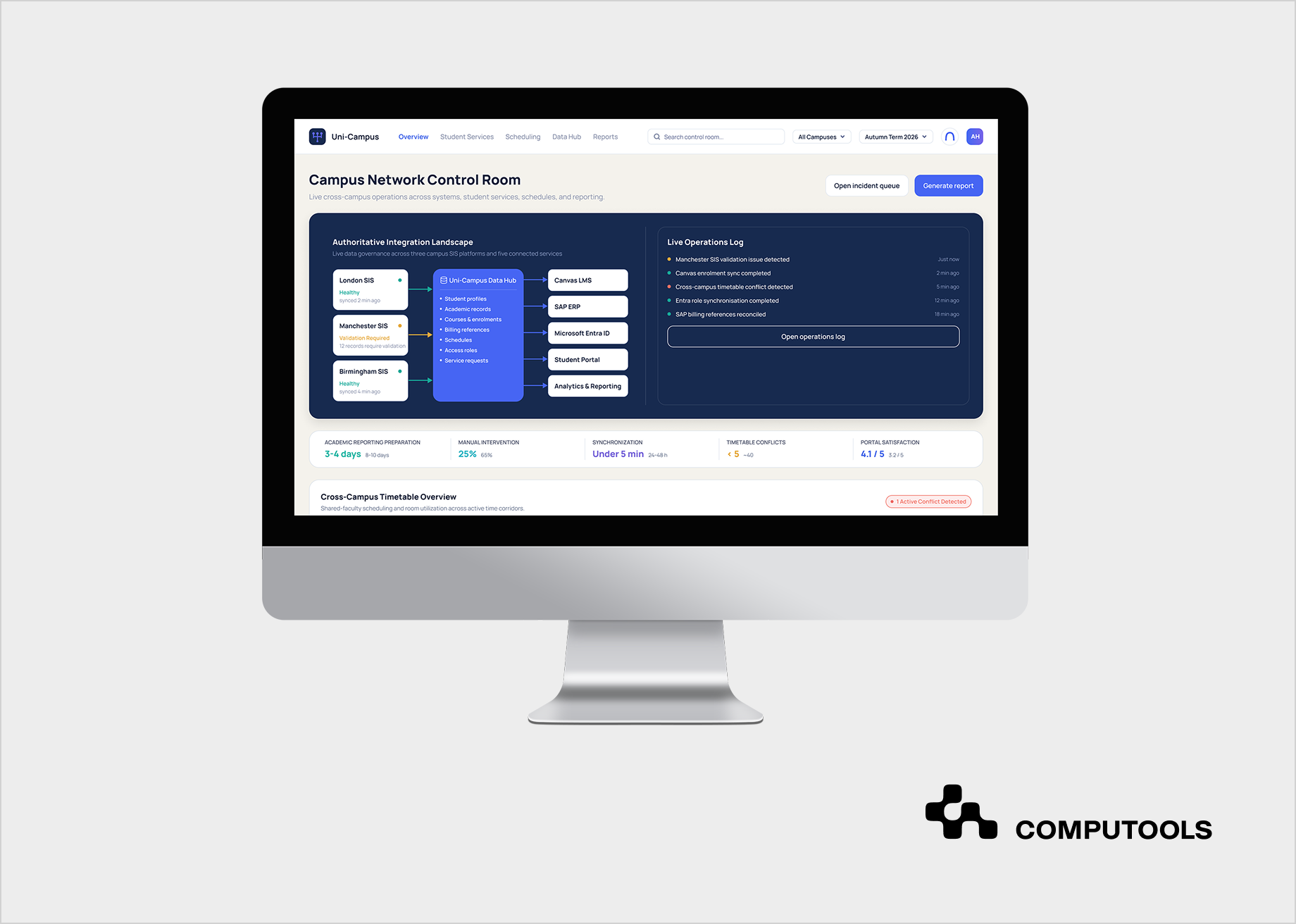
The results reported by the client were substantial:
| Operational metric | Before | After |
| Academic reporting preparation | 8–10 business days | 3–4 business days |
| Tickets requiring manual intervention | 65% | 25% |
| Cross-campus data synchronization | 24–48 hours | Under 5 minutes |
| Scheduling conflicts per semester | About 40 | Fewer than 5 |
| Student portal satisfaction | 3.2/5 | 4.1/5 |
The original SIS platforms continued managing academic records throughout the rollout.
Two decisions made this possible. Computools established data ownership rules before developing centralized services, then introduced integrations in stages aligned with the academic calendar.
The same principle can guide other institutions, provided the current SIS remains sufficiently secure, maintainable, and capable of supporting the required integrations.
For a more detailed explanation of how student records, learning platforms, and financial systems exchange information, read our guide on how to integrate SIS, LMS, and ERP systems. It covers integration architecture, data ownership, synchronization rules, and common implementation problems.
How to approach legacy SIS modernization in 8 steps
Before development begins, university leaders need an answer to a basic question: which responsibilities should remain in the SIS, and which would operate better through new applications?
The answer affects architecture, costs, cybersecurity issues, and the university’s ability to change systems later.
Step 1. Find out which problems actually require SIS changes
A legacy system often gets blamed for problems originating elsewhere.
Take transcript processing. The SIS might retrieve academic records within seconds, while the request takes three days because employees manually check payment information, route approvals, and generate documents.
Replacing the database that holds academic results would accomplish little.
Start the SIS modernization strategy with an assessment of current workflows. Examine how information moves between admissions, academic administration, finance, the LMS, identity management, and reporting tools.
The assessment should produce not only an application inventory. For every important workflow, record the responsible department, systems involved, processing time, manual actions, and known failure points.
Also examine the technical condition of the SIS. An institution may have stable academic functions but depend on unsupported middleware or custom scripts that fail whenever an application changes.
For higher education legacy system modernization, classify applications according to the action they require.
| Decision | Suitable situation |
| Retain | Core functionality is reliable, supported, and meets academic requirements. |
| Integrate | The application works but exchanges data poorly. |
| Extend | Existing records can support improved interfaces or workflows. |
| Retire | Duplicate applications create unnecessary maintenance. |
| Replace | Security, vendor support, or functional limitations make continued use unacceptable. |
Universities looking to modernize legacy university systems should prioritize workflows according to operational impact.
The assessment should end with a prioritized backlog, dependency map, and measurable baseline for the first modernization phase.
Step 2. Decide which System owns each student record
It becomes difficult to connect university applications when multiple databases house the same information with variations.
For example, a student may have one identifier in the SIS, another in the LMS, and a different customer reference in the finance system. Academic departments may also use different course codes and grading schemes.
A reliable solution to these differences cannot be achieved by a central portal without data rules.
Begin by identifying core entities operational to a university: student, program, course, enrollments, grades, invoicing, timetables, access, etc.
With each of these entities, identify an authoritative source.
Appoint an authoritative source for each.
For example, enrollment and academic status may be maintained in the SIS, while invoicing may be the function of the ERP system.
The integration architecture can then create a shared representation of this information while keeping ownership in the original applications.
This requires a universal data model that provides consistency across campus records.
In particular, historical changes in data need to be modeled carefully. Courses can change over time and a student’s enrollment status can change several times in a semester. Failure to model such changes can result in generation of incorrect reports and/or miscalculation of degrees.
In Uni-Campus, the Computools team created data ownership across three SIS environments and normalized academic, financial and identity records.
Following the same logic decreases the probability that a new integrated portal will show inconsistent data or become a new database which requires manual reconciliation.
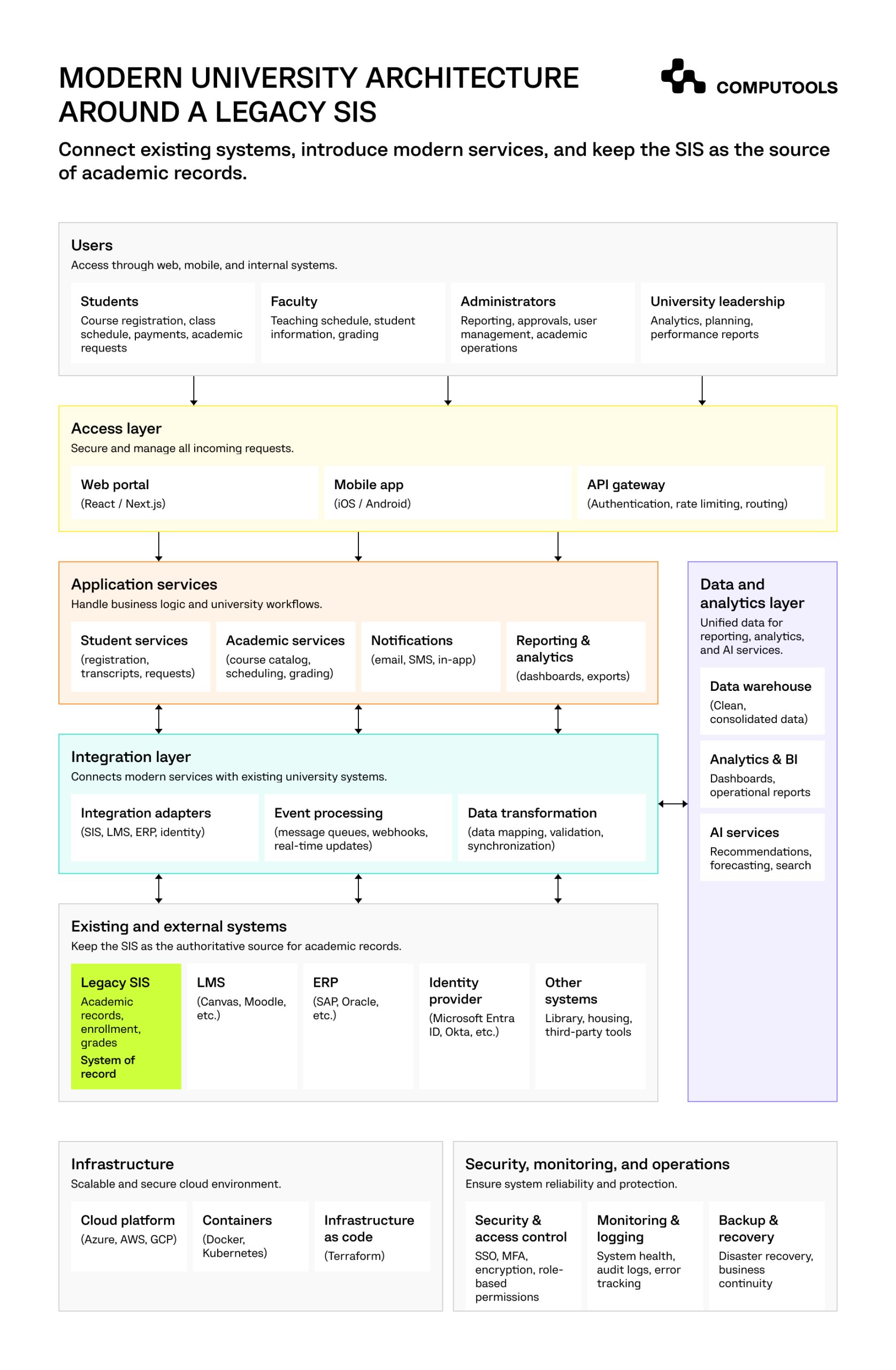
Step 3. Put an integration layer between the SIS and new applications
Earlier versions of university applications were designed to perform a limited set of administrative functions. More recent portals, analytics services, and mobile apps require integration of multiple systems.
Integrating every new application to all legacy systems quickly becomes unmanageable.
A better architecture is to implement an integration layer to manage how data is requested, validated, exchanged and monitored.
In the context of higher education systems integration, this layer can comprise an API gateway, and adapters for legacy applications, as well as domain and message-processing components.
Consider for example, a mobile app that allows students to enrol in courses.
The application sends a request to a registration service, which is responsible for checking the student’s eligibility and prerequisites as well as other registration rules, and then submits the request to the supported SIS. The SIS confirms whether the enrollment was successful.
Based on the enrollment, other services can then update the student’s schedule and access to the LMS, and notify the student.
This technology option depends on the existing platform.
For systems with documented interfaces, REST APIs work well. Webhooks can also be used to notify an application of a change to a record. Other options for older systems may include scheduled exports, vendor-provided connectors, and managed file transfers.
Institutions may also look at interoperability frameworks and standards like the 1EdTech Edu-API to support enterprise integration. It outlines exchange formats for academic enterprise data. They should assess its vendor support and specification status prior to consideration for use.
Integration of learning tools can also be supported through LTI 1.3.
For university IT leaders interested in how to modernize SIS without replacement, the approach is to keep authoritative transactions within SIS interfaces and use other services to implement application logic.
Avoid unsupported writes directly to legacy databases. They can bypass validation rules and cause problems when the SIS vendor releases an update.
Step 4. Build data synchronization that handles failures properly
Successfully completing a registration transaction creates a set of downstream tasks.
For example, the LMS needs to enroll the student in a course. The schedule should be updated to reflect the course and the student’s portal should show the new course enrollment.
Not all these updates will happen in the same transaction. Some systems take more time to process information than others.
This is where student data synchronization becomes an operational challenge.
Higher education institutions should differentiate between synchronous and asynchronous data. The SIS should confirm the registration transaction was successful; a notification to the student’s schedule may be sent a few seconds to a few minutes later; and some types of reports may be scheduled to run periodically.
Event queues can prevent temporary failures in downstream systems from interrupting the original transaction. However, the integration must also handle duplicate messages, delayed events, and processing failures.
Use idempotent operations so that a repeated enrollment event cannot accidentally create two records. Apply version checks where updates might arrive out of order. Failed events should enter a monitored recovery process, with reconciliation jobs checking whether the target applications eventually received the correct information.
For university data integration, define freshness requirements for each important record type.
A five-minute delay may be acceptable for a reporting dashboard but unsuitable for an access decision during an examination.
In the Uni-Campus project, cross-campus synchronization improved from 24–48 hours to under five minutes.
That result depended on changing how records moved between systems, rather than changing the academic databases themselves.
Step 5. Redesign administrative workflows before building the student portal
The modernization of student services often centers around the development of a student portal. Its success depends upon what happens after the request button is pressed.
Let’s consider an official transcript request. A student signs in, selects the transcript and submits the request. The application has to determine the student’s identity, retrieve the student’s academic records, check eligibility, and decide whether an administrative approval is needed.
If all of these rules are satisfied, the system is ready to produce the transcript. The transcript is sent to an authorized employee for review.
The student has to be able to check the status of the request without contacting the registrar’s office.
This requires services for identity verification, request management, approval routing, notification and document processing.
The administration portal also needs enhancement. Staff members should be able to see the requests assigned to them, see the reason for any exceptions, and be authorized to accept or reject the requests.
Certain duties can be totally automated. Others may require academic judgment.
Accessibility needs to be part of the initial interface design requirements. WCAG 2.2 AA is a goal that higher education institutions may work toward, along with mobile accessibility and other usability goals and support for varying user needs.
The Uni-Campus portal consolidated various information including student schedules, requests and services as well as financial and billing information. Its reported satisfaction level went up from 3.2/5 to 4.1/5.
Other institutions should also evaluate their portal according to the same criteria:
- the number of completed requests;
- average request processing time;
- the number of requests abandoned by users
- customer support ticket volume.
A modern-looking portal that still requires employees to re-enter user-submitted data has not resolved the underlying problem.
Step 6. Protect academic records and maintain service availability
More integrations mean more ways to access university information.
For example, student academic and service records, identity and financial details, and student services history may be processed in the same application environment. Therefore, permissions must be extended to those areas, including reporting and administrative databases and dashboards.
Students are concerned about their security. The 2026 EDUCAUSE Students and Technology Report states that 46% of surveyed students encountered a cybersecurity threat during the previous academic year.
One way to help ease the management of multiple credentials for teams and students is to implement centralized authentication, supported by MFA, role-based access controls, secure API authentication and authorization, encryption, and auditable administrative actions.
Changes to access should occur in conjunction with student and staff lifecycle events, e.g., when a student withdraws, the SIS may change that student’s record to withdrawn. Linked applications should also make the respective changes to the student’s access to courses, student portal, and other university services.
Universities must also meet relevant privacy obligations, for instance, UK GDPR for applicable UK institutions and FERPA for education records in the US.
Availability requires separate planning.
Thousands of users may make simultaneous requests for information during course registration. Cache reference data and limit request rates. Protect back-end service endpoints from large, unexpected loads.
A reporting service may fail without consequence to user experience. Teams should have test and proven procedures for recovery of service when SIS interfaces are unavailable, when messages have to be queued for later processing, and when the database is unavailable.
Set specific Recovery Point Objectives (RPO) for critical services and ensure they are tested before they go live.
Universities planning to introduce automated attendance tracking or remote exam monitoring face additional privacy concerns.
Our article on computer vision in education examines these applications, their technical requirements, and the risks associated with collecting student images and behavioral data.
Step 7. Introduce AI and analytics where the data supports them
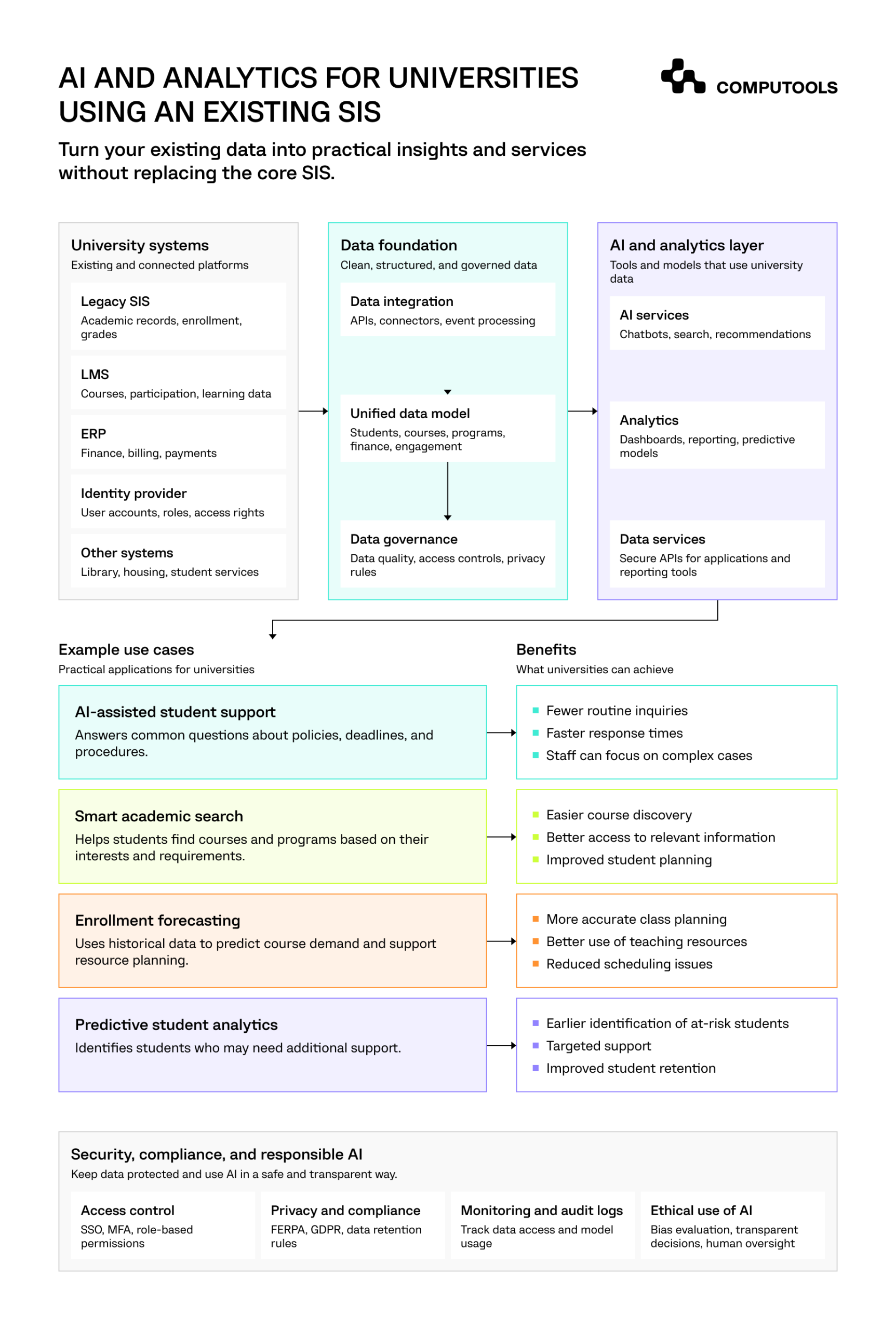
A legacy SIS can work with modern AI applications as long as the institution can capture accurate, properly governed data.
The 2025 EDUCAUSE Horizon Report on Data and Analytics explores how institutions are expanding their data management and analysis capabilities in conjunction with increased use of AI.
For institutions retaining their SIS, the first AI projects should be focused on operational tasks.
| AI feature | How it works | Benefits for universities |
| AI-assisted student support | Answers common questions about university rules, deadlines, and procedures. Sends more difficult questions to staff. | Reduces support requests and helps students get answers faster. |
| Smart academic search | Helps students find courses and programs based on their interests, requirements, and previous studies. | Makes it easier to choose courses and find relevant information. |
| Enrollment forecasting | Uses past enrollment data and student demand to predict how many students will join courses. | Helps universities plan class sizes, teaching staff, and classroom availability. |
| Predictive student analytics | Analyzes grades, attendance, and student activity to identify students who may need additional support. | Helps staff offer assistance earlier and reduce the risk of students dropping out. |
All of these applications require clean, structured data as a foundation.
Start with a limited pilot. Determine in advance how the results will be assessed and who will be responsible for correcting the errors.
A key element for further innovative applications has been put in place with the Uni-Campus data infrastructure.
For more examples, explore our article on the role of big data in education, which discusses student performance analysis, personalized learning, resource planning, and data protection challenges.
Step 8. Test and release changes around the academic calendar
Universities have limited opportunities to introduce disruptive changes safely.
An integration failure during registration can affect course access. Problems during examinations or academic reporting may require urgent corrections across several departments.
Plan releases around these dependencies.
A sensible first phase might focus on one campus, a limited set of student requests, or a specific reporting workflow. Compare its performance with the existing process before expanding.
Testing must cover more than interface functionality.
Contract tests should verify that APIs exchange the expected fields and handle schema changes. Data reconciliation tests should compare authoritative records with information displayed in connected applications.
Simulate delayed messages and unavailable services. Check whether integrations can recover without losing transactions or creating duplicates.
Load tests should simulate actual registration patterns, specifically showing the elevated demand during and immediately after the enrollment window.
There are situations where permission testing is critical, for example if the same system is used by students and instructors as well as finance and administrative staff.
Each new release must be aligned with a rollback plan, and have a defined set of acceptance criteria.
There were two week development iterations for Uni-Campus, followed by reviews by the stakeholders, and the release was scheduled according to the academic calendar.
Following the release, compare the synchronization delays, reporting times, request volumes and service availability and reliability.
Prolong the modernization project if the new system is able to reliably support the business during normal and peak times.

Modernize legacy university systems within 1–3 months without replacing the core SIS, connect modern applications and workflows around existing infrastructure, reduce maintenance and manual work, and improve service delivery without the cost and disruption of a full system replacement.
How to calculate the business value of SIS modernization
University leaders should be able to explain what a modernization budget is expected to change.
In the EDUCAUSE 2025 QuickPoll, 58% of respondents selected operational efficiency as a modernization priority. Student success and retention followed at 46%.
A financial assessment should translate technical improvements into measurable operating results.
| Area | Metric | Financial or operational effect |
| Academic reporting | Preparation time per report | Administrative labor requirements |
| Student services | Manual interventions per 100 requests | Support workload |
| Scheduling | Conflicts per semester | Room and faculty utilization |
| Integrations | Failed updates and synchronization delays | Reconciliation and incident costs |
| Financial administration | Billing exceptions | Payment administration effort |
| IT maintenance | Hours spent supporting integrations | Ongoing technology costs |
A lower initial implementation budget does not automatically mean a lower total cost of ownership. If the existing SIS is approaching the end of vendor support or requires expensive custom maintenance, replacement may be the more economical option.
Why choose Computools for legacy SIS modernization?
Universities need technology decisions that respect academic processes, existing investments, institutional governance, and the realities of operating throughout the academic year.
Computools approaches these challenges through business analysis, data architecture, integration planning, and phased delivery.
Our education software development services address academic management, student administration, and integrations with existing institutional platforms.
Through eLearning software development and EdTech software development, the company also works with learning applications and services that depend on university records.
Computools combines data engineering for governed information exchange and reporting with web development services for student portals and administrative applications. AI development expertise supports responsible automation and analytics where the required data foundations are available.
The Uni-Campus project offers a relevant example of this work. The team preserved three SIS environments and managed to improve reporting, student services, scheduling, and cross-campus synchronization.
For universities considering a similar investment, the starting point is an assessment of existing systems, their dependencies, and the processes consuming the most administrative resources.
Keep the SIS where it still makes business sense
An existing SIS can effectively manage student records. Delays and unnecessary additional work are often caused by other applications.
Various solutions are possible if workflow issues become apparent. Some problems will require the redesign of workflows or the development of better integrations. Other problems may justify the replacement of part of the current SIS.
The legacy SIS modernization decision should be based on the available evidence and the operational costs and goals of the university.
If integrations with partner systems, fragmentation of student records, and slow reporting lead to an increase in the admin work in your university, Computools can assess your current architecture and identify opportunities for phased modernization.
Computools
Software Solutions
Computools is an IT consulting and software development company that delivers innovative solutions to help businesses unlock tomorrow.


