Corporate Skillum

How Corporate Skillum connected fragmented learning systems into one AI-powered experience for 3,530 employees.

case image

AT A GLANCE

The client is a US-based B2B SaaS company with approximately 3,530 employees. Rapid growth had left corporate learning fragmented across BambooHR, a legacy LMS, collaboration tools, and manual content production processes. Employees mainly used the LMS for mandatory training, while the L&D team lacked a connected view of learning activity and workforce skills.

The company needed a corporate learning platform that could connect existing systems without disrupting compliance records or HR operations. Computools built Corporate Skillum as an AI learning platform for corporate L&D, combining learning orchestration, AI-assisted content creation, skills intelligence, and delivery through Slack and Microsoft Teams.

The new platform increased monthly learning participation from 22% to 48%, reduced course authoring time by 70%, accelerated onboarding, and gave HR leadership a clearer view of internal skills and mobility opportunities.

THE CLIENT

The client employs approximately 3,530 people across technical, sales, and corporate functions. BambooHR stored employee and role information, while an existing enterprise learning management system remained responsible for compliance training and historical completion records.

As the company scaled, learning operations became harder to coordinate. Product knowledge changed quickly, onboarding requirements differed by role, and the L&D team had limited capacity to continuously rebuild training materials.

Leadership saw corporate learning AI as a way to reduce manual content production and improve workforce skill visibility, but the solution had to work with existing systems, satisfy information-security requirements, and avoid another standalone application that employees would rarely use.

BUSINESS CHALLENGE

The core problem was fragmentation across learning delivery, content creation, employee data, and workforce skills.

  • Low learning engagement. Employees mainly opened the LMS for mandatory compliance training, leaving voluntary learning disconnected from daily work.
  • Slow content production. Creating one interactive learning module required up to 80 hours of L&D work, making it difficult to keep training aligned with product and process changes.
  • Limited skill visibility. HR data, learning records, and manual skill spreadsheets did not provide a current view of workforce capabilities or future skill gaps.
  • Disconnected systems. BambooHR, the LMS, collaboration tools, and content sources operated separately, increasing manual reconciliation and limiting personalization.
  • Strict AI governance requirements. Internal documentation used for course creation had to remain controlled and isolated from public model-training workflows.

The project required corporate training software development expertise across HR and LMS integrations, AI-assisted learning workflows, identity management, collaboration tools, and workforce analytics. It also required EdTech software development services capable of supporting enterprise-scale delivery without replacing systems that already handled HR and compliance processes.

SOLUTION SUMMARY

Computools built Corporate Skillum as a learning intelligence and orchestration platform connected to the client’s existing HR, LMS, and collaboration infrastructure. BambooHR remained the source for employee and role data, while the legacy LMS continued to manage compliance records and completed training history.

The platform introduced learning in the flow of work through Slack and Microsoft Teams. Employees could receive role-relevant learning prompts, short activities, and development recommendations inside the tools they already used throughout the workday.

AI content authoring for corporate learning used approved internal PDFs, corporate wikis, and other company materials to accelerate course creation. Generated content remained subject to L&D review and approval before publication.

Skills mapping software connected role information, learning history, and capability requirements into a dynamic workforce view. HR and L&D teams could identify skill gaps, support internal mobility, and assign development paths aligned with upcoming business needs.

IMPACT

Corporate Skillum improved learning participation, content-production capacity, onboarding speed, internal mobility, and L&D operating costs:

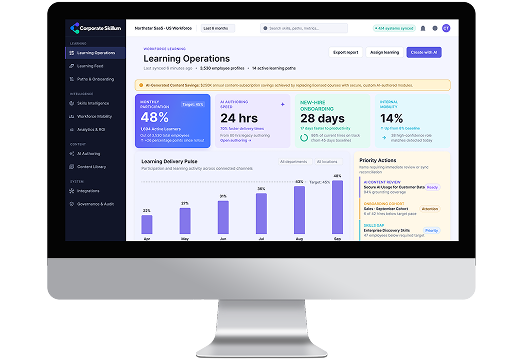
  • Monthly active learners increased from 22% to 48% during the first six months after rollout.
  • Course authoring time decreased from 80 hours to 24 hours, a 70% reduction, measured across 15 pilot modules.
  • Time-to-productivity for new engineering and sales hires decreased from 45 days to 28 days.
  • Internal mobility increased from 8% to 14% over two quarters among active platform users.
  • The client reported approximately $250,000 in annual savings after canceling redundant third-party learning content subscriptions.

The AI microlearning platform helped move shorter, role-relevant learning activities into employees’ daily work environment. This reduced the effort required to access training and contributed to higher monthly participation.

Faster authoring allowed the L&D team to update training as products and internal processes changed. Skills data also became more useful for workforce planning, giving HR teams greater visibility into existing capabilities, development needs, and potential internal moves.

WHY COMPUTOOLS

The project required LMS integration services, HRIS synchronization, enterprise identity management, AI governance, and collaboration-tool integrations without disrupting existing compliance workflows.

Computools combined web development, enterprise integration, data engineering, and AI engineering to connect BambooHR, the legacy LMS, Slack, Microsoft Teams, and approved corporate content within one controlled environment.

Delivery priorities were tied to measurable outcomes, including learning participation, course production time, onboarding speed, skills data quality, internal mobility, and L&D operating costs.

Launch your software solution within 1-3 months instead of years. Unlock tomorrow. Build a future-ready business through innovation.

STORY IN DEPTH

Background

The client’s learning environment had expanded alongside the company’s rapid growth. BambooHR managed workforce records, the legacy LMS handled formal training and compliance, collaboration happened in Slack and Microsoft Teams, and much of the learning content was still created manually.

These systems supported individual processes but resulted in a fragmented learning experience for employees. Staff had to step away from their normal workflow to access training, while the L&D team spent significant time creating and updating courses.

HR leadership also lacked a current view of workforce capabilities. Job titles and completion records were available, but they did not show how employee skills aligned with future roles, projects, or development priorities.

Approach to solution

Computools mapped ownership of employee, learning, identity, skills, and content data across the existing environment. This established which systems would remain authoritative and which workflows Corporate Skillum needed to coordinate.

BambooHR continued to manage employee and role information, while the legacy LMS retained compliance and historical learning records. Corporate Skillum synchronized the required data and coordinated the delivery of learning, recommendations, skills intelligence, and analytics.

The content-authoring workflow used approved corporate materials as its source base. Internal PDFs, wikis, and other controlled documentation could be retrieved during generation, while L&D teams retained responsibility for review and publication.

Slack and Microsoft Teams became delivery channels for learning activities. Role and learning data were then connected to skills requirements to support development planning and internal mobility analysis.

Computools role

Computools was responsible for:

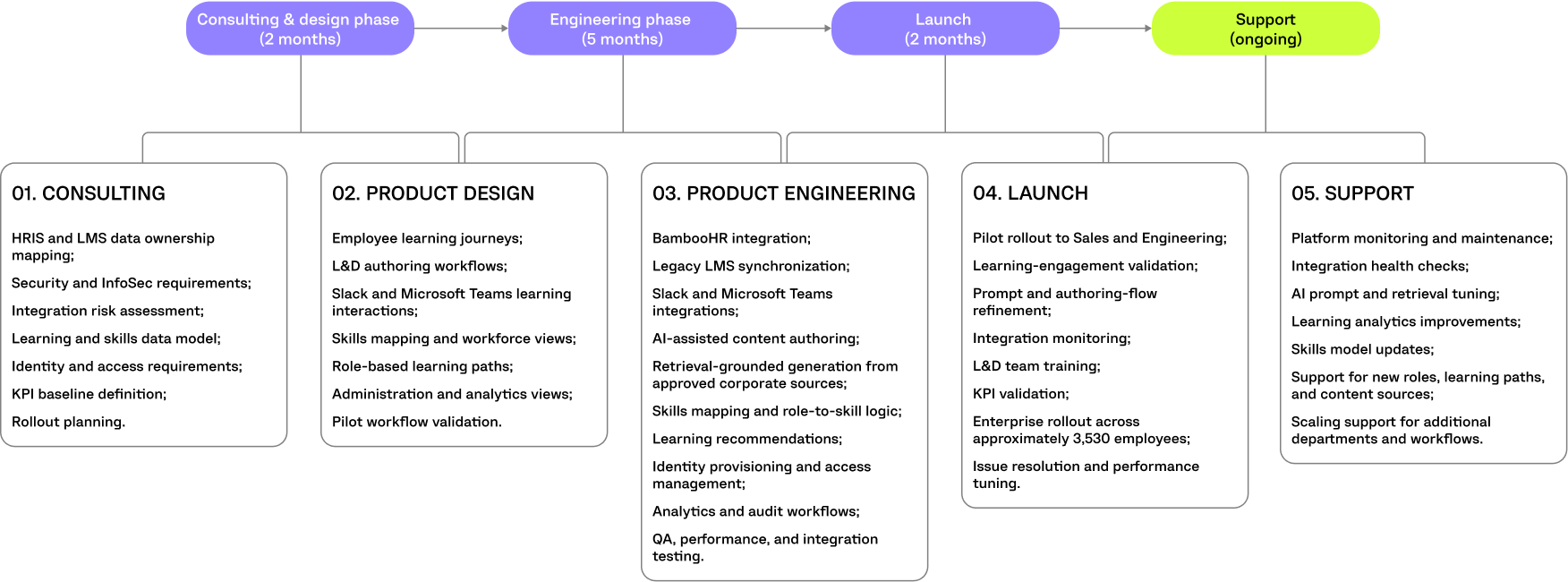
  • mapping HR, LMS, collaboration, identity, and content workflows;
  • defining data ownership and synchronization requirements;
  • designing the learning orchestration architecture;
  • integrating BambooHR, the legacy LMS, Slack, and Microsoft Teams;
  • developing retrieval-grounded content-authoring workflows;
  • normalizing employee, role, learning, and skills data;
  • implementing skills mapping and role-based learning logic;
  • configuring enterprise identity and access workflows;
  • supporting pilot validation with Sales and Engineering teams;
  • refining learning flows and prompts based on pilot usage;
  • supporting enterprise rollout across approximately 3,530 employees.

Key decisions and outcomes

Core systems retained their existing responsibilities. BambooHR continued to manage workforce records, while the LMS remained the source for compliance and historical completion data. This reduced migration risk and preserved established reporting processes.

Learning delivery moved into Slack and Microsoft Teams, reducing the number of steps employees needed to take to access training and making short learning activities easier to fit into daily work.

Generated learning content was grounded in approved corporate sources and remained subject to L&D review. The approach reduced authoring effort while maintaining control over what employees received.

Skills intelligence connected roles, learning history, and capability requirements. HR teams gained a more current view of internal talent and could identify development opportunities before opening additional external hiring.

DESIGN

The product design focused on low-friction learning for employees and practical control over content, workforce skills, and reporting for L&D and HR teams.

USER PERSONA → SITE MAP → WIREFRAMES → USER INTERFACE

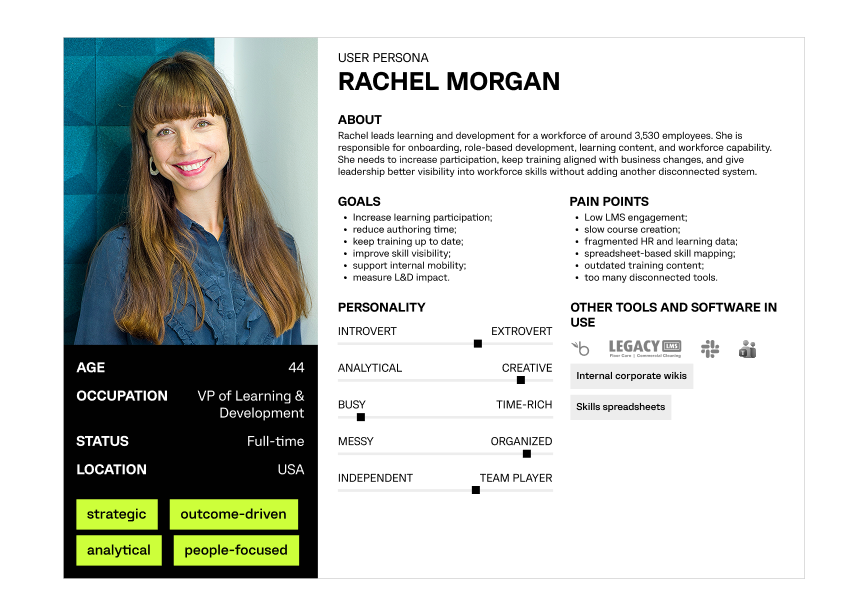
USER PERSONA

Defining the needs of L&D leaders responsible for workforce capability, content operations, learning engagement, and skills visibility.

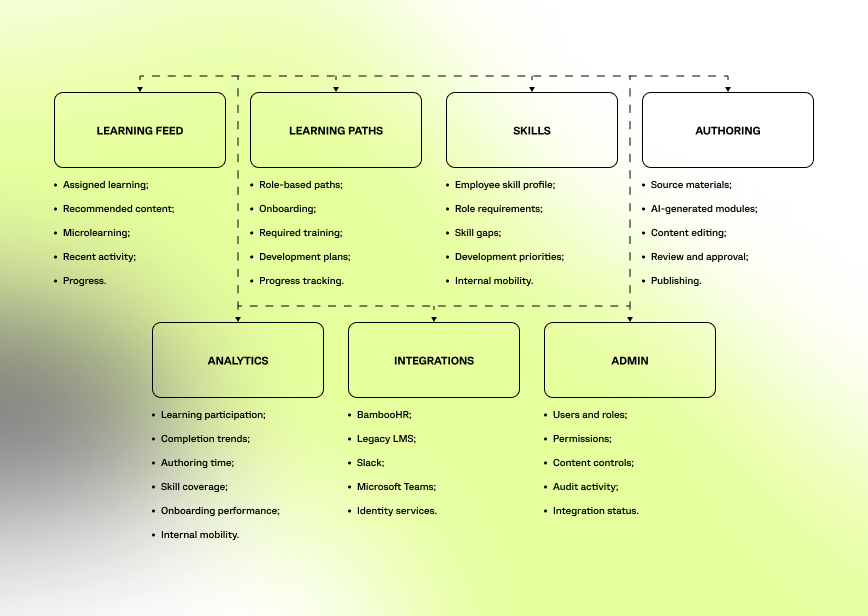
SITE MAP

Structuring employee learning, content authoring, skills intelligence, analytics, integrations, and administration within one corporate learning environment.

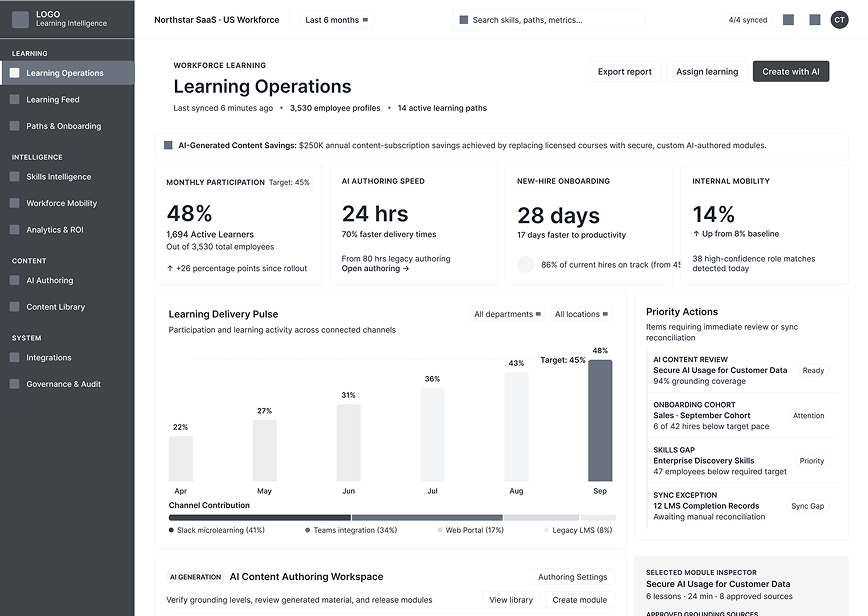
WIREFRAMES

The wireframes validated employee learning delivery, Slack and Teams interactions, role-based learning paths, AI-assisted authoring, skill-gap views, and L&D reporting before interface development.

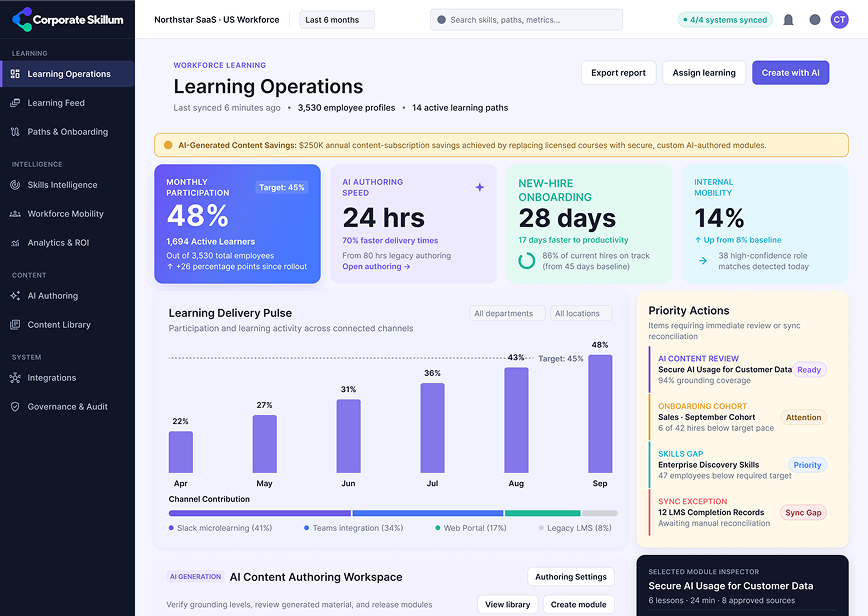
USER INTERFACE

The interface kept employee interactions lightweight while giving L&D and HR teams dedicated workspaces for content authoring, skills analysis, learning administration, and reporting.

DIGITAL PLATFORM & TECHNOLOGY

Corporate Skillum combined enterprise integrations, identity services, and AI development to support controlled content generation, learning recommendations, and workforce skills analysis.

PROJECT MANAGEMENT METHODOLOGY

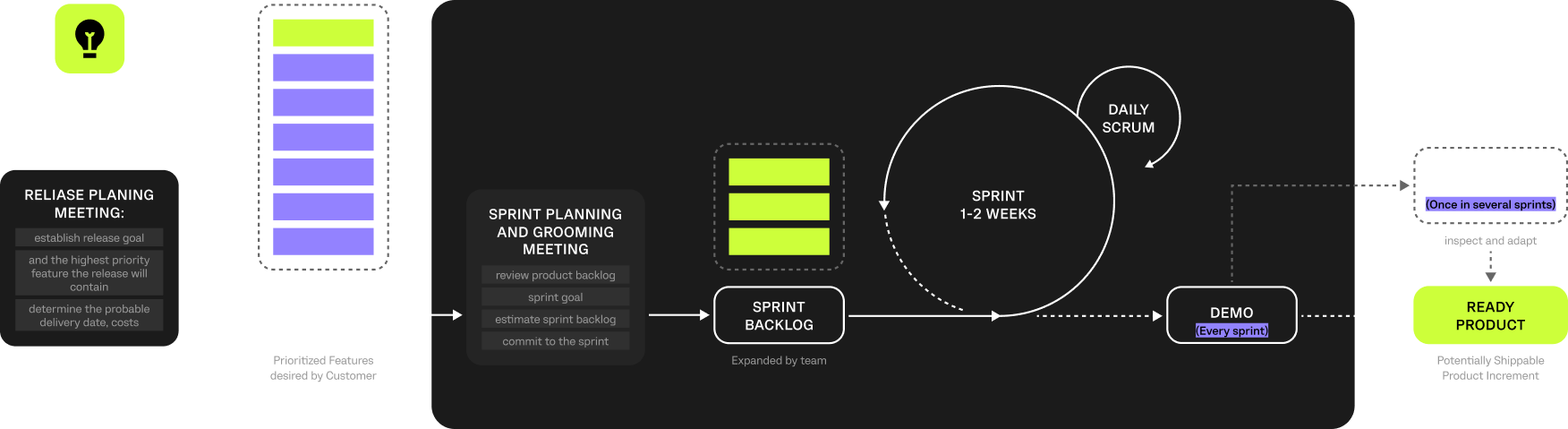
Computools used two-week Scrum iterations with regular L&D, HR, and pilot-user validation and measurable acceptance criteria. Each sprint tied technical delivery to learning participation, authoring time, integration reliability, skills-data quality, and onboarding performance.

Early iterations validated data ownership, BambooHR and LMS synchronization, identity workflows, and AI authoring with approved corporate content. Later sprints focused on delivery for Slack and Microsoft Teams, skills mapping, analytics, prompt quality, performance, and release readiness.

The Sales and Engineering teams participated in the pilot before the enterprise rollout. Their usage data and L&D feedback were used to refine learning workflows, AI prompts, and engagement logic before deployment across approximately 3,530 employees.

PROJECT MANAGEMENT METHODOLOGY

PROJECT TIMELINE

image

WHAT OUR CLIENT SAID

The biggest change was that employees no longer had to leave their workflow to learn. That, combined with AI-assisted authoring, gave our small L&D team significantly more capacity to focus on strategic talent development.

CONTACT US TO GET A COST-EFFECTIVE
PROJECT ESTIMATE

Thank you for your message!

Your request will be carefully researched by our experts. We will get in touch with you within one business day.

WHAT HAPPENS NEXT?

01.
We deeply analyse your request.
02.
We create project roadmap, accelerating your time-to-value.
03.
We co-scope features, minimizing project risk upfront.
04.
We submit a comprehensive project proposal with estimates, timelines, CVs, etc.
Trusted by: