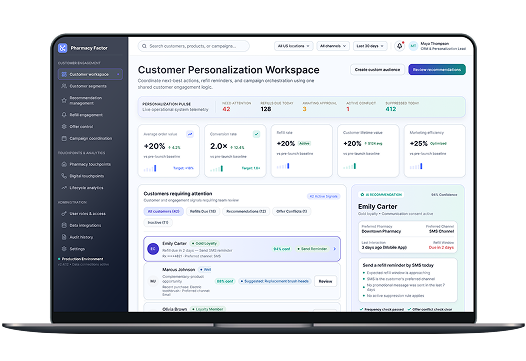
The client was a USA-based multi-location pharmacy retailer with strong customer, transaction, and product data. Commercial interactions remained largely generic across pharmacy and digital touchpoints, while product recommendations depended heavily on individual pharmacist knowledge.
The retailer needed a pharmacy personalization platform that could connect purchase behavior, product relationships, refill timing, offer logic, and communication channels. Customers needed more relevant recommendations and reminders, without being overloaded with duplicate or poorly timed promotions.
Computools developed an AI-powered pharmacy customer engagement platform that combined recommendation models, refill-cycle logic, customer segmentation, offer optimization, and marketing orchestration. The platform increased average order value by 20%, doubled conversion rates, improved refill rates by 20%, lifted customer lifetime value by 30%, and improved marketing efficiency by 25%.
The client is a USA-based pharmacy retailer operating multiple locations and digital customer touchpoints. Its business model combines prescription-related engagement, over-the-counter product sales, wellness categories, repeat purchases, and loyalty interactions.
The company had accumulated valuable data from pharmacy visits, product purchases, digital engagement, and refill behavior. However, this data was not consistently used to guide product suggestions, refill communication, or offer selection.
The retailer needed pharmacy customer loyalty software capabilities that could support repeat purchases, personalized offers, and consistent customer communication across locations. Pharmacists and digital channels required the same recommendation logic, so customer engagement could rely on data patterns, not isolated employee experience.
The main challenge was converting existing customer and transaction data into personalized commercial interactions. The pharmacy had enough behavioral signals to understand customer needs but lacked a unified system to turn those signals into recommendations, refill reminders, and targeted offers.
The client needed AI pharmacy software that could make recommendations, reminders, and offers more relevant without increasing manual work for pharmacists, marketers, or store teams. The project also required pharmacy management software development experience to align pharmacy retail workflows, customer data, engagement logic, and operational constraints.
Computools built Pharmacy Factor as an AI-powered personalization layer for pharmacy retail. The platform connected customer data, product relationships, refill logic, recommendation models, offer optimization, and campaign orchestration within a single operating environment. The product recommendation engine analyzed transaction history, category behavior, product affinity, and purchase sequences to suggest relevant complementary and personalized products across pharmacy and digital touchpoints.
The pharmacy refill reminder system tracked expected refill windows and identified customers who needed timely communication, reducing reliance on manual follow-up.
Offer optimization selected the most relevant offer, timing, and channel based on customer behavior, purchase history, and engagement patterns. Computools applied AI development to support recommendation logic, next-best-action selection, and controlled personalization workflows.
A centralized orchestration layer supported omnichannel customer engagement by managing campaign priority, message frequency, channel interaction, and suppression rules across pharmacy and digital touchpoints.
The personalization layer increased the value and consistency of customer interactions across the pharmacy’s digital and in-store ecosystem:
Context-aware recommendations helped customers discover relevant complementary products based on previous purchases and product relationships. This increased basket value and made product suggestions more consistent across pharmacy and digital touchpoints.
Personalized pharmacy marketing improved refill engagement, offer relevance, and campaign efficiency by aligning customer behavior with better timing, channels, and messaging logic.
The platform strengthened AI-powered customer personalization by giving pharmacists and digital channels a shared recommendation logic. Customer purchase behavior, refill timing, offer response, and engagement data also created a stronger base for future data engineering initiatives across segmentation, analytics, and lifecycle optimization.
The client selected Computools because the project required pharmacy retail workflow analysis, customer data modeling, AI recommendation logic, offer governance, and phased rollout support. Computools turned fragmented customer, transaction, refill, and product data into a practical personalization model for recommendations, refill reminders, and targeted offers.
Delivery priorities were tied to measurable KPIs: average order value, conversion rate, refill rate, customer lifetime value, and marketing efficiency.
The team covered business analysis, CX and UX design, architecture, AI logic, integrations, QA, rollout validation, and post-launch optimization.

The design focused on clear customer insights, controlled recommendation workflows, refill visibility, offer orchestration, and campaign performance tracking.
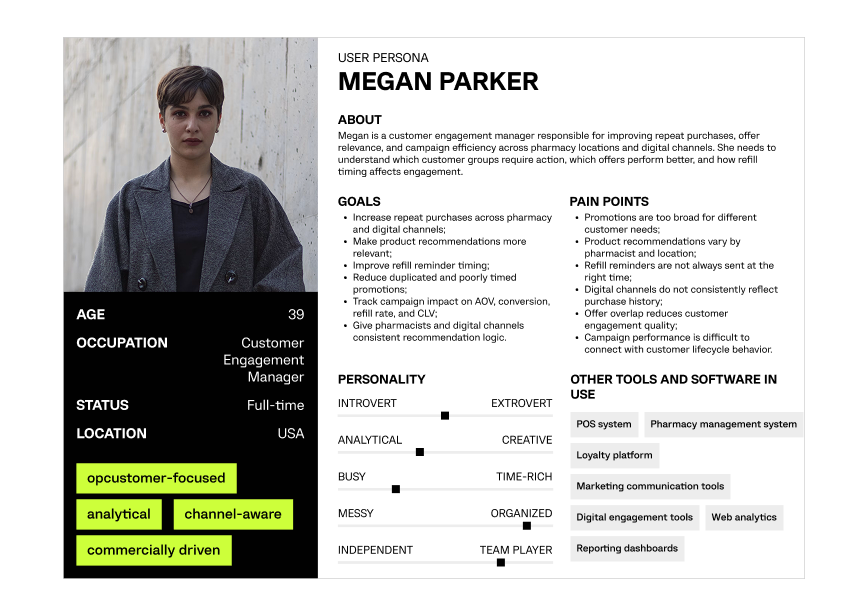
Defining pharmacy retail needs, customer engagement workflows, recommendation logic, refill communication, and marketing performance visibility.
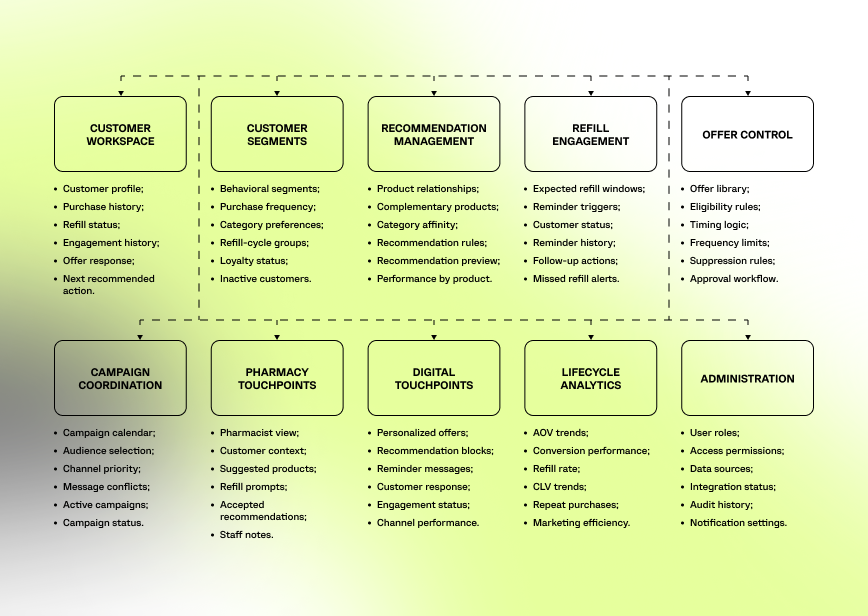
Structuring the platform around customer signals, refill timing, recommendation logic, offer control, and lifecycle performance.
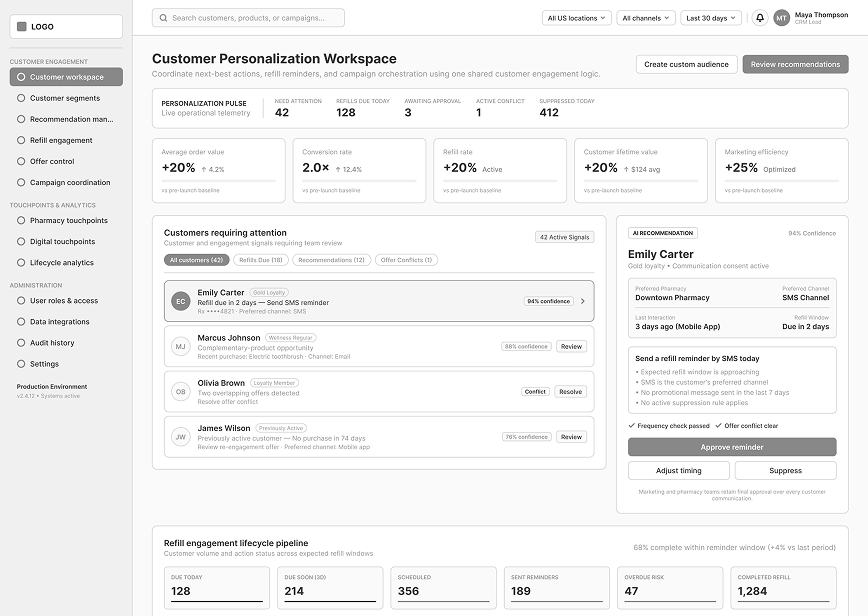
Designing low-fidelity layouts for customer profiles, recommendation workflows, refill reminders, offer approvals, campaign orchestration, and lifecycle analytics.
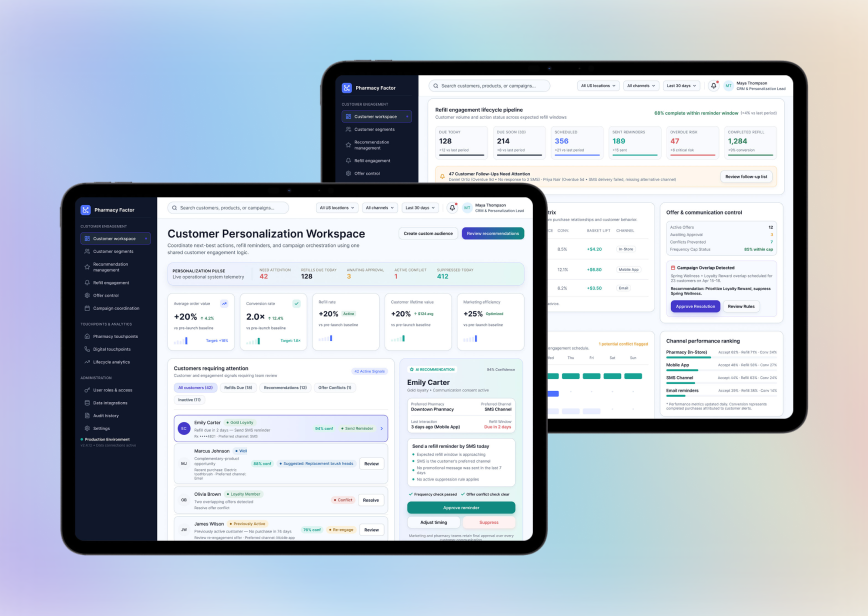
The interface gave teams one place to review customer signals, manage offers, and track recommendation or refill actions using the same customer logic across pharmacy and digital touchpoints.

TypeScript
TypeScript provided a shared engineering foundation for frontend and backend components, improving reliability across customer profiles, recommendation workflows, offer rules, and analytics views.

Next.js and React
Next.js- and React-powered role-based web interfaces for marketing, pharmacy operations, analytics, and executive teams. The interface supported customer profiles, offer controls, recommendation previews, refill engagement views, and campaign performance dashboards.

Node.js and NestJS
Node.js and NestJS handled backend business logic, workflow orchestration, campaign rules, user permissions, notification triggers, and integrations with pharmacy and marketing systems.

Python and FastAPI
Python and FastAPI powered recommendation models, refill-cycle prediction, customer segmentation, offer relevance scoring, and next-best-action services.

PostgreSQL and pgvector
PostgreSQL stored structured customer profiles, transaction history, product relationships, refill-cycle data, campaign rules, offer history, and KPI records. pgvector supported vector-based retrieval for AI-driven personalization workflows.

AWS, Docker, and Terraform
AWS, Docker, and Terraform supported cloud deployment, environment consistency, infrastructure automation, monitoring, and scalable processing for recommendation and campaign workloads.

PyTorch
PyTorch supported the development and inference of recommendation models using transaction history, product affinity, category behavior, purchase sequences, and customer response signals.

OpenAI and Claude integrations
Controlled LLM integrations supported AI-assisted personalization and customer engagement workflows within predefined business rules and campaign logic.

REST APIs, webhooks, and scheduled data pipelines
These integration mechanisms connected POS, pharmacy management, loyalty, customer engagement, and digital analytics systems.
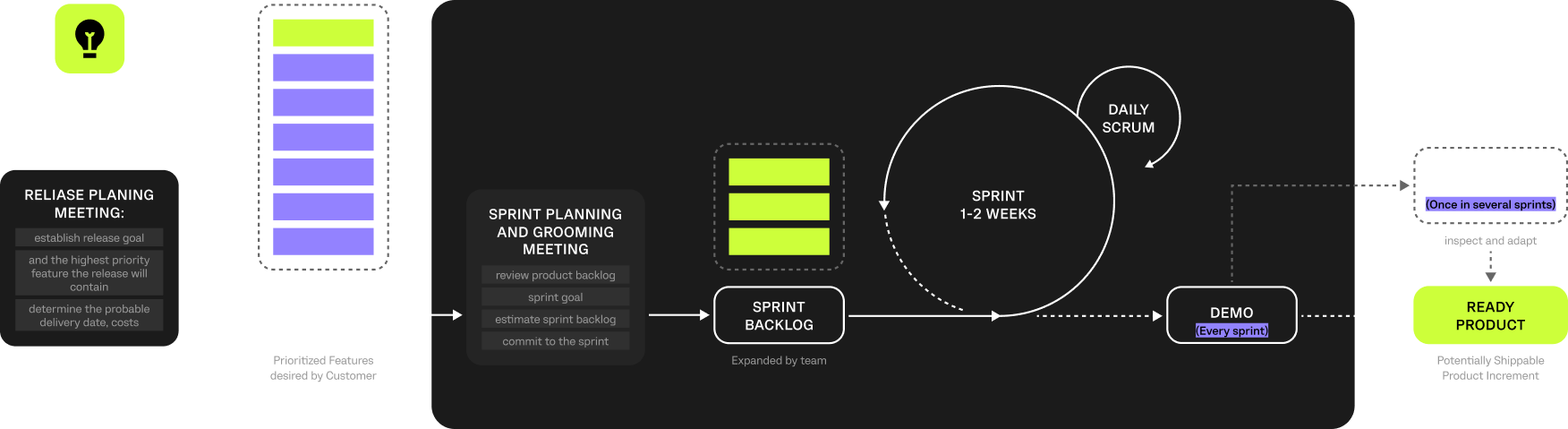
Computools used a Scrum-based delivery model with two-week iterations and KPI-based acceptance criteria. Each sprint connected a platform capability to a business metric: AOV, conversion rate, refill rate, customer lifetime value, or marketing efficiency.
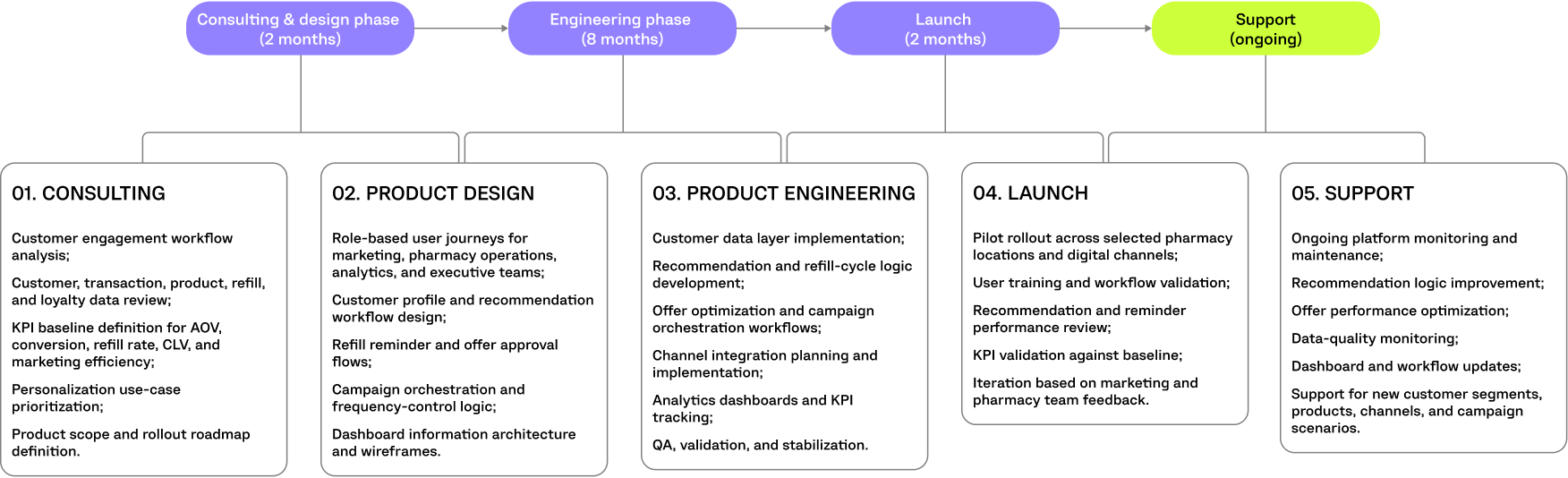
The team started with workflow and data analysis, then validated recommendation logic, refill reminders, offer orchestration, and analytics step by step. Marketing, pharmacy operations, digital, and analytics stakeholders reviewed each release before broader rollout.
Before Pharmacy Factor, we had the data, but every team used it differently. Computools helped us turn it into clear recommendation, refill, and offer logic. Customer communication became more relevant, and our teams could manage engagement with much better consistency.




Computools | 341 Raven Cir, Camden Wyoming, Delaware 19934, US