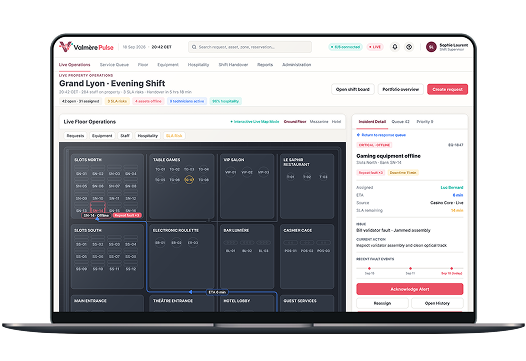
The client operates eight land-based casinos in France, combining gaming floors with restaurants, bars, entertainment venues, and two adjoining hotels. Service requests, equipment incidents, shift handovers, reservations, and management reporting were handled through separate systems and departmental processes.
The group needed casino operations management software that could connect frontline teams without replacing the systems already responsible for gaming transactions, hospitality records, and access-sensitive data. Computools built Valmère Pulse as a unified casino operations platform for service requests, floor incidents, maintenance activity, shift coordination, hospitality workflows, and portfolio reporting.
Six months after full deployment, median service resolution time decreased by 32%, unplanned gaming equipment downtime fell by 23%, and reporting preparation time dropped by 46%. Property teams gained a consistent operating model across all eight locations while retaining role-based access to sensitive information.
The client manages a mixed portfolio of urban and destination casino properties. Operations run extended or continuous schedules and depend on close coordination between floor attendants, guest-service teams, technicians, hosts, restaurant staff, hotel teams, supervisors, and property managers.
The group already relied on a casino management platform for core gaming activity, but service delivery remained fragmented. Radios, paper logs, email, maintenance tools, booking applications, and local workarounds often carried different parts of the same guest request.
This fragmentation affected both gaming-floor service and broader hospitality operations. A single issue could involve several departments before completion, yet no shared operational view showed ownership, current status, pending actions, or whether the next shift had accepted responsibility.
The main problem was limited visibility across a fast-moving operating environment where unresolved tasks could affect guest service, equipment availability, and property performance.
The project required casino workflow automation to formalize ownership, escalation, handovers, and completion without over-automating decisions that still required supervisors or specialists.
It also required reliable casino service management across guest-facing and technical workflows, supported by land-based casino software development experience in multi-property operations, system integration, access controls, and continuous-service environments.
Computools built Valmère Pulse as an operational coordination platform around the group’s existing casino and hospitality systems. Gaming transactions remained in their original systems of record, while staff gained one workspace for service requests, incidents, equipment status, reservations, shift tasks, and operational reporting.
The guest service management software workflow assigned every request an owner, priority, timestamp, status, and escalation path. Staff could see which department was responsible, whether the guest had already been contacted, and what action was required next.
For casino maintenance management, the platform connected equipment status, incident history, technician assignments, and service zones through an interactive floor view. Repeat faults could be identified more consistently, while supervisors gained clearer visibility into equipment awaiting intervention.
A shared shift board tracked open work, acknowledgment, unresolved incidents, and supervisor sign-off. Restaurant, hotel, and entertainment workflows were connected through the same hospitality operations platform, giving teams current reservation and service context without exposing unrelated sensitive information.
Property and group managers received dashboards covering service resolution, equipment downtime, workload, reservation fulfillment, handover performance, and cross-property operating trends.
Valmère Pulse improved service responsiveness, equipment availability, shift continuity, reservation execution, and management reporting across the casino group:
Clear ownership and escalation reduced the time between request creation and confirmed completion. Equipment history and technician routing helped teams respond faster to recurring faults and reduce downtime.
Connected reservation and shift workflows reduced gaps between departments, while casino operations analytics gave managers a consistent basis for comparing service quality, downtime, workload, and hospitality performance across properties.
Valmère Pulse required experience in multi-property operations, cross-system integration, role-based access, and continuous-service environments. Computools applied travel and hospitality software development and web development expertise to connect casino, maintenance, hotel, restaurant, workforce, and reporting systems without disrupting daily operations.
Delivery was tied to operational KPIs including service resolution time, equipment downtime, handover completion, reservation fulfillment, and reporting effort. A phased rollout allowed property teams to validate workflows and integrations before expanding the platform across all eight casinos.

The design prioritized speed, clarity, and low cognitive load for teams working in busy physical venues. Tablet interactions used large touch targets, short status labels, visible ownership, and clear next actions.
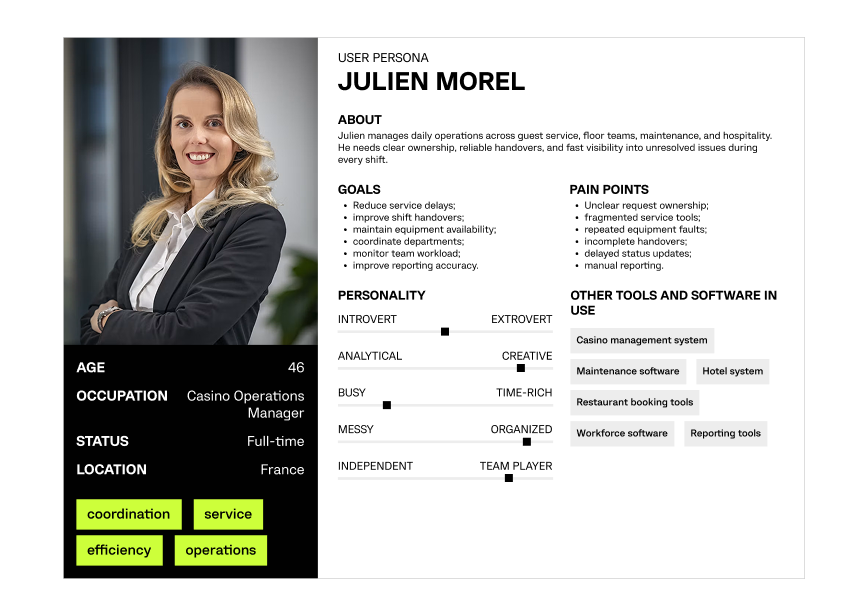
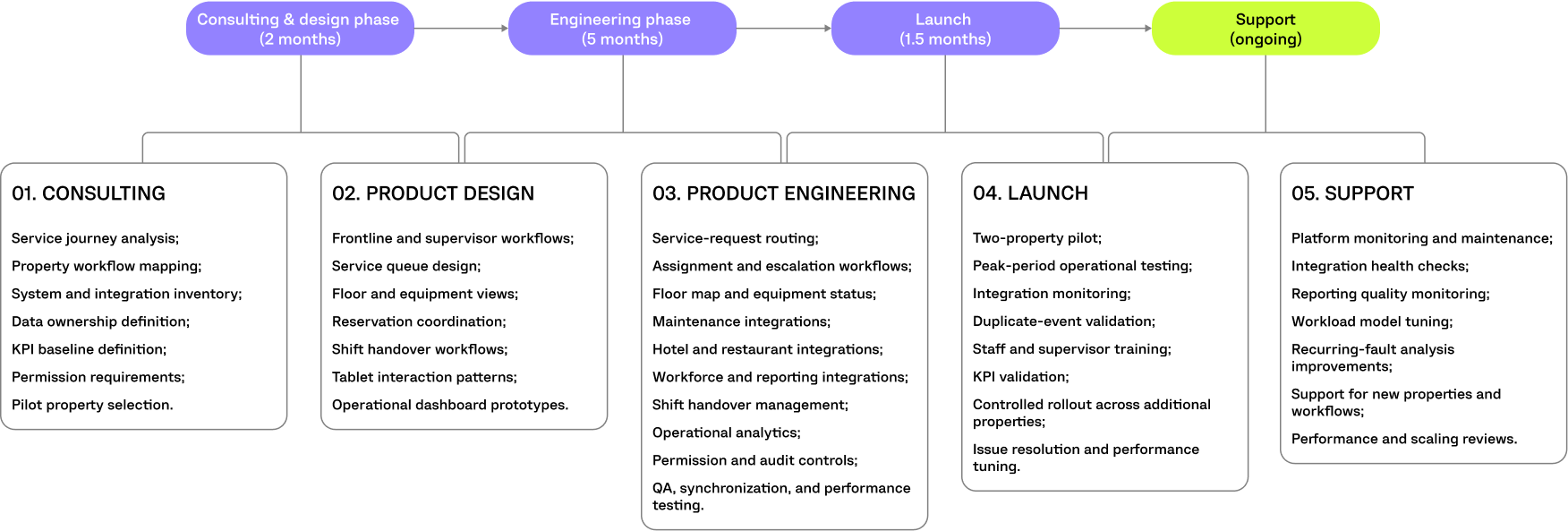
Defining the needs of casino operations managers responsible for service coordination, shift continuity, and floor performance.
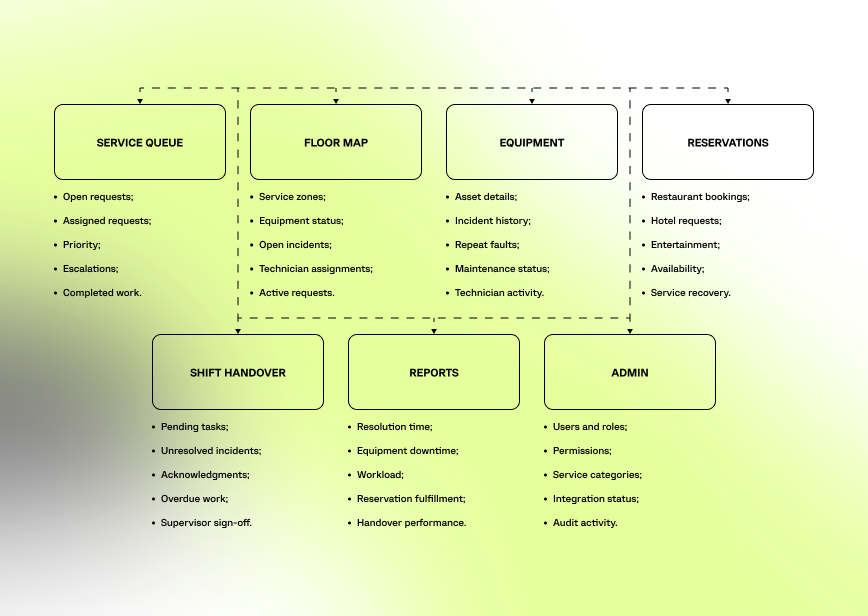
Structuring guest service, floor operations, maintenance, hospitality coordination, shift continuity, and reporting within one staff workspace.
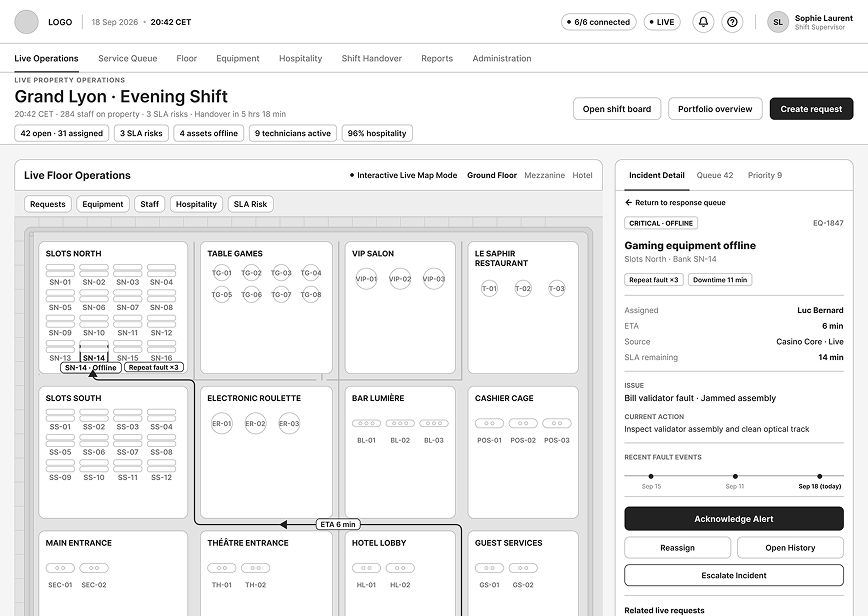
Testing core service, maintenance, reservation, and shift-handover workflows before interface development.
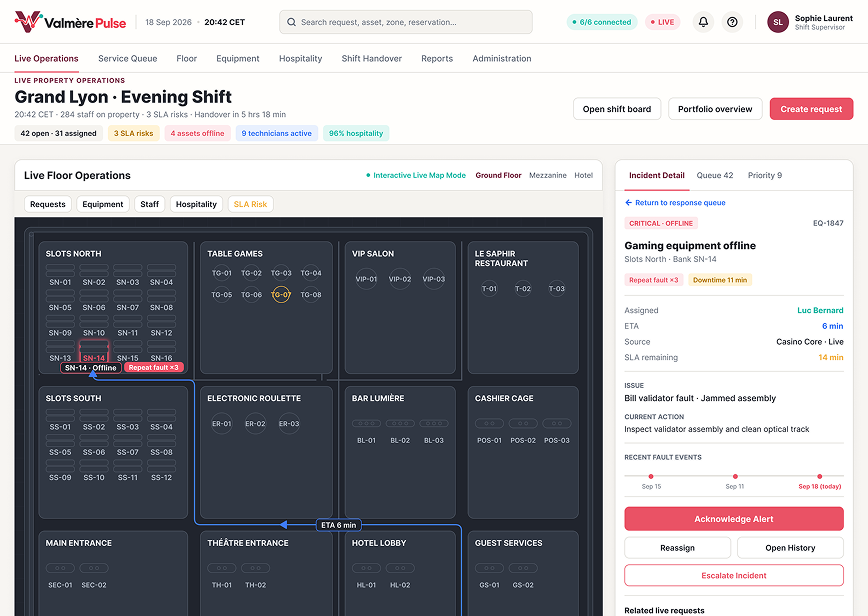
Creating a responsive staff workspace for fast service coordination, floor visibility, and operational control.

TypeScript
TypeScript supported shared application contracts across interfaces, APIs, and system integrations, reducing inconsistencies between service cases, incidents, assignments, reservations, and reporting records.

Next.js and React
Next.js and React powered the management portal and tablet staff interface, including service queues, floor maps, shift boards, equipment views, and operational dashboards.

Node.js and NestJS
Node.js and NestJS handled request routing, assignments, escalation, notifications, and system synchronization. REST APIs, webhooks, and scheduled imports connected casino management, maintenance, restaurant, hotel, workforce, and reporting systems.

PostgreSQL and Redis
PostgreSQL stored service cases, asset references, assignments, event identifiers, and audit records. Redis supported short-lived queue state and carefully scoped caching for operational workflows.

Python and FastAPI
Python and FastAPI supported recurring-fault analysis, workload forecasting, and reporting quality checks used by operational teams.

AWS, Docker, and Terraform
AWS provided cloud infrastructure, Docker supported consistent deployment environments, and Terraform automated infrastructure configuration and deployment.
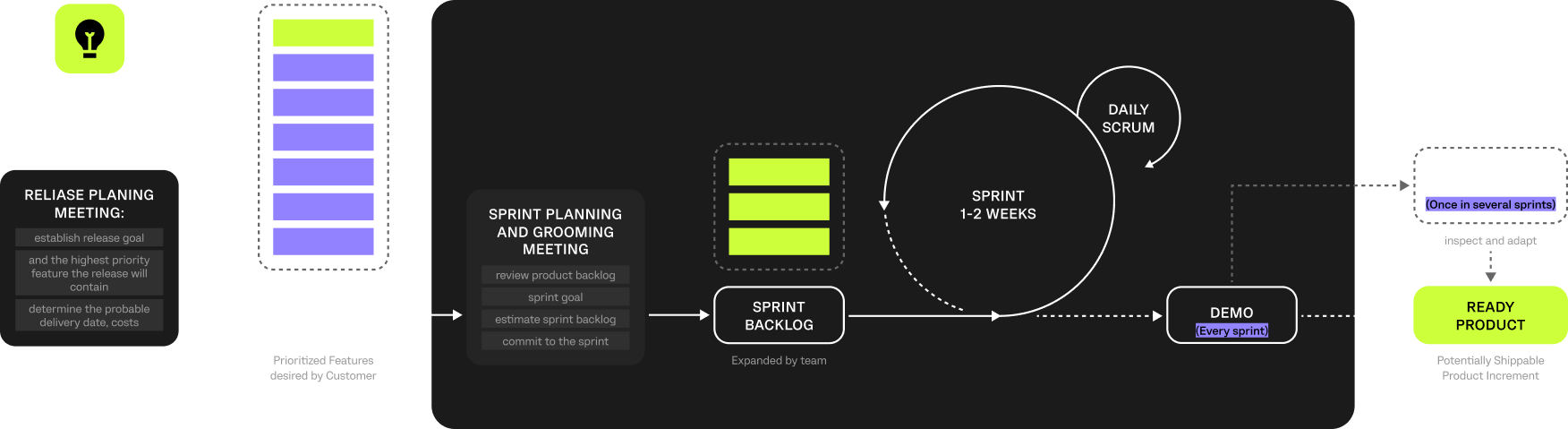
Computools used two-week Scrum iterations with property representatives, supervisors, and domain specialists validating workflows throughout delivery. Acceptance criteria covered routing accuracy, permissions, integration reliability, usability, and reporting.
Early sprints focused on ownership rules, shift workflows, and integrations. Later work covered floor operations, maintenance, hospitality coordination, analytics, and release readiness. A two-property pilot tested peak periods, outages, duplicate events, and shift transitions before wider rollout.
Before Valmère Pulse, we spent too much time finding out who owned a request. Now teams can see what needs to happen next, and fewer issues get lost between shifts. Guests get more consistent service, and managers can see much faster where delays are actually coming from.


Computools | 341 Raven Cir, Camden Wyoming, Delaware 19934, US


