
THE AUTHOR:

An automated shipment status system is becoming increasingly important for maritime logistics operators facing high shipment volumes, fragmented data, and tighter operating conditions.
Maritime transport still carries over 80% of the volume of international trade in goods, while UNCTAD projects maritime trade growth of 0.5% and containerized trade growth of 1.4% in 2025.
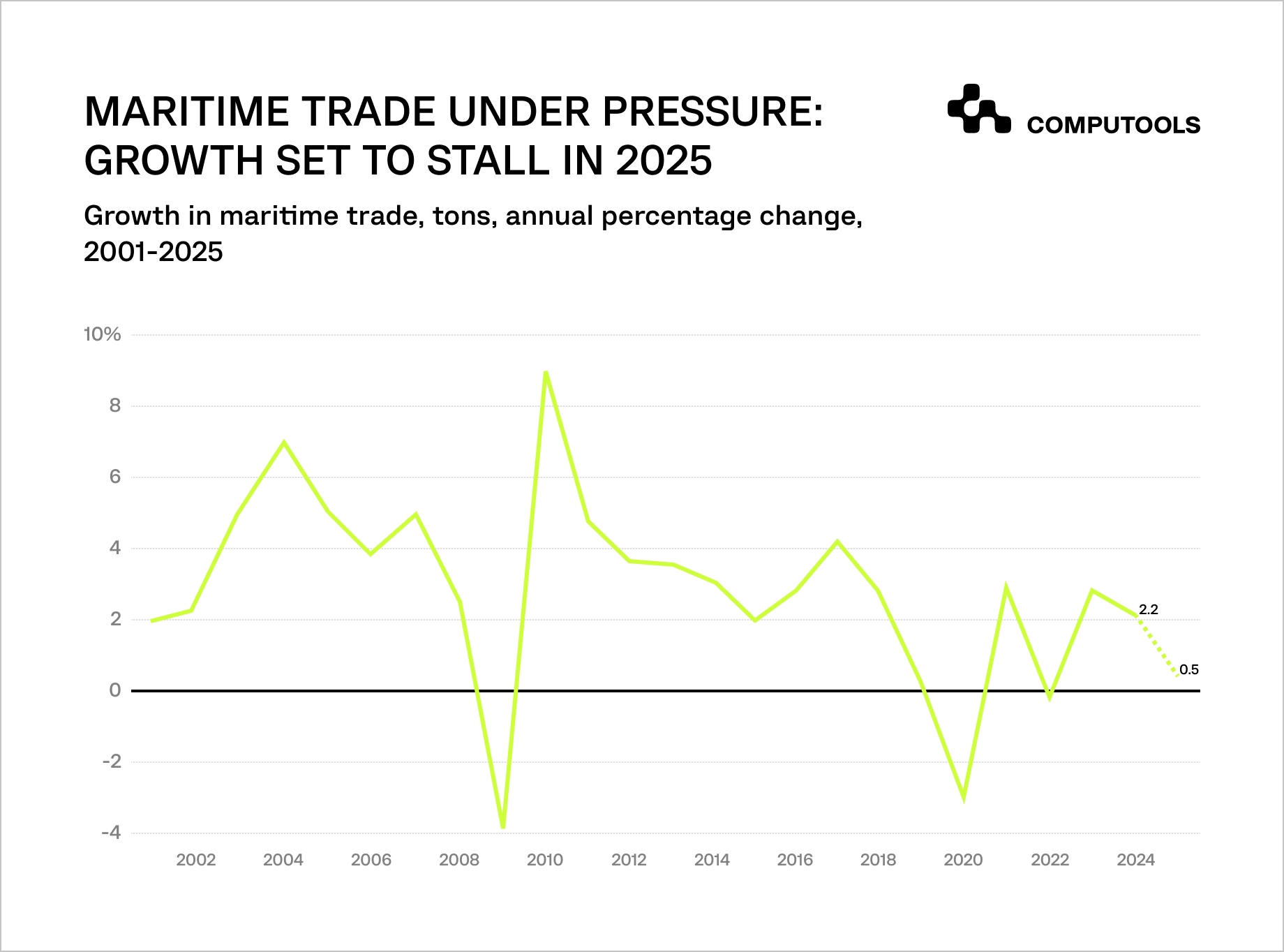
In most maritime supply chains, shipment status management remains operationally inefficient. Updates are distributed across carrier platforms, port systems, emails, spreadsheets, and internal logistics applications, forcing teams to reconcile inconsistent milestones, manually adjust ETAs, and respond to repetitive customer inquiries.
Real-time maritime cargo tracking delivers business value only when incoming events are standardized, validated, and converted into automated workflows rather than passive visibility.
This gap remains significant: in January 2026, global schedule reliability stood at 62.4%, while late vessel arrivals were delayed by an average of 5.17 days.
The industry already has the digital foundation to move beyond fragmented status handling. DCSA’s Track & Trace standard supports more than 180 million monthly container-tracking events and covers 75% of global container shipping volume, providing a practical foundation for consistent, event-driven automation across carriers and logistics partners.
The challenge is building a trusted layer that converts fragmented shipment signals into synchronized updates, handles exceptions, and enables timely stakeholder communication.
How Computools developed an automated shipment status system for real-time cargo visibility
Navis Horizon shows how this approach works in practice for a maritime logistics operator that needed to replace fragmented shipment reporting with one reliable operational platform.
For this Hamburg-based client, we developed the solution as part of our maritime software development services.
Previously, the operator relied on disconnected data sources, including AIS feeds, GPS signals, carrier updates, port-event data, emails, and spreadsheets, which led to slow, inconsistent shipment status management.
We developed Navis Horizon to centralize these inputs and convert raw tracking data into reliable shipment statuses, automated alerts, and predictive delay insights.
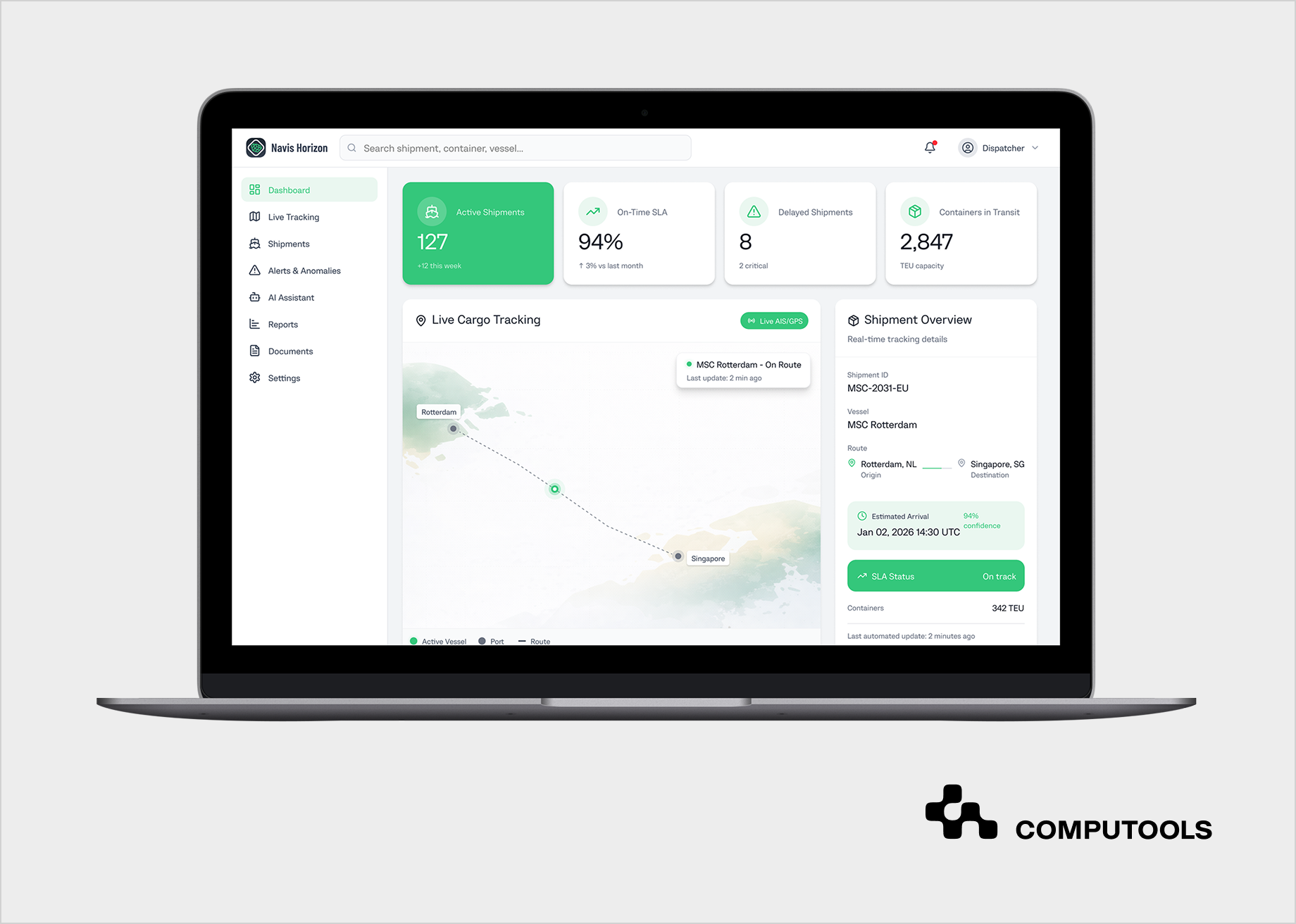
To make the platform effective in daily operations, we focused on both usability and data accuracy. Our AI development services produced an intelligent assistant that enables dispatchers to identify anomalies, review shipment summaries, and respond quickly to disruptions.
We also provided custom web development to deliver a unified interface that allows dispatchers and customers to access tracking data, timelines, and shipment updates in one location.
As a result, the client reduced dispatcher workload by 40%, increased customer satisfaction by 23%, accelerated shipment incident resolution by 18%, and achieved a single, transparent view of cargo status updates across tracked shipments.
How to automate shipment status management across maritime supply chains: a step-by-step guide
Navis Horizon is a practical example of how this model can be implemented in a real maritime environment. The project reflects our hands-on experience in designing and delivering an automated shipment status system that connects fragmented data sources, supports faster decisions, and improves shipment visibility. Based on this expertise, let us break down the key steps required to build such a system.
Step 1. Audit Current Shipment Status Workflows
The first step is to understand how shipment statuses are actually managed across the operation today. In many maritime environments, updates come from multiple disconnected sources, including carrier portals, terminal messages, AIS feeds, emails, spreadsheets, and internal platforms.
Because these inputs are handled by different teams and often reviewed manually, status visibility becomes slow, inconsistent, and difficult to trust. Dispatchers spend time switching between systems, customer-facing teams wait for confirmations, and delays are often recognized too late.
Before introducing any shipment status automation, the company needs a clear map of the current workflow. That means identifying where status data enters the process, who works with it, how it is interpreted, where it is stored, and how it moves from one team to another.
It is equally important to document manual actions, such as copying updates between tools, reconciling milestones from different sources, correcting ETAs, or responding to routine tracking requests. A proper audit should show where time is being lost, where inconsistencies appear, and where teams depend on personal knowledge instead of structured system logic.
At this stage, special attention should be paid to process gaps that are easy to overlook during high-level planning. These often include duplicated updates from different channels, status changes that arrive too late to be useful, milestones described differently across providers, and communication loops where customers can only get answers after someone manually checks several systems.
These details matter because they reveal which parts of the workflow create the highest operational load and which ones should be automated first.
Skipping this step usually results in a weak outcome. A company may introduce new dashboards or add more integrations, yet still keep the same manual bottlenecks in the background. The interface looks better, but the process remains fragile, and users continue to rely on spreadsheets, calls, and workarounds because the platform does not reflect how shipment tracking actually works in practice.
In Navis Horizon, we began by examining how the client handled shipment updates across AIS feeds, carrier messages, emails, and spreadsheets. This helped us pinpoint the sources of dispatcher overload, delayed responses, and inconsistent communication. That early workflow analysis shaped the platform architecture and gave us a solid base for the automation stages that followed.
Step 2. Define a Unified Event Model
After auditing the current workflow, the next step is to define a single event model that will govern how shipment updates are interpreted across the platform. In maritime operations, status data rarely arrives in one clean format.
The same movement can be described differently by a carrier, a terminal, an AIS provider, or an internal operations team. One source may show vessel departure, another may still reflect gate activity, and a third may report a delay without linking it to the actual shipment stage. Until these updates are translated into one shared logic, status management remains inconsistent.
To avoid that, the business needs to define a common set of shipment milestones and the rules behind them. This usually includes events such as booking confirmed, container received, gate-in, loaded on vessel, vessel departed, transshipment completed, arrived at port, customs hold, out for delivery, delivered, delayed, or exception detected.
Each event should have a clear business meaning, a source priority, and a timestamp rule that determines when the status becomes valid. This is what turns disconnected updates into a functional maritime shipment tracking system rather than a collection of data feeds.
The event model also needs to reflect operational priorities. Some milestones should only appear in the timeline, while others should trigger ETA recalculations, alerts, escalation rules, or customer notifications.
It is also important to define how the platform handles duplicate events, overlapping updates, missing milestones, and records from different systems that conflict. Without these rules, the platform may still display shipment data, but teams will continue arguing over which status is correct and whether action is required.
When companies skip this step, automation quickly becomes fragile. New integrations keep adding data, but statuses remain unreliable because there is no shared logic behind them. Operations teams continue to manually cross-check updates, customer communication remains inconsistent, and the system loses credibility as soon as exceptions arise. In practice, this means more data on screen, but not more control.
In Navis Horizon, we created a unified event structure that aligned AIS, GPS, and carrier-event inputs with the client’s actual shipment flow. This gave the platform a consistent way to interpret raw tracking signals, detect meaningful status changes, and support the automation logic that came next, including alerts, delay prediction, and timeline-based communication.
Step 3. Integrate All Shipment Data Sources
Once the shipment event model is in place, the platform needs a reliable data foundation. In maritime operations, shipment visibility depends on multiple external and internal systems that were never designed to work as one.
Carrier updates, terminal events, port messages, AIS streams, GPS signals, customs records, and internal TMS or ERP data all reflect different parts of the shipment journey. They also arrive at different speeds, use different identifiers, and vary in reliability. Until these sources are connected and aligned, status management remains fragmented.
This stage requires a dedicated integration layer that continuously ingests, standardizes, and matches shipment-related data across the entire transport flow. That includes mapping events to the correct shipment, booking, container, vessel, voyage, and route segment while preserving source context and event timing.
In practice, many companies discover that their visibility problem is not caused by a lack of data but by the absence of a controlled way to connect it.
A carrier milestone may lag behind an AIS movement update. A terminal event may confirm activity before the customer-facing record changes. A customs hold may affect delivery readiness without changing the vessel timeline. The system has to absorb these differences while maintaining a coherent operational picture.
The quality of this layer depends on details that are often underestimated during planning. Source priority rules, identifier resolution, late-arriving events, retry logic, schema changes, duplicate suppression, and source health monitoring all affect whether the platform can be trusted in daily use.
The architecture should also reflect real maritime data behavior, where some feeds are streamed in near real time, and others are synchronized on a schedule. Without that, even well-designed automated cargo tracking software will produce broken timelines, incomplete shipment views, and operational blind spots that force teams back into manual checks.
In our case, we connected AIS, GPS, and carrier-event streams into one structured operational environment and aligned them with the client’s shipment entities and workflows.
This allowed the platform to maintain a consistent flow of trusted updates across multiple sources and gave dispatchers a unified view of cargo movement instead of scattered fragments across portals, emails, and spreadsheets.
Step 4. Reconcile and Validate Status Updates
Once all shipment data sources are connected, the platform still needs a controlled way to decide which updates should shape the shipment timeline and which should not. In maritime operations, incoming events rarely arrive in a clean sequence.
The same milestone may be reported by several sources with different timestamps, different names, or different levels of completeness. A carrier may publish a departure update later than when vessel movement is already visible in AIS data. A terminal event may confirm container handling while the customer-facing record still shows the previous stage.
Without reconciliation, the system collects data, but it does not produce a status flow that operations teams can trust.
At this stage, the platform needs validation rules that compare each incoming event against the expected shipment sequence, source priority, timing logic, and related shipment references.
The goal is to determine whether an event confirms a real status change, duplicates an existing update, arrives too late to remain operationally relevant, or conflicts with a more reliable source. This is the layer that turns fragmented data into a usable operational picture and makes real-time shipment status monitoring possible at scale.
The reconciliation logic should account for the situations that appear most often in maritime shipment execution. These include duplicate milestones from multiple providers, delayed carrier updates, missing transshipment events, inconsistent port activity records, and shipment stages that appear out of sequence because one source is updated faster than another.
It is also important to validate how events relate to one another across shipments. container, vessel, and voyage levels, since not every vessel movement should trigger an immediate customer-facing shipment update. The system needs clear rules for when to merge events, when to suppress them, when to hold them for verification, and when to escalate them as potential exceptions.
If this layer is weak, the rest of the automation stack becomes unstable. ETA calculations start from inconsistent inputs, automated alerts are triggered at the wrong time, and users continue checking external portals because the platform does not accurately reflect the shipment state.
In that situation, the business may have more data in one place, but it still lacks a reliable operating system for shipment visibility.
In Navis Horizon, we implemented reconciliation logic that aligned AIS, GPS, and carrier-event data with the client’s shipment flow and business rules. This allowed the platform to suppress duplicate updates, resolve timing conflicts, validate milestone sequences, and present shipment statuses as one consistent operational timeline rather than a mix of competing source signals.
Step 5. Automate ETA and Exception Handling
Once shipment events have been validated and reconciled, the platform should start converting them into operational decisions. At this point, the objective is no longer to show where a shipment is, but to determine whether the shipment is still moving according to plan and whether the business needs to act.
In maritime logistics, delays rarely present a single, obvious signal. They emerge through changes in vessel movement, missed transshipment windows, extended dwell times, lagging carrier milestones, or gaps between expected and actual shipment progression.
If these signals are not automatically interpreted, teams remain dependent on manual monitoring and delayed responses.
To handle this properly, the platform needs dynamic ETA logic and a structured exception framework. ETA should be recalculated whenever new operational inputs affect the shipment path, including changes to vessel movements, terminal activity, carrier milestones, and route-level disruptions.
At the same time, the system should evaluate whether the shipment is still following its expected sequence and timing thresholds. If the deviation becomes operationally relevant, the platform should trigger the appropriate action, whether that means updating the shipment timeline, flagging the case for dispatcher review, escalating a service risk, or issuing automated cargo status updates to the relevant stakeholders.
The strength of this layer depends on how well exception logic reflects real operating conditions. The system should distinguish between minor variation and meaningful disruption. A short timing shift may require no action, while a missed transshipment milestone, a prolonged port stay, or a widening gap between AIS movement and carrier confirmation may require immediate escalation.
The rules should also reflect route-specific patterns, carrier behavior, service-level commitments, and communication priorities. Without that discipline, the platform either creates too much alert noise or fails to surface risks early enough to matter.
When this step is underdeveloped, automation remains superficial. Teams may receive more tracking data, but they still have to interpret disruptions manually, decide whether a delay matters, and figure out who should respond. That slows issue resolution, weakens ETA reliability, and makes proactive customer communication difficult.
In practice, this is where many visibility platforms stop being operational systems and become passive dashboards.
In our project with a port logistics operator in Hamburg, we implemented logic that continuously reassessed shipment timing as new AIS, GPS, and carrier events were added to the platform.
We also configured exception handling to identify meaningful deviations early and route them into operational follow-up before they turn into larger service issues. This helped the client respond faster to disruptions, improve ETA accuracy, and reduce the manual effort required to monitor shipment progress across active routes.
Shipment visibility becomes even more valuable when combined with smarter planning. Learn more in Route Optimization Software: A Must-Have Tool for Modern Logistics Businesses.
Step 6. Build Dispatcher Workflows
Once ETA logic and exception handling are in place, the platform has to deliver that intelligence in a form that dispatchers can act on immediately. In maritime operations, teams do not work with isolated events.
They work with shipment priorities, service commitments, delay risks, and exceptions that need a timely response. If critical updates are buried in fragmented screens or low-level event logs, the system slows operations rather than improving them.
At this stage, the platform should be structured around dispatcher actions rather than around data sources. The interface needs to show which shipments require attention, what changed, how serious the issue is, and what should happen next.
This usually means combining exception queues, milestone timelines, ETA deviation indicators, vessel and route context, document access, and communication history into a single operational workspace. That is where shipping logistics automation becomes practical, because the system no longer just collects updates but helps teams move from detection to action with less delay and less manual effort.
The design of these workflows should reflect the reality of high-volume logistics operations. Dispatchers need prioritization rules, severity levels, filtering, and role-based views that separate critical disruptions from routine status changes. They also need enough context to understand whether a case threatens delivery timing, customer commitments, or internal service performance.
A strong workflow reduces cognitive load by surfacing the next decision first and leaving deeper shipment details available when needed. It should help the user act faster, not force them to interpret the platform before they can respond.
If this layer is weak, even accurate tracking and exception logic will fail to deliver their full value. Dispatchers will continue sorting alerts manually, checking multiple systems for confirmation, and losing time on follow-up that should already be supported by the platform.
That weakens consistency, slows issue resolution, and limits the automation effort’s business impact because the operational interface is not aligned with how teams actually work.
In Navis Horizon, we designed dispatcher workflows to handle exceptions, prioritize shipments, and improve operational speed.
The platform gave users a single environment where they could review live statuses, understand why a shipment required attention, and move directly into follow-up without switching between disconnected tools or communication channels.
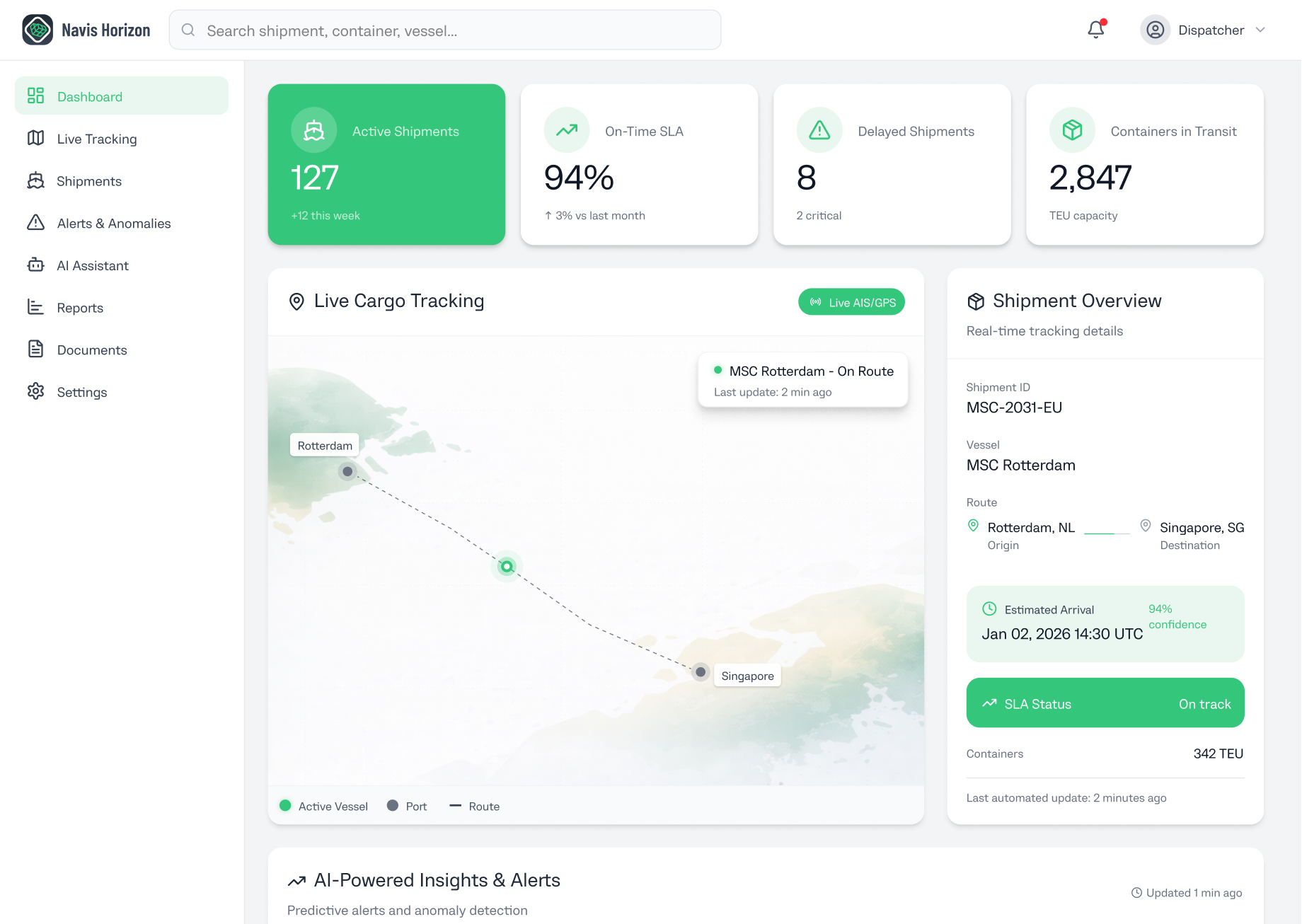
Example of a dispatcher workspace in Navis Horizon, showing live cargo tracking, shipment priorities, SLA visibility, and AI-supported operational monitoring.
Step 7. Enable Customer Self-Service Visibility
Once internal shipment status management is stable, the next step is to make that visibility available to customers without creating new communication risks.
In maritime logistics, a significant share of manual workload comes not from shipment execution itself, but from repeated requests for status confirmation, ETA clarification, delay explanations, and document access. When customers cannot retrieve this information on their own, support and operations teams serve as a constant relay between fragmented systems and external stakeholders.
At this stage, the platform should provide customers with direct access to shipment information relevant to them, already validated by the system’s operational logic.
This typically includes current shipment status, milestone history, ETA changes, delay notifications, route progress, booking or container references, and selected documentation.
The objective is to give customers a clear, reliable view of shipment progress in a format they can use without assistance. This is where a maritime logistics software solution supports clearer customer communication and stronger internal shipment control.
The customer-facing experience should follow the same governance rules as the operational platform. Visible statuses should reflect reconciled and approved shipment logic rather than raw external events. Permissions need to be role-based, document access should be controlled, and notifications should be tied to meaningful shipment changes instead of background fluctuations that create confusion.
It is also important to define how ETA changes, delays, and shipment exceptions are communicated so that external users receive accurate information without being exposed to operational noise.
If this layer is underdeveloped, the company continues to pay the communication costs of poor visibility. Customers keep requesting updates through email or support channels, teams repeat the same clarifications across different accounts, and trust weakens when external communication lags behind the shipment reality already visible inside operations.
In that situation, automation improves internal workflows, but it does not reduce the broader service burden caused by fragmented shipment communication.
Working on the Navis Horizon case, we extended visibility beyond dispatcher workflows and gave customers direct access to shipment timelines, delay information, and supporting records through a structured self-service interface.
This reduced manual status requests, improved consistency across customer communication, and helped the client deliver clearer updates without increasing operational overhead.
Step 8. Scale, Secure, and Optimize the Platform
Once the platform supports internal workflows and customer-facing visibility, it has to perform reliably under real operating load. In maritime logistics, that means handling growing shipment volumes, additional carriers, new trade routes, more customer accounts, and a rising number of status events without losing speed, stability, or data consistency.
A platform that performs well during rollout can fail quickly once traffic increases and more teams depend on it for daily decisions. This final stage turns a working implementation into infrastructure that can support long-term maritime supply chain automation.
At this point, the system needs a scalable architecture, strict access control, and continuous operational monitoring. Event processing must remain stable as traffic grows, real-time updates must reach users without delay, and core services must evolve without disrupting the rest of the platform.
Security should include encryption in transit and at rest, role-based access controls, auditability, environment separation, and controlled exposure of customer-facing data. Performance monitoring is equally important.
The business should track update latency, event processing success rates, ETA accuracy, alert relevance, platform uptime, and user adoption across operational roles.
Without that discipline, even a well-engineered vessel shipment tracking system will start to lose credibility as usage expands.
This is where strong engineering decisions shape long-term business value. Growth in routes, carriers, interfaces, and customer scenarios increases system pressure over time, and weak architecture tends to surface at that stage.
Experienced logistics software development services account for resilience, observability, maintainability, and controlled scaling from the start, so the platform can absorb change without major rework.
When this stage is handled poorly, the platform degrades in predictable ways. Real-time updates slow down under heavier traffic, status timelines begin to lag behind live operations, permissions become harder to manage, and new integrations start introducing instability into workflows that were previously reliable.
Teams lose confidence in the platform, manual checks return, and the business ends up carrying the cost of a system that no longer supports the pace of operations.
In Navis Horizon, we delivered a secure, modular platform architecture built for continuous real-time processing, role-based access, and expansion across additional shipment flows and user groups.
This allowed the client to maintain reliable visibility, support live operational workloads, and improve service performance as requirements evolved.
These steps create the foundation of a reliable shipment status automation platform. The next question is what modern maritime platforms must support in 2026, and when standard tracking tools will no longer be enough.

Launch your maritime shipment tracking solution in 1–3 months instead of years, automate status updates, improve cargo visibility, and keep stakeholders informed in real time.
What modern maritime tracking platforms need to support in 2026
In 2026, modern maritime tracking platforms are expected to do far more than display container location on a map.
As schedule reliability remains under pressure, with global liner reliability at 62.4% in January 2026 and average delays for late vessel arrivals at 5.17 days, platforms need to help operators interpret shipment progress, detect deviations early, and support faster operational response.
This is why digital transformation in maritime logistics is increasingly centered on event standardization, live data exchange, and workflow automation rather than on basic tracking alone.
A modern platform should combine carrier milestones, AIS signals, port and terminal events, internal shipment data, ETA logic, and exception alerts into a single operating layer. DCSA’s Track & Trace standard offers a technological foundation for ongoing visibility into container locations and operational events through standardized data definitions and APIs.
It currently handles over 180 million monthly container tracking events and accounts for 75% of global container shipping volume. In practice, this means the market is moving toward interoperable status models that can synchronize multiple sources, rather than relying on isolated feeds or manual updates.
The same shift is visible in port-side digital infrastructure. Since 1 January 2024, all IMO Member States have been required to use a Maritime Single Window to collect and exchange information when ships call at ports, and UNCTAD notes that digital infrastructure and data collaboration can greatly improve port efficiency and global supply chain efficiency.
That raises the baseline for what companies should expect from supply chain visibility for maritime logistics: not fragmented status reporting, but validated shipment events, clearer milestone coordination, and more reliable communication across the shipment journey.
A platform that meets 2026 requirements should therefore support standardized shipment events, real-time and scheduled integrations, ETA forecasting, exception-driven alerts, role-based operational workflows, and controlled customer visibility.
Without these capabilities, companies may still collect more tracking data, but they will struggle to convert it into faster decision-making, more accurate status tracking, and dependable shipment control across maritime supply chains.
Real-time tracking often relies on operational data that is connected. For a related perspective, read How to Integrate IoT Sensors With Railway Fleet Management Platforms.
Should you build or buy a maritime shipment tracking platform?
Off-the-shelf tools can work when a company needs basic shipment visibility, works with a limited number of carriers, and does not require complex workflow customization. They are usually enough for viewing milestones, checking ETA updates, and sharing tracking access with teams or customers.
The limits become apparent when visibility must support real operations. Standard shipping status management software can display shipment events and basic alerts, but it often cannot reconcile multiple data sources, apply internal SLA rules, support dispatcher workflows, or separate internal and customer-facing status logic.
At that stage, the issue is no longer access to tracking data but whether the platform can turn fragmented inputs into one reliable operational flow.
A custom platform is the better choice when shipment execution depends on AIS signals, carrier updates, terminal events, internal systems, and customer communication working together in a single environment.
In that case, an automated shipment status system for maritime supply chains supports execution, coordination, and service communication, not just tracking. That was the case in Navis Horizon, where the client needed a platform built around real maritime workflows rather than a standard tracking interface.
Why companies choose Computools for maritime automation projects
Companies choose Computools for maritime automation projects because maritime logistics platforms must unify fragmented data, support real-time decision-making, and remain stable under operational load.
Our team delivers maritime software development services for companies that need to automate shipment visibility, connect operational workflows, and build reliable digital infrastructure for complex logistics environments.
Today, Computools brings together 250+ in-house engineers and has delivered 400+ projects globally over 12+ years in software engineering.
Across our portfolio, we have completed 40+ logistics and maritime software projects, including supply chain visibility platforms, fleet monitoring systems, freight marketplaces, and dispatch coordination tools.
This work also depends on strong technical depth. Our IoT development services support solutions built around live operational inputs such as vessel movement signals, GPS streams, cargo condition data, and other sensor-based events that influence shipment status in real time.
Our data engineering services help unify AIS data, carrier updates, terminal events, and internal shipment records into a consistent data foundation that can support automation at scale.
According to Computools’ reported logistics program metrics, tailored digital platforms have contributed to 45% faster delivery operations, 35% lower operational costs, and 23% higher customer satisfaction.
If you are planning a maritime automation platform, contact our team at info@computools.com
Looking for the right delivery partner for a maritime automation project? Read Top 20 Maritime Software Development Companies Globally.
To sum up
For maritime companies, shipment status automation improves control over execution, reduces manual follow-up, and makes service performance more predictable across complex trade routes. A platform built on validated events, integrated data, and operational workflows gives the business a stronger foundation for port-to-port shipment tracking and faster response to disruptions.
That is why logistics automation for shipping companies is playing an increasingly important role in improving visibility, coordination, and operational consistency across the supply chain.
Computools
Software Solutions
Computools is an IT consulting and software development company that delivers innovative solutions to help businesses unlock tomorrow.