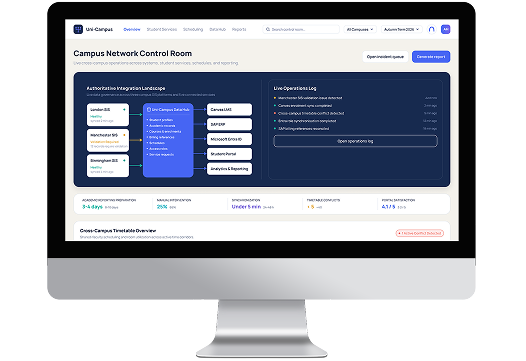
The client is a UK-based private university group operating three campuses and serving more than 25,500 students and 1,535 faculty members. After campus expansion, academic, administrative, and student-service systems became fragmented across localized SIS environments, LMS, ERP, and identity infrastructure.
The university needed higher education system integration that could connect campus-level systems of record while preserving operational continuity. Leadership needed consistent academic, scheduling, billing, and student-service data without launching a high-risk core-system replacement.
Computools delivered Uni-Campus, a phased integration solution connecting three legacy SIS environments, LMS, ERP, IAM, a unified data hub, analytics, and a central student portal. After rollout, academic reporting preparation decreased from 8–10 business days to 3–4 business days, routine requests requiring manual intervention fell from 65% to 25% of ticket volume, and cross-campus data synchronization improved from 24–48 hours to under five minutes.
The client is a UK-based private multi-campus university group with three campuses, more than 25,500 students, and over 1,535 faculty members. The institution manages academic records, course registration, tuition billing, student requests, identity access, and cross-campus scheduling across a complex application landscape.
Each campus operated its own localized Student Information System. This created a need for student information system integration across academic records, grading formats, course structures, student profiles, and reporting workflows.
The university’s digital environment also included LMS, ERP, and IAM infrastructure that supported learning delivery, financial administration, identity management, and access control. These systems were operationally important, but disconnected data flows created manual work for IT, academic administration, student services, and leadership teams.
The main challenge was fragmentation across academic and administrative systems. The university had functioning core platforms, but each campus managed data through different structures, workflows, and synchronization cycles.
The project required higher education software development experience across academic workflows, student services, legacy integrations, identity management, and phased rollout. It also required legacy system modernization for universities because the institution needed a new digital layer while keeping existing systems of record in place.
Computools designed Uni-Campus as a phased integration layer for multi-campus university integration. The solution connected three SIS environments, LMS, ERP, IAM, analytics, and a central student portal through an API-driven architecture.
The core architecture supported API integration for higher education by exposing controlled data flows between campus systems, administrative platforms, and student-facing services. Existing SIS, LMS, ERP, and IAM platforms remained the systems of record.
A unified data hub normalized academic records, student profiles, course data, billing references, access roles, scheduling information, and service-request data. This created one operational foundation for reporting, portal workflows, and cross-campus visibility.
Computools delivered student portal development that gave students one access point for timetables, academic requests, billing visibility, and service interactions. The portal reduced navigation across separate systems and lowered repetitive helpdesk demand.
The integration scope included LMS ERP SIS integration with Canvas via LTI 1.3, SAP ERP, Microsoft Entra ID, and three legacy SIS environments. Role-based access controls and centralized governance supported the university’s UK GDPR and data-protection framework.
The phased rollout improved reporting speed, data availability, student-service efficiency, scheduling accuracy, and portal experience across the university group:
The education data integration platform gave academic, administrative, and IT teams one governed view of student, course, schedule, billing, and access data. This reduced manual reconciliation, improved reporting reliability, and made student-service workflows easier to manage across campuses.
The unified data foundation also prepared the university for future AI development use cases, including student-service automation, academic analytics, and early-risk indicators.
The client selected Computools because the project required legacy integration, academic data modeling, student-service UX, IAM alignment, API architecture, and phased rollout across three campuses.
Computools connected fragmented SIS, LMS, ERP, IAM, and student-service data into a practical operating model for reporting, portal workflows, access control, and cross-campus visibility.
Delivery priorities were tied to measurable KPIs: reporting preparation time, manual-intervention requests, data synchronization speed, scheduling conflicts, and student portal satisfaction.
The team covered business analysis, CX and UX design, architecture, integrations, QA automation, security alignment, rollout validation, and post-launch support.

The design focused on student-service clarity, role-based access, cross-campus visibility, academic workflows, and administrative efficiency.
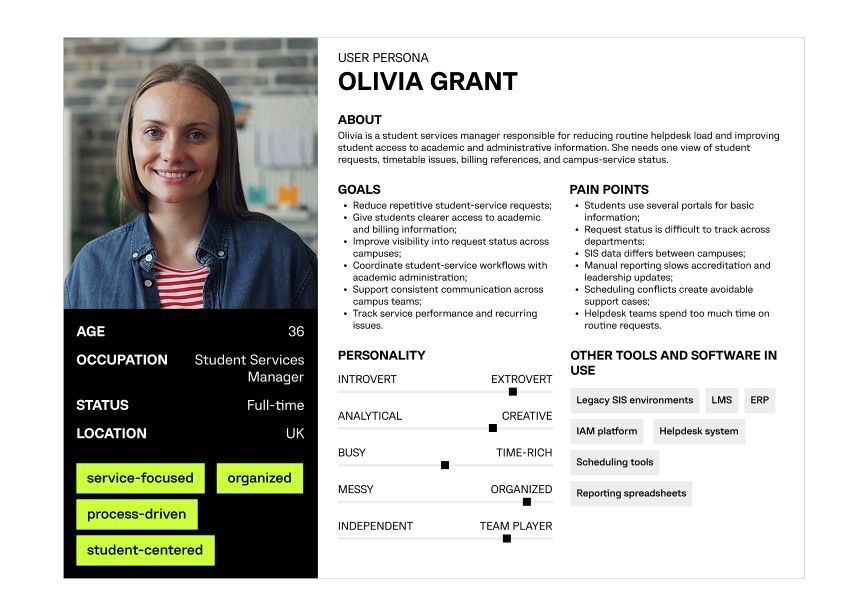
Defining student-service needs, academic administration workflows, IT operations, faculty scheduling, and leadership reporting.
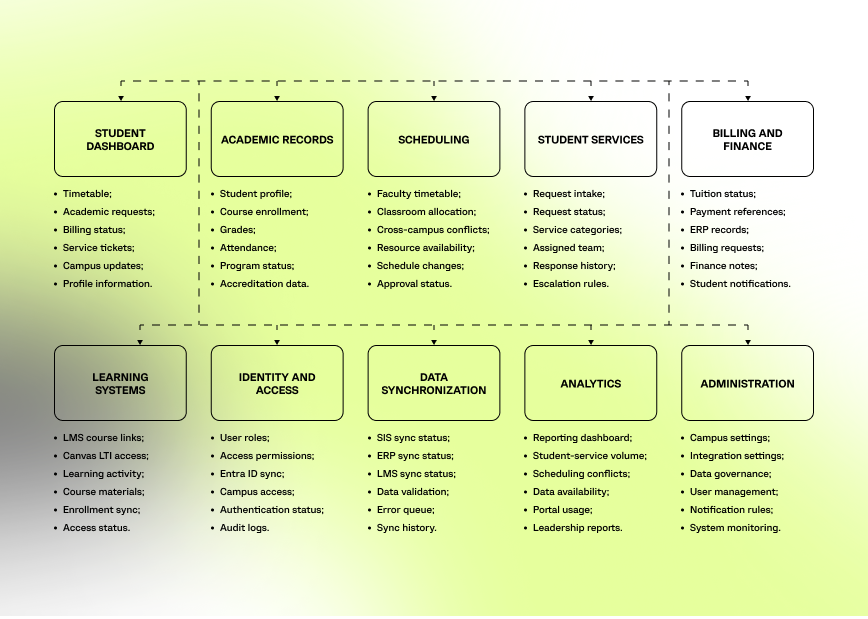
Structuring the platform around student services, academic records, campus operations, data synchronization, and role-based reporting.
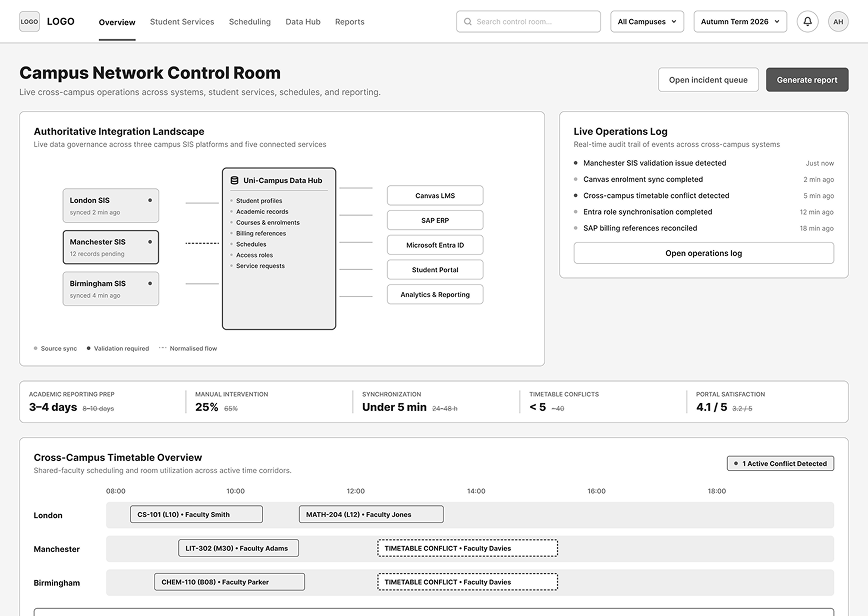
Designing low-fidelity layouts for student dashboards, service-request flows, academic records, scheduling conflict views, data-sync monitoring, and leadership reporting.
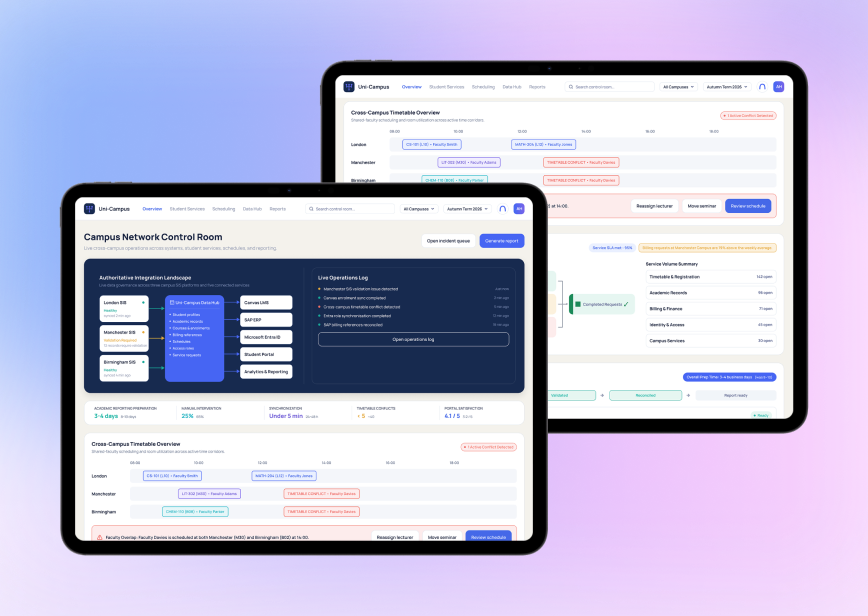
The interface gave students one access point for core academic services while giving staff controlled views of requests, records, schedules, and cross-campus data.

TypeScript
TypeScript supported consistent frontend and backend development across student portal workflows, API services, access logic, and reporting interfaces.

Next.js and React
Next.js and React powered responsive portal and staff interfaces for students, faculty, student services, academic administration, IT, finance, and leadership teams.

Node.js and NestJS
Node.js and NestJS handled application logic, API orchestration, service-request workflows, user permissions, notifications, and integration coordination.

PostgreSQL
PostgreSQL stored normalized student profiles, course references, request records, synchronization history, reporting data, access metadata, and audit events.

Azure, Docker, and Terraform
Azure, Docker, and Terraform supported cloud deployment, environment consistency, infrastructure automation, monitoring, and scalable processing for integration workloads.

Integration technologies
REST APIs, webhooks, scheduled synchronization jobs, LTI 1.3, and Microsoft Graph API connected three legacy SIS environments with Canvas LMS, SAP ERP, and Microsoft Entra ID.

Security and governance
RBAC, audit trails, access policies, and centralized data-governance rules supported controlled access to student, academic, billing, and operational data.
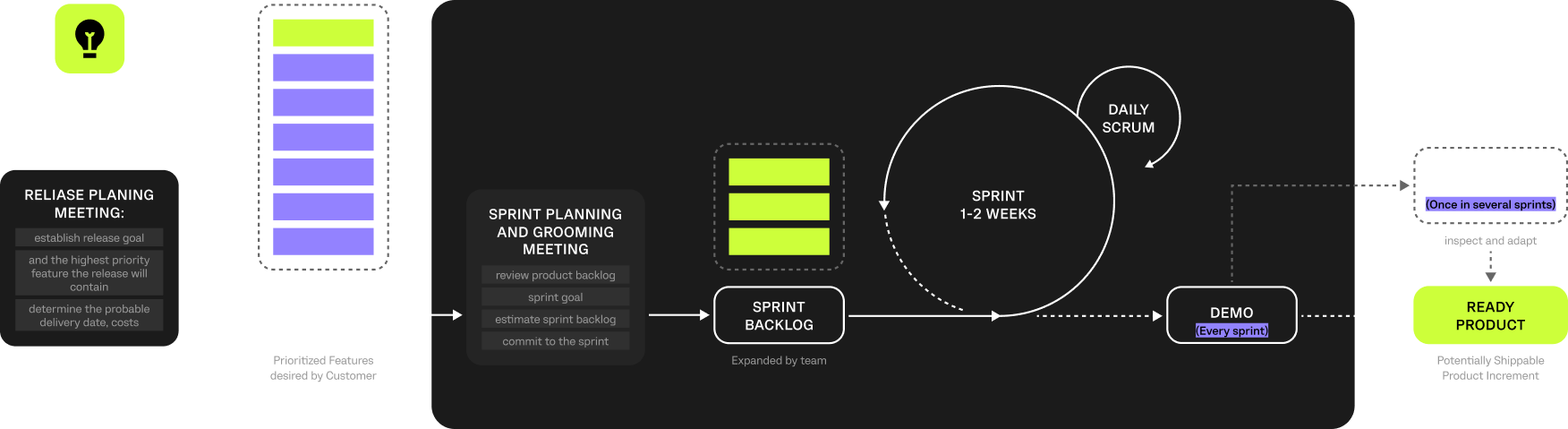
Computools used a phased delivery model with two-week iterations, stakeholder demos, and KPI-based acceptance criteria. Each sprint connected a platform capability to a measurable operational outcome: reporting preparation time, manual-intervention requests, synchronization speed, scheduling accuracy, or portal satisfaction.
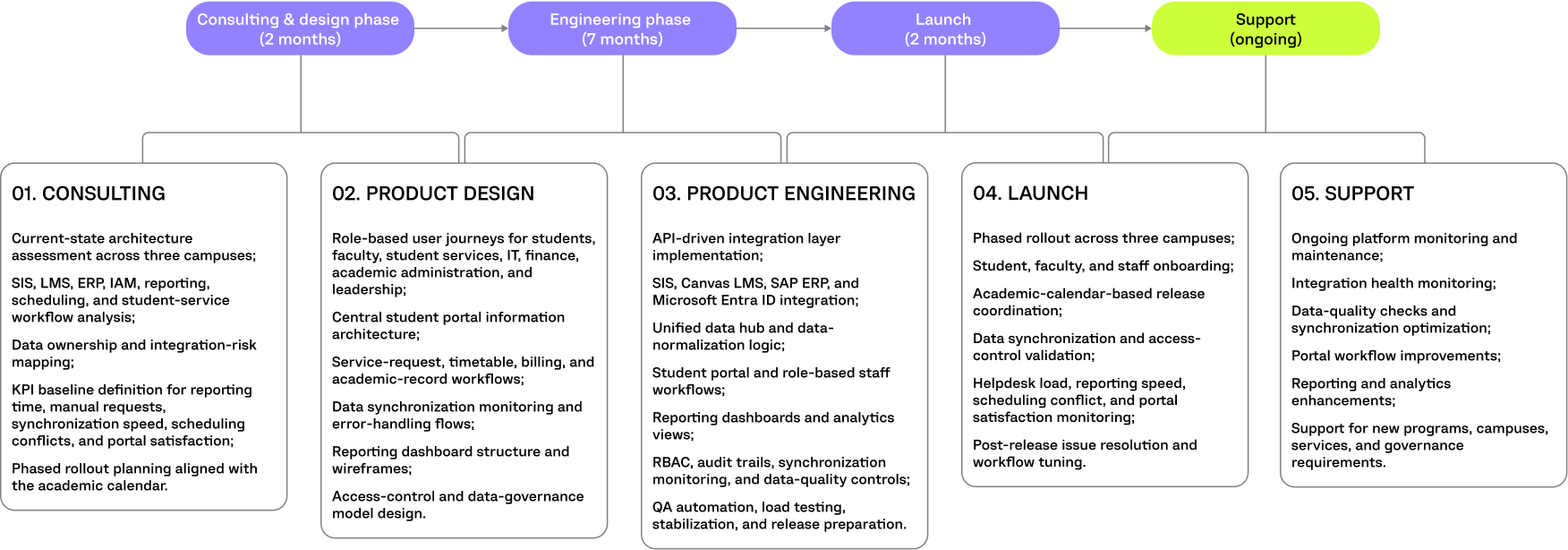
The team started with current-state architecture assessment, integration mapping, and data-model consolidation. Portal workflows, reporting dashboards, synchronization logic, and IAM integration were introduced after data ownership and validation rules were agreed.
The rollout followed the academic calendar. Campus teams, IT stakeholders, student services, finance, and academic administration reviewed each release before broader deployment.
Uni-Campus gave us one consistent view of academic and student-service data without forcing us to replace the systems our campuses still depend on. Reporting became faster, students had a clearer digital entry point, and our IT team gained a safer path for modernization.




Computools | 341 Raven Cir, Camden Wyoming, Delaware 19934, US