Valmère Pulse

How Valmère Pulse cut guest service resolution time by 32% across eight casinos.

case image

AT A GLANCE

The client operates eight land-based casinos in France, combining gaming floors with restaurants, bars, entertainment venues, and two adjoining hotels. Service requests, equipment incidents, shift handovers, reservations, and management reporting were handled through separate systems and departmental processes.

The group needed casino operations management software that could connect frontline teams without replacing the systems already responsible for gaming transactions, hospitality records, and access-sensitive data. Computools built Valmère Pulse as a unified casino operations platform for service requests, floor incidents, maintenance activity, shift coordination, hospitality workflows, and portfolio reporting.

Six months after full deployment, median service resolution time decreased by 32%, unplanned gaming equipment downtime fell by 23%, and reporting preparation time dropped by 46%. Property teams gained a consistent operating model across all eight locations while retaining role-based access to sensitive information.

THE CLIENT

The client manages a mixed portfolio of urban and destination casino properties. Operations run extended or continuous schedules and depend on close coordination between floor attendants, guest-service teams, technicians, hosts, restaurant staff, hotel teams, supervisors, and property managers.

The group already relied on a casino management platform for core gaming activity, but service delivery remained fragmented. Radios, paper logs, email, maintenance tools, booking applications, and local workarounds often carried different parts of the same guest request.

This fragmentation affected both gaming-floor service and broader hospitality operations. A single issue could involve several departments before completion, yet no shared operational view showed ownership, current status, pending actions, or whether the next shift had accepted responsibility.

BUSINESS CHALLENGE

The main problem was limited visibility across a fast-moving operating environment where unresolved tasks could affect guest service, equipment availability, and property performance.

  • Fragmented service ownership. Requests could move between the floor, host, hotel, restaurant, and technical teams without a clear owner, leading to delays and repeated communication.
  • Recurring equipment issues. Maintenance teams lacked a consistent incident history, making repeat faults harder to identify and prolonging avoidable downtime.
  • Weak shift continuity. Pending tasks and incidents were transferred through inconsistent handover processes, increasing the risk of work being missed after shift changes.
  • Disconnected guest and operational data. Different applications stored overlapping service information, permissions, and restrictions, limiting the context available to frontline teams.
  • Slow reporting. Managers assembled daily reports from separate exports, making cross-property comparison time-consuming and less reliable.

The project required casino workflow automation to formalize ownership, escalation, handovers, and completion without over-automating decisions that still required supervisors or specialists.

It also required reliable casino service management across guest-facing and technical workflows, supported by land-based casino software development experience in multi-property operations, system integration, access controls, and continuous-service environments.

SOLUTION SUMMARY

Computools built Valmère Pulse as an operational coordination platform around the group’s existing casino and hospitality systems. Gaming transactions remained in their original systems of record, while staff gained one workspace for service requests, incidents, equipment status, reservations, shift tasks, and operational reporting.

The guest service management software workflow assigned every request an owner, priority, timestamp, status, and escalation path. Staff could see which department was responsible, whether the guest had already been contacted, and what action was required next.

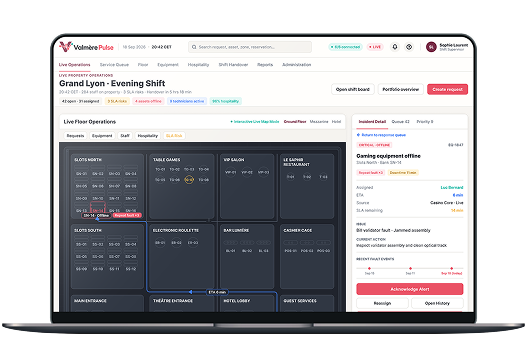
For casino maintenance management, the platform connected equipment status, incident history, technician assignments, and service zones through an interactive floor view. Repeat faults could be identified more consistently, while supervisors gained clearer visibility into equipment awaiting intervention.

A shared shift board tracked open work, acknowledgment, unresolved incidents, and supervisor sign-off. Restaurant, hotel, and entertainment workflows were connected through the same hospitality operations platform, giving teams current reservation and service context without exposing unrelated sensitive information.

Property and group managers received dashboards covering service resolution, equipment downtime, workload, reservation fulfillment, handover performance, and cross-property operating trends.

IMPACT

Valmère Pulse improved service responsiveness, equipment availability, shift continuity, reservation execution, and management reporting across the casino group:

  • Median service resolution time decreased by 32%.
  • Unplanned downtime of gaming equipment decreased by 23%.
  • Daily reporting preparation time decreased by 46%.
  • Restaurant reservation fulfillment improved by 17%.
  • Missed handover tasks decreased by 28%.

Clear ownership and escalation reduced the time between request creation and confirmed completion. Equipment history and technician routing helped teams respond faster to recurring faults and reduce downtime.

Connected reservation and shift workflows reduced gaps between departments, while casino operations analytics gave managers a consistent basis for comparing service quality, downtime, workload, and hospitality performance across properties.

WHY COMPUTOOLS

Valmère Pulse required experience in multi-property operations, cross-system integration, role-based access, and continuous-service environments. Computools applied travel and hospitality software development and web development expertise to connect casino, maintenance, hotel, restaurant, workforce, and reporting systems without disrupting daily operations.

Delivery was tied to operational KPIs including service resolution time, equipment downtime, handover completion, reservation fulfillment, and reporting effort. A phased rollout allowed property teams to validate workflows and integrations before expanding the platform across all eight casinos.

Launch your software solution within 1-3 months instead of years. Unlock tomorrow. Build a future-ready business through innovation.

STORY IN DEPTH

Background

The group’s eight properties had developed their technology environments through separate investment cycles. Casino systems, maintenance applications, restaurant booking tools, hotel software, workforce systems, and reporting processes differed between venues.

Local workarounds kept individual departments functioning but made cross-department work difficult to trace. The same equipment incident or guest request could appear in a radio log, a spreadsheet, a maintenance queue, and an email thread without a shared identifier.

Management therefore saw totals without enough operational context. A delay could come from a recurring equipment fault, a staffing bottleneck, an incomplete handover, or a failed integration, but the available reporting did not distinguish these causes reliably.

Approach to solution

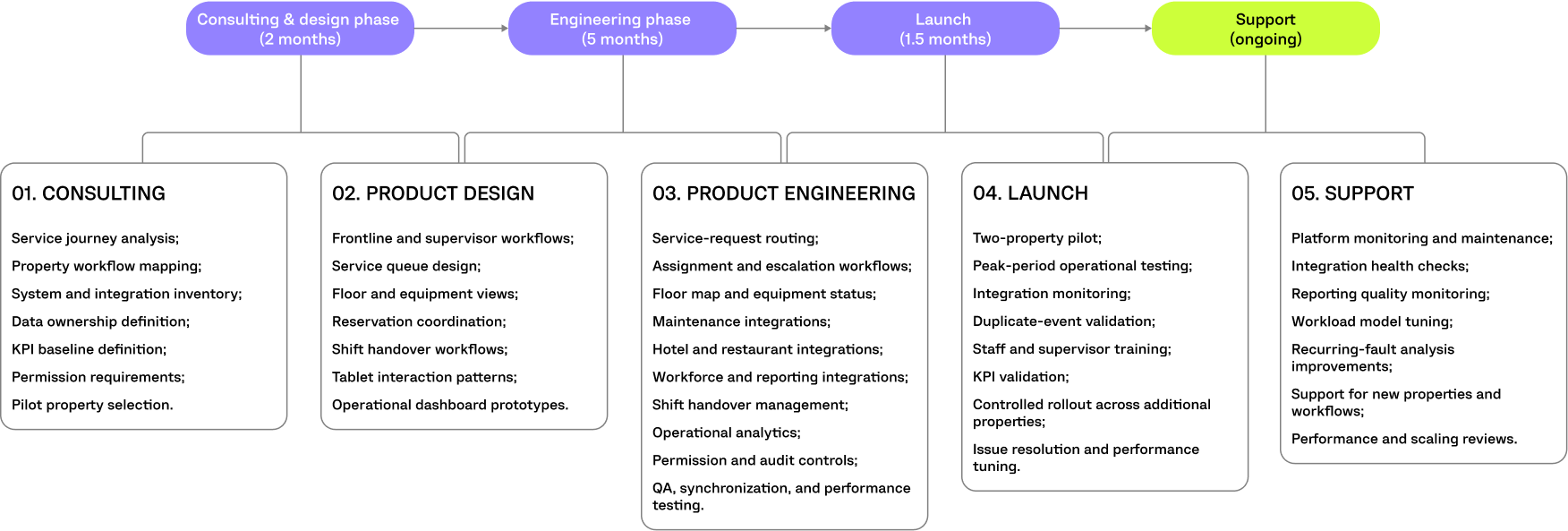
Computools mapped complete service journeys with floor attendants, guest-service teams, hosts, technicians, restaurant staff, hotel teams, supervisors, and property managers. Representative requests were traced from first contact through assignment, escalation, handover, and closure.

The team also documented which source system owned each piece of information. This prevented Valmère Pulse from becoming a conflicting second source for gaming records, guest restrictions, or authorization decisions.

A common incident taxonomy, request-routing model, integration monitoring, and shift board were established before more complex floor and hospitality workflows were added.

Data engineering connected operational records from existing systems through consistent identifiers, source timestamps, reconciliation rules, and shared reporting definitions. This gave management comparable data without removing ownership from the systems that generated it.

Computools used AI development for operational decision support, including workload forecasting and recurring-fault analysis. Aggregated operational signals helped supervisors plan staffing and maintenance priorities without automating high-impact guest decisions.

Computools role

Computools was responsible for:

  • analyzing guest-service, maintenance, reservation, handover, and reporting workflows;
  • defining common service categories, ownership rules, escalation logic, and KPI definitions;
  • designing tablet and desktop workflows for frontline staff and managers;
  • integrating casino, maintenance, hotel, restaurant, workforce, and reporting systems;
  • implementing equipment incident history and recurring-fault analysis;
  • building workload visibility and management reporting;
  • defining permission boundaries, audit events, and data-minimization rules;
  • validating operations through a two-property pilot;
  • supporting training, rollout, and post-launch monitoring.

Key decisions and outcomes

Existing systems retained clear responsibility for sensitive and regulated data. Valmère Pulse coordinated operational work while source references and timestamps showed where information originated and whether it was current.

Interrupted connectivity was handled explicitly. Staff could save permitted non-sensitive maintenance notes locally, while actions requiring current authorization waited until the relevant source system could be verified.

Operational analysis focused on service reliability and staffing needs. Forecasts used queue and workforce patterns, while equipment analytics highlighted recurring technical faults. Player-protection decisions and restrictions remained under the control of specialists within their designated systems.

DESIGN

The design prioritized speed, clarity, and low cognitive load for teams working in busy physical venues. Tablet interactions used large touch targets, short status labels, visible ownership, and clear next actions.

USER PERSONA → SITE MAP → WIREFRAMES → USER INTERFACE

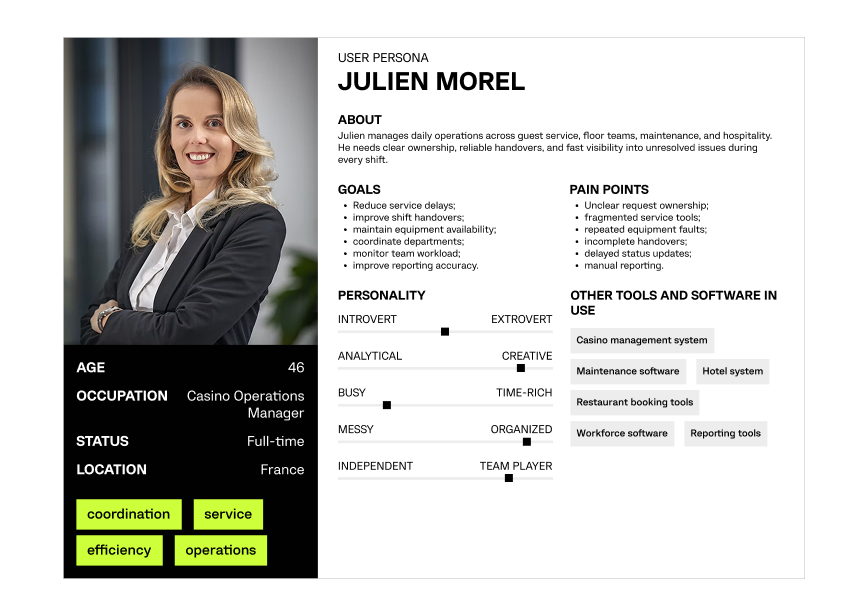
USER PERSONA

Defining the needs of casino operations managers responsible for service coordination, shift continuity, and floor performance.

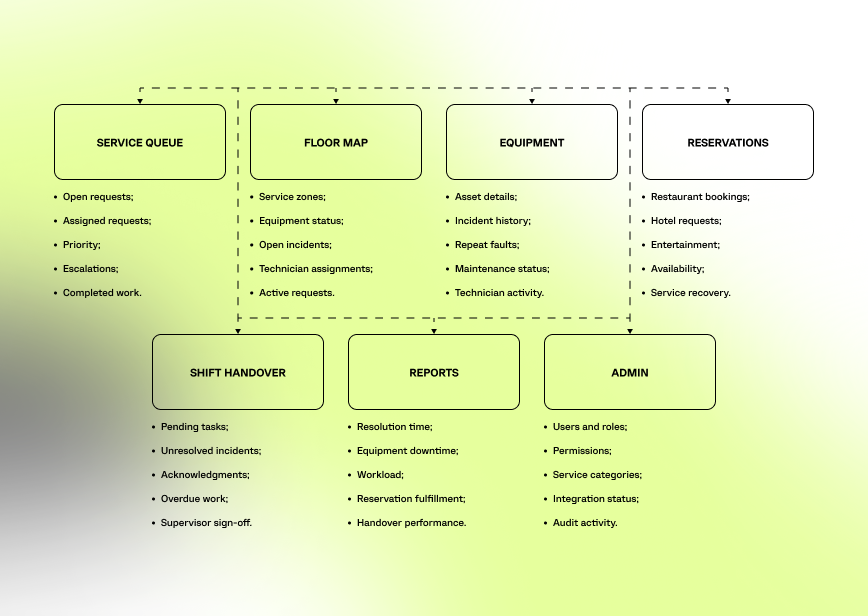
SITE MAP

Structuring guest service, floor operations, maintenance, hospitality coordination, shift continuity, and reporting within one staff workspace.

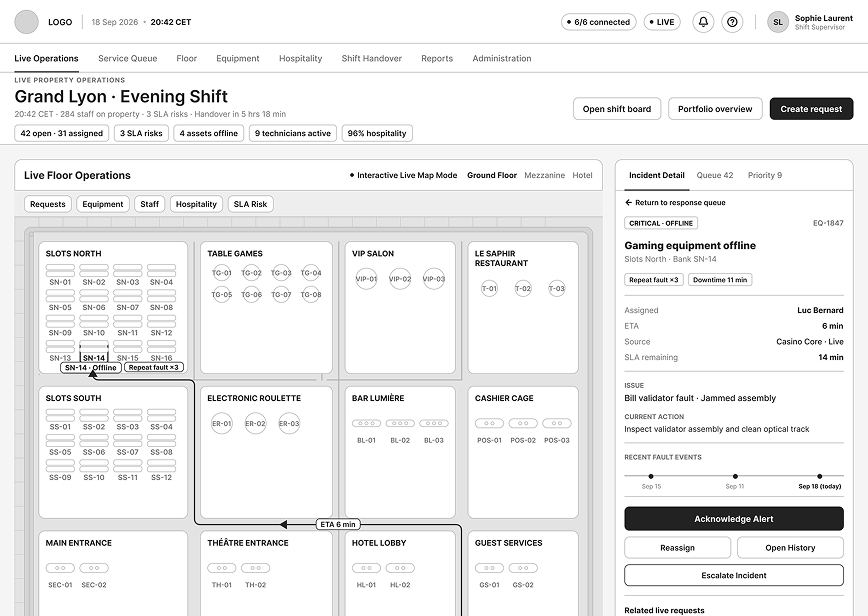
WIREFRAMES

Testing core service, maintenance, reservation, and shift-handover workflows before interface development.

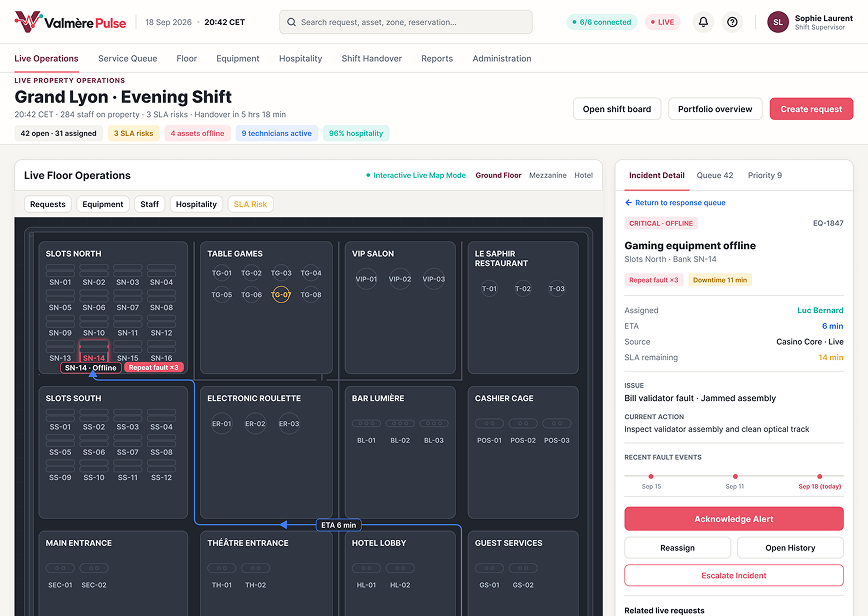
USER INTERFACE

Creating a responsive staff workspace for fast service coordination, floor visibility, and operational control.

DIGITAL PLATFORM & TECHNOLOGY

Valmère Pulse used a modular web architecture designed for continuous property operations, multi-system synchronization, tablet use, operational reporting, and controlled access to sensitive information.

PROJECT MANAGEMENT METHODOLOGY

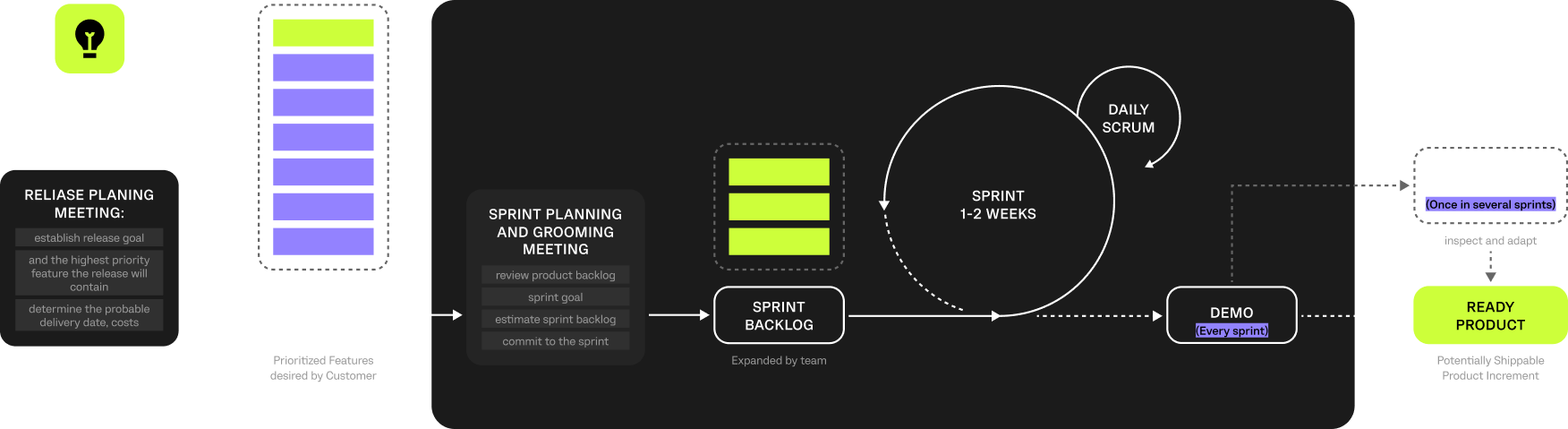
Computools used two-week Scrum iterations with property representatives, supervisors, and domain specialists validating workflows throughout delivery. Acceptance criteria covered routing accuracy, permissions, integration reliability, usability, and reporting.

Early sprints focused on ownership rules, shift workflows, and integrations. Later work covered floor operations, maintenance, hospitality coordination, analytics, and release readiness. A two-property pilot tested peak periods, outages, duplicate events, and shift transitions before wider rollout.

PROJECT MANAGEMENT METHODOLOGY

PROJECT TIMELINE

image

WHAT OUR CLIENT SAID

Before Valmère Pulse, we spent too much time finding out who owned a request. Now teams can see what needs to happen next, and fewer issues get lost between shifts. Guests get more consistent service, and managers can see much faster where delays are actually coming from.

CONTACT US TO GET A COST-EFFECTIVE
PROJECT ESTIMATE

Thank you for your message!

Your request will be carefully researched by our experts. We will get in touch with you within one business day.

WHAT HAPPENS NEXT?

01.
We deeply analyse your request.
02.
We create project roadmap, accelerating your time-to-value.
03.
We co-scope features, minimizing project risk upfront.
04.
We submit a comprehensive project proposal.
Trusted by: