Nordevane Trust

How Nordevane Trust increased multi-site pass sales by 34% across 18 heritage attractions.

case image

AT A GLANCE

The client operates 18 historic attractions across Denmark, including castles, estates, open-air museums, restored industrial sites, and heritage gardens. Ticketing, memberships, capacity rules, campaign tools, and visitor data were managed through separate local systems.

Computools built Nordevane Trust as a connected visitor-pass and operations platform linking discovery, ticket products, mobile access, memberships, admission workflows, and network reporting. The visitor pass platform gave visitors one account and one journey across multiple attractions while each site retained control over pricing, capacity, and local operations.

Nine months after network-wide adoption, multi-site pass sales increased by 34%, peak entry queues fell by 26%, and repeat visits rose by 21%. Campaign launch time also decreased by 38%, while cross-site visits increased by 29%.

THE CLIENT

The client manages a diverse heritage portfolio with high-volume city attractions, seasonal rural properties, family destinations, specialist collections, and locations with different membership models.

Each property had developed its own attraction ticketing processes, product rules, refund policies, scanning tools, and capacity controls. Visitors who planned to see several locations often repeated purchases, account creation, reservation steps, and entry checks.

The organization wanted to create one digital visitor experience without removing local autonomy. Effective heritage attraction management still required each site to control availability, prices, benefits, and on-site operations while contributing to a shared network journey.

BUSINESS CHALLENGE

Fragmentation affected both visitors and operations. Travelers could discover several attractions through one brand, but purchasing and admission remained separate local experiences.

  • Disconnected ticketing systems. Attractions used different ticket, payment, scanning, and membership tools, making network-wide products difficult to operate.
  • Uneven visitor distribution. Flagship sites experienced peak queues while nearby properties had unused capacity.
  • Complex admission rules. Pass benefits, refunds, discounts, timed-entry requirements, and family eligibility were difficult for visitors and staff to interpret.
  • Fragmented identity and membership records. Families, repeat visitors, and members could not rely on one consistent account across the network.
  • Slow campaign execution. Product rules and available inventory were spread across local tools, extending the time needed to launch coordinated offers.

The organization needed admission management software that could coordinate products, reservations, entitlements, access, and exceptions across independently operated attractions.

The project also called for heritage tourism software development experience in multi-site admission, offline validation, capacity planning, and local operating autonomy.

Broader travel and hospitality software development expertise was important because the visitor journey crossed discovery, purchase, reservations, entry, membership, and repeat visits.

SOLUTION SUMMARY

Computools developed Nordevane Trust as a shared operational environment around the attractions’ existing systems. Local ticketing and commerce tools remained in place while the platform synchronized visitor identity, pass entitlements, reservations, capacity, and entry events.

The multi-site ticketing system supported day passes, multi-day products, family tickets, group products, member offers, and campaign-specific packages. Visitors could make a one-time purchase and use the same account across several properties.

A digital visitor pass stored active entitlements, companion tickets, reservation details, and QR credentials. Entry validation continued during weak connectivity, with synchronization once service returned.

The platform supported timed entry reservation for attractions with capacity limits. Visitors could reserve or change arrival windows, while site teams managed allocations and availability through a shared operating view.

Integrated membership management software connected benefits, member status, repeat visits, event offers, and entitlement rules across the network.

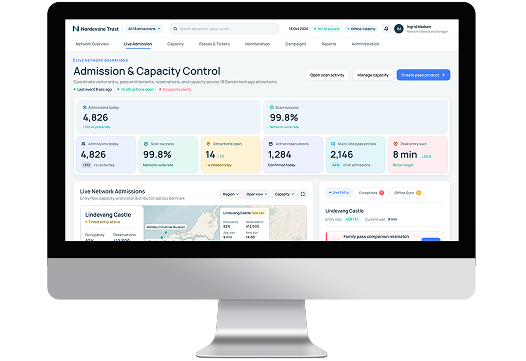
Staff received tools for scanning, re-entry, exception handling, capacity monitoring, refunds, and campaign inventory. Network leaders gained dashboards covering pass activation, entry patterns, cross-site movement, repeat visits, and revenue.

IMPACT

Nordevane Trust improved pass adoption, admission efficiency, repeat visitation, campaign execution, and movement across the heritage portfolio:

  • Multi-site pass sales increased by 34%.
  • Peak entry queues decreased by 26%.
  • Repeat visits increased by 21%.
  • Campaign launch time decreased by 38%.
  • Cross-site visits increased by 29%.

Simplified products and one checkout made multi-attraction visits easier to purchase. Mobile credentials and pre-arrival reservations reduced the need for manual checks at busy entrances.

Better visitor flow management helped the network distribute demand more effectively across properties. Capacity signals and cross-site recommendations made it easier to direct visitors toward relevant attractions with available space.

Shared product and campaign rules also reduced coordination across sites, while finance teams gained traceable records of pass usage and settlements.

WHY COMPUTOOLS

The project involved 18 independently operated attractions, various admission systems, local commercial rules, offline entry requirements, and a single shared visitor experience.

Computools applied web development expertise to build responsive visitor, wallet, staff, and management experiences across desktop and mobile environments.

AI development supported capacity forecasting, cross-site recommendations, campaign analysis, settlement checks, and anomaly detection. These capabilities used operational and visitor signals to support decisions without removing local control.

Delivery was tied to measurable outcomes including pass sales, queue time, scan reliability, repeat visits, cross-site movement, campaign speed, and reconciliation accuracy.

Launch your software solution within 1-3 months instead of years. Unlock tomorrow. Build a future-ready business through innovation.

STORY IN DEPTH

Background

The client had built a recognizable heritage portfolio, but the commercial journey ended at the boundary of each attraction.

Some properties used modern e-commerce and access-control systems. Others depended on on-site tills, printed membership cards, manual group lists, or locally configured booking tools.

Ticket definitions, capacity rules, discounts, refunds, and member benefits also differed between attractions. Staff could not always confirm whether a pass had already been activated elsewhere, while leadership lacked timely visibility into cross-site usage.

Approach to solution

Computools mapped admission journeys for day visitors, families, members, school groups, tour operators, and visitors with accessibility requirements. The team also documented how front-of-house, finance, marketing, membership, and site-management teams created products, allocated capacity, handled exceptions, and reconciled revenue.

The platform introduced a shared product model, visitor identity, pass ledger, and consistent entry validation while allowing local systems to remain authoritative for site-specific rules.

Timed reservations, companion sharing, membership recognition, and campaign workflows were added once the core transaction and entitlement model was stable.

Recommendations used visit history, interests, capacity, and other transparent signals. Consent controls governed the use of visitor data across the network.

Computools role

Computools was responsible for:

  • analyzing visitor journeys, admission rules, queue patterns, memberships, refunds, and reconciliation;
  • defining the shared pass model, entitlement rules, KPIs, and rollout roadmap;
  • designing visitor and staff workflows across desktop and mobile environments;
  • integrating ticketing, payment, CRM, membership, event, and access-control systems;
  • implementing capacity forecasting and cross-site recommendations;
  • building settlement checks and anomaly detection;
  • supporting offline credential verification and synchronization;
  • defining consent, audit, and security controls;
  • validating the platform across four pilot attractions;
  • supporting staff training and network-wide rollout.

Key decisions and outcomes

Local systems retained responsibility for site-specific prices, availability, refunds, and settlement rules. Nordevane Trust managed network products and entitlements while translating those rules into one visitor journey.

Offline admission was treated as a core operational requirement. Signed credentials and controlled synchronization allowed staff to validate access during connectivity loss without creating uncontrolled entry.

Analytics focused on network value, including second visits, capacity pressure, member behavior, campaign performance, and cross-site movement. This gave leadership a clearer view of how individual attractions contributed to the broader visitor journey.

DESIGN

The design balanced the character of historic attractions with the speed required during purchase and entry. Editorial imagery supported discovery, while passes, reservations, accessibility information, and entry credentials remained easy to find.

USER PERSONA → SITE MAP → WIREFRAMES → USER INTERFACE

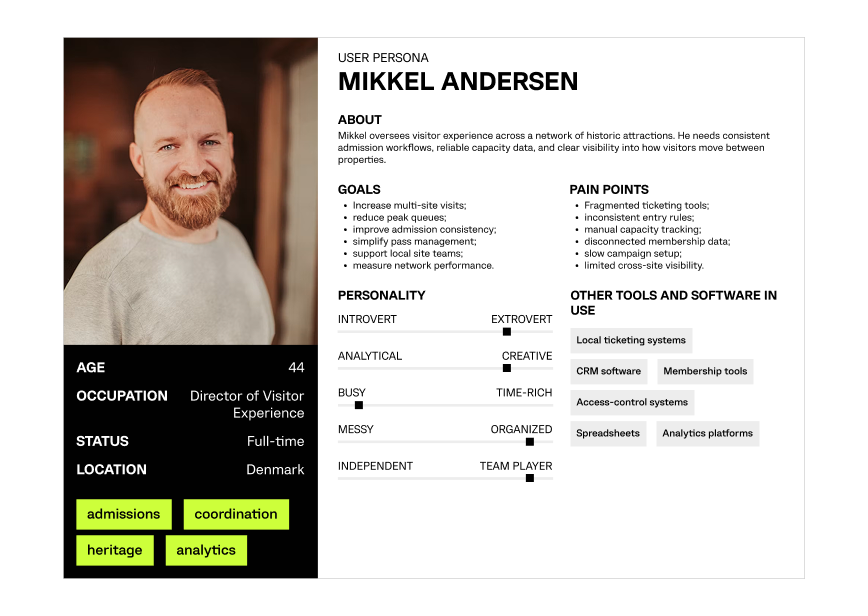
USER PERSONA

Defining the needs of heritage visitor experience leaders responsible for admission, capacity, memberships, and cross-site coordination.

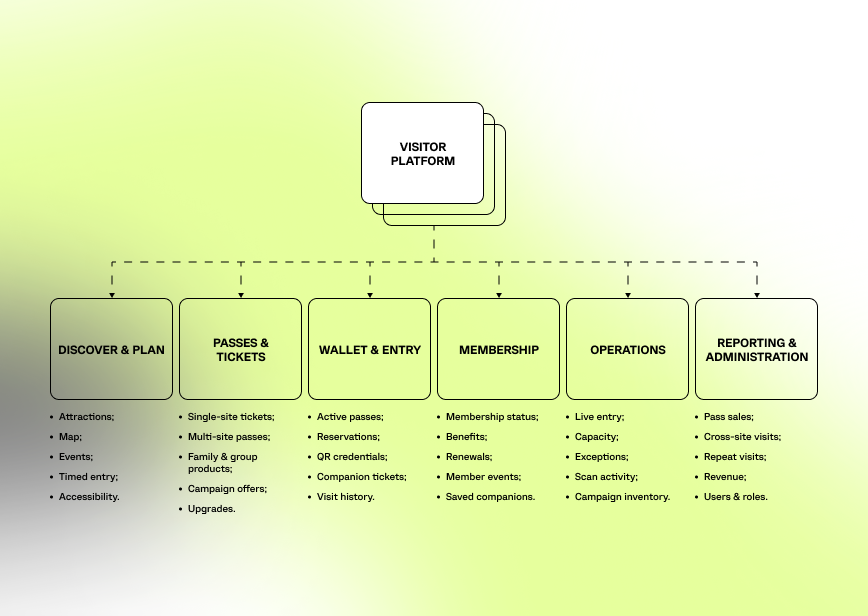
SITE MAP

Organizing visitor discovery, passes, reservations, membership, admission, and operations across one connected heritage platform.

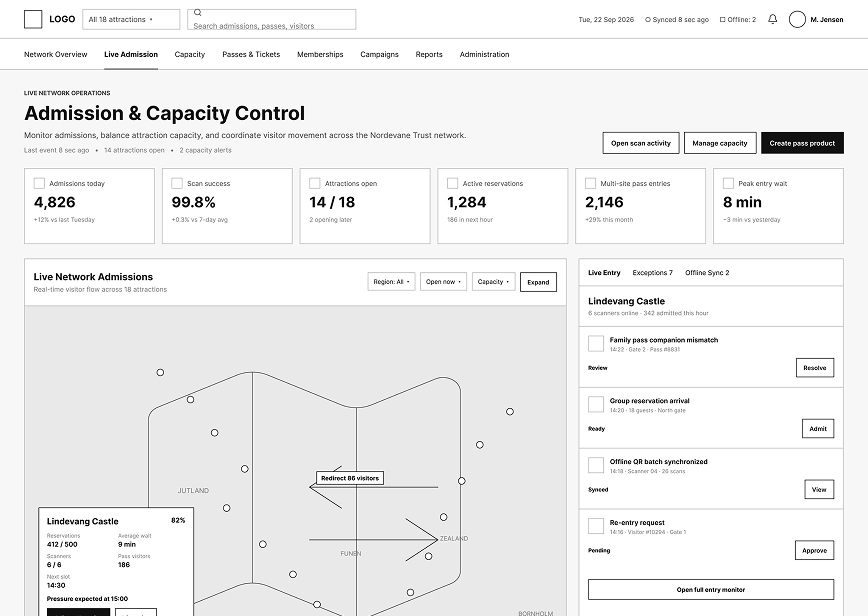
WIREFRAMES

Testing pass purchase, reservation, wallet, entry, capacity, membership, and staff workflows before interface development.

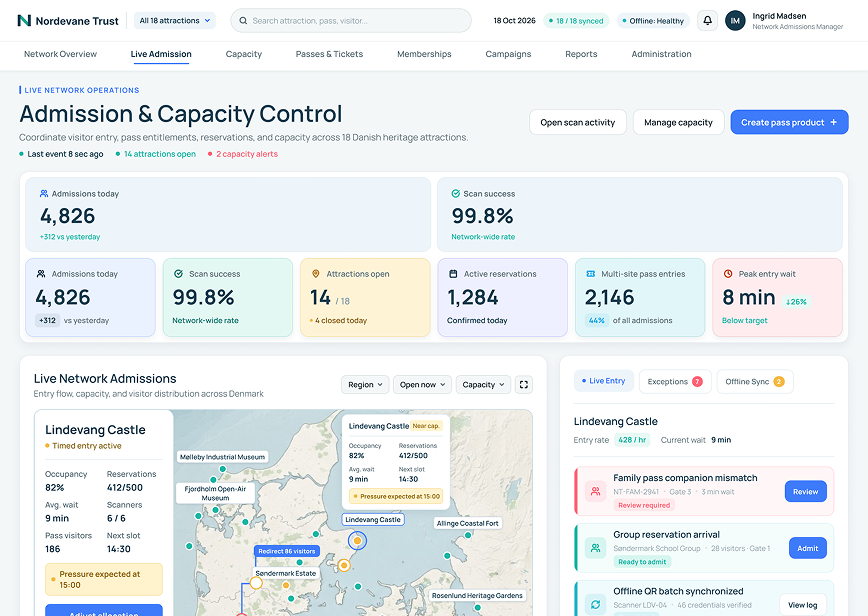
USER INTERFACE

Creating a responsive visitor and staff experience for fast purchasing, admission, and cross-site coordination.

DIGITAL PLATFORM & TECHNOLOGY

Nordevane Trust used a modular architecture supporting multi-site commerce, mobile credentials, admission validation, visitor data, operational analytics, and offline entry.

PROJECT MANAGEMENT METHODOLOGY

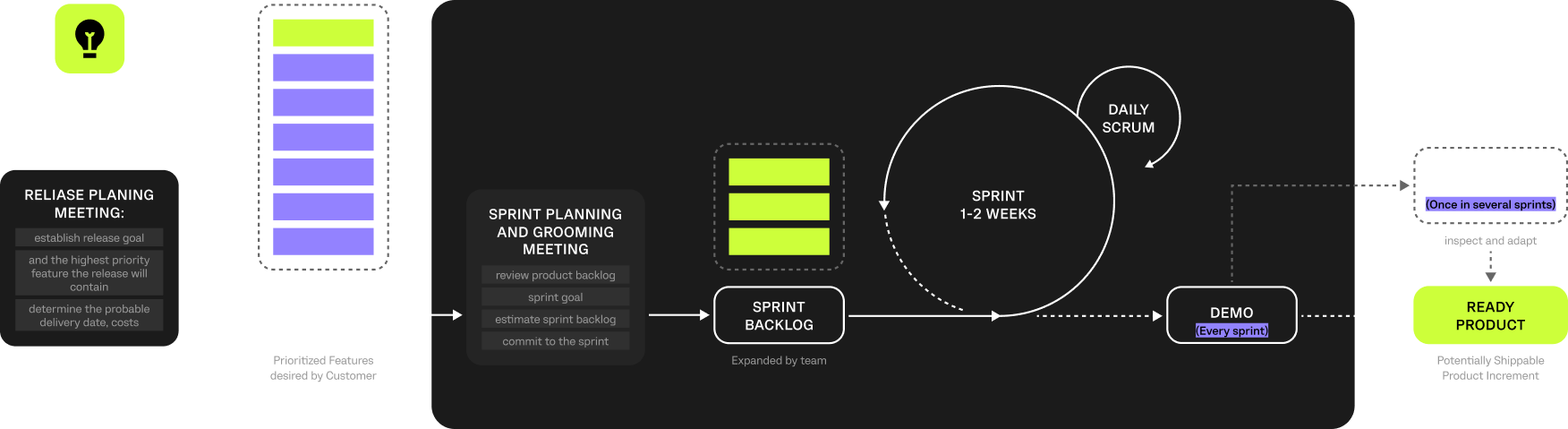
Computools used two-week Scrum iterations with visitor, front-of-house, membership, finance, marketing, and site-management representatives reviewing working functionality throughout delivery.

Acceptance criteria covered product accuracy, checkout performance, scan reliability, offline operation, accessibility, reconciliation, and staff readiness.

Four pilot attractions represented different audiences, ticketing systems, queue patterns, membership models, and connectivity conditions. Their results informed workflow and integration changes before the platform expanded across the remaining sites.

PROJECT MANAGEMENT METHODOLOGY

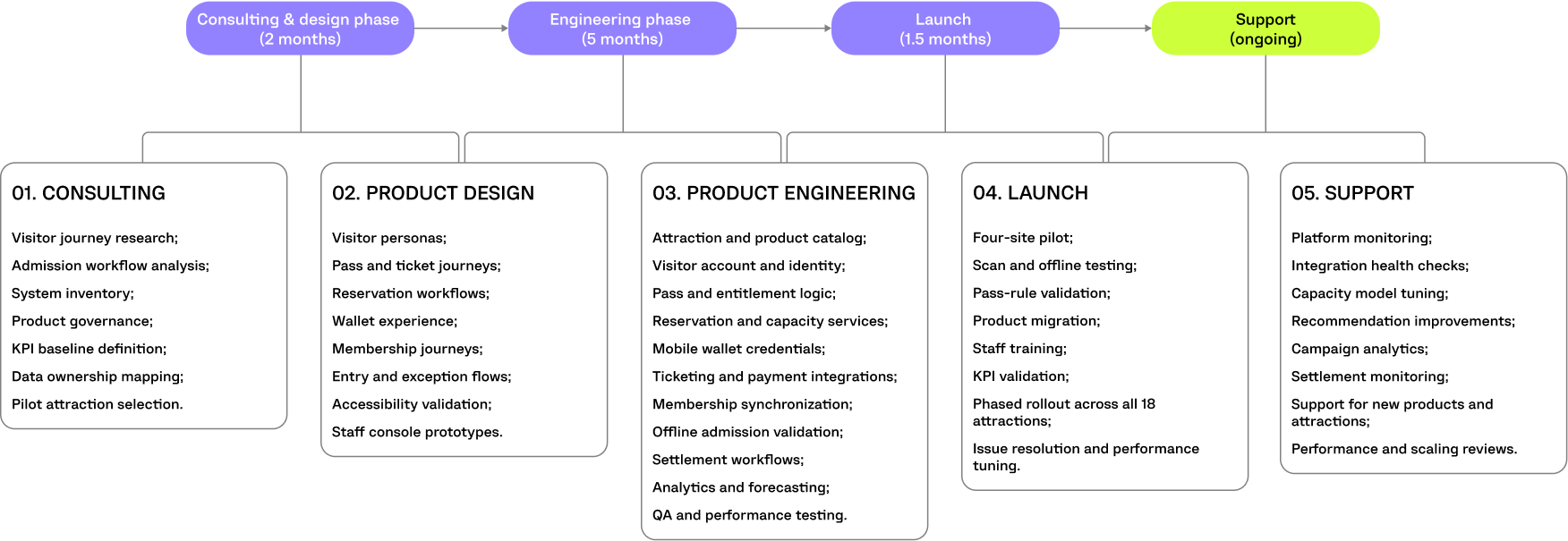
PROJECT TIMELINE

image

WHAT OUR CLIENT SAID

Before Nordevane Trust, buying a network pass was only the first step. Visitors still had to deal with each attraction separately. Now the whole trip feels connected, and our teams can finally see what’s happening across the network in real time.

CONTACT US TO GET A COST-EFFECTIVE
PROJECT ESTIMATE

Thank you for your message!

Your request will be carefully researched by our experts. We will get in touch with you within one business day.

WHAT HAPPENS NEXT?

01.
We deeply analyse your request.
02.
We create project roadmap, accelerating your time-to-value.
03.
We co-scope features, minimizing project risk upfront.
04.
We submit a comprehensive project proposal.
Trusted by: