
THE AUTHOR:

Food distributors operate in an environment where small operational delays quickly become financial losses. A missed inventory update can lead to unavailable products for a restaurant customer. An inaccurate demand estimate can create excess stock with limited shelf life. A disconnected warehouse and ordering system can slow fulfillment during peak periods.
Businesses that want to build food distribution management software require a connected platform that coordinates suppliers, warehouses, inventory, customers, pricing, deliveries, and analytics in real time.
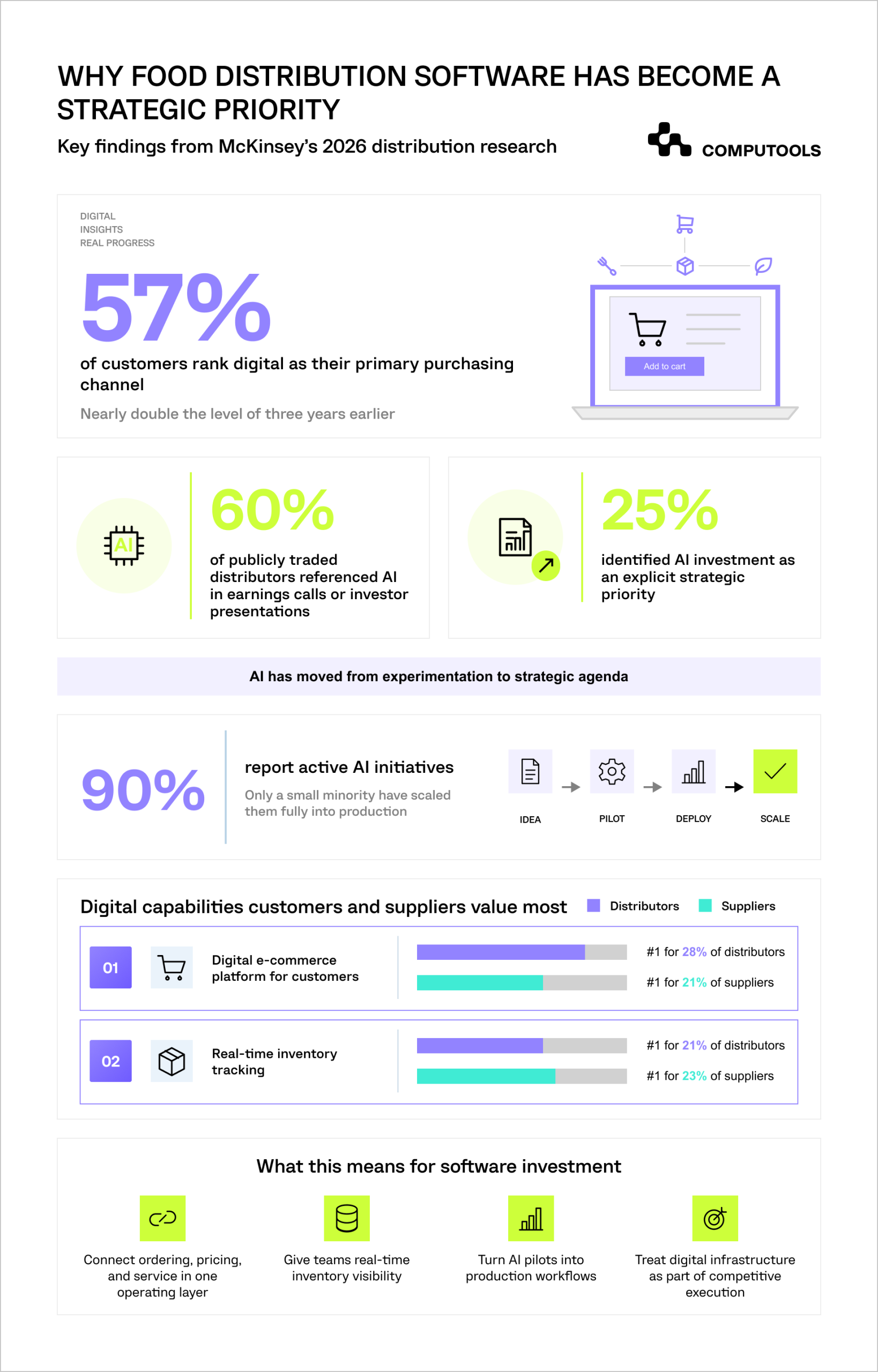
Food distributors are investing in technology to improve warehouse productivity, inventory visibility, and customer experience. The Distribution Strategy Group’s State of Distributor Technology 2026 report found that 55% of distributors have invested in major business systems such as ERP, CRM, e-commerce, and analytics platforms without fully integrating them. The research also shows a significant gap in technology maturity. High-maturity distributors use an average of 28 technologies, compared with 5 among lower-maturity companies, showing that connected workflows are becoming a defining factor in operational performance.
According to the Lineage 2026 Cold Chain Survey, 72% of food and beverage industry chain leaders forecast a rising need for temperature-controlled storage and transport. The survey also shows that about 60% of the leaders interviewed believe that the supply chain of 2026 will be dominated by AI and data. McKinsey’s research on distributors points to the use of AI and advanced analytics to optimize inventory, predict and mitigate variability in customer demand, and enhance supply chain and logistics planning and pricing.
Customers expect the convenience of consumer online shopping when they shop as a business. They demand accurate product availability, digital ordering, personalized catalogs, quick reorder options, and transparent delivery information.
A modern platform combines food distribution software development with operational intelligence. It connects ERP systems, warehouse processes, supplier relationships, customer ordering, delivery coordination, and data analytics into a single environment.
Features of food distribution management software
| Business area | Modern platform capabilities |
| Inventory & cold chain | Real-time inventory visibility, IoT sensor monitoring, batch tracking, expiration management, and automated alerts. |
| Wholesale commerce | Digital ordering, customer-specific catalogs, dynamic pricing rules, bulk purchasing, and self-service portals. |
| Supply chain coordination | Supplier integrations, demand forecasting, purchasing recommendations, and automated replenishment workflows. |
| Warehouse & delivery operations | Warehouse automation, barcode/RFID tracking, route optimization, GPS visibility, and delivery status updates. |
| Data & AI intelligence | Predictive analytics, AI-based forecasting, smart search, reporting dashboards, and operational insights. |
The article provides insight into the development of food distribution management software and touches on the system’s architecture, integrations, inventory and warehouse functions, AI and automation, the Internet of Things, security, and practical development considerations.
Companies exploring automation at a broader operational level can also review How to Automate Marketplace Operations for examples of workflow automation across complex digital commerce environments.
Computools Case: How to build food distribution management software with B2B marketplace capabilities
A food distribution platform requires the same foundation as other complex B2B commerce systems: structured product data, reliable transaction workflows, customer-specific logic, and architecture designed for growing transaction volumes.
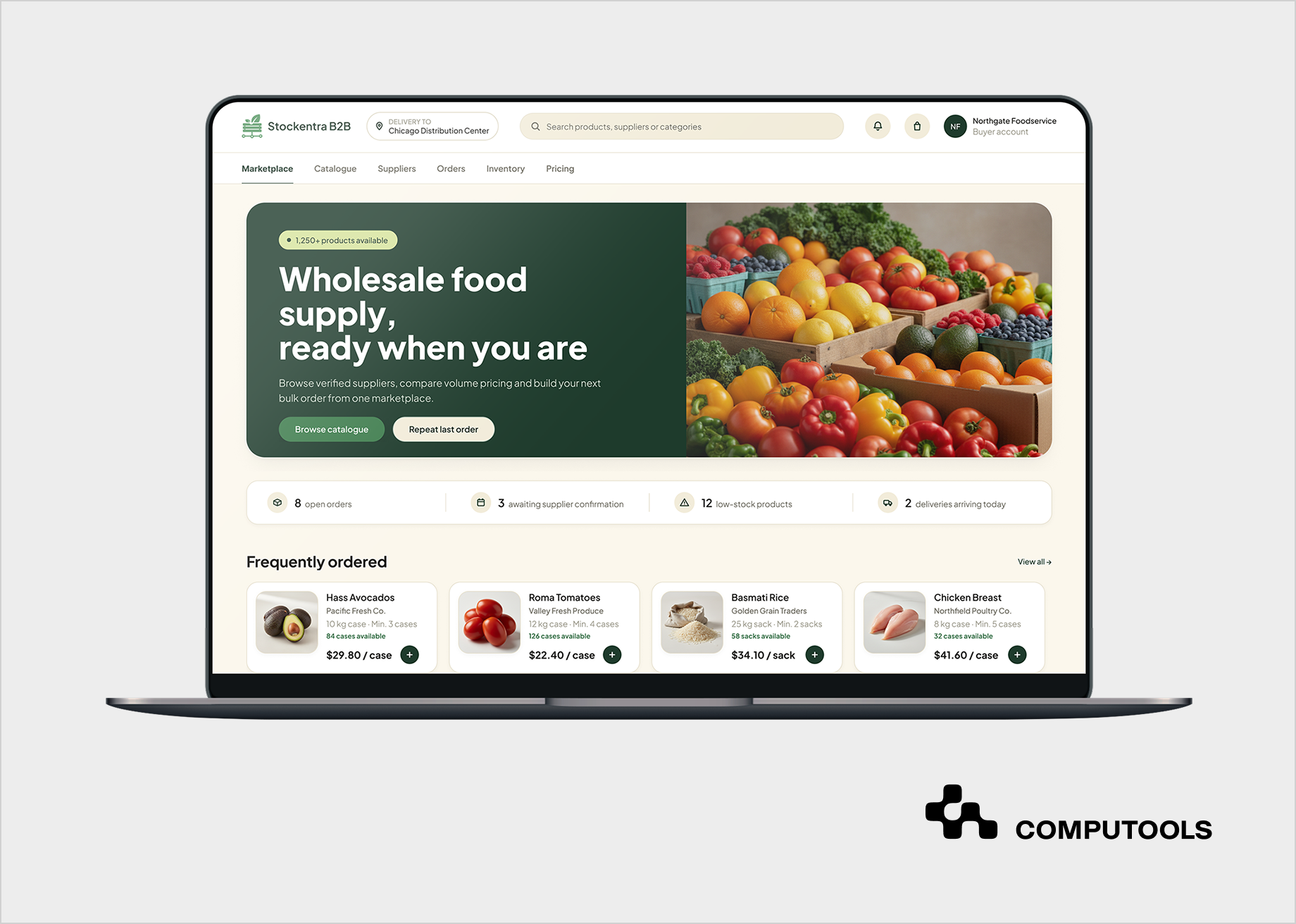
The StockentraB2B project demonstrates how digital infrastructure can support wholesale business operations through connected workflows and scalable platform architecture.
Client context
Stockentra operates in the wholesale food supply space, connecting producers and buyers through a digital marketplace. It required a B2B platform that could support wholesale interactions between businesses. The solution needed to allow Stockentra to manage suppliers’ product catalogs, customer accounts, and orders in an end-to-end digital system.
Business challenge
The main challenge was creating a system capable of supporting multiple business workflows through one platform.
The platform needed to solve several operational challenges:
- support multiple suppliers with different product catalogs;
- manage large volumes of product information;
- simplify bulk purchasing workflows;
- provide buyers with clearer product availability;
- maintain reliable performance as transaction volumes increased.
For distributors, these limitations directly affect order accuracy, warehouse planning, and customer relationships.
A restaurant chain placing recurring orders, for example, expects product availability information to match warehouse reality. Sales teams need access to customer-specific pricing. Operations managers need reliable data to coordinate fulfillment.
The platform architecture needed to support these connected requirements.
Computools solution
Computools developed a scalable wholesale marketplace software architecture.
The solution included:
- a React and TypeScript frontend for buyer and supplier interfaces;
- a Node.js and TypeScript backend supporting marketplace business logic;
- PostgreSQL database architecture for product, customer, order, pricing, and inventory data;
- REST API architecture connecting platform modules;
- Redis caching to improve response speed during high-volume activity;
- AWS S3 and CloudFront for product media storage and delivery.
The technical approach focused on creating a foundation where different business processes could work together instead of operating as isolated modules.
Supplier and product management
Suppliers could manage product information within a centralized marketplace structure, reducing inconsistencies across catalogs.
Wholesale order processing system
The platform supported B2B purchasing scenarios where buyers needed to browse products, compare options, and place larger-volume orders.
Structured business data
Product, customer, and transaction data were organized in a way that supported reporting, future automation, and additional platform capabilities.
Performance-focused architecture
Caching and cloud infrastructure helped maintain responsive performance as the number of users and transactions increased.
Computools approach is directly relevant for wholesale food distribution software, where ordering, inventory, supplier communication, and logistics need continuous data exchange.
Business result
The platform improved the digital experience for wholesale users by creating a more organized environment for business transactions and operational management.
The solution supported:
- faster access to business information;
- improved visibility across workflows;
- reduced manual coordination;
- stronger scalability for future growth.
For food distributors, the same principles apply when building a platform that connects buyers, suppliers, warehouses, and delivery operations.
Develop a food distribution management platform in 8 steps
To build food distribution management software, starts with understanding how products, data, and decisions move through the distribution network, then design the architecture, integrations, and automation capabilities.
Step 1. Define distribution workflows before designing the platform
The way products and orders are organized and moved through a business plays a key role in defining how a food distribution management system functions.
A successful platform should reflect the complete product lifecycle:
Supplier → Receiving → Quality Control → Storage → Inventory Allocation → Customer Order → Picking → Delivery → Invoice
Each of these steps in the process results in the generation of data that affects the next step in the process. Receiving staff must have precise information about the supplier and the shipment batch. The warehouse manager must be aware of the availability of the item. The sales staff must know the customer’s individual level of access and the customer’s previous orders. A customer may only be able to make a purchase from a particular supplier if the item is available.
The design of the data model must reflect the above constraints. Core entities typically include products, SKUs, suppliers, buyers, warehouses, inventory batches, expiration dates, orders, shipments, invoices, and pricing rules.
For example, a distributor supplying hotels and restaurants may need different ordering rules for each customer group. A hotel chain may have scheduled weekly deliveries, contracted prices, and approved product lists, while smaller restaurants may place daily orders based on current availability. These scenarios require flexible business logic built into the platform architecture.
In the Stockentra B2B project, Computools worked with similar B2B workflow challenges by creating structured data management and digital processes around wholesale operations. This approach is also important for food distributors where multiple business users interact with the same product and transaction data.
Step 2. Design architecture around transaction volume and operational complexity
Food distribution platforms operate under constant data exchange. Every order affects inventory. Every inventory change affects availability. Every delivery update affects customer communication. The architecture needs to support these connections without creating delays between departments.
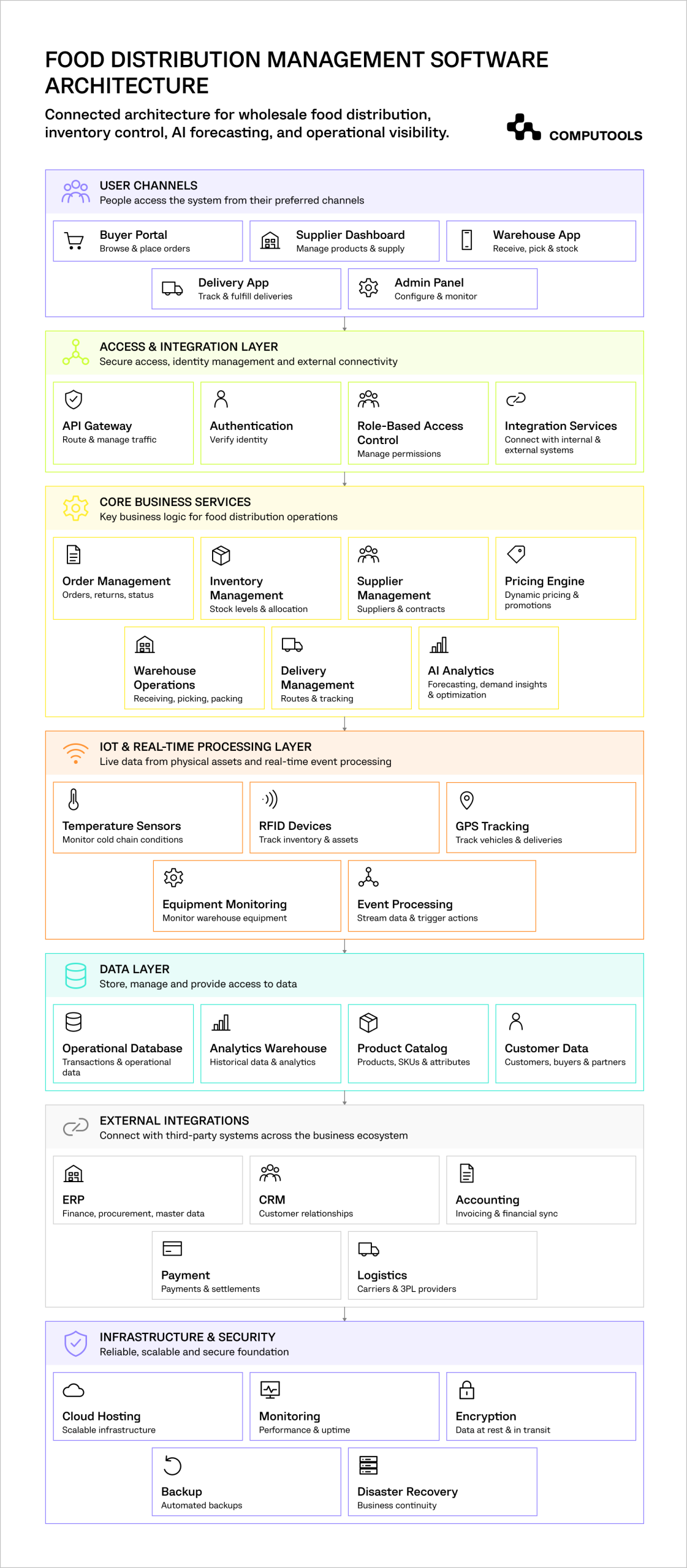
A typical enterprise system includes several interconnected layers:
User interfaces
Buyer portal, supplier dashboard, warehouse applications, delivery tools, and administration panels.
Business services
Order processing, inventory management, supplier management, pricing logic, warehouse operations, delivery coordination, and analytics.
Data infrastructure
Operational databases, product catalogs, customer records, inventory history, and analytical data storage.
Integration layer
ERP systems, CRM platforms, accounting software, payment providers, and logistics solutions.
This structure allows distributors to expand functionality gradually. A company may begin with a digital ordering platform and inventory visibility, then add demand forecasting, automated purchasing recommendations, or multi-warehouse optimization as operational needs grow.
The architecture decision also affects performance. A platform processing thousands of daily orders requires different infrastructure compared with a regional distributor managing a smaller customer base. Performance requirements should be defined before development begins.
Companies planning a larger digital ecosystem may also benefit from understanding how marketplace data platforms are designed, including ingestion pipelines, governance, analytics layers, and integration requirements.
Explore this topic in How Much Does a Marketplace Data Platform Cost for Retail?.
Step 3. Connect inventory management with live warehouse and cold chain data
This industry is particularly vulnerable to errors in inventory management. First, incorrect information can affect what food is bought and sold. Second, the shipment of food can be mishandled, thus compromising food quality.
A basic stock database shows what should be available. A modern distribution platform needs to show what is physically available, where it is located, how long it can remain in storage, and whether it meets required conditions.
A food distributor inventory tracking system should combine warehouse operations with:
- batch-level inventory records;
- expiration date monitoring;
- barcode or RFID scanning;
- stock reservation logic;
- warehouse location tracking.
IoT gives an extra edge in the management of frozen, dairy, meat, or fresh products. Temperature sensors embedded in the distribution fleet and cold storage facilities can continuously transmit data.
For example, if the system detects that a product in a refrigerated vehicle exceeds the threshold of a permissible temperature, it can capture the product batch, alert the personnel and initiate a product quality control inspection. Some of the use cases are presented in the table below.
| IoT capability | Data collected | Operational use |
| Temperature sensors | Storage and vehicle temperature | Detect conditions that may affect product quality |
| RFID tags | Product movement and location | Improve inventory accuracy |
| GPS tracking | Vehicle location and delivery progress | Provide shipment visibility |
| Equipment sensors | Refrigerator and warehouse equipment status | Support preventive maintenance |
The technical architecture usually includes IoT devices, data gateways, event processing services, and platform APIs. These data streams also improve AI capabilities because forecasting models receive information about actual inventory movement and storage conditions.
Step 4. Build digital ordering around wholesale customer behavior
Wholesale ordering has different requirements from consumer ecommerce. Buyers often manage recurring purchases, negotiated prices, approval workflows, and large product catalogs.
A modern bulk food ordering platform should support the way professional buyers actually work. Distributors need supplier and buyer management software that maintains accurate relationships between vendors, purchasing teams, and customers. For example, a restaurant group may need to reorder the same ingredients every week, compare available alternatives, approve purchases internally, and select preferred delivery windows.
The platform should support:
- customer-specific catalogs;
- contract pricing;
- recurring orders;
- account permissions;
- order history;
- availability checks.
Behind the interface, the system requires a pricing engine, customer management logic, inventory synchronization, and integration with financial systems.
The goal is to reduce manual communication between buyers and sales teams while keeping commercial rules visible and controlled.
Step 5. Integrate suppliers, ERP systems, and delivery operations
A food distribution platform becomes significantly more valuable when it connects existing business systems.
Most distributors already rely on ERP platforms, warehouse management tools, accounting systems, or logistics software. However, traditional food distribution ERP software often requires additional digital layers to support modern customer ordering, real-time inventory visibility, AI analytics, and connected warehouse workflows. A dedicated platform can extend existing ERP capabilities by connecting operational data with customer-facing and automation processes.
A new system should exchange data with these systems through APIs and integration services. Supplier connections allow companies to receive updated product information, availability changes, and purchasing data. ERP integration keeps financial and operational records synchronized. Delivery integrations provide customers with accurate shipment information.
For example, when a customer places an order, the system can automatically:
1. validate product availability;
2. reserve inventory;
3. send warehouse instructions;
4. update delivery schedules;
5. synchronize financial records.
Computools applied similar integration principles in the Stockentra B2B project, where platform architecture and data management supported connected B2B operations.
Learn more about designing scalable data infrastructure in How to Build a Retail Data Warehouse with Kafka and BigQuery.
Step 6. Add AI capabilities based on reliable operational data
AI features are most valuable in assisting distribution decision-making.
AI can help forecast demand based on various factors such as historical orders, seasonality, customer behavior and movement of inventory. The use case for forecasting demand can help a distributor optimize inventory levels.
Recommendation engines can advance the functionality of food inventory management software by determining alternate products to suggest to customers in case of unavailability of the preferred product. These engines can also help with sales by suggesting cross-selling or up-selling opportunities.
AI-powered search is essential for distributors carrying thousands of products. AI search enables customers to execute searches based on product characteristics (e.g. product color) as opposed to rigid SKU look-ups. As a result, large and unstructured product catalogs become easy to search.
Predictive analytics can also identify:
- potential inventory shortages;
- unusual purchasing patterns;
- equipment maintenance risks;
- customer demand changes.
Before a developer can implement these capabilities, the company must digitize and standardize its data. Distributors must maintain the consistency and accuracy of their data throughout their process from supply to demand to ensure complete and correct results.
Step 7. Ensure security and reliability
Food distribution software is trusted with protecting sensitive business information. This includes the terms negotiated with customers and suppliers, as well as other operational details.
In the course of designing the system, the following elements of security should be provided:
- role-based access control;
- encrypted data transmission;
- secure API connections;
- activity logging;
- backup procedures;
- infrastructure monitoring.
Reliability and availability of the application must be prioritized. An unavailable application during peak customer order periods can negatively impact order placement and fulfillment.
Cloud infrastructure, monitoring tools, and disaster recovery processes provide the operational stability required for large-scale distribution environments.
Step 8. Test the platform against real distribution conditions
Testing should reflect actual business scenarios, not only technical requirements. A distribution platform needs validation across order processing, inventory synchronization, warehouse workflows, integrations, and peak usage conditions.
Performance testing should simulate situations such as:
- multiple customers placing orders simultaneously;
- large inventory updates;
- warehouse teams processing high-volume shipments;
- delivery systems exchanging frequent updates.
Computools uses similar testing approaches in complex B2B platforms, where reliability under growing transaction volumes directly affects customer experience and operational continuity.
After launch, performance monitoring should continue through metrics such as order processing time, inventory accuracy, system response speed, and user activity patterns.
The ordering experience directly affects conversion and repeat purchasing, especially when buyers manage frequent bulk orders. Reducing friction across checkout, payment, and order confirmation processes is also a major consideration for digital commerce platforms.
Additional insights are available in How Checkout Friction Affects Ecommerce Payment Data.

Launch a food distribution management system within 1–3 months to automate ordering, inventory, and fulfillment, reduce costly stock and processing errors, and increase order capacity without expanding your operations team.
Why Computools for food warehouse and delivery management software development
Food distribution software succeeds when it reflects the decisions teams make every day: when to reorder stock, which products should move first, how warehouse capacity affects fulfillment, how customer pricing is calculated, and where delivery delays begin.
Computools focuses on these operational dependencies before defining the technology approach. Our team analyzes existing workflows, data sources, and system connections to understand where information gets delayed or duplicated and where automation can remove unnecessary manual work.
Computools engineers platforms that combine:
- complex B2B ordering logic with account-based pricing, catalogs, and purchasing rules;
- integrations between ERP, CRM, warehouse, payment, and logistics systems;
- real-time data exchange between inventory, orders, and fulfillment processes;
- AI capabilities based on structured operational data;
- secure cloud architectures designed for growing transaction volumes.
Through retail software development services, we help businesses connect digital commerce with inventory, customer information, and internal operations.
For distributors moving toward digital purchasing channels, eCommerce software development expertise is well-suited for complex B2B scenarios such as bulk ordering, account-based catalogs, pricing rules, and recurring purchases.
Web development services support the creation of role-specific interfaces for buyers, suppliers, warehouse operators, and administrators, ensuring that each user works with the information required for their tasks.
With AI development, distributors can introduce practical automation, including demand forecasting, product recommendations, intelligent search, and workflow assistance based on internal operational data.
Through data engineering, Computools helps organize operational data for reporting, analytics, and AI-driven decision support.
By combining operational knowledge with modern architecture, AI, and data capabilities, Computools helps distributors build systems that improve control over inventory, orders, and delivery processes as complexity grows.
Final thoughts
Building food distributor management software is not about replacing one manual process with a digital form. The real objective is creating a connected operating layer where purchasing decisions, inventory availability, warehouse activity, customer orders, and deliveries are based on the same reliable data.
The best software for food distribution accounts for the complexities of the industry, including variations in customer demand, product categories and types, uncertainties in supplier supply, and warehouse capacity constraints.
The best tech partners take a modular approach to integration. This means a food distribution company will be able to adapt and update the software based on the new needs, processes and data requirements of the business. Distributors can start with connected ordering and inventory workflows, then expand into demand forecasting, IoT monitoring, automated replenishment, and AI-supported planning as their data maturity grows.
Computools
Software Solutions
Computools is an IT consulting and software development company that delivers innovative solutions to help businesses unlock tomorrow.