
THE AUTHOR:

As banks implement mobile apps, CRMs, instant payments, compliance solutions, and other third-party offerings around their existing legacy core systems, the need for strategic banking system integration has risen. Independently functioning systems cause fragmented customer records, lagging customer data refreshes, the need for manual data sync, and inconsistent customer experiences across the mobile, web, branch, and contact center interfaces.
The application-centered approach to digital transformation in banking is insufficient. Banks need critical process updates in real time (for example, payments, cards, fraud, and customer service) and proper failure management. In addition, organizations require controlled communication and deliberate ownership of data between inter-system communications.
This guide explains how core banking, CRM, payment, and compliance systems connect with digital channels via modern APIs, events, workflows, and data pipelines. It also covers security, observability, and phased banking modernization.
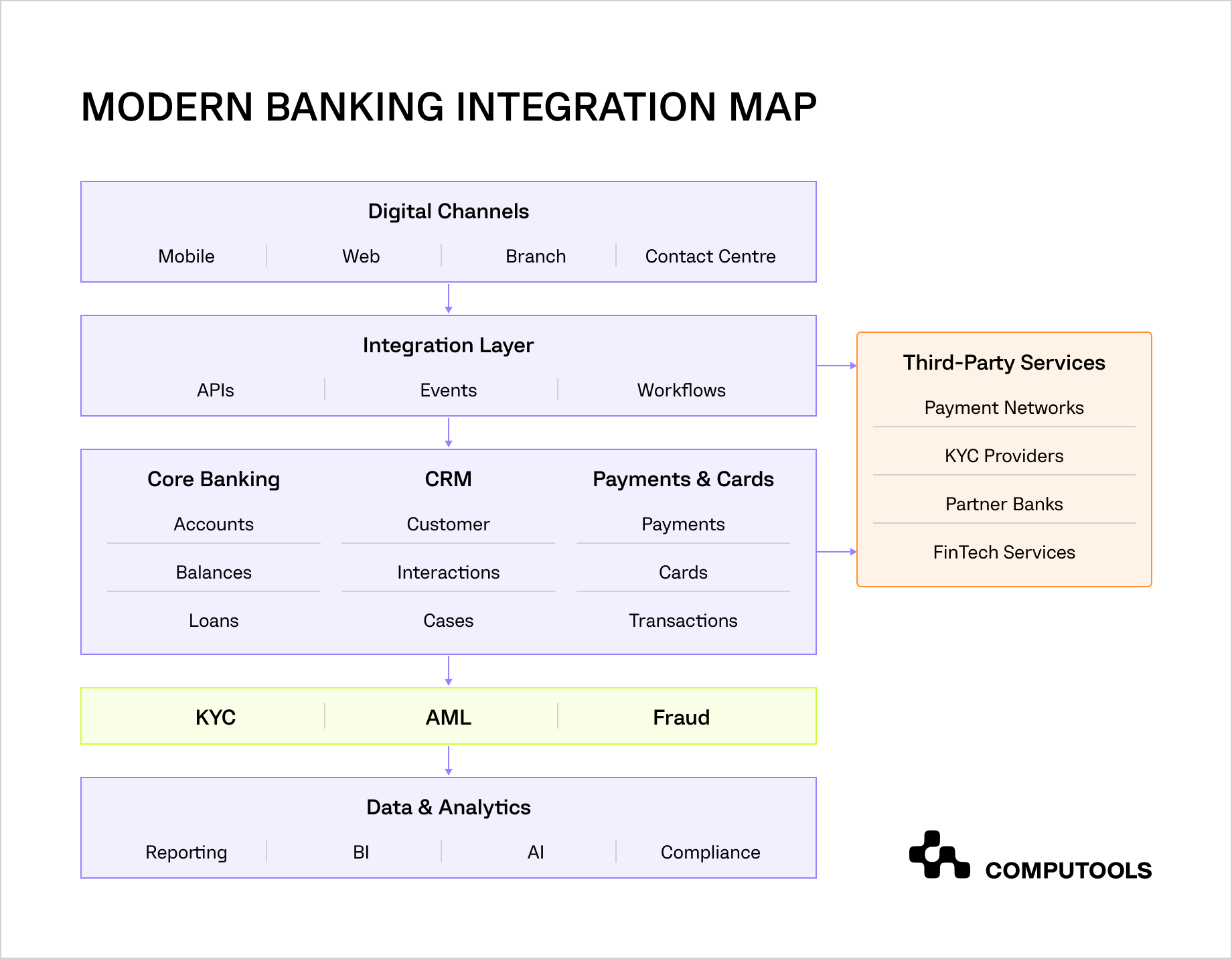
How banking system integration connects the entire technology stack
A modern bank employs distinct software for accounts, payments, cards, customer relationships, compliance, analytics, and customer services. Integration of these systems helps exchange information while maintaining the security and integrity of all transactions.
Banking applications typically exchange:
- Commands, such as blocking a card or initiating a payment.
- Queries, such as retrieving a balance or loan status.
- Events, such as a payment being settled or customer data being updated.
- Documents, including contracts and KYC evidence.
- Analytical data for reporting, fraud detection, and segmentation.
Core components of the banking environment
| Component | Main responsibility | Typical data |
| Core banking | Accounts, balances, deposits, and loans | Account status, balance, product data |
| CRM | Customer and partner relationships | Interactions, cases, preferences |
| Card platform | Card lifecycle management | Card status, limits, token references |
| Payment platform | Payment processing | Payment details and settlement status |
| KYC and AML systems | Identity and risk checks | Verification results, alerts, risk scores |
| Digital channels | Customer and employee access | Requests, sessions, journey status |
| Data platform | Analytics and reporting | Historical and aggregated records |
| Integration layer | Routing and orchestration | APIs, events, messages, policies |
The core banking system normally owns financial account records. CRM owns interactions and service cases. Card, payment, and compliance platforms manage their specialised processes.
The integration layer connects them through API gateways, events, workflows, legacy adapters, and data pipelines. It should control communication without taking ownership of banking logic.
For example, a mobile request may pass through an API gateway to an account service, which retrieves the balance from core banking. After a payment is completed, an event can update CRM, analytics, and notification systems.
Integration does not mean replicating every record
A common mistake in enterprise banking integration is copying complete customer and transaction records into every platform. This creates conflicting versions of the same information.
A better model defines one authoritative source for each data type:
- Core banking owns balances and account status.
- CRM owns customer interactions and service cases.
- Card systems own card lifecycle data.
- Compliance platforms own alerts and risk decisions.
- Data platforms store governed historical copies.
CRM may display an account summary, but it should not calculate the balance. A chatbot may retrieve payment status through an API, but it should not access the payment database directly.
This model improves banking interoperability because systems depend on stable interfaces rather than internal databases. A reliable financial system integration strategy therefore defines who owns each record, who can update it, how quickly changes must propagate, and how failed updates are reconciled.
Why legacy banking integrations fail at scale
Integration problems usually develop within legacy banking modernization when new systems are added through isolated connectors instead of redesigning the wider architecture.
1. Point-to-point connections
In a point-to-point model, mobile banking, CRM, branch systems, and contact-centre tools connect separately to the core platform.
This creates tight dependencies:
- Data formats and identifiers differ between systems.
- Business rules are repeated across connectors.
- One core change affects several applications.
- Security controls must be managed separately.
- Failures are difficult to trace.
A new account status, for example, may require changes to mobile banking, CRM, reporting, notifications, and fraud controls.
2. Conflicting customer data
Disconnected platforms often store different versions of customer information. Common issues include duplicate profiles, inconsistent identifiers, outdated contact details, and different KYC statuses.
Reliable banking data exchange requires shared identifiers, source-of-truth rules, validation, and reconciliation. Without them, an update made in CRM may never reach core banking or the notification platform.
3. Batch processing delays
Batch processing remains useful for reporting, historical analytics, and large migrations. It is less suitable for processes that require current information, including:
- Payment confirmation.
- Card blocking.
- Balance updates.
- Fraud detection.
- Application status tracking.
- Transaction notifications.
If CRM receives transaction data once per night, support employees cannot see a payment made minutes earlier.
4. Legacy infrastructure
Older systems may rely on proprietary protocols, shared databases, or fixed-format files. This creates fragile dependencies and limits independent scaling.
Banking middleware can connect incompatible technologies, but it becomes a bottleneck when it also stores business rules that should remain within customer, payment, account, or compliance services.
5. Limited monitoring
Traditional monitoring may show that servers and scheduled jobs are running without confirming that the full customer request succeeded.
Modern monitoring should track:
- End-to-end request status.
- Synchronisation delays.
- Failed messages and retries.
- Unmatched records.
- Required manual intervention.
Legacy vs modern banking system integration
| Area | Legacy approach | Modern approach |
| Connectivity | Point-to-point links | Governed APIs and events |
| Data exchange | Files and shared databases | APIs, streams, CDC, and pipelines |
| Coupling | Internal schema dependencies | Versioned service contracts |
| Processing | Scheduled batches | Real-time where required |
| Failure handling | Manual investigation | Retries, queues, and reconciliation |
| Security | Controls per connector | Central policy enforcement |
| Monitoring | System-level logs | End-to-end tracing |
| Change management | Coordinated releases | Independently versioned interfaces |
For a practical example, see our guide on how to modernize legacy banking systems without downtime, which explains how a bank can introduce a modern integration layer while keeping critical services operational.
How core banking connects with CRM
Core banking integration allows companies to manage both back-and front-office banking processes conveniently. Customer Relationship Management (CRM) systems house customer records, service requests, and communications. Core banking manages accounts and transactions, and should retain its role as the primary platform for balances, loans, and transactions.
1. Define data ownership first
Before building interfaces, banks should decide which system owns each data object.
| Data object | Authoritative system | CRM use |
| Customer identity | Customer master or core banking | Contact and relationship view |
| Accounts and balances | Core banking | Read-only account summary |
| Loans | Core or lending platform | Application and servicing status |
| Cards | Card management platform | Masked details and card status |
| Transactions | Core or payment platform | Recent activity and support context |
| Interactions and cases | CRM | Complete service history |
| KYC and fraud alerts | Compliance platform | Task status and assigned actions |
This separation prevents duplicate records and conflicting updates. CRM may display an available balance, for example, but the value should come from core banking through a governed API.
2. Use the right synchronization method
Effective CRM integration for banks usually combines three patterns:
- Synchronous APIs for current balances, eligibility checks, and account status.
- Events for committed changes such as a new account, updated address, or completed payment.
- Batch or CDC pipelines for historical records, reporting, and large-volume migration.
Banks should avoid updating CRM and core banking independently within the same request. A safer approach commits the change in the authoritative platform first, then publishes an event for other systems.
3. Create a consistent customer identity
Reliable customer data synchronization depends on a shared customer identifier that links CRM, core banking, card, lending, and compliance records.
The architecture should include:
- Identifier mapping across platforms.
- Duplicate detection and merge rules.
- Validation of customer-profile changes.
- Audit records for every update.
- Reconciliation when events fail or arrive late.
This gives employees a Customer 360 view without copying complete financial records into CRM.
4. How this works in practice
In the CardFalcon project, the Computools team used Salesforce as the relationship-management layer, while Java and Spring Boot services controlled contracts, offers, requests, approvals, and partner workflows. PostgreSQL stored structured operational records, and Angular supported employee and partner interfaces.
This approach connected CRM data with banking operations while maintaining clear system responsibilities. It improved partner visibility, reduced manual transfers between teams, and shortened request processing.
Well-designed banking data integration therefore connects systems through stable APIs and events rather than shared databases. This makes core banking software integration easier to maintain as banks add new channels, products, and external partners.
Connecting digital banking channels
Mobile apps, web portals, branch systems, contact centres, and chatbots should not connect directly to core banking databases. A safer digital banking integration model routes requests through an API gateway and dedicated domain services.
A typical flow looks like this: Channel → API Gateway → Domain Service → Core Banking or Operational Platform
This structure keeps authentication, routing, validation, and business rules outside customer-facing applications.
1. Use channel-specific service layers
Different digital banking channels often need different data formats and permissions.
- Mobile apps require compact responses and fast transaction status updates.
- Web portals may support more detailed account and product workflows.
- Branch systems need access to customer, account, compliance, and case data.
- Contact centres need a combined view of recent transactions, service requests, and channel activity.
- Partner portals should receive only records linked to the authorised partner.
Banks can use a backend for frontend layer to adapt the same banking services to each interface without duplicating core logic.
2. Preserve customer journeys across channels
Effective omnichannel banking allows customers to start a process in one channel and continue it in another.
For example:
- A customer starts a loan application in a mobile app.
- The application service stores the draft.
- CRM receives an application-created event.
- A contact-centre employee can view and continue the same case.
- The customer sees the updated status in mobile and web banking.
Shared customer, journey, and case identifiers support this omnichannel customer experience. Critical changes, such as payment confirmation, card blocking, or application approval, should appear across channels in near real time.
3. Control AI and chatbot access
Chatbots and virtual assistants should retrieve customer and product information through governed APIs. They should not access core databases or execute sensitive transactions independently.
A secure design includes:
- Authenticated customer sessions.
- Permission and consent checks.
- Step-up verification for sensitive actions.
- Transaction confirmation.
- Complete audit records.
Computools can apply its AI development expertise to build customer assistants that work with approved banking services, use only the data required for each request, and pass sensitive actions back to controlled transaction workflows. This helps banks automate support and routine service tasks without giving AI components unrestricted access to core systems.
The same architecture can support more advanced agents for onboarding, compliance, payments, reconciliation, and internal operations.
Our guide on AI agents for financial workflow automation explains how these agents can connect with trusted financial systems while keeping permissions, workflow controls, and audit trails in place.
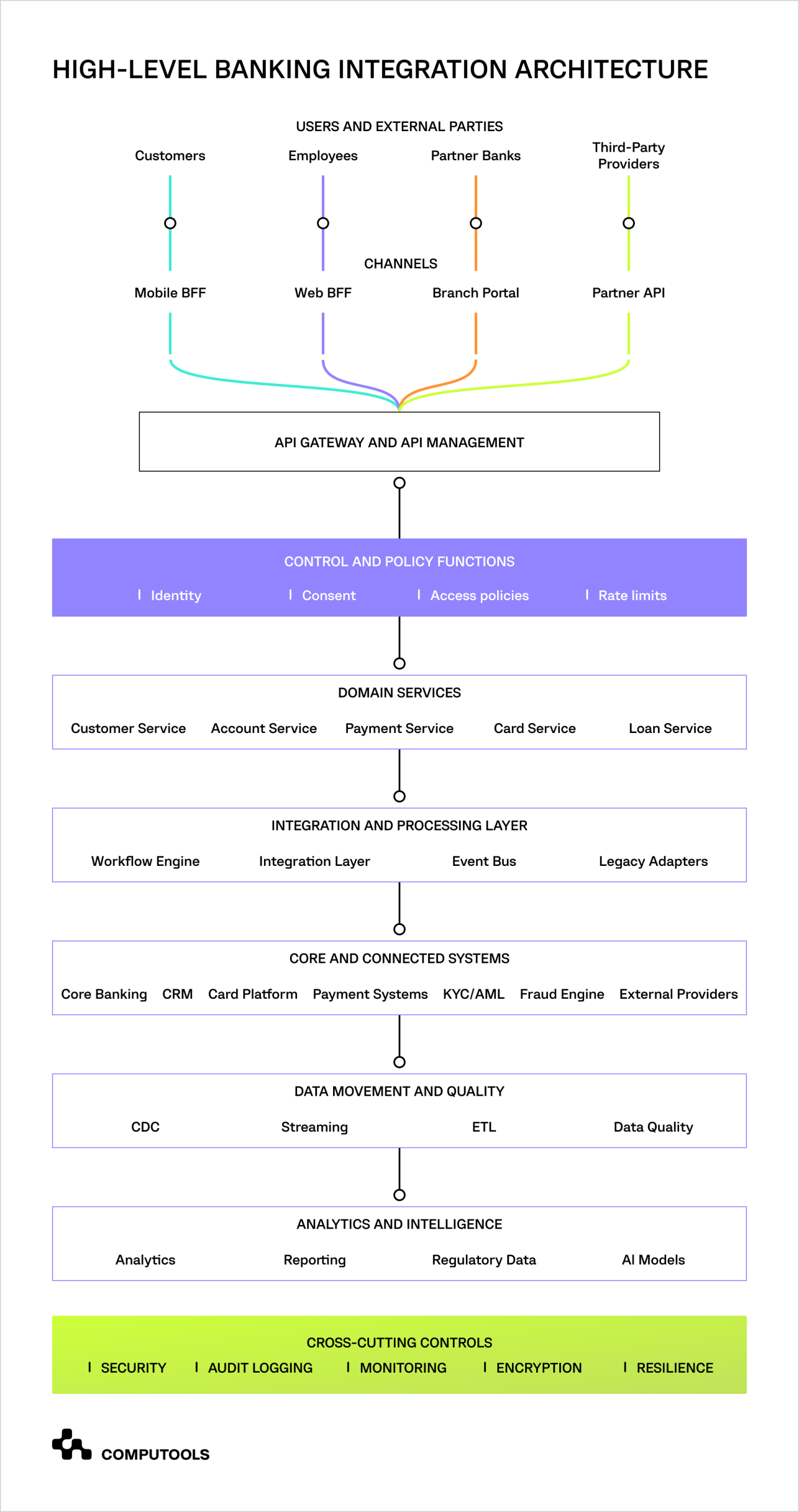
Banking system integration architecture
A modern banking integration architecture separates customer channels, domain services, systems of record, and analytical platforms. This reduces direct dependencies on core banking and allows each layer to change without affecting the entire environment.
1. API gateway
The API gateway is the entry point for mobile apps, web portals, branch systems, partners, and third-party providers.
It manages:
- Authentication and token validation.
- Request routing.
- Rate limits.
- API versioning.
- Schema validation.
- Threat protection.
The gateway should enforce access policies, but business rules should remain inside account, payment, card, lending, or customer services.
2. Banking middleware and orchestration
Banking middleware can integrate systems with diverse communication protocols and formats, and different integration styles. It is particularly applicable to legacy core, card, and service platforms when modern banking APIs need to communicate.
An orchestration service manages intersystem activities. For example, the process for account opening may involve several checks and actions across multiple systems, such as product eligibility and identity verification, CRM updates, core system account creation, document generation, and customer notification.
This type of API orchestration should include timeouts and retries for each of the APIs, as well as compensation steps and clear ownership for each step in the process.
3. Event-driven integration
APIs work well when a channel needs an immediate response. Events are better when several systems need to react after a change has been completed.
A payment-settled event may update:
- CRM.
- Customer notifications.
- Fraud monitoring.
- Analytics.
- Reconciliation systems.
Reliable event processing requires idempotent consumers, versioned event schemas, retry policies, dead-letter queues, and reconciliation. This supports real-time banking integration without forcing every system to be available during the original transaction.
4. Microservices and domain services
Microservices can separate account, payment, card, customer, and compliance capabilities. However, dividing every function into a separate service can create unnecessary complexity.
Banks should define services around stable business domains and data ownership. Each service should expose controlled APIs and events rather than allowing direct access to its database.
This API-first banking model improves scalability and simplifies API integration for internal teams, partners, and new channels.
5. Data orchestration
Operational systems should send governed data to analytical environments through event streams, CDC, or managed pipelines.
The data layer can support:
- Customer 360 views.
- Regulatory reporting.
- Fraud analytics.
- Product performance.
- Customer segmentation.
- AI models.
Heavy analytical workloads should run on a data platform rather than directly against core banking databases. Computools data engineering services help standardise records, validate data quality, manage lineage, and prepare information for reporting and analytics.
An effective banking integration platform enhances rather than replaces existing capabilities in core banking, CRM, or payment systems. It integrates a controlled connection layer that facilitates dependable real-time transaction processing and data exchange, and supports gradual system modernization.
Batch, API, and event processing: which pattern should banks use?
Banks generally need a mix of batch processing, real-time APIs, and event integration. It is mostly determined by how fast the data needs to be transferred, whether the user needs a response in real-time, and how important the transaction is.
1. Synchronous APIs
APIs are suitable when a channel or employee needs an immediate answer.
Common examples include:
- Retrieving an account balance.
- Checking loan eligibility.
- Verifying card status.
- Initiating a payment.
- Confirming whether a customer can access a product.
The main limitation is runtime dependency. The application making the request may experience a failure if the target system is slow or unresponsive. Banks should implement timeouts, fallback responses, retry rules, and circuit breakers for their platforms.
2. Event-driven processing
Events are appropriate where a number of systems are required to respond to a change that has occurred.
A good example is the Payment Settled event that occurs after the completion of a payment and updates the CRM, notifications, analytics, fraud, and reconciliation systems.
Real-time transaction processing is achieved through event processing and minimizes the direct dependencies of systems integration.
However, it also requires:
- Idempotent consumers.
- Versioned event schemas.
- Retry policies.
- Dead-letter queues.
- Event ordering controls.
- Reconciliation for missing or delayed messages.
3. Batch processing
Batch processing remains useful when immediate updates are unnecessary.
Typical use cases include:
- Regulatory reporting.
- Historical analytics.
- Model training.
- Large data migrations.
- End-of-day reconciliation.
- Periodic customer segmentation.
Banks should avoid using batch jobs for card controls, payment confirmation, fraud decisions, or customer-facing status updates.
Comparing integration patterns
| Criterion | Batch | Synchronous API | Events or streaming |
| Best use | Reporting and bulk processing | Immediate queries and commands | Distributing completed changes |
| Response time | Minutes or hours | Immediate | Near real time |
| Dependency | Scheduled file or job | Target must be available | Consumers operate independently |
| Example | Daily regulatory extract | Retrieve current balance | Notify CRM after payment settlement |
| Failure handling | Job restart and reconciliation | Timeout, retry, fallback | Retry, dead-letter queue, replay |
| Main risk | Stale information | Cascading failure | Duplicate or out-of-order events |
A practical decision rule
Before choosing an integration pattern, banks should ask:
1. Does the user need an immediate response?
2. Which system authoritatively completes the action?
3. Must several systems react to the same change?
4. Can the process tolerate temporary inconsistency?
5. What happens if one consumer is unavailable?
6. How will failed records be identified and reconciled?
A balance request normally uses an API because the customer needs a current value. A completed payment should publish an event because CRM, fraud, notifications, and analytics may all need the update. A monthly reporting extract can remain batch-based.
This mixed model provides reliable banking data exchange without forcing every process into the same technical pattern.
How core banking, CRM, and channels synchronize data
A typical banking workflow combines synchronous requests with asynchronous updates. The customer receives an immediate response, while CRM, analytics, notifications, and compliance systems receive events after the transaction is committed.
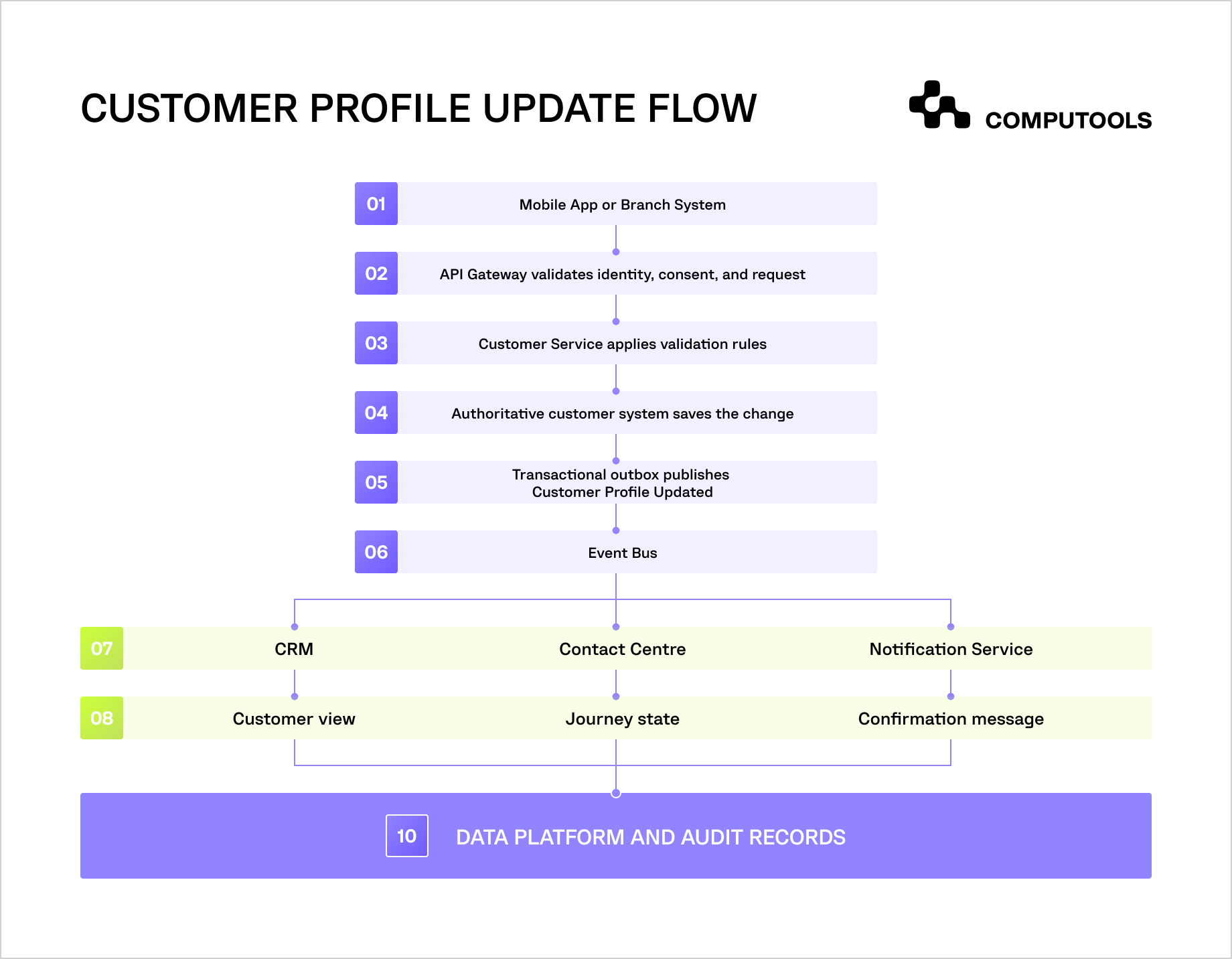
This flow prevents channels from updating several databases independently. The authoritative system commits the change first, and other applications receive the update through a reliable event.
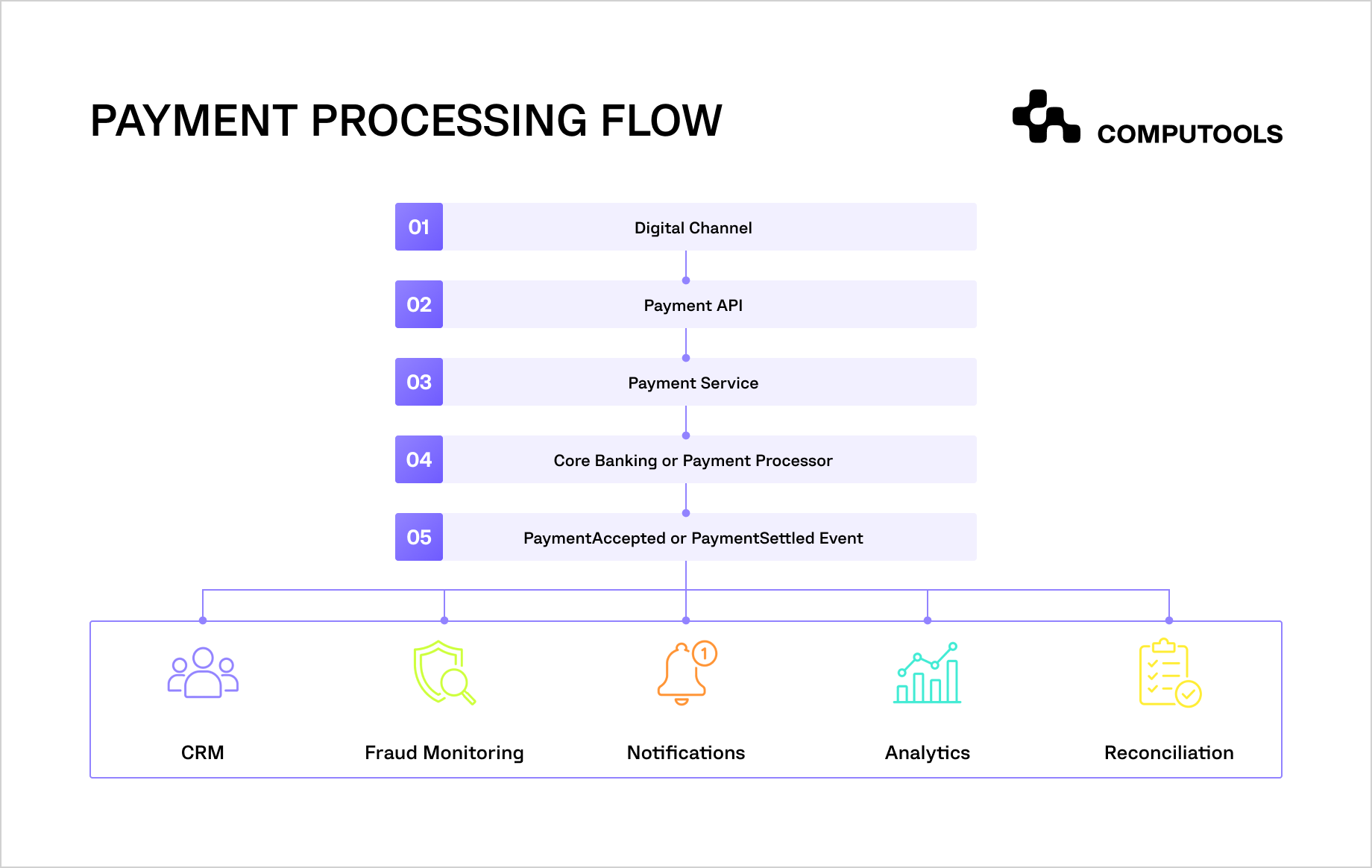
The payment request uses a synchronous API because the customer needs an immediate status. Downstream systems update asynchronously so a temporary CRM or analytics outage does not block the transaction.
Controls required for reliable synchronization
Effective customer data synchronization requires:
- Shared customer, account, and transaction identifiers.
- Transactional outbox or CDC to prevent lost events.
- Idempotency keys to prevent duplicate processing.
- Correlation IDs for end-to-end tracing.
- Retry and dead-letter queues.
- Reconciliation of missing or inconsistent records.
- Versioned API and event contracts.
In CardFalcon, our team followed this separation by using CRM for relationship data and backend services for contracts, requests, approvals, and partner workflows. Interfaces could display current operational information without becoming responsible for the underlying banking records.
This model supports consistent data across digital channels while keeping transaction ownership within the correct banking platform.
Security, compliance, and operational resilience by design
Banking integrations move sensitive identity, account, card, and transaction data across internal and external systems. Security controls must therefore apply to every API, event, workflow, and data pipeline rather than only to customer-facing channels.
1. Secure API and system access
A secure banking API integration model should include:
- OAuth 2.0 and OpenID Connect for authentication and delegated access.
- Short-lived tokens and narrowly defined scopes.
- Mutual TLS or sender-constrained tokens for high-risk connections.
- Role-based access control, or RBAC, for employees and partners.
- Step-up authentication for payments, card controls, and sensitive profile changes.
- Separate identities for applications, services, and users.
- Central secrets and encryption-key management.
Banking APIs using OAuth 2.0 should follow the OAuth 2.0 Security Best Current Practice defined in RFC 9700, which addresses current threats and replaces several less secure implementation patterns. Financial APIs can also apply the FAPI 2.0 Security Profile for stronger authorization and interoperability controls.
The API gateway can validate tokens, enforce rate limits, and block malformed requests. Account, payment, customer, and compliance services should still make the final authorization decision based on the user, action, account, risk level, and transaction context.
2. Apply compliance across the data flow
Integration architecture should support:
- PSD2 requirements for secure payment access and strong customer authentication.
- Readiness for the proposed PSD3 and Payment Services Regulation framework.
- PCI DSS v4.0.1 controls wherever cardholder data enters, moves through, or remains within scope.
- GDPR data minimisation, retention, consent, access, and deletion rules.
Integration design also needs to account for the EU’s Digital Operational Resilience Act (DORA), which makes ICT risk management, resilience testing, incident handling, and third-party technology dependencies important considerations for banks.
For core banking integration, banks should also minimise the data shared with CRM, channels, and analytical platforms. A support interface may need a masked account number and current status, but it rarely needs full ledger records or unrestricted transaction histories.
3. Monitor complete banking workflows
Infrastructure monitoring alone cannot confirm that a customer request succeeded. Banks should trace the full path through the channel, API gateway, domain service, core platform, event broker, and downstream consumers.
Required controls include:
- Correlation IDs across APIs and events.
- API latency and error-rate monitoring.
- Event-consumer lag tracking.
- Failed-message and dead-letter queue alerts.
- Reconciliation of unmatched records.
- Immutable audit logs.
- Recovery and replay procedures.
- Clear incident ownership and escalation.
For example, a payment may complete in core banking but fail to update CRM or notifications. Monitoring should identify the incomplete workflow, retry the update, and create an operational alert if automated recovery fails.
Effective banking integration solutions combine preventive security with auditability, resilience, and controlled recovery. Computools cybersecurity services are useful to assess API exposure, access controls, cloud configurations, compliance gaps, and incident-response readiness.

Launch your banking system integration in 1–3 months, not years, and connect core banking, CRM, and digital channels into a unified ecosystem that reduces manual work, improves data consistency, and enables faster customer service.
Computools banking integration case studies
Computools’ banking projects show how integration can solve different operational problems, from connecting CRM and partner workflows to linking transaction data with KYC, AML, and fraud controls.
CardFalcon: connecting CRM, partners, and banking workflows
CardFalcon needed to coordinate issuing operations across internal teams, partner banks, intermediaries, contracts, offers, and service requests. Much of this work was previously managed through emails, spreadsheets, PDFs, and separate tools.
The new platform connected Salesforce CRM with backend services built on Java and Spring Boot. Angular interfaces supported employees and partners, while PostgreSQL stored structured operational data.
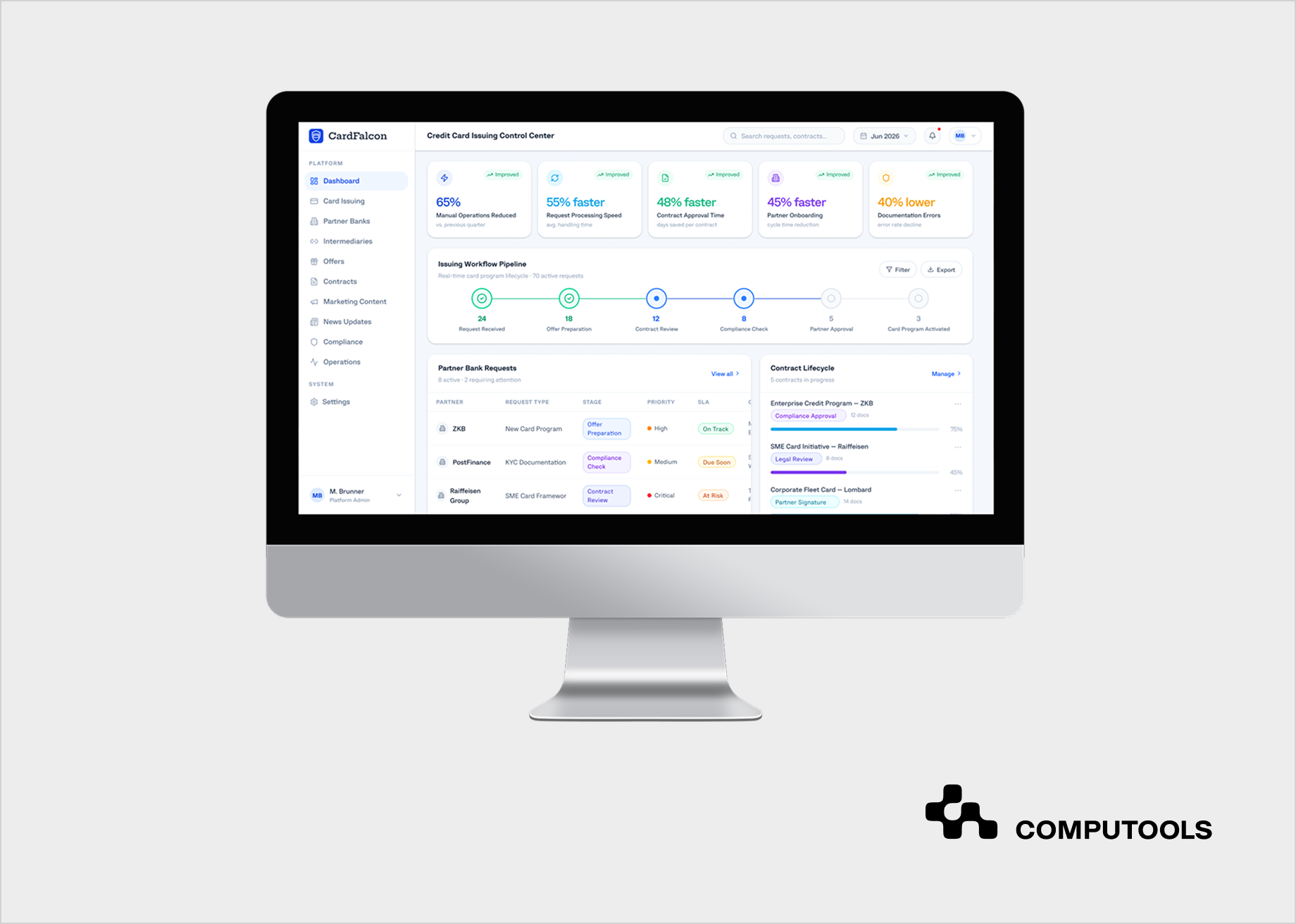
The architecture centralised:
- Partner and customer records.
- Contract and offer management.
- Request and approval workflows.
- Communication history.
- Role-based access.
- Operational status tracking.
This setup kept CRM focused on relationship data while backend services controlled banking rules and workflow execution. It also reduced manual transfers between teams and improved visibility across the partner ecosystem.
The results included:
- 65% fewer manual operations.
- 55% faster request processing.
- 48% faster contract approvals.
- 45% faster partner onboarding.
- 40% fewer documentation errors.
CardFalcon shows how banking workflow automation can connect CRM, operational services, and partner processes without placing all business logic inside one platform.
For a closer look at how banks can connect partner-facing workflows with internal systems, APIs, compliance checks, and lifecycle management, read our guide on banking partner onboarding software.
KYCentrum: integrating KYC, AML, and fraud controls
KYCentrum demonstrates how compliance and risk systems can connect with customer and transaction data in near real time.
Its architecture used Java and Spring Boot services, Python-based fraud models, Kafka, PostgreSQL, rules engines, and external KYC and AML providers.
A simplified processing flow looked like this: customer and transaction data → event processing → KYC and AML enrichment → fraud scoring → case workflow → analyst review and audit record.
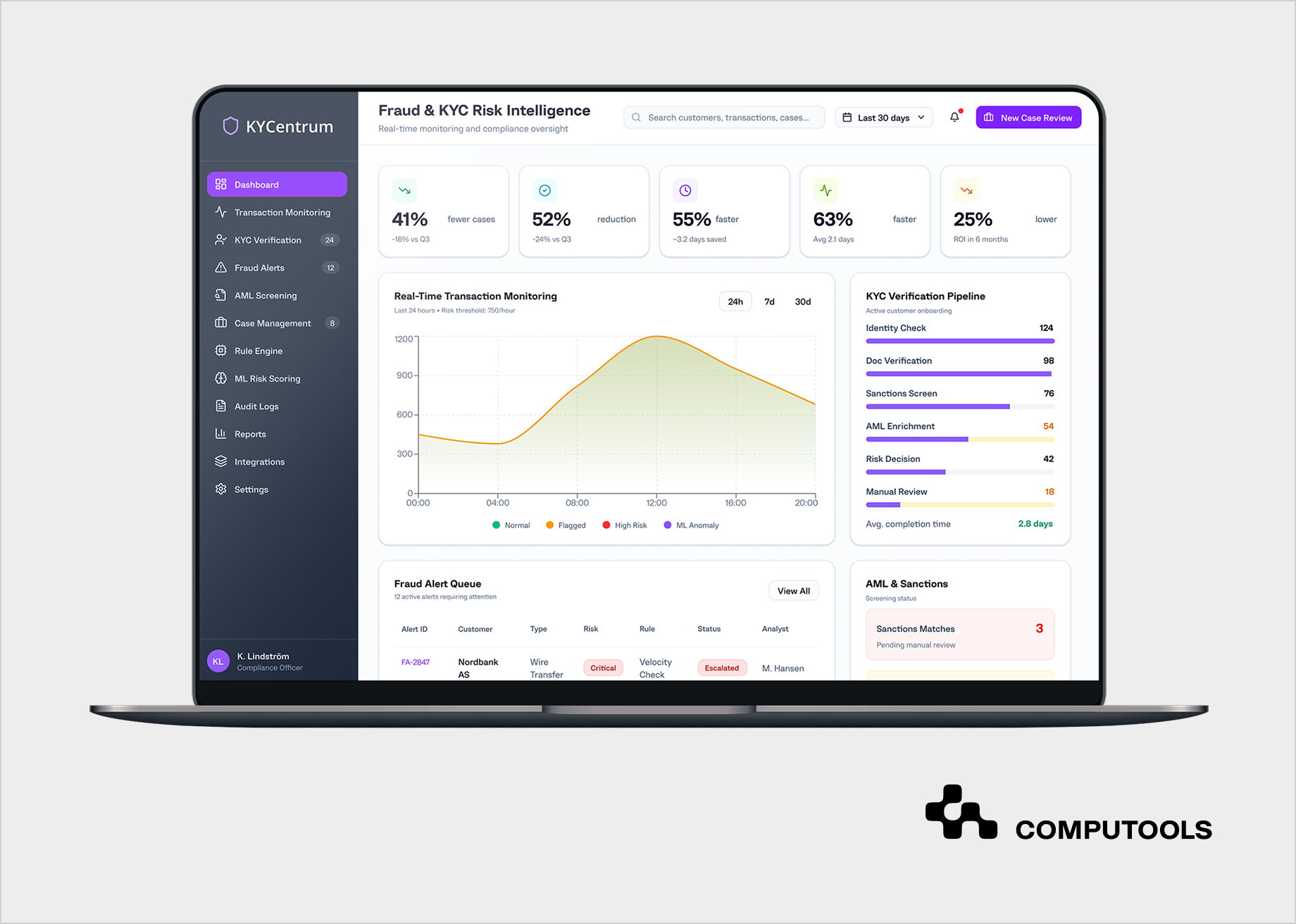
The platform supported:
- Identity verification.
- Sanctions and AML screening.
- Real-time fraud scoring.
- Alert prioritisation.
- Case management.
- Explainable decision records.
- Compliance reporting.
The results included:
- 41% fewer confirmed fraud cases.
- 52% fewer false positives.
- 50–60% shorter onboarding.
- 63% faster compliance case resolution.
- 20–30% lower compliance operating costs.
KYCentrum shows how Computools banking system integration services can connect transaction processing with compliance, fraud detection, and analyst workflows while preserving traceability.
For a more detailed look at how transaction data, risk rules, alert workflows, and compliance systems can be connected within one architecture, read our guide on building an AML transaction monitoring system.
How to plan a banking integration project
A banking integration project should start with business workflows and data ownership, not with the selection of middleware or API tools. The goal is to identify which connections create the most risk, delay, and manual work, then modernize them in controlled phases.
1. Assess the existing environment
Create an inventory of:
- Core, CRM, payment, card, compliance, and channel systems.
- APIs, batch files, database connections, and message queues.
- Data owners and identifiers.
- Third-party dependencies.
- Failed jobs, reconciliation work, and recurring incidents.
- Critical workflows that cannot tolerate downtime.
This assessment should reveal where systems duplicate data, depend on unsupported interfaces, or require employees to transfer information manually.
2. Define data and process ownership
For each customer, account, payment, card, loan, and compliance record, specify:
- The authoritative system.
- Applications allowed to update it.
- Systems that consume the data.
- Required synchronization speed.
- Retention and security requirements.
- Failure and reconciliation procedures.
Clear ownership prevents CRM, channels, and analytical systems from becoming unofficial copies of core banking.
3. Classify each integration flow
Separate integrations by purpose:
| Flow type | Example | Recommended pattern |
| Immediate query | Retrieve current balance | Synchronous API |
| Immediate command | Block a card | API with idempotency controls |
| Business event | Payment settled | Event stream |
| Long-running process | Customer onboarding | Workflow engine |
| Bulk transfer | Historical migration | Batch pipeline |
| Analytical feed | Transaction reporting | CDC or data pipeline |
This classification prevents banks from using real-time APIs for every workload or relying on batch jobs for time-sensitive operations.
4. Design the target architecture
The architecture should define:
- API gateway and access policies.
- Domain services.
- Event broker.
- Workflow orchestration.
- Legacy adapters.
- Master-data and identifier mapping.
- Monitoring and reconciliation.
- Security zones and encryption.
- Recovery and rollback procedures.
The design should also document API and event contracts so teams can change systems without breaking dependent applications.
5. Start with a vertical implementation slice
Avoid beginning with a broad infrastructure replacement. Select one complete workflow that crosses channels, banking services, and systems of record.
A practical first slice could be: mobile card-block request → API gateway → card service → card platform → CRM update → customer notification → audit record.
This tests authentication, authorization, business rules, data exchange, events, monitoring, and recovery within one measurable process.
In CardFalcon, we followed a similar business-led approach by connecting partner records, requests, contracts, approvals, and operational interfaces instead of replacing every existing banking component at once.
6. Modernize in phases
Banks can introduce new integration components alongside existing interfaces through:
- The strangler pattern.
- Parallel processing.
- Feature flags.
- Shadow traffic.
- Read-only replicas.
- Gradual channel migration.
- Controlled cutovers with rollback plans.
Each phase should reduce dependency on direct database connections, manual file transfers, and duplicated business logic.
7. Test failure scenarios
Testing should cover more than successful requests. Banks need to verify how the architecture handles:
- Duplicate or delayed messages.
- Core banking timeouts.
- CRM or provider outages.
- Expired tokens.
- Partial workflow completion.
- Out-of-order events.
- Schema changes.
- Failed retries and manual replay.
- Disaster recovery.
Financial operations also require reconciliation tests to confirm that every accepted transaction reaches all required downstream systems.
8. Measure business and technical results
| Business metric | Technical metric |
| Request-processing time | API latency |
| Manual handoffs | Straight-through processing rate |
| Data-correction workload | Synchronization failures |
| Customer support resolution time | End-to-end workflow completion |
| Partner onboarding time | Event-consumer lag |
| Reconciliation effort | Unmatched record count |
A phased approach helps banks deliver measurable improvements while limiting operational risk. It should support architecture assessment, implementation, testing, migration, and production monitoring as one connected program.
Through our banking software development services, Computools can review existing systems and integrations, identify weak points, and design a target architecture. The team can then replace fragile connections step by step with APIs, events, adapters, and monitoring, without requiring a full bank-wide system replacement.
Final thoughts
Banks do not need to replace the entire core banking stack to improve connectivity. In many cases, the main problems are outside the core itself, such as direct database connections, duplicated customer data, batch files, separate channel integrations, and workflows that are hard to trace when something fails.
A practical banking system integration strategy starts with clear ownership. Banks should define which system owns customer, account, payment, card, and compliance data, then use the right integration method for each process. APIs work well for immediate requests such as balance checks. Events are better for distributing completed changes, such as payment settlement or profile updates. Batch processing can still handle reporting, migrations, and other non-urgent workloads.
Each critical flow should contain, at a minimum, continuous monitoring, transaction logging, retries, idempotency controls, and reconciliation. This approach offers banks the flexibility to modernize workflows one at a time, while systems remain functional to support routine daily operations.
CardFalcon demonstrates the operational impact of this approach. Integration of CRM and partner records, plus contracts, requests, and approvals, reduced manual operations by 65% and increased the speed of requests by 55%.
The compliance side is illustrated by KYCentrum, which integrated transaction data, KYC, AML, and fraud with near real-time case management, and resulted in a 52% reduction of false positives and a 63% increase in the speed of compliance case closure.
The most practical first step is to identify the most significant sources of operational risk, manual work, data conflicts, and delays in integrations and address these.
Computools provides financial software development services for banks that need to map existing dependencies, design the target architecture, replace fragile integrations, and modernize critical workflows in controlled phases.
Through fintech software development, we design the service layer that connects customer-facing applications with accounts, payments, cards, CRM, and compliance systems. With web development services, we build customer portals, employee applications, and partner interfaces without creating a separate integration path for every channel.
Our approach reduces duplicated logic, simplifies future channel expansion, and keeps security and business rules in one controlled backend layer.
Computools
Software Solutions
Computools is an IT consulting and software development company that delivers innovative solutions to help businesses unlock tomorrow.