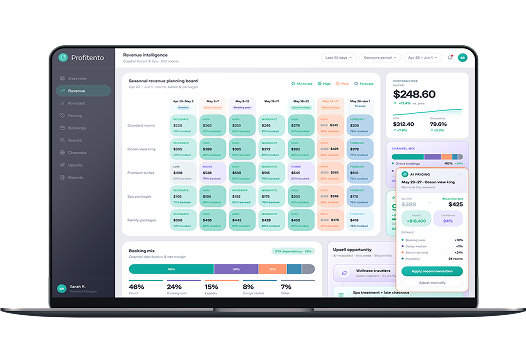
The client operated a 420-room coastal resort and spa in the USA catering to leisure travelers and families as well as conference and wedding attendees, wellness travelers, and seasonal vacation demand. The resort experienced strong occupancy during holidays and peak travel periods. Still, revenue varied by room type, travel package, booking channel, and ancillary services. Pricing relied on exports from the property management system, OTA dashboards, competitor price comparisons, spreadsheets, and a manual pricing effort.
Computools engineered Profitento as an AI hotel revenue optimization platform that combined dynamic pricing and demand forecasting with guest data, OTA exposure, direct booking, and upsell management. With this solution, the client was able to make rapid revenue decisions based on integrated and structured data rather than fragmented hospitality revenue management systems.
The client is a US-based resort operator managing a large coastal property featuring 420 guest rooms, suites, and spa services along with multiple restaurants and a variety of beach activities. The resort offers paid upgrades, wedding packages, family offers, and seasonal promotions. Branded resorts, boutique coastal hotels, vacation rentals, and listings on OTAs are among the resort’s main competition. Demand is highly variable based on school travel, long weekends, destination weddings, local events, and travel impacted by the weather.
Before Computools, the revenue team worked across disconnected systems. The client needed custom hotel revenue management software that could connect pricing logic, guest profiles, booking channels, resort packages, upsell execution, and profit visibility in one operating model.
The resort’s main challenge was revenue leakage caused by delayed pricing decisions and fragmented data. During peak vacation periods, competitor prices and package offers changed faster than the internal review process. The team often noticed demand shifts after rooms, suites, or packages had already been sold at outdated rates. OTA commissions reduced net revenue, while spa, dining, upgrade, activity, and late checkout offers depended on manual follow-up.
A booking engine or isolated CRM could not solve the issue. The client needed hotel pricing optimization software within a wider AI hotel revenue management system. Computools supported the project with product design, data integration, hospitality workflow analysis, and AI development services.
Computools designed and delivered Profitento as a hotel revenue intelligence platform that combined pricing intelligence, forecasting, guest data, OTA margin control, direct booking workflows, and AI-supported upsell logic.
The solution consolidated booking, guest, pricing, channel, package, and service data into one decision-support environment. It included hotel demand forecasting software capabilities, dynamic pricing rules, competitor rate tracking, seasonal demand signals, CRM segmentation, a guest data platform, a direct booking platform for hotels, OTA Margin Monitor, hotel upsell software, reports, alerts, and role-based administration. Each module addressed a specific revenue loss point across pricing, channels, forecasts, guest value, and ancillary revenue.
Within six months after launch, the client improved revenue performance across several key metrics.
Results were measured against the six-month pre-launch baseline using PMS data, channel reports, booking engine data, OTA performance data, CRM records, upsell activity, and revenue dashboards.
The direct booking platform for hotels, guest data platform, and hotel upsell software helped the resort protect margin and monetize guest demand more effectively.
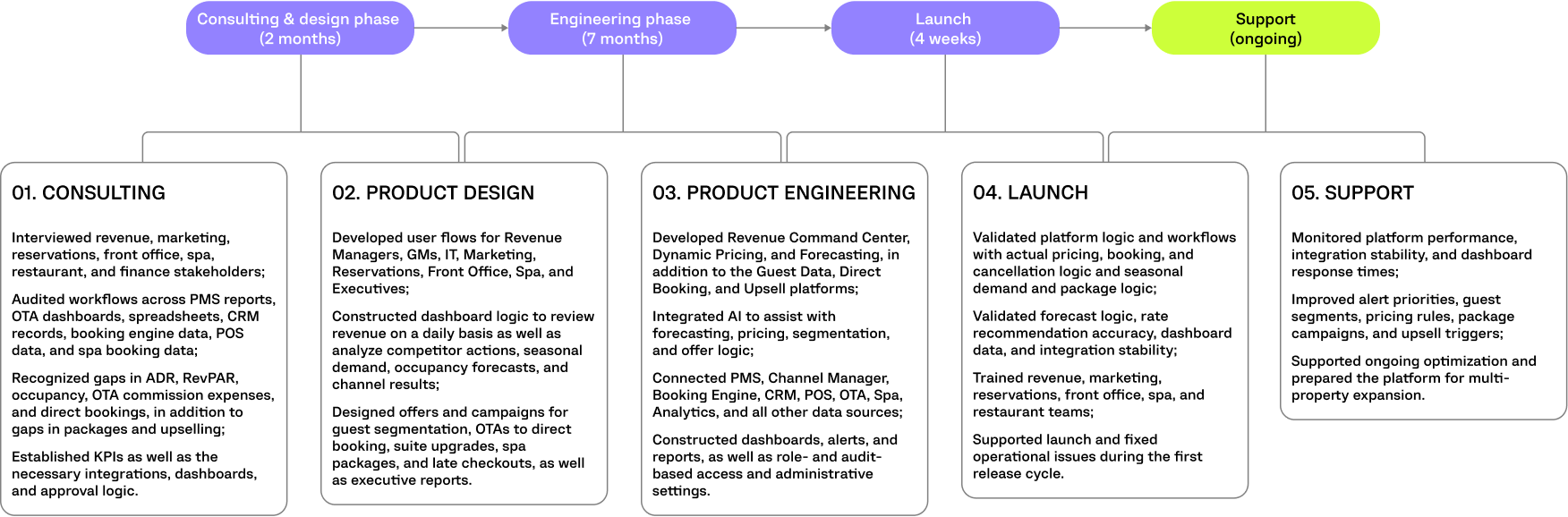
Computools was chosen as the end-to-end technology partner because this project extended beyond hotel software development. The client required a team that mapped resort revenue workflows and integrated hospitality systems in addition to designing scalable data flows. The operator needed the technology to help it make daily operational trade-offs based on pricing, guests, packages, and channels.
Computools’ expertise includes product design, data engineering, integration, AI development, cloud infrastructure, and travel and hospitality software development. For Profitento, the team integrated property management systems, channel managers, booking engine, CRM, POS, online travel agencies, and spas and restaurants to create a unified operational system for pricing approval, demand forecasting, direct booking, channel control, upselling, and executive reporting.

The design focused on helping resort teams move from scattered data review to fast, controlled decisions across pricing, forecasting, direct booking, guest segmentation, package performance, and upsell workflows.
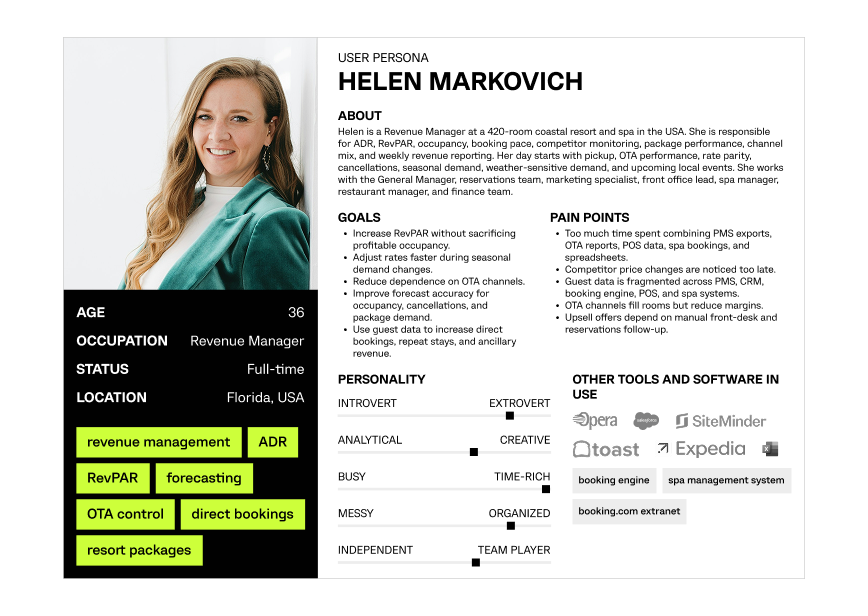
The user persona was created to define how different hotel teams interact with Profitento and what each role needs to make faster revenue, guest, and upsell decisions.
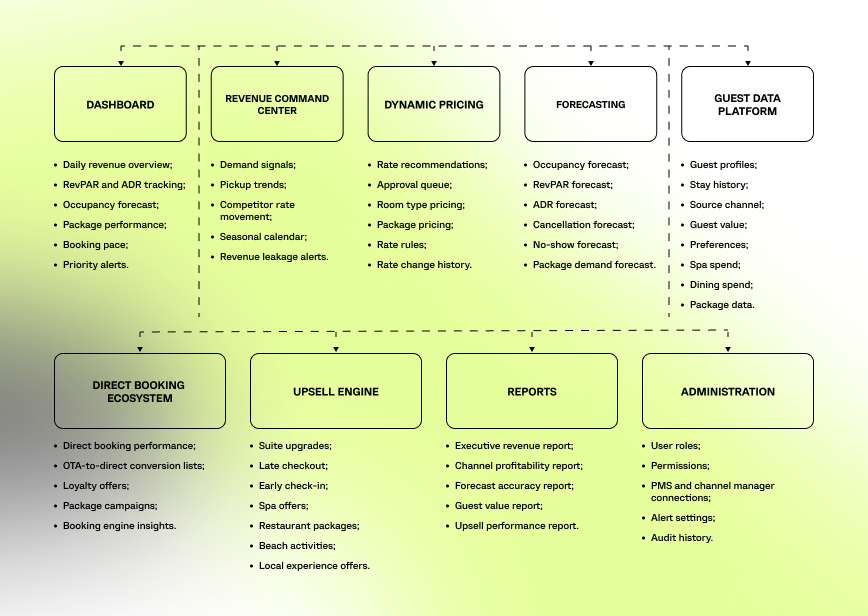
The sitemap was structured around the hotel’s daily revenue decisions, helping teams move from performance monitoring to pricing actions, guest campaigns, upsell execution, and management reporting.
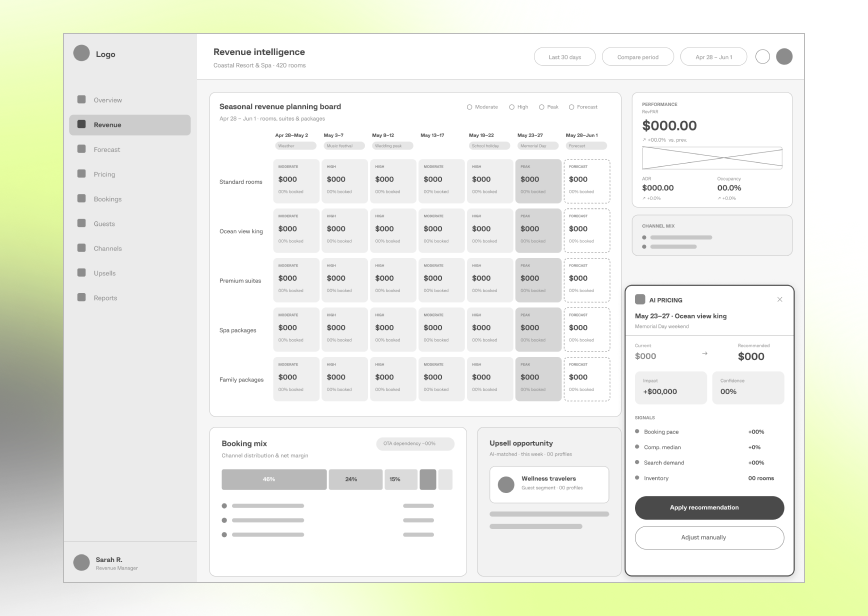
The wireframes simplified how users moved from demand signals to pricing decisions, from guest segments to campaigns, and from booking data to upsell actions.
The UI gave each role a focused workspace. Revenue Managers saw pricing and forecast priorities. Marketing teams saw guest segments and campaign lists. Front office staff saw guest-level upsell prompts. Spa and restaurant teams saw relevant guest demand signals. Executives saw revenue performance, channel profitability, and demand risk.

REACT
React was used to build a responsive management interface for revenue, marketing, reservations, front office, spa, restaurant, and executive teams. The frontend supported dashboard views, role-based navigation, pricing alerts, guest segments, direct booking performance, OTA dependency tracking, package performance, and upsell opportunities.

PYTHON
Python powered forecasting, pricing, segmentation, and recommendation logic. It supported demand analysis, rate optimization scenarios, cancellation prediction, no-show prediction, guest segmentation, package demand analysis, and contextual upsell recommendations. This was central to the hotel demand forecasting software capabilities of Profitento.

FASTAPI
FastAPI supported the service layer behind forecast requests, pricing recommendations, guest data workflows, upsell triggers, direct booking campaigns, and third-party integrations. It connected the React interface with backend logic and external hospitality systems.

POSTGRESQL
PostgreSQL served as the core relational database for booking history, pricing rules, guest profiles, room categories, package data, channel performance, direct booking records, upsell activity, and reporting structures. It supported the guest data platform and revenue analytics logic.

REDIS
Redis supported caching and fast data retrieval across dashboards, pricing workflows, forecasting views, guest profiles, package data, and upsell operations. Faster access to current data reduced delays between revenue signals and action.

PMS / CHANNEL MANAGER API INTEGRATIONS
The Profitento had API integrations with multiple systems: Opera PMS, SiteMinder channel manager, a booking engine, various OTAs, CRM, POS and spa service data. The integrations helped to consolidate reservations, availability, rates, pickup and channel performance, guest profiles, bookings and related ancillary spend.

AWS
AWS supported scalable hosting, secure data processing, and reliable access for resort teams. The cloud setup allowed the platform to support larger booking volumes, more users, more revenue workflows, and future multi-property expansion.

DOCKER
Docker supported controlled deployment, environment consistency, and release management across development, staging, and production environments.

TERRAFORM
Terraform automates infrastructure provisioning, while AWS supplies the scalable cloud environment that powers AI operations software across multiple properties and expanding operational functions.

DATA ENGINEERING
Data engineering covered the mapping, cleaning, and structuring of resort data across PMS, channel manager, booking engine, CRM, POS, spa, OTA, and revenue sources. This work supported travel and hospitality software development requirements where pricing, guest value, package performance, and upsell workflows depend on clean connected data.
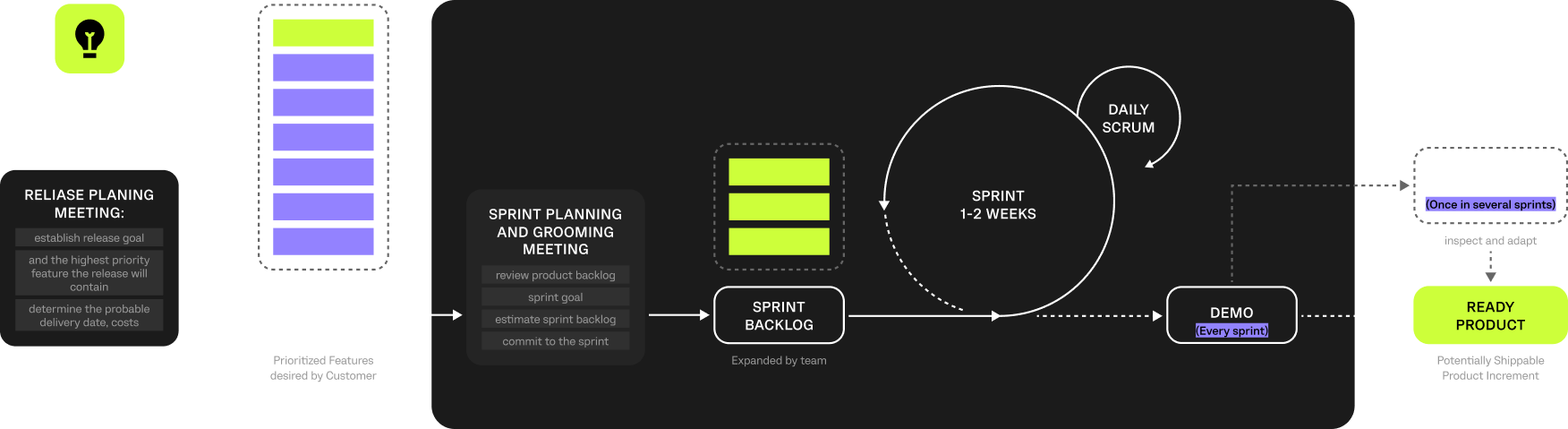
Computools used Scrum with a dedicated engineering team and planned work in two-week sprints. The team aligned delivery to operational workflows, such as revenue, price, and demand, guest segmentation, and direct booking, as well as tracking parcels, and upselling, and preparing executive reports.
This approach helped validate assumptions before full rollout. Revenue scenarios were tested with resort stakeholders before engineering work moved into production. Iterative delivery reduced risk because the platform evolved around the resort’s daily work, seasonal demand patterns, and guest monetization model.
Before Profitento, our revenue team had the data, but it lived in too many places. We had to check PMS reports, OTA dashboards, competitor prices, booking engine data, spa bookings, restaurant spend, guest records, and spreadsheets before making pricing decisions. During peak periods, that delay affected both rate control and channel profitability.
Computools helped us turn resort revenue management into a connected workflow. Now our team can see demand changes, pricing recommendations, guest segments, OTA exposure, package performance, direct booking opportunities, and upsell prompts in one place. The biggest difference is speed. We can act earlier, protect margin, and make better use of the guest data we already have.




Computools | 341 Raven Cir, Camden Wyoming, Delaware 19934, US