Background
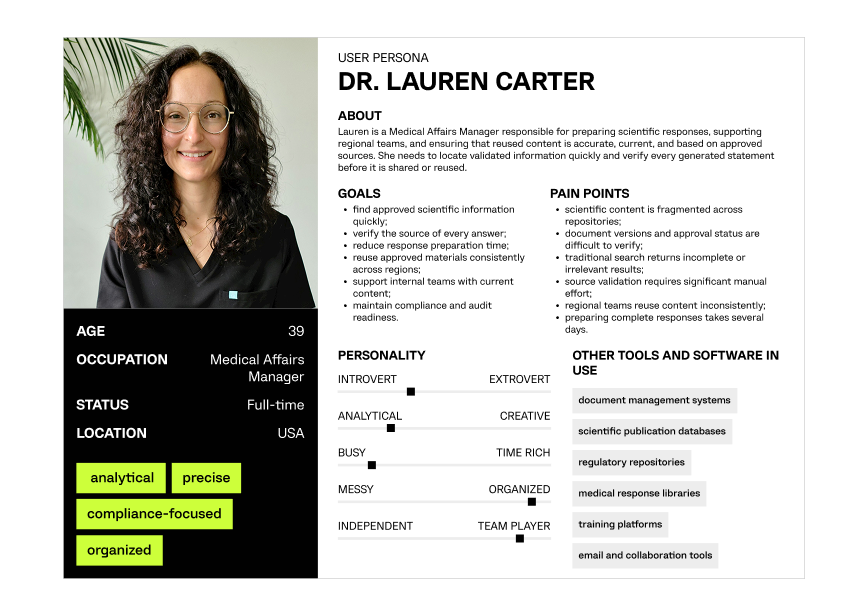
Medical Affairs, Regulatory Affairs, and Scientific Operations teams worked with large volumes of content distributed across SOP libraries, publication databases, approved response documents, training portals, and regional repositories.
The same scientific topic could appear in several files with different versions, approval statuses, geographic limitations, and access permissions. Employees had to search across systems, verify which document was current, and confirm whether it could be reused for a specific market or audience.
This slowed response preparation, increased manual source validation, and made it difficult to maintain consistent use of approved materials across regions.
Approach to solution
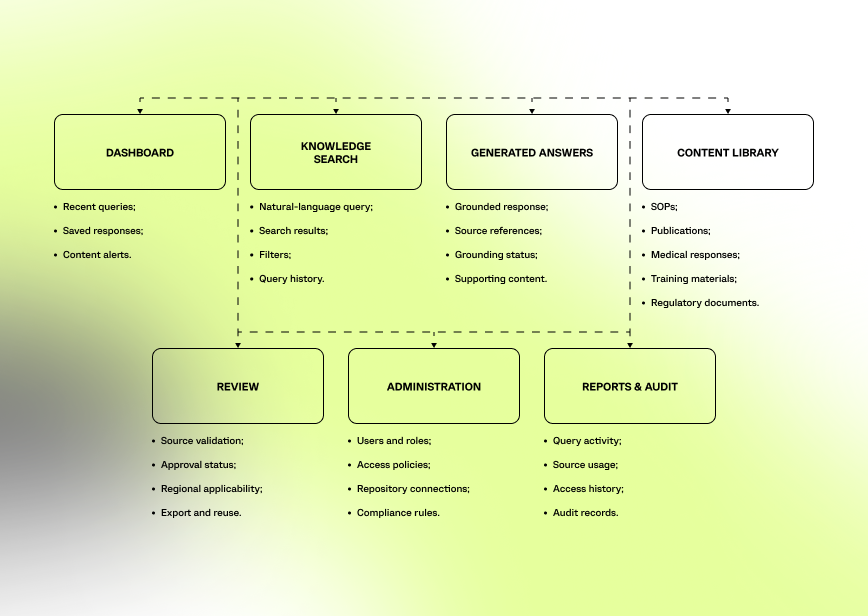
Computools built Retrionex as a centralized intelligence layer on top of the client’s existing content repositories. Documents were ingested, normalized, enriched with metadata, and classified by content type, version, region, approval status, and access level before being indexed in a unified semantic environment.
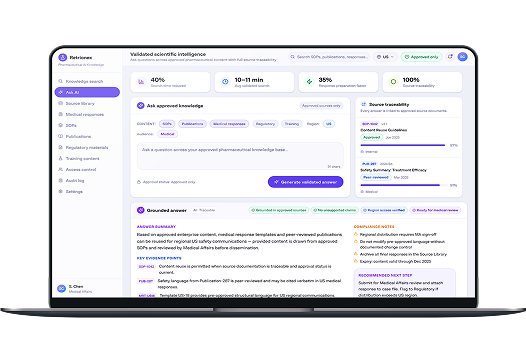
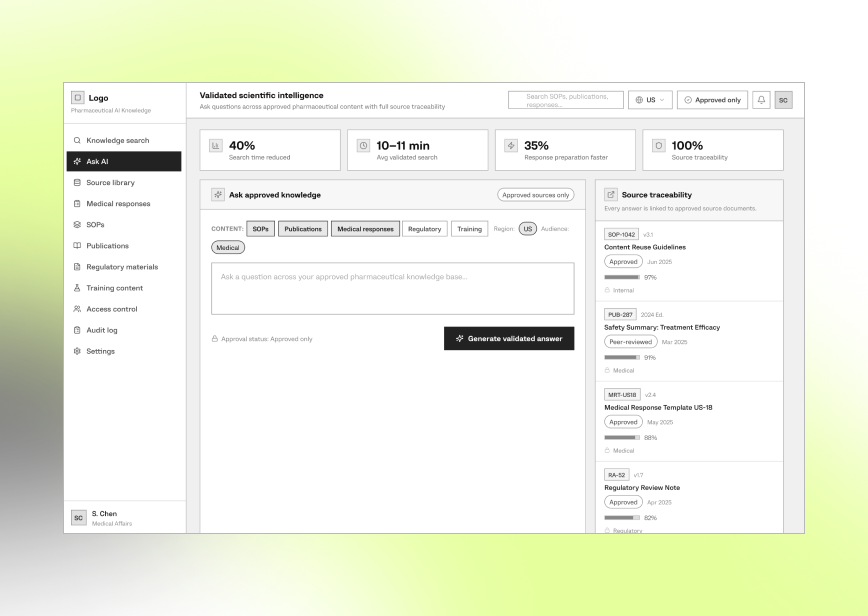
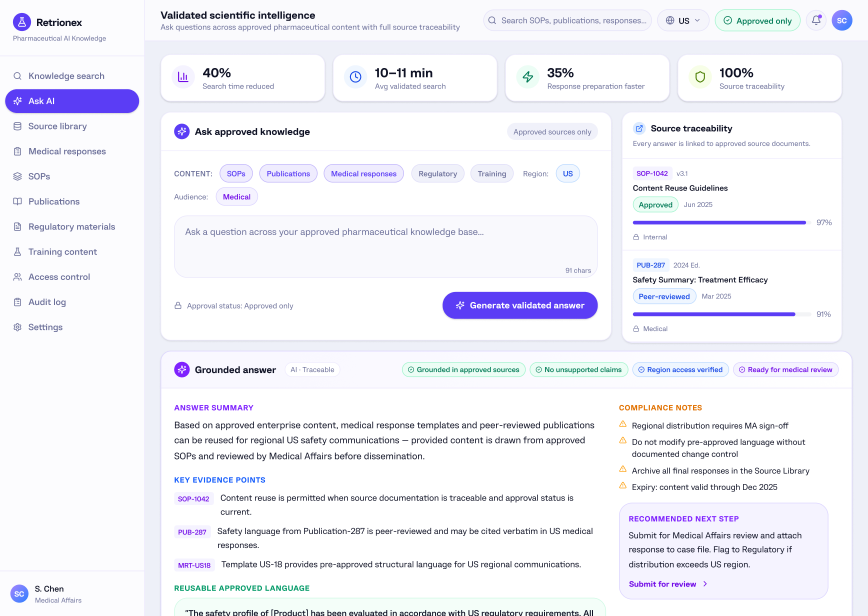
When users submitted questions in natural language, the platform retrieved only relevant approved documents and generated grounded responses with direct source references. Permission rules were applied before retrieval and generation, while unsupported answers were blocked when the system could not find sufficient approved evidence.
This approach created one searchable layer across existing repositories without requiring the client to migrate content or replace established approval workflows.
Integration challenges & approach
The client’s scientific and regulatory content was distributed across multiple repositories with different document formats, metadata structures, versioning models, and update cycles. Building separate point-to-point connections would have increased maintenance effort and made it difficult to keep indexed content up to date.
Computools implemented a shared ingestion and synchronization layer that connected existing repositories, extracted content and metadata, normalized document attributes, and tracked version and approval-status changes. The platform mapped all materials into a unified enterprise schema and updated the semantic index as source documents changed.
This approach gave Retrionex consistent access to current, approved content across connected systems without requiring the client to migrate documents or replace existing repositories.
Computools role
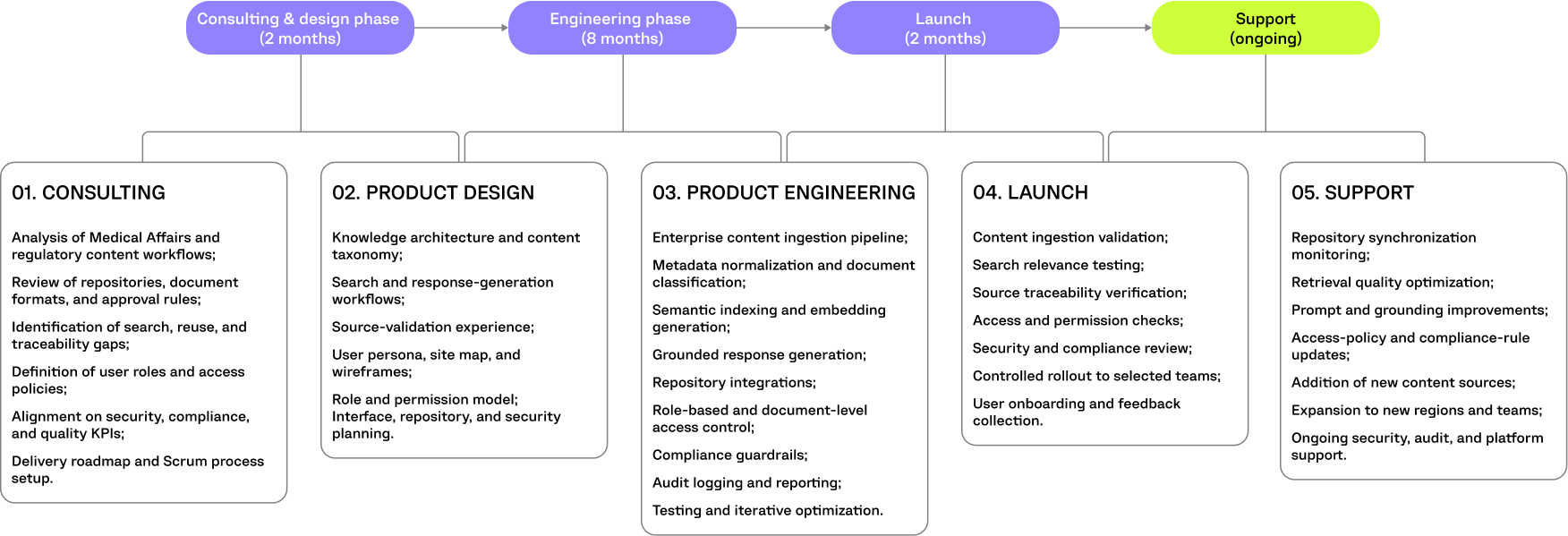
Computools acted as the end-to-end delivery partner, responsible for:
- Analysis of scientific, regulatory, and content approval workflows;
- Repository and content-source mapping;
- Product strategy, UX/UI design, and platform architecture;
- Enterprise content ingestion and normalization;
- Semantic retrieval architecture;
- Retrieval-Augmented Generation orchestration;
- Enterprise knowledge schema development;
- Role-based and document-level access control;
- Compliance guardrails and audit logging;
- Testing, launch, and ongoing optimization.
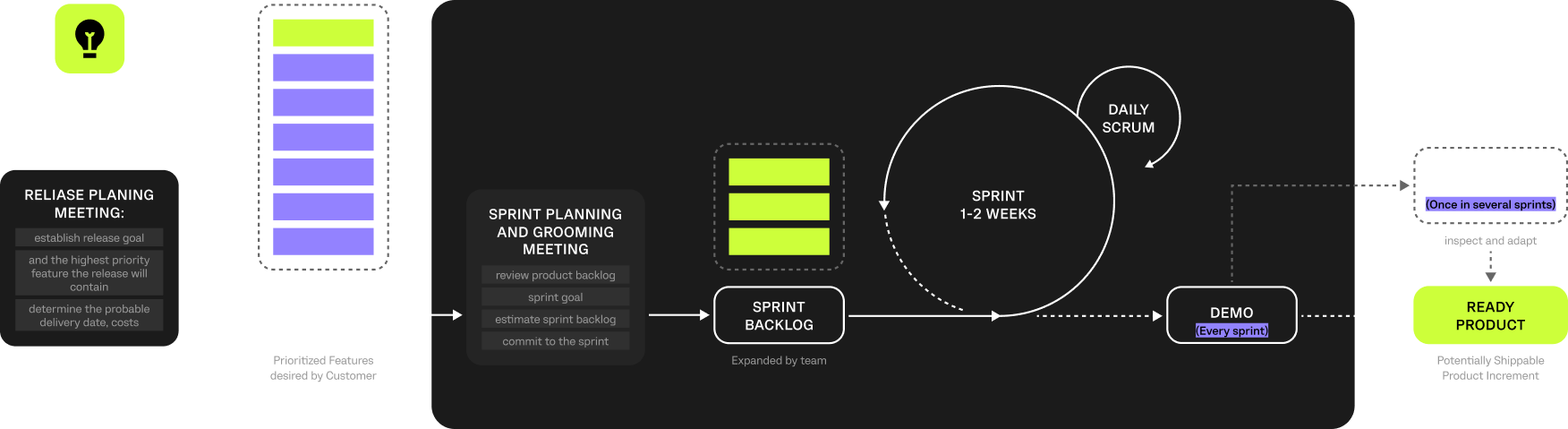
The team worked with Medical Affairs, Regulatory Affairs, Scientific Operations, compliance, and IT stakeholders to align the platform with content approval, access, and traceability requirements.
Key decisions and outcomes
Key architectural decisions focused on keeping existing repositories separate from the intelligence layer, restricting response generation to approved enterprise content, and preserving direct source references for every answer.
The platform also used meaning-based retrieval instead of keyword-only search and enforced permissions at both the document and query levels.
As a result, the average time required to locate validated information fell from 18 to 10-11 minutes, an improvement of approximately 40%.
Scientific and medical response preparation decreased from 2.5 days to 1.6-1.8 days, reducing turnaround time by approximately 30-35%.
These changes also improved consistency in the reuse of approved content across regions by up to 25% and ensured full traceability of generated answers.