




Share your request and business context using the form. This allows us to prepare for an effective first call and align on next steps from the start. After the first call and a detailed discussion of your project, we prepare three structured project estimation options (Max Estimation, Mid Estimation, Min Estimation). Each option shares the same business goal but differs in scope, delivery speed, level of optimization, and budget. This allows us to align on the right approach before moving forward.
We clarify the business outcomes you want to achieve and define measurable success criteria. Working sessions with your team help align priorities, constraints, and KPIs. Business analysis and technical review are used to validate assumptions and prepare the initiative for delivery.
We design the product concept based on agreed goals and constraints. Technology choices and design decisions focus on practicality, maintainability, and long-term evolution. User-centered design ensures the solution addresses real usage scenarios, while the architecture supports controlled change over time.
We define the team composition based on project goals, timelines, and delivery expectations. A core team is engaged from the start to ensure continuity and knowledge retention, supporting efficient onboarding as the team evolves over time.
Our DevOps team configures and deploys core environments, including Dev, QA, Staging, and Production. Monitoring, alerting, and support responsibilities are defined upfront to ensure system stability and operational readiness.
CI/CD planning starts during the architecture design phase. We use established tools such as GitLab, Docker, Kubernetes, and leading cloud platforms, including AWS, Microsoft Azure, and Google Cloud, to support a reliable and efficient delivery pipeline.
We develop the product iteratively from the earliest stages and evolve it throughout the lifecycle, ensuring changes are introduced in a controlled and predictable way.
We focus on proactive quality assurance supported by automated and regression testing. A well-defined release candidate strategy is applied to align testing and stabilization with the planned release schedule.
We design a launch plan that accounts for stakeholder requirements, business processes, and organizational context. Based on this plan, we execute a controlled system launch and perform final validation activities. Additional testing procedures are applied as needed, and your team is guided to confidently manage and operate the platform.
We ensure continuous and reliable operation through proactive monitoring, regular updates, and rapid issue resolution. This approach minimizes downtime and helps maintain stable performance across your cloud environment.
We continuously assess the product after release, incorporating feedback and operational insights to guide ongoing improvements and support long-term evolution.
Share your request and business context using the form. This allows us to prepare for an effective first call and align on next steps from the start.
We clarify your goals and staffing needs to define the required skills, experience, and level of expertise for your development team.
Based on the agreed requirements, we prepare detailed profiles of IT professionals that match your criteria, technical stack, and delivery expectations.
Once the required profiles are defined, we select suitable candidates from our pool of experts and present their resumes for your review and selection.
We support onboarding and integration of the selected IT experts into your internal team, enabling them to become productive quickly and work effectively within your processes.
We use the Scrum agile framework as a standard project management methodology for distributed delivery teams. Sprint-based planning and daily coordination ensure alignment with delivery goals while allowing controlled flexibility.
Jira is used for task tracking, role distribution, and progress monitoring, providing transparency and supporting effective execution across all stages of the engagement.
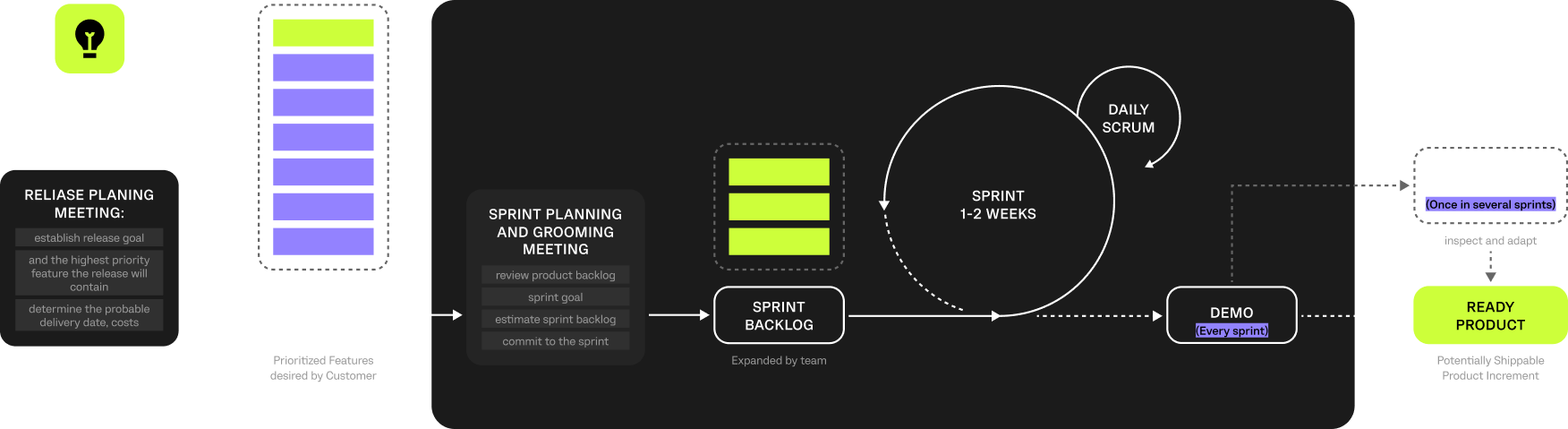
A standardized delivery framework used across all projects.
We offer three estimation options to reflect different delivery priorities and constraints. Each option addresses the same business goal but varies in scope, engineering depth, optimization level, and delivery speed.
This approach allows you to choose the most appropriate balance between quality, timelines, and budget before development starts.
A Max estimation covers a full-featured software solution designed for long-term growth.
It includes an extended feature set, advanced architectural decisions, performance and scalability optimization, and proactive risk mitigation from the start.
A Mid estimation focuses on a stable, ready software product aligned with your core requirements.
It includes an optimal feature set, solid architecture, and predictable delivery without unnecessary complexity or over-engineering.
A Min estimation is suitable when speed and cost efficiency are the primary priorities.
It focuses on essential functionality needed to validate an idea or meet immediate business goals, with limited optimization and conscious technical trade-offs.
Yes, we provide team augmentation services, including dedicated development teams, SAP staff augmentation, and Salesforce staff augmentation. You can engage a single developer or a full cross-functional team, depending on your requirements. Our model allows you to scale talent up or down as needed, accessing the right expertise at the right time without long-term overhead.
We use Scrum to manage our work. The project moves forward in short, organized sprints. At the end of each sprint, we show you a working demo of your product. This way, you can see our progress, provide early feedback, and adjust priorities as needed.

Computools | 341 Raven Cir, Camden Wyoming, Delaware 19934, US