
THE AUTHOR:

There are a lot of considerations when running multiple clinical studies in parallel. Individual trial applications rarely resolve the coordination problem, as they do not provide enough integration of studies, sites, regulatory activities, vendors, operations, and internal teams. Sponsors, as well as contract research organizations (CROs), need a clinical trial management platform to connect and manage these different streams within a governed ecosystem/environment.
Sites already feel the cost of fragmented technology. A 2025 review of clinical research trends reported that site staff can encounter as many as 22 systems in a single trial and spend up to 12 hours per week on redundant data entry.
Veeva’s 2026 Clinical Data Trend Report also identifies reducing data transcription and connecting laboratory, device, EHR, and other data sources as an active industry priority.
According to IQVIA’s Global R&D Trends 2026, the average length of clinical studies has expanded and the gap between successive studies has grown by 3 months. The growing complexity of clinical trials is also challenging research sites. WCG’s 2025 survey found that staffing (30%) and clinical trial start-up (31%) were the next major challenges for clinical research sites after clinical trial complexity (35%). Sponsor-funded technology was a problem for 20% of surveyed clinical research sites.
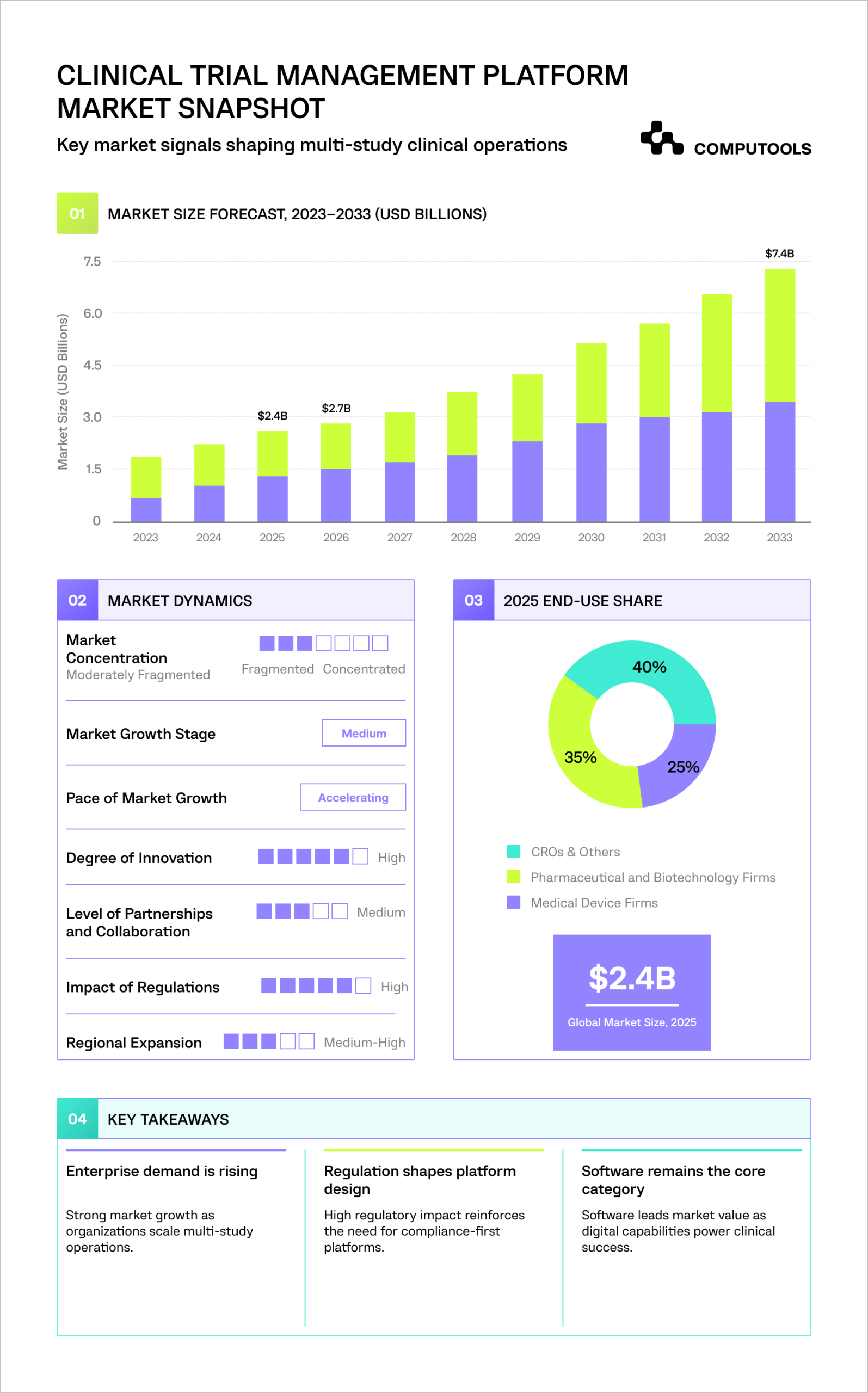
Investment is addressing operational issues. Grand View Research estimates the CTMS market at $2.7 billion in 2026 and expects it to increase to $7.4 billion by 2033. In 2025, enterprise platforms accounted for over 75% of the market.
These numbers indicate a greater scope for clinical trial management software. A modern platform lies between specialized applications for clinical use and the management of the research portfolio. It is responsible for the connectivity of the portfolio, study, country, site, participant, milestone, task, issue, data, and decision. This operating model is highly relevant when an organization uses other systems for EDC, eTMF, safety, IRT/RTSM, regulatory, finance, and analytics.
Key functionalities of a multi-study clinical trial management platform
| Operational area | What the platform should do | Operational value |
| Study setup | Create reusable study structures, manage protocol versions, define milestones, and apply country- or site-specific rules. | Speeds up launch preparation and keeps study configuration consistent across the portfolio. |
| Site coordination | Track activation steps, enrollment progress, monitoring activity, task ownership, and overdue actions. | Makes site bottlenecks visible earlier and reduces time lost to manual follow-up. |
| Clinical data exchange | Connect EDC, eTMF, IRT/RTSM, safety, lab, eCOA/ePRO, and internal systems through controlled data flows. | Reduces duplicate entry, reconciliation effort, and conflicting records. |
| Workflow orchestration | Trigger tasks, approvals, status changes, alerts, and escalations when predefined events occur. | Keeps dependencies moving without relying on constant email and spreadsheet coordination. |
| Portfolio control | Compare milestone variance, enrollment trends, issue aging, site performance, and forecast dates across studies. | Shows which studies are drifting from plan and where management attention is needed. |
| AI-supported analysis | AI forecast delays, assess site performance, rank risks, detect unusual patterns, and search study information. | Gives teams earlier warning of emerging problems and improves prioritization. |
| Governance and traceability | Enforce access rules, preserve audit history, record data provenance, manage versions, and retain regulated records. | Strengthens inspection readiness and makes operational decisions easier to reconstruct. |
This article describes how to develop such a platform, connect clinical data, automate operational workflows, deploy AI to practical scenarios, safeguard regulated data, and build the software architecture to cater to multiple studies in a scalable way.
For a closer look at AI supporting clinical decisions, read How to Build an AI Clinical Decision Support System. The article examines data preparation, model integration, clinical workflows, explainability, and deployment requirements.
Computools case: a clinical trial management platform for integrated study data and workflows
A Computools project, ClinUnity, shows why the architecture around a clinical trial portfolio matters as much as the individual applications supporting each study.
Client context
The client was a US-based pharmaceutical company conducting multiple studies in the U.S. and Europe at the Phase II-IV level. The clinical operational model involved CROs, study coordinators, data managers, and regulatory teams, as well as multiple parallel studies.
With growing business, operational information remained distributed across EDC, CTMS, Excel, safety systems, internal applications, and local databases.
Business challenge
Teams repeatedly copied information between systems, reconciled inconsistent records, searched for current study status, and prepared reports manually.
The fragmentation affected core operational processes. Recruitment tracking slowed. Site activation required more coordination. Reporting depended on data assembled from several sources. Audit preparation consumed substantial staff time. Portfolio managers lacked a current operational view across studies.

Computools solution
The Computools team developed a flexible and scalable layer that incorporates and manages an organization’s separate clinical technology tools.
The unified data model introduced standard concepts for studies, sites, participants, workflows, and compliance. Communication between linked systems was automated via data ingestion. Workflow management reduced the need for human intervention, and requests were processed based on allocated operational duties.
The architecture employed Python and software APIs for data preparation and workflow automation, respectively. Workflow management, transactional record management, and integrated event-based data synchronization were implemented using PostgreSQL, Amazon Web Services (AWS), Apache Kafka, Keycloak, and Docker. User interfaces were developed in React.
Business result
The platform produced the following operational gains:
| Result | Improvement |
| Time spent on operational tasks | 35% lower |
| Manual data handling | 40% lower |
| Study setup | 25% faster |
| Cross-study visibility | Improved |
| Audit preparation | Continuous readiness |
ClinUnity illustrates a practical approach to multi-study clinical trial operations. Connect specialized systems through common data, workflow, access, and monitoring layers, then expand the platform as study volume increases.
Explore another digital health use case
How to Build a Digital Therapeutics Platform examines the product, data, integration, and compliance requirements behind software that operates closer to the patient side of digital healthcare.
How to develop a clinical trial management platform
Building the platform starts with the operating model. Architecture, automation, analytics, and AI should follow the way clinical teams actually manage studies and make decisions.
Step 1. Define how the portfolio will be controlled
Start by defining which decisions the platform must support across programs, studies, countries, sites, vendors, and teams.
For multi-study clinical trial management, a useful hierarchy is: Portfolio → Program → Protocol → Study → Country → Site → Participant.
Each level requires its own status, milestones, ownership rules, dependencies, and reporting logic.
Define the operational metrics management will use, such as site activation time, enrollment against plan, open issue aging, monitoring completion, protocol deviations, country milestones, vendor performance, and forecast completion dates.
The platform also needs clear roles for sponsors, CRO teams, CRAs, site personnel, regulatory staff, data managers, QA teams, and administrators.
This structure gives clinical study management consistent definitions across the portfolio. Without common definitions, one study may mark a site “active” after regulatory approval and another after contracts, training, and system access are complete. Portfolio reports then compare different operational states under the same label.
Step 2. Design a clinical data model that supports change
The data model becomes a central architecture decision in clinical trial management system development.
Core entities usually include:
- Study
- Protocol
- Protocol version
- Country
- Site
- Investigator
- Participant reference
- Milestone
- Visit
- Monitoring activity
- Task
- Issue
- Deviation
- Vendor
- Document reference
- Payment
- Audit event
Protocol versioning deserves particular attention. Amendments can change visit schedules, endpoints, eligibility criteria, site responsibilities, data collection, and required documents. The platform should retain previous versions and show which workflows, sites, participants, and actions each change affects.
This requirement is becoming more relevant as clinical protocols become more structured. FDA finalized ICH M11 CeSHarP in May 2026, providing a standardized protocol structure, terminology, and data fields intended to support electronic exchange of protocol information.
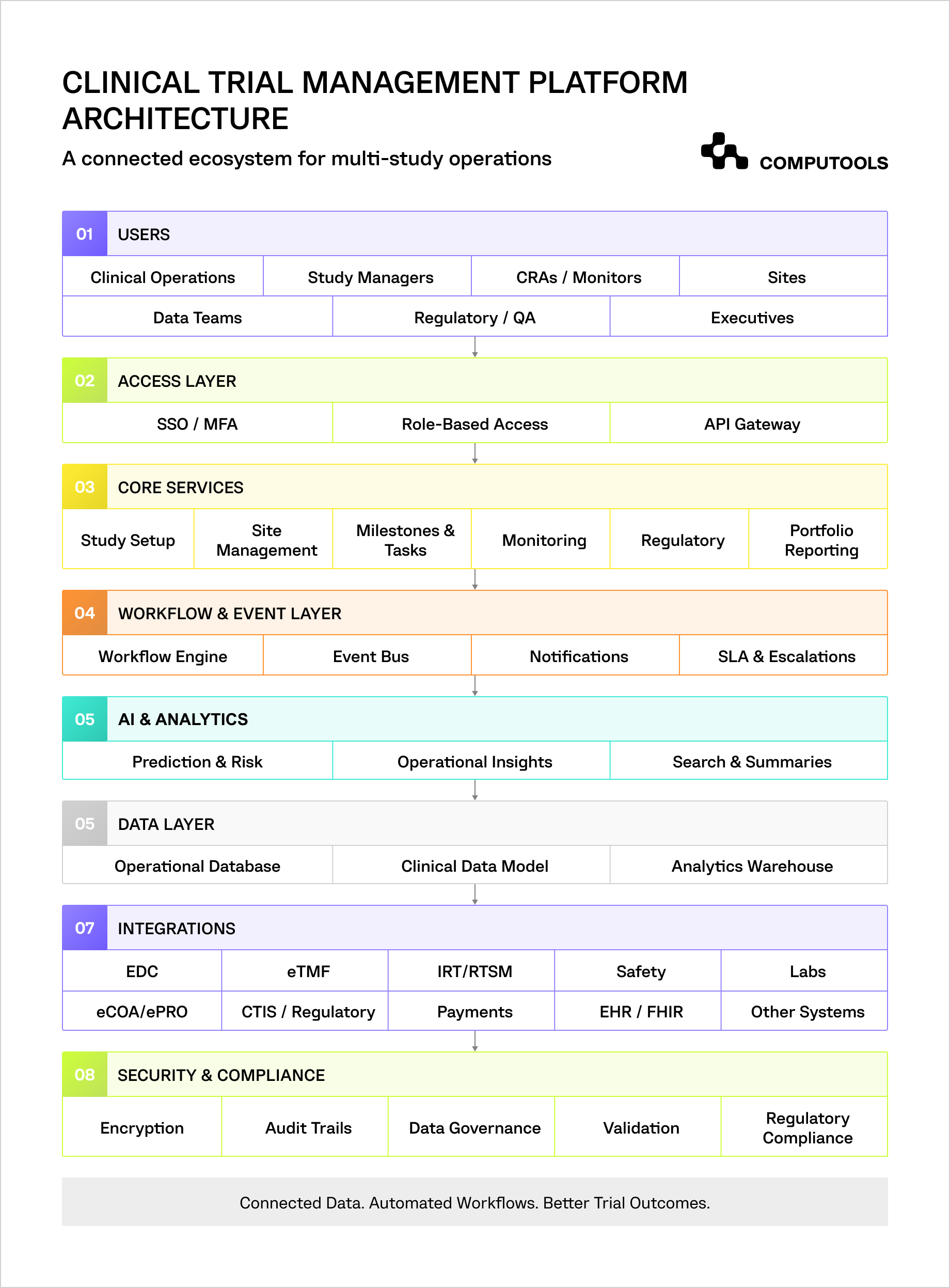
Architecturally, use configurable metadata and rules for study-specific behavior. Shared services can manage identity, studies, sites, tasks, workflows, alerts, integrations, and reporting without duplicating application logic for every protocol.
In ClinUnity, our team applied this principle through a unified data model and PostgreSQL-based operational storage, giving multiple connected systems a consistent representation of clinical operations.
Additional reading
If you are exploring how structured clinical information should move beyond study operations, see How to Build a Clinical Documentation System for Hospitals. It covers architecture, data flows, integrations, and documentation workflows in another regulated healthcare environment.
Step 3. Treat integration as a core product capability
Most sponsors already own multiple specialized clinical systems. A new clinical trial operations software environment needs to coordinate them.
Common connections include:
- EDC/CDMS;
- eTMF and eISF;
- IRT/RTSM;
- pharmacovigilance and safety platforms;
- eConsent, eCOA, and ePRO;
- laboratories and imaging vendors;
- regulatory systems;
- participant payment platforms;
- identity providers;
- EHR and FHIR-based sources where appropriate.
Good clinical study data integration requires not only API connectivity. The integration layer needs source identifiers, canonical platform IDs, data mapping, schema validation, deduplication, retry policies, reconciliation, error queues, and provenance.
Use REST APIs for transactional exchange, events or webhooks for time-sensitive operational changes, and controlled batch pipelines for systems with limited interfaces.
In ClinUnity, we connected EDC, CTMS, safety systems, spreadsheets, and internal sources through APIs and automated data flows, preserving existing specialized applications and reducing repetitive data handling.
Step 4. Convert clinical processes into configurable workflows
A multi-study platform should turn operational procedures into trackable states, dependencies, deadlines, and actions.
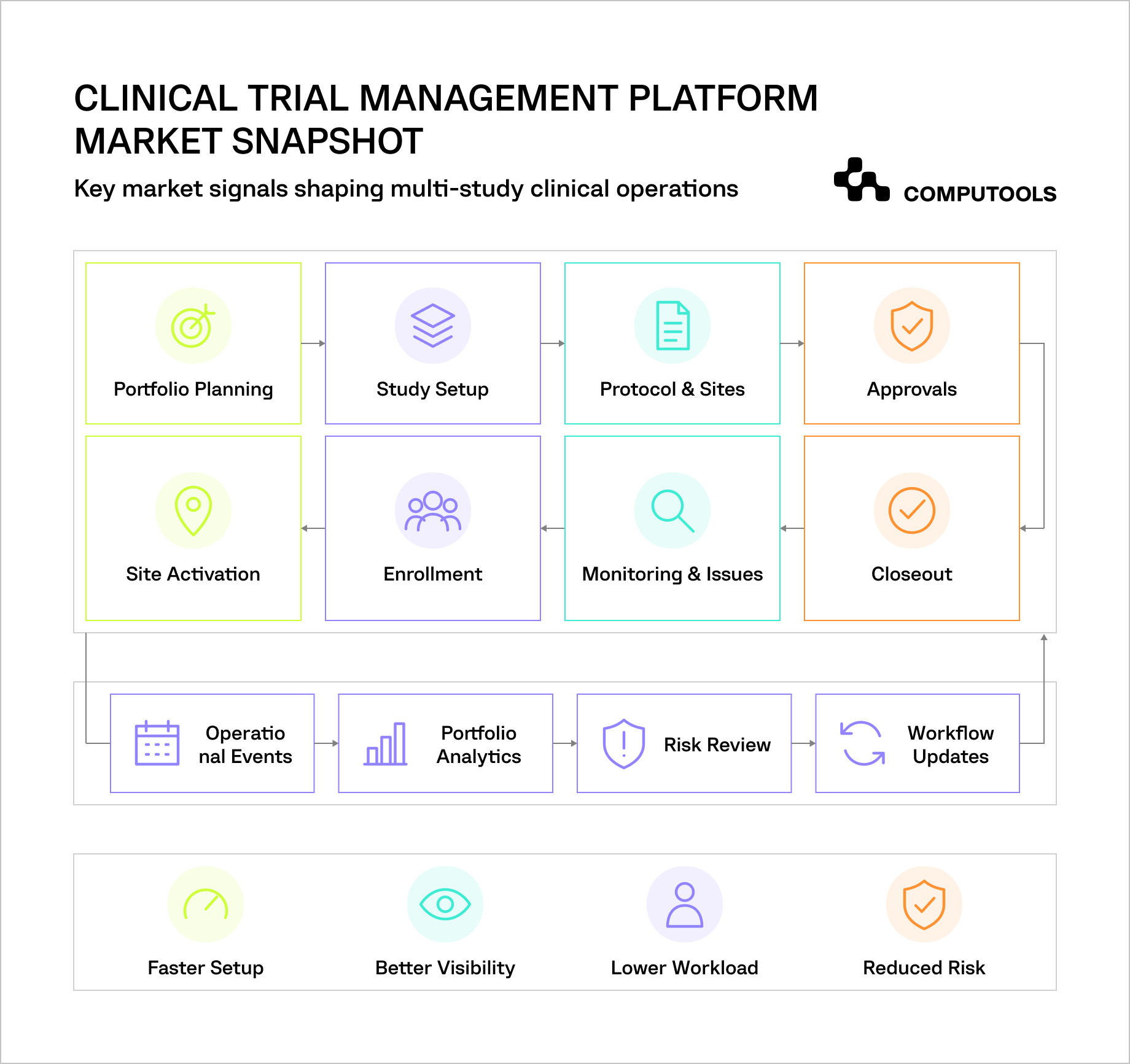
For example: Study setup → Country preparation → Site qualification → Regulatory approval → Contracting → Training → Site activation → Enrollment → Monitoring → Closeout.
Effective clinical trial workflow management relies on configurable rules. Teams should define which conditions move an object into its next state, which approval is required, who owns the next action, and when escalation occurs.
A workflow engine can respond to events such as:
- ethics approval received;
- site contract completed;
- training completed;
- enrollment below forecast;
- monitoring visit overdue;
- protocol amendment released;
- unresolved issue approaching its SLA;
- regulatory milestone approaching.
With clinical trial management automation, the platform can create tasks, update statuses, calculate deadlines, send notifications, and escalate exceptions automatically.
For example, completing the final site activation dependency can change the site’s operational state, create recruitment tasks, update the portfolio forecast, and notify the responsible clinical operations team.
This type of clinical research workflow automation gives employees an exception-based workload. They spend more time resolving material problems and less time checking whether routine prerequisites are complete.
Administrators should be able to configure templates, thresholds, milestone types, country requirements, approval paths, notification rules, and permissions without requiring a new software release.
Step 5. Create portfolio-level monitoring and risk control
Study teams need detail. Executives need patterns within the portfolio.
A useful clinical trial portfolio management layer should provide several levels of visibility.
At portfolio level, teams can track studies at risk, milestone variance, enrollment performance, site capacity, upcoming regulatory deadlines, and forecast completion dates.
At study level, they need enrollment versus plan, country activation, site performance, monitoring status, deviations, outstanding issues, and vendor delivery.
At site level, they may examine enrollment rate, activation duration, monitoring findings, unresolved actions, and recurring operational problems.
This turns clinical trial monitoring and reporting into a decision system. A red KPI should lead directly to the studies, sites, milestones, or issues responsible for the variance.
The need is significant because development productivity remains under pressure. IQVIA reported that the improvement in clinical program productivity was not sustained in 2025. Trial durations increased overall, and intervals between trials grew by three months.
For performance, keep operational transactions separate from expensive analytical queries. An operational database can serve current workflows, with event pipelines sending standardized information into a warehouse or analytical store for portfolio reporting and forecasting.
Step 6. Apply AI to specific operational decisions
AI creates more value when it targets measurable clinical operations problems.
| AI capability | Operational benefit |
| Study delay prediction | Flags milestone patterns associated with schedule slippage. |
| Site performance forecasting | Estimates activation, recruitment, or operational performance. |
| Participant dropout risk | Identifies cases requiring retention attention when data and intended use support it. |
| Deviation risk detection | Surfaces patterns that require clinical review. |
| Smart search | Finds relevant protocols, issues, notes, SOPs, and study records within user permissions. |
| Operational summaries | Summarizes study changes, unresolved actions, and emerging risks for review. |
| Priority scoring | Ranks alerts by business and clinical risk. |
| Portfolio forecasting | Updates expected milestones using current study and site performance. |
Medidata’s 2026 survey of 200 senior pharma, biotech, and CRO decision-makers found that among organizations with more than 18 months of AI experience, 72.9% reported improved trial timelines and 67.5% reported reductions in protocol deviations.
Veeva’s 2026 research points in a similar direction, with clinical data teams moving toward a mix of rule-driven automation and AI for reconciliation, review, query management, orchestration, and other high-volume processes.
Yet, the foundation comes first. AI depends on clean, structured, traceable data, consistent definitions, reliable integrations, and appropriate permissions. Models also need defined intended uses, performance monitoring, version control, and review workflows appropriate to the risk of each decision.
ClinUnity’s event-driven architecture and standardized data model create the type of foundation required for future predictive capabilities. The client is considering analytics for patient dropout risk and study delays as a later platform phase.
For additional technical context
How to Design HIPAA-Compliant AI Architecture looks at the architecture behind AI systems that process sensitive healthcare data, including access controls, data isolation, model workflows, and infrastructure decisions.
Step 7. Make security, data integrity, and traceability part of the platform logic
Security has direct operational consequences in clinical research. Weak access control creates compliance risk. Missing audit evidence increases inspection work. Poor data provenance makes discrepancies harder to resolve.
Build controls into every relevant transaction:
- SSO and MFA;
- role-based or attribute-based access;
- study, country, and site-level data boundaries;
- least-privilege permissions;
- encryption in transit and at rest;
- secrets management;
- timestamped audit trails;
- record and protocol version history;
- approval records;
- data provenance;
- retention policies;
- backups and disaster recovery;
- security monitoring and incident logging.
The architecture should support applicable requirements under 21 CFR Part 11, GDPR, HIPAA where protected health information is involved, and relevant GCP requirements.
This became essential with ICH E6(R3).
FDA published the guideline in September 2025 with a focus on quality by design and a greater emphasis on risk-based approaches, participant protection, and reliable and trustworthy trial outcomes, as well as appropriate use of technology.
In Europe, the E6(R3) Principles and Annex 1 have applied since July 23, 2025. Annex 2, covering decentralized and pragmatic trials and trials incorporating real-world data, was adopted in 2026 and became effective on January 15, 2027.
Changes have also occurred with EU operational requirements. As of January 31, 2025, all ongoing clinical trials conducted in the EU are under the scope of the Clinical Trials Regulation, and CTIS is the single-window system for reporting and supervision of central clinical trial applications.
A clinical trial data traceability platform simplifies preparation for audits and clinical evidence protection, while also providing sponsors with a reliable electronic record of information changes, workflow, and timing.
Recommended reading
Cloud Security in Healthcare Businesses provides a broader view of cloud security requirements for healthcare systems, including identity management, data protection, infrastructure controls, monitoring, and compliance considerations.
Step 8. Test the platform as a multi-study operating environment
A platform that works with one study and ten users may behave differently with dozens of active trials, hundreds of sites, large reporting queries, and simultaneous integration events.
Test realistic conditions:
- concurrent study updates;
- large site portfolios;
- protocol amendments;
- high-volume integration events;
- delayed upstream systems;
- duplicate messages;
- failed APIs;
- large reporting queries;
- authorization changes;
- workflow escalations;
- backup restoration.
The test strategy should include unit, integration, API contract, workflow, data reconciliation, security, performance, disaster recovery, and risk-based computerized system validation.
Production monitoring should track API failures, event-processing lag, integration exceptions, workflow backlog, reporting latency, authentication errors, and infrastructure availability.
Post-launch optimization then moves to business metrics. Measure study setup time, site activation duration, manual touchpoints, reconciliation volume, issue-resolution time, monitoring workload, and reporting effort.
Computools used a modular architecture for ClinUnity so the client could roll the platform out in phases and add further studies without redesigning the operating model. This reduced implementation risk and created room for new analytics and automation as the portfolio expanded.

Launch a clinical trial management platform within 1–3 months, centralize multi-study operations, reduce manual coordination across teams, and accelerate study execution with real-time visibility into milestones, resources, and trial performance.
Why choose Computools for clinical trial management platform development
A clinical operations platform has to keep study activity, data, responsibilities, and system events aligned across the portfolio. Computools focuses on the processes that consume the most time or create the most execution risk, such as study setup, site activation, approvals, data reconciliation, reporting, and cross-system handoffs. The solutions help our clients to:
1. Reduce coordination load across studies
Through healthcare software development services, we design regulated platforms around access control, auditability, interoperability, and traceable data flows. For sponsors, CROs, and life sciences companies, pharmaceutical software development extends that expertise to clinical, regulatory, research, and pharmaceutical workflows.
2. Connect trial operations with provider systems
When studies depend on hospital infrastructure, hospital software development services support data exchange between trial workflows, hospital systems, clinical data sources, and internal operational tools. This reduces duplicate entry and gives research teams more consistent access to current information.
3. Turn clinical data into faster decisions
Web development services translate complex study processes into role-specific workspaces for sponsors, CRAs, sites, data teams, and administrators. AI development adds delay forecasting, intelligent search, anomaly detection, and risk prioritization.
Data engineering provides the pipelines, shared data structures, validation rules, and analytical datasets required to keep those functions accurate.
ClinUnity demonstrates how these areas work together. We used APIs, common data models, event-driven processing, workflow automation, and access/portfolio interfaces to join siloed clinical systems. This reduced operational work by 35% and the amount of manual data input by 40%. We were also able to speed up study setup by 25%.
Final thoughts
A clinical trial management platform should give sponsors and CROs the ability to manage the relationships between all studies, sites, systems, milestones, clinical data, risks, and teams.
The best architecture integrates existing clinical applications through a common operational model. Repetitive work is eliminated through automation and workflows. Portfolio analytics provide visibility into the areas of execution that are drifting from the planned state. AI should be added for prioritization and forecasting once trustworthy data, governance, and trail of record are available.
The end result is a flexible and scalable basis to support the growing and escalating needs of clinical trial execution.
Computools
Software Solutions
Computools is an IT consulting and software development company that delivers innovative solutions to help businesses unlock tomorrow.