



THE AUTHOR:

Transportation networks are becoming more fragmented as freight demand increases and supply chains depend on multiple independent carriers, regional operators, and third-party logistics providers. This shift is driving demand for multi-carrier logistics platform solutions that allow logistics companies to coordinate shipments, share transport capacity, and manage freight operations across multiple providers within a single digital environment.
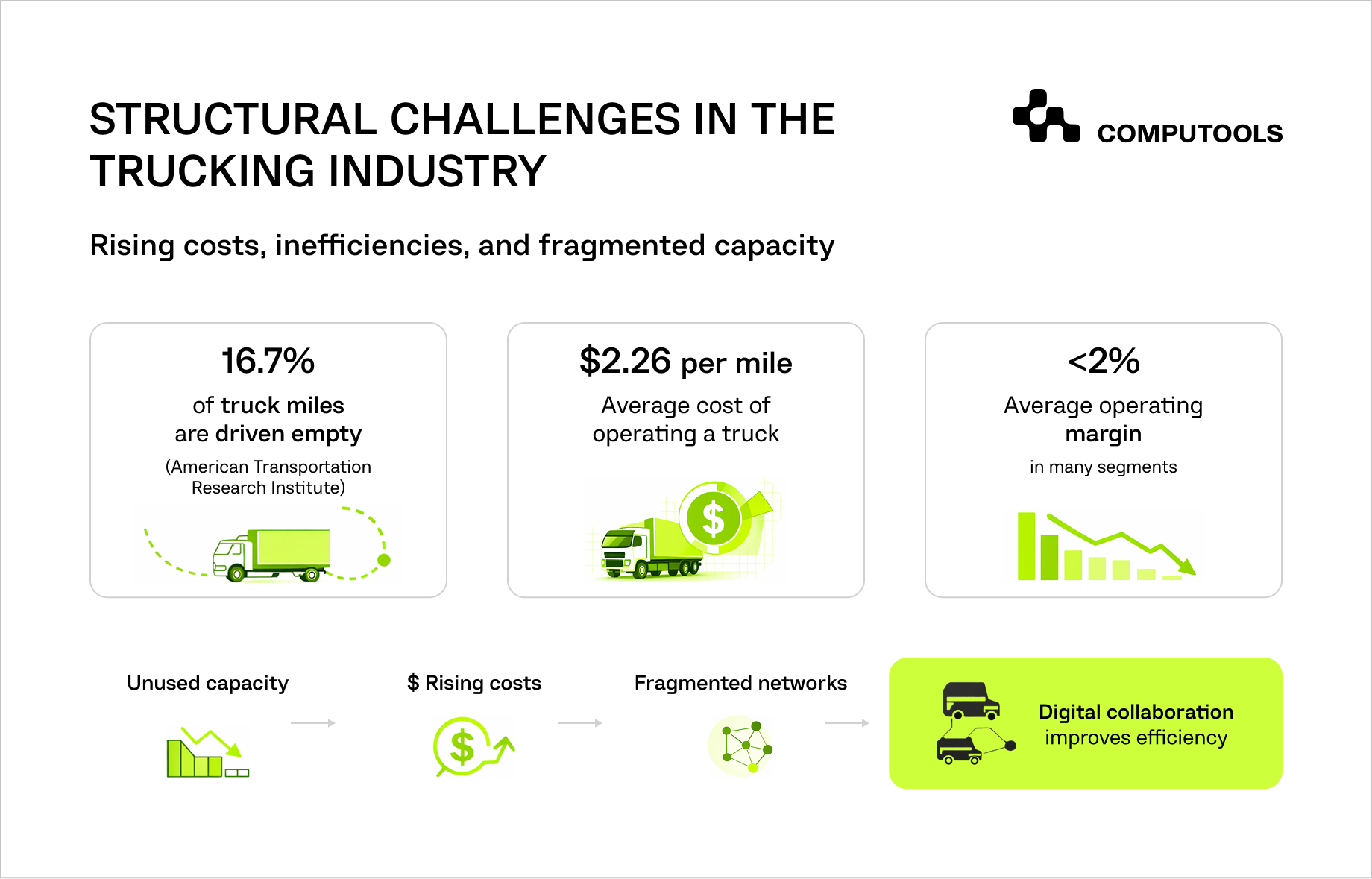
At the same time, the trucking industry continues to face structural inefficiencies and rising operational pressure.
According to the American Transportation Research Institute, 16.7% of truck miles are driven empty, leaving a significant share of transport capacity unused.
In addition, the average cost of operating a truck reached $2.26 per mile in 2024, while industry operating margins in many segments remain below 2%.
As carriers struggle with rising costs and fragmented capacity, digital collaboration tools that connect multiple carriers within shared logistics ecosystems are becoming increasingly important.
Coordination gaps between logistics participants also create major cost pressure. McKinsey estimates that 13–19% of logistics costs can stem from inefficient mid- and last-mile handovers, amounting to as much as $95 billion in annual losses in the United States alone. These inefficiencies boost demand for logistics platforms enabling companies to coordinate shipments, share transport capacity, and manage freight across multiple partners in one digital environment.
To better understand how these systems are implemented in real logistics environments, let’s look at a practical example of how to build a multi-carrier logistics platform for logistics ecosystems that connects independent carriers, drivers, and logistics operators within a single digital infrastructure.
How Computools built a multi-carrier logistics platform
Computools implemented a digital platform that enabled a distributed network of independent carriers and drivers to coordinate freight operations within a shared digital environment.
The solution was developed for LOCARGO, a Texas-based B2B freight marketplace operating around the Port of Houston. The client’s goal was to transform fragmented regional transport capacity into a coordinated delivery ecosystem where multiple carriers could respond to freight demand in real time.
Before the platform was introduced, shipment coordination depended heavily on manual communication between dispatchers, drivers, and local transport providers. As the number of deliveries and participating carriers increased, managing shipment requests, tracking vehicle availability, and assigning loads became increasingly difficult.
The client needed a digital system capable of connecting multiple participants within one operational environment while improving visibility into available fleet capacity.
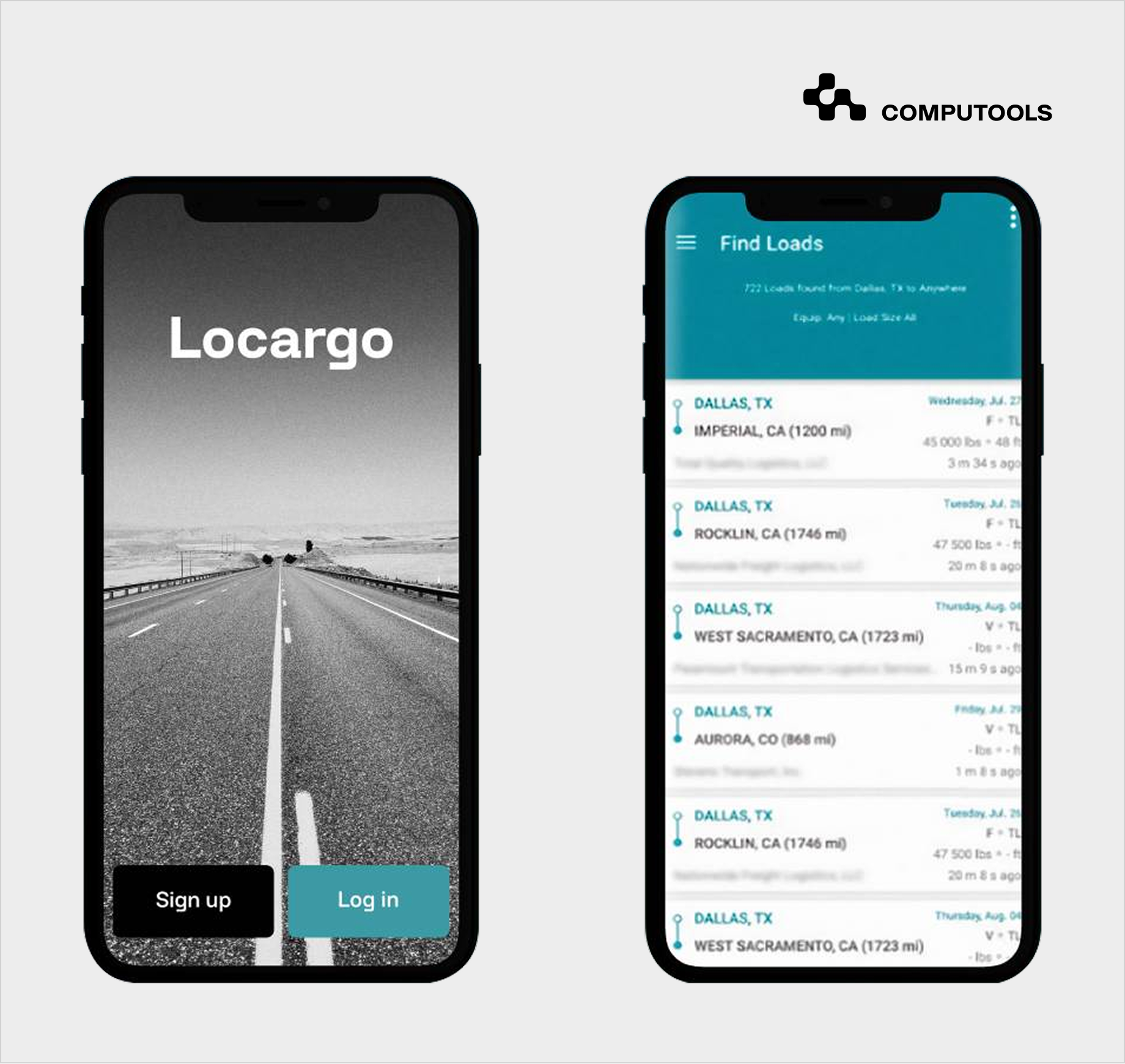
To address these challenges, our team designed logistics ecosystem platforms that synchronize freight operations across independent carriers and drivers. The system allows logistics operators to manage delivery requests, monitor transport capacity, and coordinate shipments within a single platform rather than relying on disconnected tools and manual dispatch workflows.
The platform includes a dispatcher portal for logistics operators and mobile applications for drivers, enabling them to receive assignments, track deliveries, and update shipment status in real time. To provide continuous operational visibility, the system integrates IoT development services, including GPS-based tracking and telematics signals that allow dispatchers to monitor vehicle movement, driver activity, and delivery progress across the network.
To improve delivery coordination, our engineers implemented a distribution optimization algorithm that evaluates shipment requests, driver locations, and available vehicle capacity when assigning loads. This allows the platform to distribute freight more efficiently across participating carriers and use previously unused transport capacity.
The system also integrates navigation services, route monitoring, and automated administrative workflows for order processing, documentation, and invoicing.
As a result, LOCARGO evolved from a small regional cargo operator into a collaborative freight marketplace connecting multiple carriers and drivers within the Texas trucking ecosystem. Within two years, the platform helped the company increase revenue fivefold while significantly improving operational coordination and fleet utilization across the network.
Alongside logistics marketplaces like LOCARGO, Computools engineering teams also deliver large-scale transportation platforms, including fleet monitoring systems and maritime software development solutions that help logistics operators manage complex freight networks and multi-modal transport operations.
How to develop multi-carrier collaboration platforms for logistics ecosystems
Building collaborative carrier ecosystems requires strong logistics expertise, as well as a deep understanding of scalable platform architecture and multi-party system integration. Companies developing these solutions often rely on experienced providers of logistics software development services to design platforms.
Based on our experience building digital logistics ecosystems, the following steps outline how to develop multi-carrier collaboration platforms that allow logistics companies to coordinate shipments, integrate multiple carriers, and manage freight operations more efficiently.
Step 1. Define the collaboration model and participant rules
The first step in creating a multi-carrier platform is to define its role within the logistics ecosystem. Unlike single-fleet transportation software, collaborative systems involve coordinating independent carriers, brokers, shippers, dispatch teams, and drivers with varied constraints and objectives.
Initially, companies must establish the network’s structural model: whether it will be an open freight marketplace, a controlled partner network, or a hybrid in which select carriers receive priority access. Each model demands different rules for load sharing, participation, and accountability.
Operational policies are vital when multiple providers compete for freight. The platform must specify how orders are presented, acceptance timeframes, rejection procedures, and priority rules. Clear policies prevent operational conflicts and ensure coordinated collaboration.
Another critical element at this stage is defining the boundaries of visibility and data sharing. Participants must know what information they can access, such as shipment details, pricing structures, driver availability, or delivery status, and what remains restricted. Successful supply chain collaboration platforms carefully balance transparency with operational control to ensure that carriers feel confident participating in the network without exposing sensitive operational data.
In the LOCARGO project, this stage involved mapping the relationships between local businesses requesting deliveries, independent drivers, and small regional transport providers operating around the Port of Houston. The goal was to design a participation model that allows different providers to access delivery opportunities while maintaining fair order distribution and operational consistency across the ecosystem.
Defining these rules early made it possible to build a platform that supports real collaboration rather than simply aggregating transport requests from multiple sources.
Step 2. Build a structured onboarding and connectivity model for carriers
The next practical step is to enable carriers to join and operate within the ecosystem. In multi-carrier environments, the biggest barrier is rarely demand; it is integration. Carriers differ in fleet size, digital maturity, and operational workflows, so the platform must be able to connect participants without imposing rigid technical requirements.
This means designing a structured onboarding process that standardizes how carriers register, verify credentials, and connect their operational data to the platform. Typical onboarding workflows include company registration, vehicle and driver profiles, document verification, service area configuration, and operational permissions. Without this structure, ecosystems quickly become difficult to manage as the number of participants grows.
The platform also needs to support multiple levels of technical integration. Some carriers may interact directly via a dispatcher interface or a mobile driver application, while larger providers may prefer API-based connectivity to their internal systems. Supporting both models is essential when building a carrier integration platform for logistics, because it allows the ecosystem to scale while accommodating different operational capabilities.
Another critical component is identity and access management. The system must clearly define user roles across the network, for example, dispatch managers, drivers, carrier administrators, or ecosystem operators. Role-based access ensures that each participant can access the information and tools relevant to their responsibilities without exposing sensitive operational data across competing carriers.
In the LOCARGO platform, this step focused on enabling independent drivers and smaller transport providers to participate in the ecosystem without requiring complex technical integration. The platform allowed carriers to onboard quickly, register vehicles and drivers, and begin receiving delivery opportunities through the dispatcher portal and driver mobile application. This structured onboarding approach enabled the carrier network to grow while maintaining operational consistency across the platform.
Real-time visibility of your fleet is crucial for managing shipments involving multiple carriers and transport partners. Learn more in our article: IoT in Fleet Management: How Tracking Systems Redefine Logistics Operations.
Step 3. Create a unified operational data layer
When multiple carriers operate inside the same platform, one of the biggest technical challenges is data consistency. Each participant typically uses different internal tools, naming conventions, and operational workflows. Without a unified data layer, the platform quickly becomes a collection of disconnected inputs rather than a coordinated system that reflects the real state of freight operations.
At this stage, development focuses on defining a standardized operational data model that captures all key entities involved in freight execution. This usually includes shipment orders, delivery stops, carrier profiles, vehicles, drivers, service zones, and status events. Once these elements are clearly structured, the platform can normalize operational data coming from different participants and present a consistent view of the transportation network.
This layer also enables synchronization between platform modules. Order creation, dispatch decisions, delivery updates, and administrative processes must all rely on the same underlying operational data. When a shipment is assigned, accepted, or completed, every participant in the network should see that status reflected immediately.
That is why robust multi-carrier integration solutions are essential when building collaborative freight systems. They allow the platform to consolidate operational signals from various participants without forcing carriers to replace their internal systems entirely. Instead, the platform acts as the coordination layer where information from different sources is standardized and synchronized.
In the LOCARGO project, this unified data layer made it possible to coordinate deliveries across independent drivers and small transport providers operating in the Houston logistics market. Shipment requests, driver activity, and delivery status updates were aggregated into a single operational environment, allowing dispatch teams to view the entire network rather than isolated transport operations.
Step 4. Implement shared freight execution workflows
A multi-carrier platform must support consistent execution workflows that coordinate order processing, carrier acceptance, dispatch assignments, and delivery updates across multiple independent participants.
This requires defining a clear lifecycle for every shipment. A typical workflow begins with order creation and load publication, followed by carrier selection or offer distribution. Once a carrier accepts the shipment, the system assigns it to a driver and tracks the execution process through status updates, route progress, and proof-of-delivery confirmation. Each stage must function reliably across multiple organizations while maintaining clear responsibility for each step of the process.
Shared workflows are what transform a digital marketplace into a functioning transport network. Instead of carriers operating independently, the platform orchestrates freight execution across the entire ecosystem. This is the operational core of freight collaboration systems, where multiple carriers participate in a coordinated delivery process rather than competing in isolated dispatch environments.
Another important aspect is exception management. Real logistics operations are rarely predictable; delays, cancelled shipments, route changes, and vehicle issues happen regularly. The platform, therefore, needs mechanisms to reassign loads, notify participants, and update delivery status across the ecosystem without interrupting the overall workflow.
In the LOCARGO platform, these workflows were implemented through a dispatcher portal for logistics operators and mobile applications for drivers. Dispatchers could publish delivery requests, monitor carrier responses, and assign shipments within the system, while drivers received assignments, navigation instructions, and status update tools directly in the mobile application. This shared execution layer allowed multiple carriers and drivers to coordinate deliveries through a single operational platform.
Step 5. Build coordinated dispatch and capacity management
Once shared execution workflows are operational, the platform must support coordinated dispatch across the entire carrier network. In multi-carrier environments, dispatching is not simply about assigning a load to the next available vehicle. Instead, the system must evaluate multiple providers, delivery constraints, and available capacity simultaneously.
The platform requires tools to monitor fleet availability across all participating carriers. This includes tracking driver status, vehicle capacity, service areas, and delivery progress in real time. Dispatch teams must be able to see which carriers are available, which vehicles are already assigned, and where unused capacity exists throughout the ecosystem.
This is where logistics software for multiple carriers differs fundamentally from traditional fleet management systems. Rather than optimizing one company’s trucks, the platform coordinates freight distribution across several independent operators. The system must support flexible assignment logic that routes orders to different providers based on location, availability, service agreements, or delivery urgency.
Another important element is balancing automation with human oversight. Dispatchers should be able to rely on system recommendations for carrier selection and route assignment while still retaining the ability to manually adjust decisions when operational conditions change. Effective collaboration platforms combine automated logic with intuitive dispatch interfaces, allowing operators to quickly respond to delays, cancellations, or new shipment requests.
The LOCARGO platform dispatch coordination was designed to support multiple independent drivers and small transport companies operating in the Houston logistics ecosystem. The dispatcher portal provided a unified view of delivery requests, driver availability, and shipment progress. This allowed operators to assign loads efficiently while maintaining visibility across the entire carrier network rather than managing each provider separately.
Step 6. Design the platform architecture for long-term scalability
Once dispatch coordination and carrier collaboration workflows are functioning, the platform must be engineered to support growth. Multi-carrier ecosystems rarely stay static—new carriers join the network, shipment volumes increase, and additional operational modules are introduced over time. If the architecture is not designed for scalability from the beginning, the platform can quickly become difficult to maintain or expand.
At this stage, development focuses on building a modular system architecture that separates key operational services. Core platform components typically include order management, carrier management, dispatch coordination, tracking services, and administrative workflows such as billing or document management. Each component should function independently while remaining synchronized through shared data services and APIs.
This modular approach is essential in logistics management platform development, where platforms must evolve alongside the ecosystem they support. A well-designed architecture enables engineering teams to introduce new features, such as analytics modules, performance-monitoring tools, or pricing engines, without disrupting existing operational workflows.
Another critical aspect is system performance under increasing operational load. Multi-carrier platforms often process large volumes of shipment updates, status events, and location signals simultaneously. The architecture must therefore support asynchronous processing, event-driven communication, and reliable data synchronization across services.
In the LOCARGO platform case, scalability was crucial because it was built as a marketplace rather than a single-company dispatch system. As more drivers and transport providers joined, the architecture supported increased user and shipment volumes without impacting stability or visibility.
Many multi-carrier collaboration platforms are gradually transforming into digital freight marketplaces that link shippers, carriers, and logistics providers within a single ecosystem. For more details, read our article: How to Build a B2B Logistics Marketplace Platform for Freight Operators.
Step 7. Move collaboration into a shared cloud environment
As the number of carriers and shipment events grows, the platform must support distributed participation without creating operational friction. Carriers, dispatch teams, and drivers should be able to access the same operational environment regardless of company size, internal systems, or physical location. Local or fragmented infrastructure quickly becomes a bottleneck in multi-carrier ecosystems, especially when new providers need to be onboarded rapidly.
This is why many modern collaboration networks rely on cloud-based logistics collaboration software. A cloud architecture allows multiple carriers to operate inside the same system without complex installations or tightly synchronized internal infrastructure. It ensures that shipment data, order status, and delivery updates remain synchronized across all participants in real time.
From a technical perspective, the platform must support secure multi-organization access, stable API communication, and consistent data synchronization across the ecosystem. Role-based permissions, event-driven updates, and scalable infrastructure are critical for maintaining performance as shipment volumes and carrier participation increase.
In our case, this architecture allowed various transport providers and independent drivers to operate within a unified system. Carriers could accept orders, track delivery progress, and manage dispatch activities through a shared platform, eliminating reliance on a single centralized fleet system.
Step 8. Expand operational visibility across the carrier network
As collaboration grows, the platform must provide a comprehensive operational view of the entire transportation network. Dispatch teams and ecosystem operators need to monitor shipments, carrier availability, delivery progress, and operational exceptions across all participating providers. Without this visibility, coordination between carriers becomes fragmented again, and the benefits of collaboration are quickly lost.
A mature multi-carrier logistics platform, therefore acts as a centralized coordination layer, allowing all freight activity to be monitored in real time. The system aggregates operational signals, including shipment status updates, vehicle locations, carrier availability, and delivery confirmations. This shared visibility allows logistics operators to detect delays earlier, redistribute shipments when disruptions occur, and maintain consistent service levels across multiple carriers.
Real-time network visibility also improves collaboration between partners. When carriers can see shipment timelines, status changes, and assignment updates directly in the system, communication overhead decreases, and operational decisions become faster. Instead of relying on emails or phone calls, the platform itself becomes the primary coordination environment.
In the LOCARGO ecosystem, dispatch teams used the platform to monitor deliveries across independent drivers and transport providers operating in the Houston region. This unified operational view allowed operators to track shipment progress, identify delays, and adjust assignments when needed without losing visibility across the broader carrier network.
Step 9. Transform the system into a scalable collaboration ecosystem
Once the platform supports coordinated dispatch and real-time visibility, the final step is to evolve it into long-term ecosystem infrastructure. Multi-carrier platforms rarely remain static systems. As more carriers join the network and shipment volumes increase, the platform must support new services, expanded operational areas, and additional business models.
This stage focuses on logistics collaboration platform development, where the system evolves from a delivery coordination tool into a broader logistics operating environment. The platform may begin supporting advanced features such as performance analytics, automated pricing logic, carrier scoring, contract management, or partner performance dashboards. These capabilities help operators manage the ecosystem strategically rather than simply executing daily deliveries.
Another key aspect of this stage is partner scalability. The platform should simplify onboarding new carriers, configuring operational permissions, and integrating additional logistics partners without needing a complete system overhaul. This flexibility enables the ecosystem to grow naturally while keeping operations stable.
This transformation was clearly visible in the LOCARGO project. What initially began as a digital system for coordinating local deliveries gradually evolved into a collaborative freight marketplace connecting multiple drivers, carriers, and local businesses within the regional transport network.
Step 10. Build a flexible platform capable of supporting multiple carrier models
The final design consideration is ensuring that the platform can support different carrier structures and operational models. Logistics ecosystems often include a mix of independent drivers, regional transport providers, dedicated fleets, and third-party logistics companies. Each participant may operate with different service levels, pricing structures, and delivery capabilities.
A well-designed multi-carrier shipping software platform must therefore support flexible assignment rules, service-area configurations, and shipment-prioritization logic. Some deliveries may be routed to preferred carriers based on service agreements, while others may be distributed dynamically based on availability, proximity, or pricing.
The platform should also support different shipment types and operational scenarios. For example, certain carriers may specialize in same-day delivery, while others focus on regional freight routes or specialized cargo. Allowing these different models to coexist on a single platform ensures the ecosystem can respond efficiently to diverse freight demand.
In the LOCARGO ecosystem, the system was designed to accommodate both independent drivers and smaller transport companies operating in the same regional market. By supporting multiple provider models within a single environment, the platform enabled flexible shipment distribution while maintaining a consistent operational structure across the network.

Evaluate how your logistics network can unify carriers, freight data, and operational workflows—engage our experts to scope the platform architecture and development effort.
Benefits of a multi-carrier logistics platform for modern freight ecosystems
A well-designed collaboration platform allows logistics operators to coordinate shipments across different carriers while maintaining full operational visibility.
One of the main benefits is improved capacity utilization. When dispatch teams can see available vehicles and active routes across the entire network, they can combine compatible shipments and reduce empty runs. This is where carrier collaboration software becomes particularly valuable, as it enables multiple carriers to operate within a shared operational environment rather than managing freight independently.
Another advantage is better operational coordination. A unified transportation management platform allows dispatchers, carriers, and drivers to work with the same shipment data and delivery timelines. Instead of relying on manual communication between multiple transport providers, participants receive real-time updates on shipment status, route progress, and delivery confirmation.
Collaboration platforms also make logistics networks more scalable. Companies can increase delivery capacity by onboarding additional carriers into the ecosystem rather than expanding their own fleets. This approach allows logistics operators to respond more quickly to demand fluctuations while maintaining consistent service levels across the network.
For companies like LOCARGO, this model transformed traditional freight coordination into a collaborative logistics marketplace, enabling multiple carriers and drivers to work within a single digital ecosystem.
Challenges of building multi-carrier collaboration platforms
Building collaborative freight ecosystems is considerably more complex than developing traditional dispatch systems designed for a single fleet. In multi-carrier environments, companies must coordinate multiple transport providers, operational workflows, and real-time shipment data within one shared system while maintaining stability and operational transparency.
One of the most common challenges is integrating fragmented operational environments. Different carriers often rely on their own dispatch tools, spreadsheets, or legacy systems, making it difficult to standardize workflows and data structures.
Successfully consolidating these processes into a unified environment usually requires deep expertise in logistics platform development services, where engineering teams design systems capable of synchronizing operational data without forcing every carrier to completely replace their internal tools.
Another major challenge lies in system scalability. Multi-carrier ecosystems continuously evolve as new transport providers join the network and shipment volumes increase. The platform must be able to process large volumes of operational events, including order updates, driver activity, delivery status changes, and dispatch decisions, without performance degradation.
For this reason, logistics platform development often focuses heavily on scalable architecture, modular services, and reliable data synchronization across the ecosystem.
Without addressing these challenges early in the design phase, multi-carrier platforms risk becoming fragmented coordination tools rather than stable digital environments capable of supporting long-term logistics collaboration.
When companies need a multi-carrier platform
Companies typically start implementing multi-carrier systems when logistics operations become too complex to manage manually.
Common signals include:
• Rapid growth in shipment volumes requires working with multiple transport providers simultaneously.
• Fragmented carrier coordination, where dispatch teams rely on calls, emails, or spreadsheets to manage deliveries.
• Expanding service areas, when companies need additional carriers to maintain delivery coverage without growing their own fleet.
• Operational visibility gaps make it difficult to track shipments and carrier performance across the network.
• Broader modernization initiatives, where businesses adopt logistics digital transformation platforms to coordinate freight operations and partner ecosystems more efficiently.
In these scenarios, a shared logistics platform enables companies to manage carrier networks more efficiently while supporting long-term logistics growth.
End-to-end visibility across shipments, carriers, and delivery stages is becoming a key capability of modern logistics platforms. Read more in our article: Top 20 Supply Chain Visibility Software Development Companies Worldwide.
Why companies choose Computools for logistics platform development
Developing collaborative logistics ecosystems requires technology partners who understand both transportation operations and complex platform architecture. Multi-carrier environments involve coordinating independent transport providers, processing real-time shipment data, and maintaining reliable integrations across distributed logistics networks.
Computools supports companies building collaborative logistics infrastructures by designing platforms that connect carriers, drivers, and shippers within a single operational environment. Our teams have extensive experience in ground transportation software development, enabling us to build systems that support real-time dispatch coordination, shipment visibility, and scalable carrier ecosystems.
Today, Computools brings together 250+ in-house experts, including software engineers, data specialists, and solution architects focused on complex operational platforms. With 12+ years of experience, we have delivered digital solutions for logistics companies operating in highly distributed transportation environments.
Our portfolio includes 40+ logistics and maritime projects, ranging from carrier collaboration platforms and freight marketplaces to fleet monitoring systems and operational control platforms used across transportation networks.
To further enhance operational efficiency, our teams also integrate advanced analytics and intelligent automation through AI development services, helping logistics companies analyze operational signals, improve dispatch decisions, and optimize freight coordination across carrier networks.
If your organization is planning to develop a multi-carrier collaboration platform or expand an existing logistics ecosystem, our team will be glad to discuss your project. Contact us: info@computools.com
Conclusion
Managing freight across multiple carriers has become a standard reality in modern logistics. Manual coordination cannot keep pace with rising shipment volumes and increasingly complex delivery networks. Multi‑carrier collaboration platforms bring everything into one place, offering visibility, real‑time communication, and smarter use of capacity to cut inefficiencies and improve performance.
For companies working in dynamic ecosystems, building such a platform is a strategic foundation for scalable, flexible, and future‑ready freight operations.
Computools
Software Solutions
Computools is an IT consulting and software development company that delivers innovative solutions to help businesses unlock tomorrow.










“Computools was selected through an RFP process. They were shortlisted and selected from between 5 other suppliers. Computools has worked thoroughly and timely to solve all security issues and launch as agreed. Their expertise is impressive.”