



THE AUTHOR:

In modern logistics, speed and delivery accuracy are competitive advantages and essential for business survival. Companies spend millions daily on fuel, driver wages, and vehicle maintenance, often without realizing that a significant portion of these costs can be reduced through smarter route planning. A dynamic route optimization system serves as a tool that transforms delivery chaos into a streamlined and cost-effective system.
According to Mordor Intelligence, the global route optimization software market is valued at approximately USD 8.02 billion, and is projected to grow to USD 15.92 billion by 2030, at a CAGR of ≈14.7%.
The Business Research Company estimates that the market will grow from USD 7.75 billion in 2024 to USD 8.79 billion in 2025, and could reach USD 15 billion by 2029, at a CAGR of ≈14.3%.
IMARC Group provides higher estimates: USD 10.74 billion in 2024, and by 2033 — already USD 37.57 billion, CAGR of ≈14.18% in 2025–2033.
Straits Research forecasts growth from USD 9.04 billion in 2025 to USD 25.75 billion in 2033, at a rate of ≈13.98%.
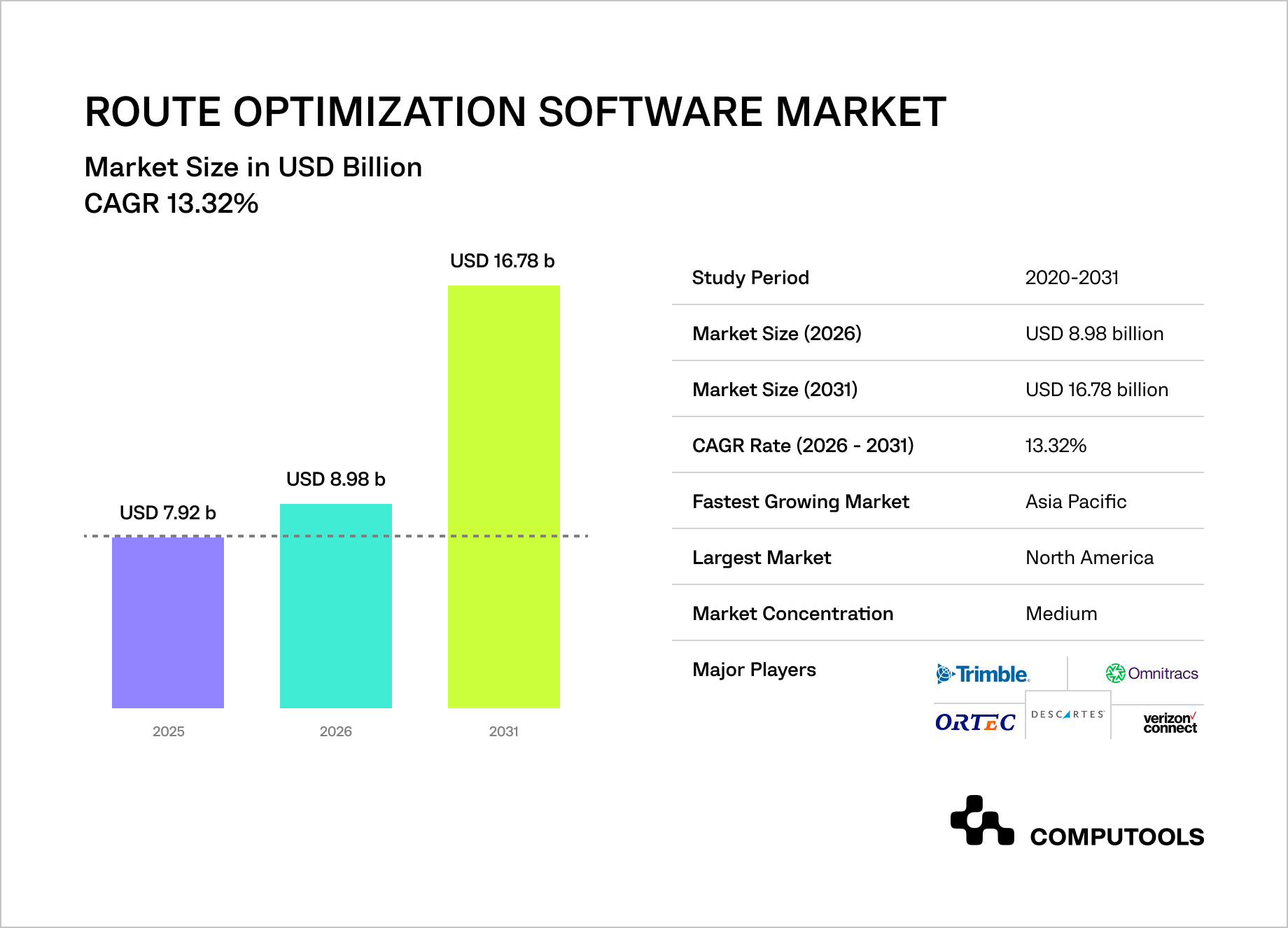
Industry analysts agree that the global route optimization software market is on a strong growth trajectory, with current estimates ranging from USD 8–10 billion in 2025 and projected to reach USD 15–38 billion within the next 5–8 years.
Forecasted CAGR figures remain consistently high, between 13.9% and 14.7%, reflecting rising adoption across logistics sectors worldwide.
North America currently leads in adoption, but the Asia-Pacific region is experiencing the fastest growth, with 16–17% CAGR figures.
Real-world results highlight the cost-saving benefits of delivery route optimization software: businesses integrating route optimization can reduce fuel costs by up to 30%, cut route distances by 10–15%, and improve delivery times by 25–30%.
Logistics route planning involves determining the most efficient vehicle paths for deliveries, pickups, service calls, and other logistics activities.
Route optimization software is a digital, state-of-the-art tool that automates and optimizes route planning for your entire fleet, considering your business’s unique requirements and constraints.
Unlike basic GPS tracking apps that provide the shortest path between two points, route optimization solutions handle many variables such as traffic conditions, delivery windows, vehicle capacity, driver schedules, fuel consumption, maintenance routes, and even real-time weather. This creates routes that minimize costs and maximize productivity.
When should businesses consider route optimization software?
For companies with a small fleet (1–2 vehicles), investing in a full-scale solution may not be immediately necessary; routes can still be planned manually, preserving cash flow for business growth.
However, automation becomes critical once delivery volumes increase or the service area expands.
For mid-sized and large carriers operating 3–50+ vehicles, specialized route optimization software in logistics allows efficient order allocation, precise route calculation, and the ability to handle even international deliveries.
Businesses should consider implementing such tools when:
• High delivery volume: daily orders or stops exceed the limits of manual planning.
• Expanding service areas: entering new regional or international markets.
• Rising operational costs: fuel prices, driver wages, and vehicle maintenance expenses are growing.
• Demand for faster delivery: meeting same-day or next-day delivery commitments.
• Dynamic conditions: traffic congestion, weather changes, or last-minute order adjustments heavily impact operations
By addressing these challenges, route optimization solutions become a cornerstone of supply chain optimization, enabling companies to cut costs, improve efficiency, and enhance customer satisfaction within a modern management system for logistics.
Who needs it?
• Third-party logistics providers (3PLs) for managing multi-client fleets, real-time tracking, and complex delivery schedules.
• E-commerce & retail chains for handling time-sensitive last-mile delivery at scale.
• Food & beverage distributors for balancing perishable goods’ shelf life with optimal routing.
• Field service companies need to plan daily routes for technicians and service crews.
• Manufacturers & wholesalers for coordinating product distribution to retailers or partners.
Why businesses use route optimization software
• Businesses can save costs by lowering fuel consumption, minimizing vehicle wear, and reducing labor hours.
• With route planning automation, companies can deliver more orders in less time without putting extra strain on drivers.
• Improved on-time delivery rates and accurate ETAs lead to higher customer satisfaction.
• Optimizing mileage helps reduce CO₂ emissions, supporting sustainability goals.
• The system allows operations to scale quickly, whether to meet seasonal peaks, expand into new regions, or grow the fleet.
• Access to detailed analytics and historical performance data enables smarter, data-driven decisions for ongoing improvements.
Types of route optimization software
1. Single Depot. Used when deliveries are made from a single warehouse to specific locations. The primary goal is to reduce planning time and transportation costs by optimizing routes for a single point of origin.
2. Multi Depot. Ideal for operations with multiple warehouses or hubs, drivers, and vehicles across different locations. The software coordinates delivery route planning for various sites, ensuring efficient allocation of resources and minimizing empty miles.
3. Integrated Fleets. Designed for enterprise-level supply chain optimization processes involving multiple warehouses, production facilities, third-party carriers, and distribution operations.
All vehicles, operators, and drivers are treated as integrated transportation resources. The software enables fleet managers to coordinate work across multiple locations, maximizing the use of available assets.
Core capabilities across all types
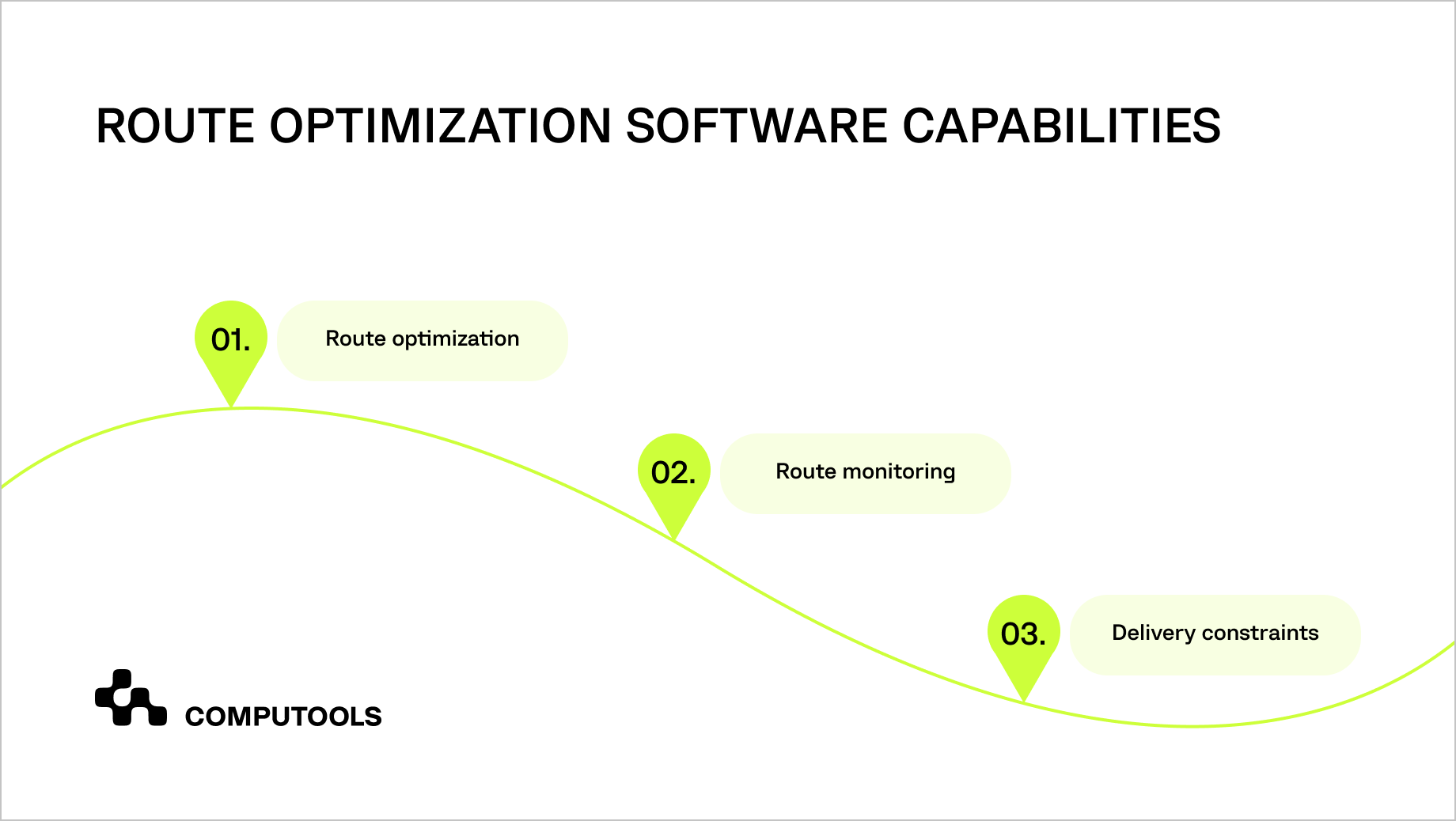
• Route optimization. Automatically generates the most efficient multi-stop, multi-driver routes by analyzing distance, traffic patterns, and delivery priorities. For example, a grocery chain can schedule perishable deliveries to first handle the nearest and time-critical stops, reducing spoilage and fuel costs.
• Route monitoring. Provides real-time visibility into active routes, enabling managers to track driver location, delivery status, and deviations from the plan. A courier service, for instance, can immediately reroute drivers around unexpected road closures or accidents to maintain on-time delivery.
• Delivery constraints management. Plans routes while factoring in specific limitations, such as vehicle size restrictions in city centers, fixed customer time slots, cargo weight limits, or hazardous goods regulations. For example, a construction materials supplier can ensure heavy loads are assigned only to trucks with sufficient capacity and permits, avoiding fines and delays.
Route planning by business type and industry
The route optimization software market in 2026 covered a wide range of industries, each using route optimization to increase profitability, reduce costs, and improve customer experience.
Various industries drive demand:
• According to the latest estimates, on-demand food delivery maintains its leading position in the market, holding over 20% share. Experts predict that this segment will maintain its leadership in 2026, with further growth due to the increasing demand for fast delivery and accurate ETAs.
• Other important sectors: Retail & FMCG, field services, ride-hailing & taxi, as well as logistics & transportation, and home care & field services are actively implementing last-mile delivery optimization solutions to reduce costs, increase ETA accuracy, and improve customer experience.
Examples by sector:
• Food delivery leads to route optimization, particularly for quick response to demand and accurate ETA.
• Retail (FMCG) uses route planning to distribute goods between warehouses and stores efficiently.
• Field services (e.g., assembly or maintenance) value routing to reduce downtime and waste.
• Ride-hailing and transportation optimize customer selection and driver workloads using AI tools.
• Other industries, such as healthcare, pharmaceuticals, mobile sales, food delivery, etc., use a multiple-stop delivery planning system to support complex real-time operations.
Implementing last-mile delivery optimization ensures these industries save costs and consistently meet or exceed customer expectations.
By business size:
• Small businesses – Small companies may lack the resources of giants like Amazon or UPS. However, affordable routing tools still allow them to optimize routes, save fuel, and improve delivery times without excessive costs.
• Medium-sized businesses – Mid-sized companies can use route optimization to handle more deliveries and serve more customers without adding vehicles or drivers, achieving Amazon/UPS-level delivery quality without matching their budgets.
• Enterprise-level last-mile planning – Large enterprises can save thousands or even millions by cutting fuel consumption, reducing accident risks, and lowering CO₂ emissions.
Enterprise-grade solutions offer advanced features like route performance dashboards, customer notifications, real-time driver tracking, planned-vs-actual route comparisons, and driver productivity monitoring.
Dynamic vs. static routing
| Dynamic routing vs. | Static routing |
| Allows new routes to be planned daily with changing destinations, adjusting in real-time for last-minute changes. | Uses fixed routes repeated daily, weekly, monthly, or yearly. |
Both approaches can be tailored to industry-specific needs, from truckload delivery routes to postal code-based planning, pickup routes, or even electric vehicle charging-aware routing.
For companies wondering how to improve delivery efficiency with route planning tools, the answer lies in selecting the right combination of routing methods, technology integrations, and real-time adjustments.
Key reasons to integrate route optimization software into logistics processes
Adopting a delivery optimization system is not just about improving routes; it’s a strategic move that impacts profitability, scalability, and competitive positioning.
Businesses should see it as an investment that strengthens their logistics management system and supports long-term growth.
1. Seamless integration with core business systems
Modern solutions connect with ERP, WMS, CRM, and telematics platforms, creating a single source of truth for all delivery operations. This reduces manual data entry, eliminates errors, and speeds up decision-making.
When to consider:
• You rely on multiple disconnected systems for delivery management.
• Manual data handling causes frequent errors or delays.
Strategic impact: Faster order-to-delivery cycle, better inventory visibility, and smoother coordination across departments with the support of dispatch and freight management software for end-to-end shipment control.
2. Scalability without proportional cost growth
As demand grows, scaling delivery capacity often means adding vehicles, drivers, and administrative staff unless operations are automated. Route optimization allows companies to handle higher volumes without a proportional resource increase.
When to consider:
• Seasonal peaks strain resources.
• Adding new territories would require significant additional headcount.
Strategic impact: Lower cost-per-delivery as the business expands.
3. Competitive Differentiation
In markets where multiple providers offer similar products, delivery performance becomes a key differentiator. Faster, more reliable, and transparent deliveries can tip customer loyalty in your favor.
When to consider:
• Customer churn is increasing due to delivery delays.
• Competitors are offering faster delivery times or better tracking features.
Strategic impact: Stronger brand positioning through consistent service and advanced multi-stop route planning software capabilities.
4. Advanced analytics for smarter decisions
Detailed historical data and performance dashboards reveal patterns, identify inefficiencies, and highlight areas for improvement—insights from analytics feed directly into strategic planning and operational refinement.
When to consider:
• Lack of clear performance data makes it hard to identify problems.
• Decisions are based on assumptions rather than actual delivery metrics.
Strategic impact: Proactive improvements instead of reactive problem-solving, powered by real-time route tracking software for immediate operational insights.
5. Future-proofing against market shifts
Regulatory changes, environmental standards, and shifts in customer expectations require operational agility. Flexible, software-driven route planning ensures you can adapt without major disruption.
When to consider:
• Your region is introducing stricter sustainability or emissions regulations.
• Customer expectations for delivery speed and transparency are evolving rapidly.
Strategic impact: Resilience to fuel price volatility, sustainability regulations, and evolving service models.

Explore how advanced route optimization software can reduce fuel costs, improve on-time performance, and unlock measurable operational efficiency—connect with our experts to assess your deployment roadmap.
Real-world case studies in route optimization software in logistics
1. Amazon – CONDOR Algorithm for Smart Routing
Amazon’s CONDOR (Customer Order and Network Density Optimizer) algorithm groups shipments into geographic clusters, reducing the number of routes and improving last-mile efficiency.
In pilot programs, this approach cut routing resource requirements by around 0.5% in smaller markets. Andrea Qualizza from Amazon SCOT noted that the algorithm enables carriers to deliver more packages to customers on time, while reducing mileage and CO₂ emissions.
2. UPS – ORION AI-Powered Routing
UPS uses its proprietary AI-powered ORION (On-Road Integrated Optimization and Navigation) system to optimize delivery routes. The rollout reduced driver mileage by 100 million miles annually, saving up to $400 million and 10 million gallons of fuel yearly.
Studies show that lowering average daily route length by just one mile across all routes saves UPS around $50 million annually. ORION processes over 200 data points from GPS and telematics, updates routes in real time, and avoids inefficient left turns to save time and fuel.
3. FedEx – AI-Driven Delivery Optimization
FedEx integrates AI and telematics into its delivery management software to optimize last-mile logistics, reduce delays, and save fuel.
The company also partnered with Microsoft to develop FedEx Surround, a predictive tracking platform for time-sensitive shipments that provides real-time visibility and proactive issue resolution.
4. Optym – Greyhound Case: DriverMAX
In partnership with Optym, Greyhound deployed the DriverMAX platform, automatically generating optimized schedules for over 1,000 drivers in under an hour. This delivery dispatch system has significantly improved driver satisfaction and cut operational costs by millions annually.
5. DHL — route planning automation & Greenplan algorithm
DHL funded and rolled out Greenplan, a dynamic routing engine that calculates full-area delivery routes based on traffic patterns and constraints like EV limits.
As part of its commitment to innovation in route optimization software in logistics, Greenplan delivers faster operations, fewer unnecessary miles, and cost reductions of up to 20% on route costs compared to standard tools.
6. Domino’s Pizza – Faster Deliveries with Real-Time Tracking
Domino’s implemented Pinpoint Delivery using Google Maps Platform, enabling customers to drop a pin for delivery anywhere, like parks or construction sites, and track the driver’s movement live in-app.
This innovation, supported by advanced logistics efficiency software, significantly enhanced delivery precision and customer transparency.
Real-world cases from Domino’s, DHL, and FedEx demonstrate that implementing modern route optimization software in logistics delivers fast, measurable results from reducing delivery times and increasing ETA accuracy to significantly reducing routing costs.
Regardless of the company’s size, examples from market leaders confirm that investments in route optimization pay off quickly and create a long-term competitive advantage.
How to integrate route optimization software into business processes: a step-by-step guide
1. Define Business Strategy and Goals
Before investing in route optimization software in logistics, clearly outline your core business goals and operational challenges. This ensures you select the right features and avoid unnecessary costs.
Common goals include saving time and fuel, reducing delivery turnaround, improving KPI benchmarking, automating task allocation, and minimizing delays or vehicle downtime risks.
Collecting accurate data on your current logistics processes and IT infrastructure is essential to ensure the chosen solution fits your operational needs and overall logistics efficiency strategy.
2. Analyze Fleet and Scale Readiness
Manual route planning might be feasible if you operate only 1–2 vehicles. Adopting vehicle routing solutions becomes critical for fleets of 3–50+ vehicles to efficiently manage orders, plan multi-stop deliveries, and scale operations.
3. Match Solution Type to Your Operations
The right deployment model depends on your operational setup.
• A Single Depot approach is ideal for businesses delivering from one warehouse, ensuring straightforward route planning and dispatch.
• Multi Depot models suit companies with multiple warehouses or hubs, enabling efficient multipoint planning and distribution.
• An Integrated Fleets model offers centralized control for large, networked fleets, often connected with a transportation management system to streamline oversight, coordination, and performance tracking across the entire network.
4. Pick a Credible Vendor
Selecting the right technology partner is crucial. Look for a vendor with proven expertise in delivering software and experience in your industry.
Review client feedback, case studies, and success stories on trusted platforms like Clutch. For complex, multi-tier supply chains, choose a provider skilled in dispatch management software integration to ensure smooth implementation and long-term scalability.
5. Leverage Core Capabilities
Modern AI-powered route planning software provides essential functionalities that significantly improve operational efficiency. It enables automated multi-stop route creation, ensuring optimal sequencing of deliveries for time and fuel savings.
Real-time route monitoring allows businesses to track delivery progress and quickly adjust when needed.
Additionally, the system can handle complex constraints such as vehicle size, specific time windows, cargo type, and regulatory requirements, making it highly adaptable to diverse logistics scenarios.
6. Development Process
Follow the standard SDLC stages to build a tailored solution:
• Discovery Phase – Gather requirements, define scope, and estimate timelines and costs.
• UI/UX Design – Create user-friendly prototypes for efficient navigation.
• Development – Transform mockups and requirements into a working application.
• Quality Assurance – Test performance, security, and stability.
• Release – Deploy the final product with complete documentation.
Ensure integration with related systems such as TMS, WMS, ERP, last-mile delivery software, and freight rate management systems to avoid data duplication and enhance workflow. Consider a supply chain optimization solution for more complex needs for centralized coordination.
7. Personnel Onboarding
Even the most advanced route optimization software in logistics is only as effective as the team using it.
Invest in structured onboarding to ensure your staff understands the tools, processes, and best practices for maximizing ROI. Effective training reduces adoption resistance and provides smooth daily operations.
8. Understand the Benefits of AI-Powered Optimization
AI-powered route optimization for transportation businesses can deliver up to 20% fuel savings, reduce vehicle wear, and minimize idle time, lowering operational expenses while improving service reliability.
Before deployment, define whether your primary goal is to cut costs, speed up deliveries, enhance customer satisfaction, or optimize driver utilization. This clarity ensures the solution addresses your most pressing operational priorities.
9. Maintenance and Scalability
Integration is not the final step. To meet market demands, continuous technical support, version upgrades, and code optimization are essential.
Scalable solutions allow you to add advanced features and maintain peak performance over time, which is crucial for competitive delivery optimization software use.
Need smarter routes and faster deliveries? See how Computools transforms logistics.
You need a strong strategy, the right tools, and a dependable partner to integrate route optimization software into your logistics operations successfully.
Computools is your expert in achieving this—a global software engineering and consulting company with 250+ engineers, 400+ delivered projects, ISO 9001/27001 certifications, GDPR & HIPAA compliance, and Microsoft Partner status. Trusted by Visa, Epson, IBM, Dior, Bombardier, and the British Council.
The company’s experience in logistics software development services and fleet management software development helps clients to optimize complex delivery networks, improve fleet utilization, and improve customer satisfaction.
Computools builds enterprise-grade solutions for real-time tracking, dispatch processes automation, and AI-driven optimization tailored to industry-specific needs. This allows clients to scale from small fleets to complex, multi-location networks while maintaining high service quality and operational efficiency.
Explore their proven logistics projects here: Computools case studies, or contact info@computools.com to discuss how they can assist in transforming your logistics operations.
Computools
Software Solutions
Computools is an IT consulting and software development company that delivers innovative solutions to help businesses unlock tomorrow.








“Computools was selected through an RFP process. They were shortlisted and selected from between 5 other suppliers. Computools has worked thoroughly and timely to solve all security issues and launch as agreed. Their expertise is impressive.”