
THE AUTHOR:

Healthcare startups operate under intense pressure: clinicians today spend nearly half their workday on administrative tasks instead of patient care, and in many practices physicians dedicate up to 3.2 hours per day just on documentation and inbox management — often more than time spent with patients.
For many emerging healthcare companies, the need to build an AI clinical documentation system becomes a direct response to these challenges rather than a long-term innovation goal.
Administrative costs also make up as much as one-third of total healthcare expenditures, with hospitals spending over 40 % of their budgets on administrative processes rather than clinical operations. These inefficiencies contribute to burnout, with nearly half of physicians reporting symptoms linked directly to paperwork burdens and staffing challenges.
Healthcare startups operate under intense pressure: clinicians today spend a large portion of their time on administrative and documentation tasks, while healthcare systems worldwide are turning to technology for relief.
One measurable indicator of this shift is the rapid adoption of AI across the healthcare sector — with recent industry data showing that by 2025 around 80 % of healthcare organizations report using AI tools in clinical workflows or operational processes, and over 40 % saying AI has already improved operational efficiency in patient care and administrative tasks.
Globally, leaders in healthcare innovation expect automation to be essential for managing workforce gaps, and in many systems AI is now being applied not just experimentally but as a core tool for operations.
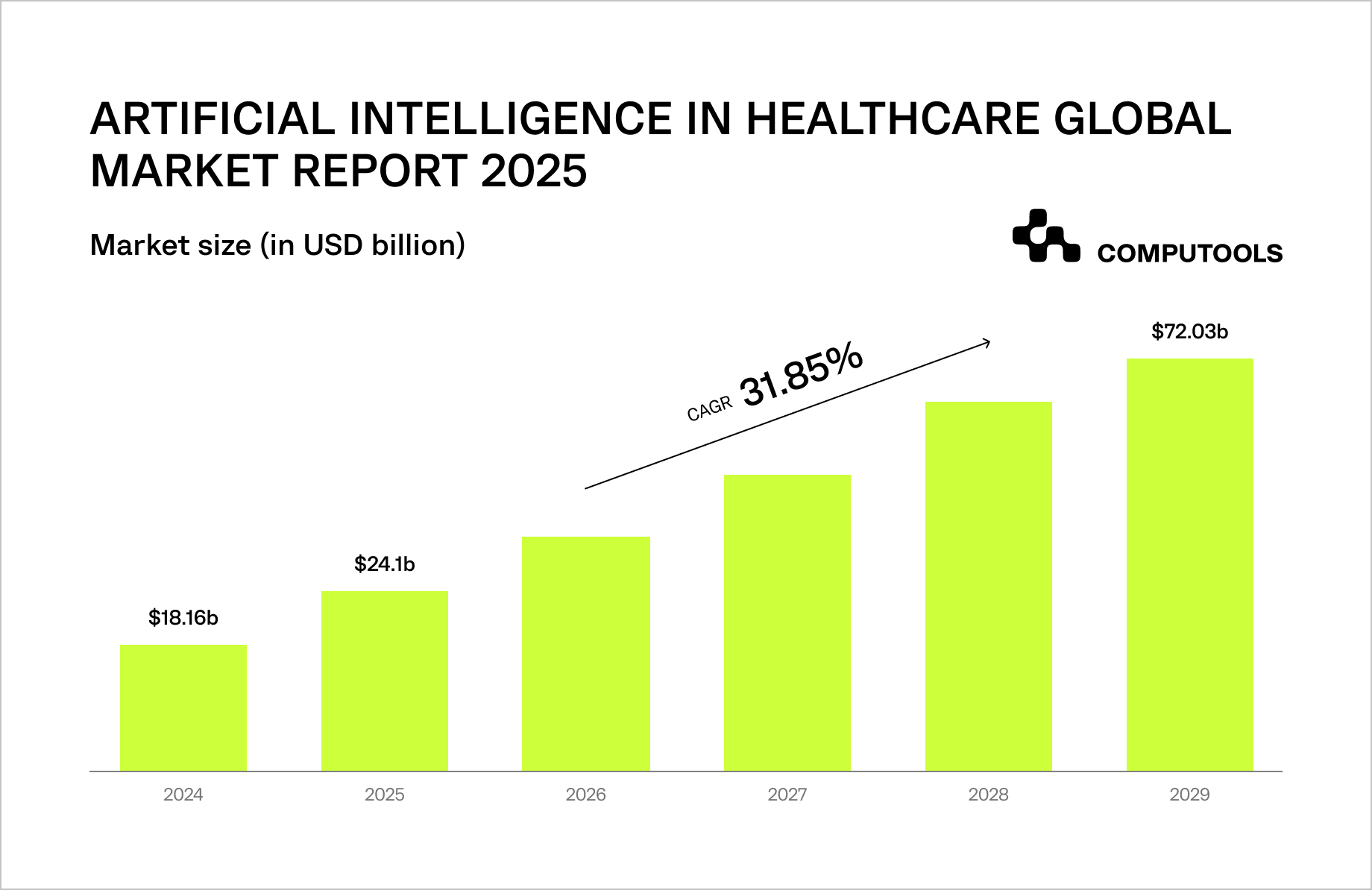
This convergence of limited resources, strict regulations, fragmented data sources, and high expectations from medical staff creates a perfect storm for healthcare startups — including Medirect, which faced many of the same operational obstacles while building an out-of-the-box digital platform for healthcare facilities.
From the very beginning, Medirect’s vision went beyond simple patient management. The company aimed to create an AI medical documentation system that would centralize patient data, optimize medication workflows, and support accurate clinical decision-making — all while reducing the administrative burden on doctors and nurses.
This is where AI clinical documentation software became a strategic foundation rather than an optional feature.
AI creates meaningful impact only when it aligns with established clinical workflows and accountability structures. How to Integrate AI Diagnostics Into Existing Hospital Workflows explores how hospitals can adopt AI solutions without interrupting care delivery processes.
Business context: Medirect’s healthcare challenge
Medirect is a fast-growing healthcare startup addressing a complex operational challenge: how to build an AI clinical documentation system that seamlessly integrates people, processes, and data within modern medical facilities.
Operating at the intersection of medicine and technology, the company set out to reduce administrative overload while improving the accuracy, speed, and security of clinical documentation. This vision directly aligned with trends such as Clinical note summarization with AI and the growing demand for healthcare AI documentation solutions.
Medirect brought together several strategic assets: highly qualified medical staff, advanced diagnostic and treatment equipment, neural networks capable of processing large volumes of unstructured medical data, and a robust data protection framework compliant with healthcare regulations. However, without automated clinical documentation AI, these components operated in silos, limiting overall efficiency.
The startup aimed to enable AI-powered clinical note taking supported by Medical NLP for clinical documentation, forming an AI system for healthcare documentation that could scale across departments. Their long-term strategy included clinical documentation automation through AI tools for clinical note summarization and AI-driven medical record documentation embedded into daily workflows.
To achieve this, Medirect explored healthcare documentation software development supported by AI in clinical workflow optimization and Intelligent clinical documentation systems.
This initiative became part of a broader roadmap that included healthtech software development services, custom healthcare software, digital transformation services, web development services, and AI development services, ensuring a unified digital environment with secure, role-based access for doctors, nurses, and administrators.
Why AI was the right answer
Medirect’s operational and clinical challenges clearly demonstrated that traditional approaches to documentation were no longer sufficient. Fragmented patient records, manual data entry, and inconsistent reporting created bottlenecks that directly affected care quality and staff productivity. These constraints naturally pointed to the adoption of Intelligent clinical documentation systems as a scalable and future-proof solution capable of handling complex clinical data flows.
The primary objective was to centralize patient records and medical histories into a single, secure digital ecosystem, eliminating duplication and information loss. By enabling AI-powered clinical note taking, clinicians could focus more on patient interaction while the system handled routine documentation tasks. At the same time, clinical note summarization with AI allowed physicians to quickly review key insights from extensive medical records, significantly reducing cognitive load.
Another critical requirement was ensuring accuracy and consistency in calculations, analytics, and clinical reports. Leveraging Automated clinical documentation AI supported standardized data processing and minimized human error, directly reducing the risk of medical mistakes. Advanced Medical NLP for clinical documentation made it possible to interpret unstructured clinical language and transform it into actionable, structured data, accelerating decision-making across departments.
This AI-first strategy aligned seamlessly with industry-wide shifts toward AI-driven medical record documentation and AI in clinical workflow optimization, where intelligent automation enhances both efficiency and patient safety.
To support this vision, Medirect relied on healthtech software development services combined with custom healthcare software as the foundation of its digital ecosystem.
The initiative was further reinforced by digital transformation services, web development services, and AI development services, ensuring that the solution was not only technologically advanced but also adaptable to future healthcare demands.
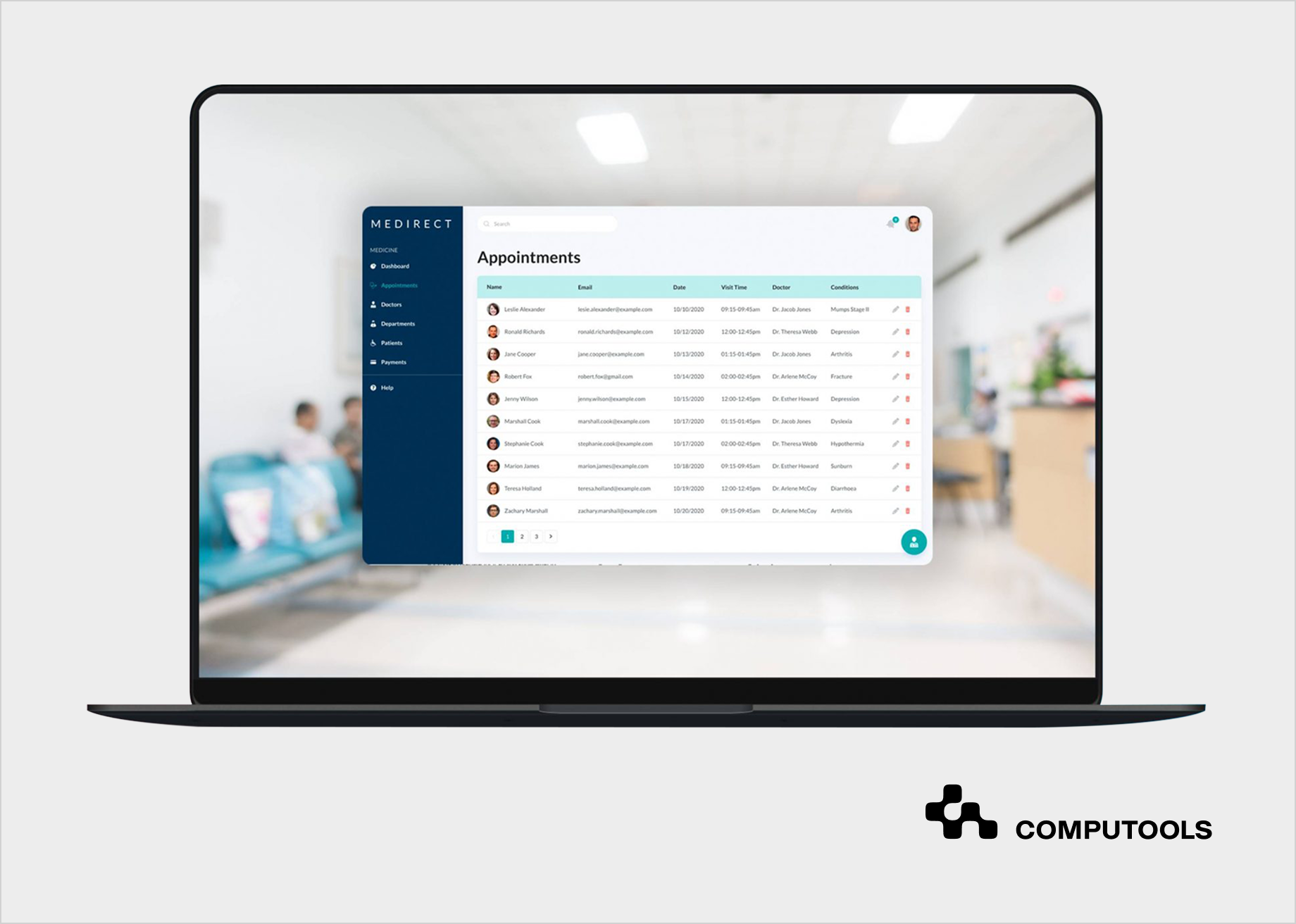
Solution overview: How Computools built Medirect
Computools designed and delivered a centralized digital platform that became the structural foundation of Medirect’s long-term technology strategy. Instead of creating a narrowly focused tool, the team approached the project as a scalable ecosystem capable of supporting future innovation. The platform was engineered to bring order to fragmented clinical and operational data while maintaining strict security and compliance requirements typical for healthcare environments.
At the core of the solution was the unification of multiple data sources into a single, coherent system. Patient records, clinical measurements, operational metrics, and administrative data were consolidated into a standardized data model, eliminating inconsistencies and duplication.
Unified calculation logic ensured that reports and clinical indicators were generated using consistent rules across departments, increasing trust in the data and supporting more informed decision-making.
Beyond consolidation, the platform introduced advanced data processing and analytical capabilities powered by neural networks. This allowed Medirect to move from passive data storage toward active insight generation.
As a result, the company established a strong technical base for progressively introducing automation, structured medical histories, and intelligent assistance for clinicians without disrupting existing workflows.
To guarantee scalability, reliability, and performance under growing data volumes, Computools selected a robust and proven technology stack.
The backend, built with .NET and C#, provided a secure and high-performance foundation capable of handling sensitive medical information. ASP.NET MVC enabled a modular architecture, allowing individual components to evolve independently as new features were introduced.
Cloud infrastructure on Azure ensured resilient data storage, efficient processing, and readiness for future computational demands.
On the frontend, Angular and jQuery delivered a responsive and intuitive user interface, while HTML5, CSS3, and Bootstrap ensured a modern, adaptive design accessible across devices.
This architecture was intentionally designed to support future expansion into advanced analytics and intelligent data processing without requiring a complete system redesign.
1. AI Layer: From Data Chaos to Clinical Intelligence
While Medirect initially launched as a centralized data platform, its internal architecture was deliberately engineered with intelligence in mind. Computools anticipated future requirements and embedded flexibility at every layer, allowing the system to evolve naturally from structured data management into a clinically intelligent environment.
From the outset, the platform supported well-defined patient data pipelines that ensured information was captured, validated, and stored in a consistent format. Standardized calculation models established a reliable analytical baseline, while secure data storage created a safe environment for iterative model training and experimentation.
Role-based access controls enabled medical professionals to remain actively involved in reviewing and validating system outputs, ensuring transparency and accountability.
These architectural elements are essential for introducing advanced capabilities in highly regulated healthcare settings. Over time, the platform’s design allows for the gradual introduction of language-based data interpretation, intelligent summaries of patient histories, and clinical decision-support tools.
This evolutionary approach transforms raw medical data into actionable clinical intelligence, empowering healthcare professionals to make faster, more confident, and better-informed decisions while maintaining full control over patient care.
2. Design & User Experience as a Clinical Safety Factor
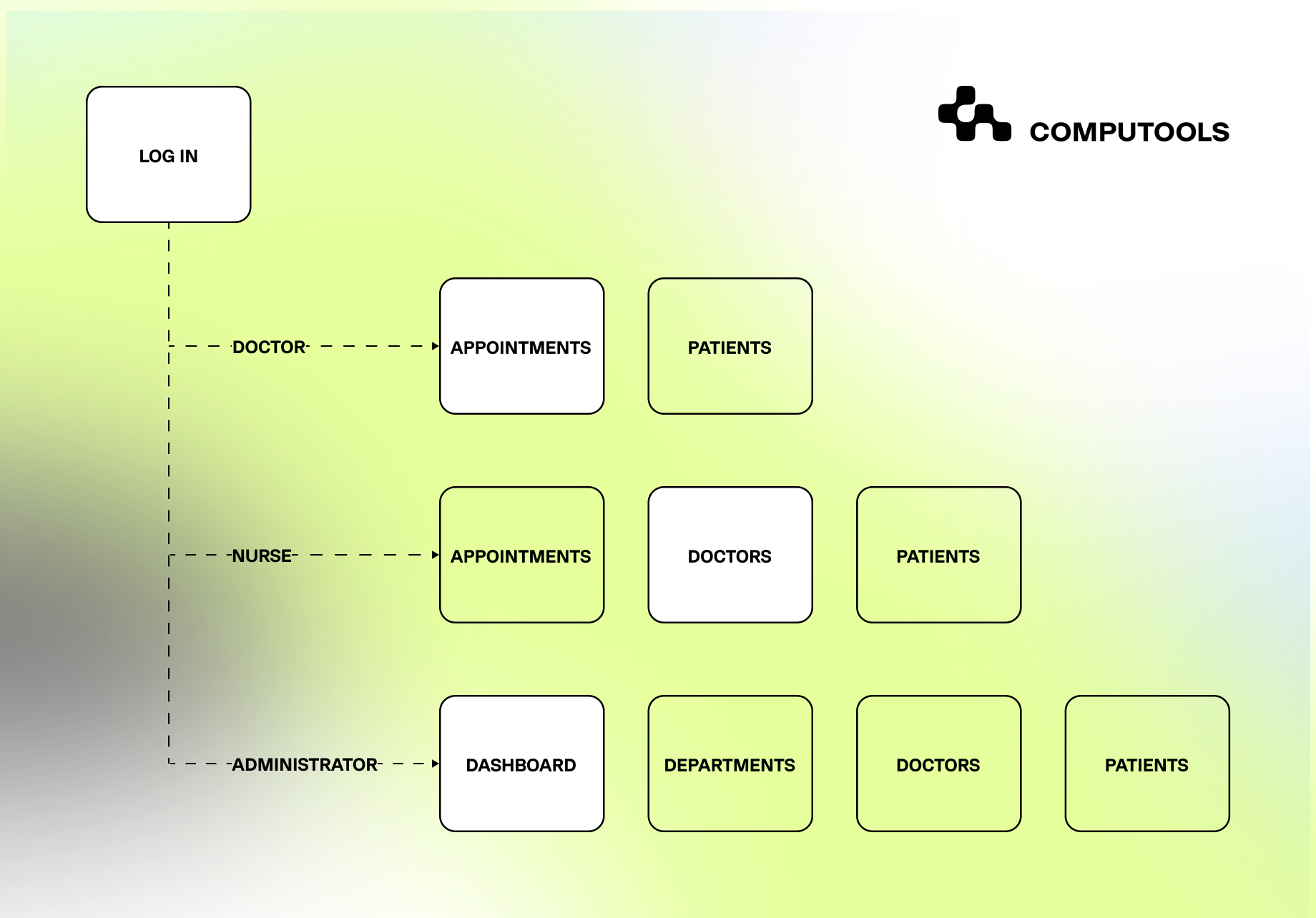
From the very beginning, Computools treated design and user experience not as a visual layer, but as a core clinical safety component. In healthcare environments, poorly designed interfaces can lead to delays, misinterpretation of data, and even medical errors. That is why the team followed a structured, user-centered design process:
USER PERSONA → SITE MAP → WIREFRAMES → USER INTERFACE
Each stage was grounded in real clinical roles and daily routines. Doctors needed fast access to patient histories without distraction, nurses required streamlined views of only the documentation relevant to their responsibilities, and administrators depended on clear workflow visibility and system control. This role-based approach significantly reduced cognitive load and helped users interact with the platform intuitively.
Such thoughtful UX design directly supported the adoption of AI system for healthcare documentation, ensuring that intelligent features complemented clinical work rather than complicating it.
Clear navigation, consistent layouts, and predictable interactions created the foundation for future clinical documentation automation, allowing advanced functionality to be introduced without disrupting established habits. In this context, the platform evolved not just as software, but as a reliable assistant embedded into everyday clinical practice.
3. Project Management & Delivery
The Medirect platform was delivered using the Scrum framework, which provided the flexibility and transparency required for a complex healthcare product. Iterative development cycles enabled the team to release functionality incrementally, gather continuous feedback from stakeholders, and validate assumptions early. This approach made it possible to identify risks at initial stages and adapt priorities as clinical and business needs evolved.
Regular sprint reviews and planning sessions ensured predictable delivery timelines while keeping the solution aligned with real-world usage. Importantly, this project management methodology allowed both intelligent components and core platform features to mature together, preventing gaps between data infrastructure and higher-level capabilities such as healthcare AI documentation solutions.
The delivery model was supported by healthtech software development services, complemented by custom healthcare software tailored to Medirect’s operational realities.
As the platform scaled, digital transformation services helped align technology decisions with long-term business goals, ensuring that innovation remained sustainable, compliant, and directly tied to measurable clinical value.

Assess how an AI documentation system can integrate with your EHR, protect PHI, and support clinicians—connect with our experts to scope and estimate the build.
Medirect’s impact: measurable business results
The launch of the Medirect platform delivered tangible, measurable outcomes that directly impacted both business performance and clinical quality. Within a relatively short period, the company recorded a 15% increase in market share, driven by improved operational transparency and faster onboarding of medical partners. Medical staff efficiency rose significantly as clinicians spent less time navigating fragmented systems and more time focusing on patient care.
Diagnostic accuracy also improved due to standardized data handling and consistent calculation models embedded into the platform. By eliminating discrepancies across reports and ensuring that clinicians worked with a single source of truth, Medirect reduced uncertainty in decision-making. As workflows became more predictable and data more reliable, the overall risk of medical errors decreased, strengthening trust in the system across all user roles.
These outcomes clearly validate the ROI of healthcare documentation software development when AI readiness is built into the core architecture from the start. Even before advanced AI capabilities were fully deployed, the platform’s design allowed Medirect to introduce AI tools for clinical note summarization, reinforcing scalability, efficiency, and clinical reliability without disrupting existing workflows.
What healthcare businesses can learn from Medirect
For healthcare business leaders planning to build AI clinical documentation systems, the Medirect case provides several practical lessons. Start with data centralization, standardize calculations early, design for AI even if AI features come later, prioritize security and compliance, and invest in user experience tailored to clinical roles.
Computools supports healthcare companies at every stage of this journey. Through healthtech software development services, complemented by custom healthcare software, AI development services, digital transformation services, and web development services, the team helps organizations implement scalable, future-ready solutions that optimize workflows, enhance patient care, and maintain regulatory compliance.
Conclusion: key takeaways from the Medirect case study
The Medirect case demonstrates that building an AI clinical documentation system is not just a technical challenge, but a strategic opportunity to transform healthcare operations. By centralizing data, automating routine tasks, and designing with clinical roles in mind, healthcare startups can reduce administrative burdens, improve accuracy, and empower staff to focus on what matters most — patient care.
The Medirect platform shows that thoughtful integration of AI and robust software architecture leads to measurable improvements in efficiency, safety, and decision-making.
For CTOs and healthcare business leaders, the lessons are clear: start with a strong data foundation, anticipate future AI needs, prioritize user experience, and ensure that security and compliance are embedded in the system from day one.
When these elements come together, AI evolves from an optional enhancement into a core operational advantage, capable of reshaping clinical workflows and outcomes.
Contact Computools at info@computools.com to discuss your healthcare software development goals and turn complex clinical challenges into scalable, intelligent solutions.
Adopting digital systems such as AI-powered clinical support often goes hand in hand with broader healthcare digital transformation efforts, including the use of CRM tools to enhance patient engagement. For deeper insights into healthcare CRM advantages, explore our analysis of the Top 12 Benefits of CRM Development for the Healthcare Industry.
Computools
Software Solutions
Computools is an IT consulting and software development company that delivers innovative solutions to help businesses unlock tomorrow.