
THE AUTHOR:

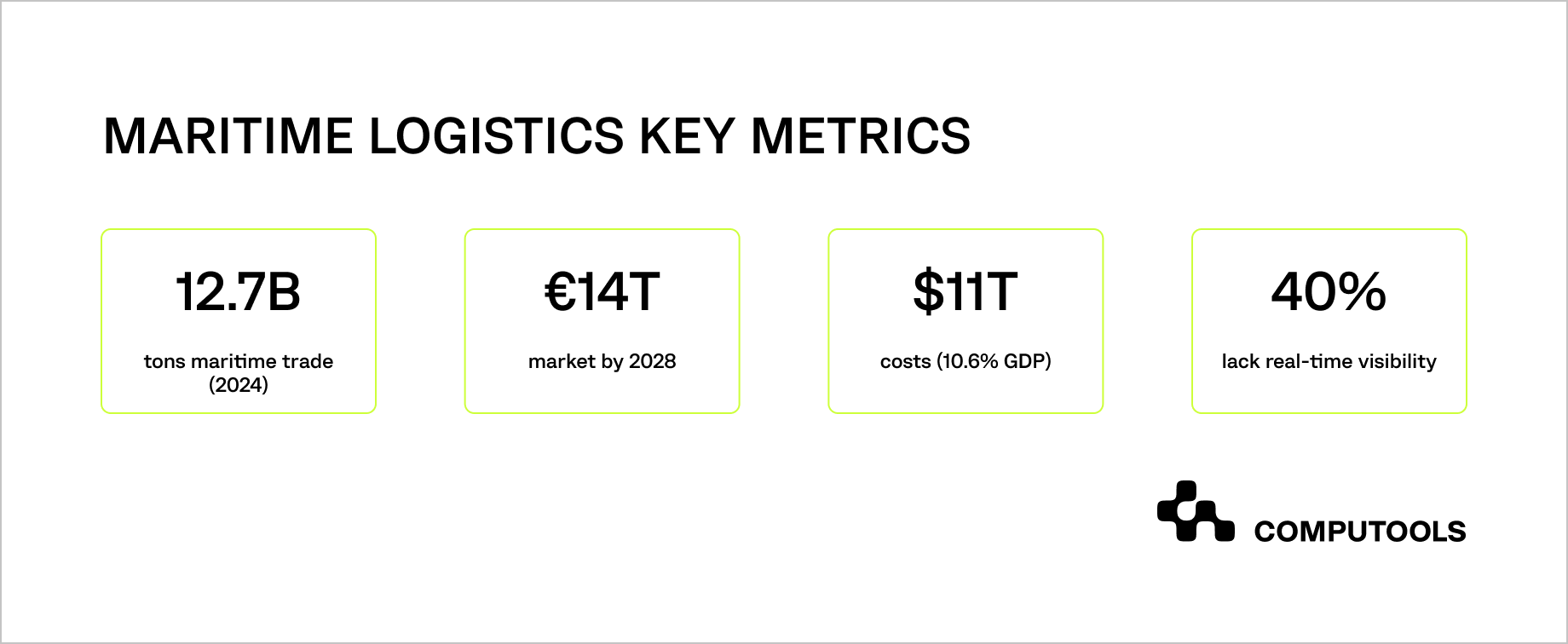
In 2024, global maritime trade volumes reached 12.7 billion tons, up 2.2% from the previous year, according to UNCTAD. The global logistics industry was valued at over 9.4 trillion euros in 2023 and is projected to exceed 14 trillion euros by 2028.
Logistics costs have surpassed 11 trillion U.S. dollars, accounting for 10.6% of global GDP. Gartner’s 2025 insights show that nearly 40% of logistics leaders identify the lack of real-time transparency as their biggest operational barrier.
For companies aiming to stay competitive in 2026 and beyond, the imperative is clear: build cargo visibility platform solutions that deliver real-time tracking, unified data, and actionable insights.
The main challenge is strategic. Fragmented data across ports, customs, and carriers causes costly downtime, reduces customer trust, and limits responsiveness to disruptions. Without a unified visibility platform, maritime logistics will struggle to maintain efficiency and resilience.
How Computools delivered a cargo visibility platform for port logistics
Our experience in maritime software development services comes from solving real challenges in international trade, where fragmented data and manual reporting create delays and inefficiencies.
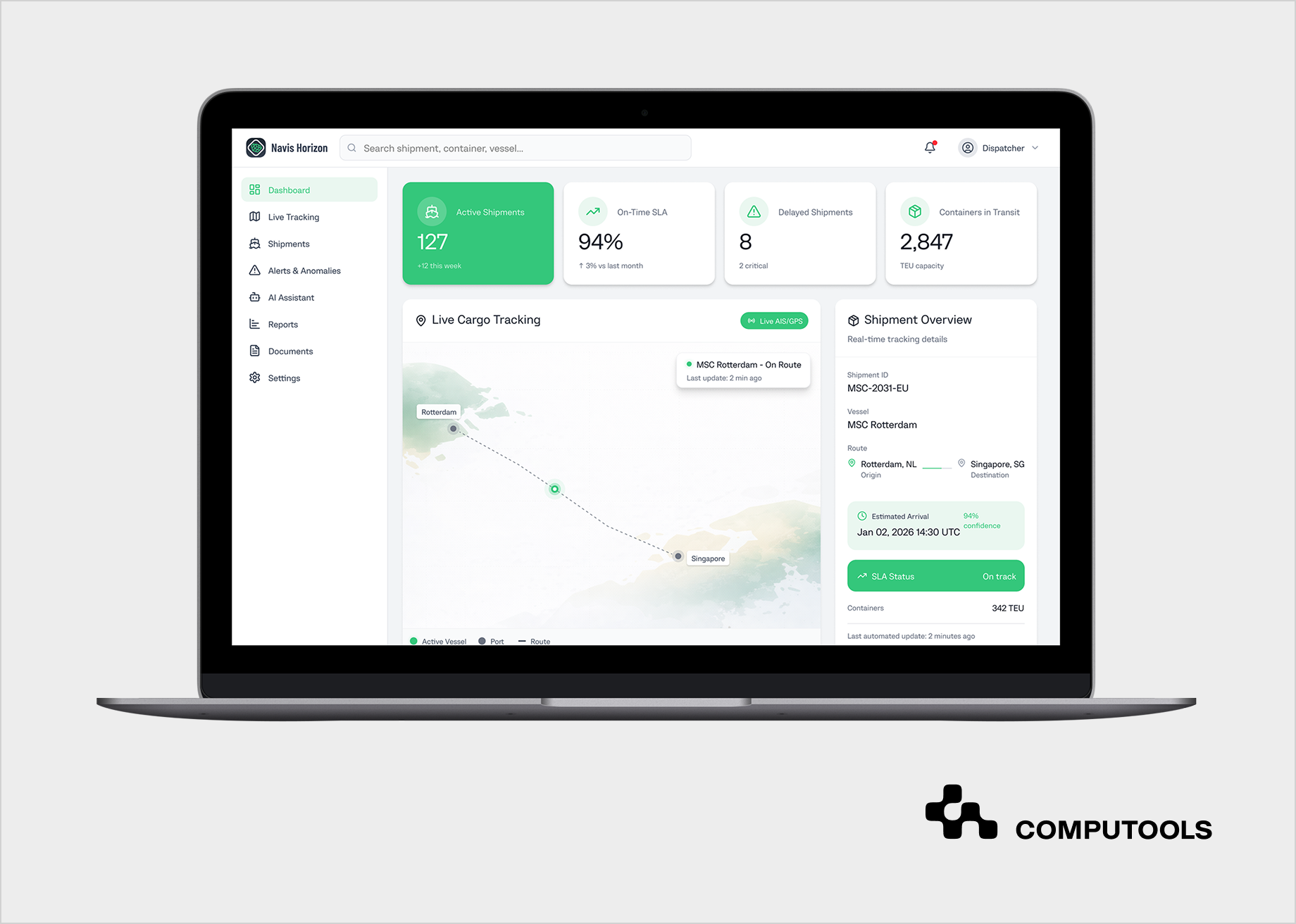
For a port logistics operator in Hamburg, we implemented Navis Horizon, a unified platform that consolidates AIS/GPS signals, carrier events, and predictive analytics. The solution gives dispatchers anomaly alerts and delay forecasts. Customers can access shipment status and documentation through an AI-powered chat interface.
By applying advanced IoT development services and integrating multiple tracking sources, the platform ensures continuous cargo visibility.
An intelligent assistant built with our AI development services automates repetitive tasks, summarizes shipment data, and delivers proactive updates.
Results achieved:
- Dispatcher workload reduced by 40%
- Customer satisfaction increased by 23%
- Shipment incident resolution accelerated by 18%
- Full transparency in cargo status updates
Delivering solutions like Navis Horizon demonstrates the ability to integrate complex data sources, design scalable architectures, and apply AI-driven support in real operational environments.
This expertise is proven by measurable results, including reduced dispatcher workload, faster incident resolution, and higher customer satisfaction.
Because we have already solved these challenges in practice, we can now share a step-by-step guide on how to build cargo visibility platform for maritime logistics. In the next section, we outline the essential stages from requirements discovery and data integration to predictive analytics, AI assistants, and customer-facing dashboards.
This guide offers a practical roadmap for companies aiming to transform fragmented operations into a transparent, efficient, and resilient logistics ecosystem.
8-step guide: how to build a real-time cargo visibility platform for port and maritime logistics
1. Map the Supply Chain and Identify Visibility Gaps
Building a supply chain visibility for maritime logistics solution starts with a deep operational audit of how cargo actually moves across the ecosystem.
In port environments, visibility gaps rarely occur within a single system; they arise at transition points between stakeholders, where data is delayed, inconsistent, or unavailable.
At this stage, companies must go beyond high-level mapping and conduct a detailed breakdown of the entire operational and data landscape, including:
- all physical nodes: ports, terminals, vessels, warehouses, inland transport;
- all digital systems involved: TOS, ERP, carrier platforms, customs systems;
- data ownership across stakeholders (who generates and controls each event);
- latency points where updates are delayed (e.g., port-to-carrier handoffs);
- manual processes such as emails, calls, and spreadsheets that replace system integrations.
A key challenge in maritime logistics is that shipment visibility is not linear. Cargo moves across multiple legs—ocean, port handling, inland delivery—each controlled by different parties with different data standards. Without identifying these fragmentation points early, companies risk building a platform that mirrors existing inefficiencies instead of eliminating them.
In our case, we conducted a workflow audit and discovered that dispatchers were manually aggregating shipment data from multiple sources, including carrier portals, port messages, and spreadsheets. The biggest issue was not a lack of data but the absence of a unified view across systems.
2. Define Critical Data and Visibility Requirements
Once the supply chain structure and visibility gaps are clearly identified, the next step is to determine which data is needed to support real-time decision-making. At this point, the focus shifts from mapping operations to establishing the information layer that will power the platform.
Effective logistics data platforms for shipping are not built around maximum data ingestion but around data relevance and consistency. In maritime logistics, the most valuable inputs are event-based and reflect changes in cargo status across the journey. These include vessel movements, container-handling events, terminal operations, customs updates, and inland transport milestones.
However, these data points are typically generated by independent systems, each with its own update frequency, structure, and level of reliability. Without a unified approach to data modeling, the same shipment may be represented differently across sources, resulting in inconsistencies and reduced trust in the platform.
To address this, the data layer must be standardized early in development. This includes defining a consistent event model, aligning naming conventions, and establishing rules for interpreting and synchronizing shipment updates. The goal is to ensure that all incoming data contributes to a coherent operational view.
Timing and data freshness are equally important. Real-time signals such as AIS and GPS should be integrated with slower updates from carriers, terminals, and customs systems, with clear rules for update frequency, delay handling, and conflict resolution.
Role-based data consumption is another critical factor. Operational teams need detailed information to manage exceptions, while customers require clear and simplified updates. This structure also supports future capabilities such as alerting, analytics, and predictive modeling.
Finally, the platform must define which sources are authoritative in specific scenarios and how discrepancies will be resolved. Without this logic, data integrity and user trust quickly erode.
In the Navis Horizon project, we defined a structured event model centered on AIS/GPS signals, carrier updates, and terminal events that directly influenced operational workflows. Data from multiple sources was normalized into a unified format and aligned with consistent event definitions.
We also implemented prioritization and validation rules to resolve discrepancies between inputs. This approach allowed dispatchers to track shipments accurately in real time while delivering clear, reliable status updates to customers, laying a stable foundation for predictive analytics and AI-driven functionality.
3. Build a Centralized Platform Architecture (Control Tower)
The next step in logistics visibility platform development is to design and implement a centralized platform architecture that consolidates all shipment data into a single operational environment.
In maritime logistics, data is inherently distributed across multiple independent systems, including carriers, port terminals, tracking providers, and enterprise platforms. Without a centralized layer, these systems remain disconnected, and visibility is limited to isolated data points rather than a coherent, end-to-end view.
A cargo visibility platform must therefore function as a control tower, a unified system that ingests, processes, and synchronizes data from all relevant sources. Its primary objective is to establish a single source of truth for shipment status that is accessible to all stakeholders.
At the architectural level, this requires designing a data pipeline capable of handling heterogeneous inputs. External data sources such as AIS feeds, GPS tracking, carrier APIs, and terminal systems must be integrated into a common ingestion layer. Incoming data is then normalized according to the predefined event model and stored in a structured format that supports both real-time access and historical analysis.
Equally important is the ability to continuously process data. A modern visibility platform must support streaming architectures that allow shipment events to be updated in near real time. This ensures that operational teams are working with the most current information available, rather than relying on delayed or batch-processed updates.
Scalability is crucial as shipments, integration points, and users increase, requiring the platform to sustain performance through modular design, distributed processing, and cloud infrastructure that handles high data volumes without latency.
The centralized system ensures consistent data governance by consolidating inputs to enforce validation, resolve conflicts, and maintain data integrity across the logistics network, building trust and ensuring reliable analytics. The control tower underpins all user features—dashboards, alerts, portals, and AI insights—by relying on unified, up-to-date data; without it, advanced features such as predictive analytics and automation can’t operate effectively.
It is important to note that centralization does not mean replacing existing systems. Instead, the platform serves as an integration and orchestration layer, connecting and enhancing them, allowing companies to leverage their existing IT infrastructure while overcoming fragmentation.
In the Navis Horizon project, we designed a centralized platform that aggregates AIS, GPS, and carrier-event data into a unified operational layer. A high-performance Go backend handles real-time data ingestion and processing, while a structured data model ensures consistency across all sources.
The platform serves as a single source of truth for both dispatchers and customers, enabling real-time visibility, reliable status updates, and seamless integration with external systems. This architecture allowed the solution to scale efficiently while maintaining low latency and high data accuracy.
For a broader overview of the market, read the Top 20 Maritime Software Development Companies Globally.
4. Ensure Data Quality and Monitoring Across Cargo Flows
Once the centralized architecture is in place, the next step is to ensure that the data flowing through the platform remains accurate, consistent, and reliable. This is a critical stage, as the value of any maritime cargo monitoring technology depends not on the volume of data collected, but on its quality and trustworthiness.
Data inconsistencies are common, with shipment events reported differently by carriers, terminals, and tracking providers. Updates may arrive late, duplicated, or conflicting. Without structured validation, the platform risks amplifying, not resolving, these issues. To address this, the system must implement a multi-layered data validation strategy. Incoming data should be verified across multiple sources wherever possible.
For example, carrier-reported events can be cross-checked against AIS or GPS signals, while terminal updates can be validated using geolocation logic and predefined operational boundaries.
This introduces contextual verification, where the platform checks if events are logically consistent within the shipment timeline. If a container is reported unloaded but vessel data shows it hasn’t arrived at port, the system flags this discrepancy.
Another essential component is data normalization and cleansing. Different systems may use varying formats, naming conventions, and time standards. The platform must standardize this information to maintain a consistent operational view. This includes aligning timestamps, unifying event definitions, and eliminating duplicate or conflicting records.
Real-time monitoring also needs clearly set rules for data prioritization. When different sources give varying values for the same event, the system must decide which source is authoritative under specific conditions. These rules should be created during development and continuously improved based on real-world experience.
Equally important is transparency in handling data uncertainty. Instead of showing potentially inaccurate information as final, the platform should display confidence levels or point out inconsistencies. This enables users to make informed decisions even when data is incomplete.
High-quality data impacts performance by enabling accurate ETA predictions, alerts, and anomaly detection. Poor data causes false alarms and missed disruptions, reducing trust. As the platform scales with more data sources and regions, maintaining quality is complex. Early validation and monitoring ensure reliability as it expands.
In the Navis Horizon platform, we implemented cross-source validation by comparing AIS/GPS tracking data with carrier and terminal events. We introduced normalization rules to align data formats and timestamps across all inputs, ensuring consistency in shipment timelines. The system also applies real-time logic to detect anomalies and discrepancies, reducing false alerts and improving decision accuracy.
This approach significantly increased data reliability and enabled both dispatchers and customers to trust the platform as a single source of truth.
5. Integrate Systems and Automate Operational Workflows
The next step is to connect the platform to the broader logistics ecosystem and eliminate manual processes. At this stage, container tracking software solutions evolve from isolated tracking tools into fully integrated operational systems.
In maritime logistics, inefficiencies often result from challenges in accessing and using data rather than a lack of data. Dispatchers typically depend on emails, phone calls, and various external portals to gather shipment updates. This approach delays decision-making, increases the risk of errors, and causes communication bottlenecks. This step aims to replace fragmented manual workflows with automated, system-driven processes.
The process starts with API-based integrations. The platform should connect directly with carriers, port terminals, tracking providers, and enterprise systems such as ERP, TMS, and warehouse platforms. These integrations support continuous data exchange without manual input, ensuring shipment updates are received and processed in real time. However, integration alone is not enough. The primary value lies in business process automation.
With seamless data integration, operational workflows can be redesigned using event-driven logic. Shipment status changes should automatically trigger predefined actions. For example, delays generate alerts for dispatchers, updated ETAs are sent to customers, and exceptions are routed to responsible teams without manual intervention.
Transitioning from reactive communication to automated workflows significantly reduces operational overhead. Teams can then focus on managing exceptions and optimizing performance, rather than repeatedly requesting updates.
Synchronization across systems is also essential. Data received by the visibility platform should be distributed to existing systems, ensuring all stakeholders have access to the same information and preventing the creation of new data silos.
Automation improves communication consistency. Customers receive proactive updates through notifications, dashboards, or integrated interfaces, reducing reliance on support teams. This decreases inbound inquiries and enhances service quality.
Automated workflows enable the platform to manage higher shipment volumes without a corresponding increase in operational workload. This scalability is crucial for companies operating across multiple ports, regions, and transport modes.
Integration and automation should be implemented incrementally. Connecting all systems at once increases complexity and risk. A phased approach, beginning with the most critical integrations and workflows, supports validation and continuous improvement.
In the Navis Horizon case, we integrated carrier APIs and port-event systems to enable automatic data exchange and eliminate manual status collection. Shipment updates are processed in real time and trigger automated notifications for both dispatchers and customers.
This reduced reliance on emails and calls, significantly decreased dispatcher workload, and ensured consistent, proactive communication across all stakeholders.
For a deeper understanding of how integration across multiple partners is implemented in practice, explore cargo tracking platform development in How to Develop Multi-Carrier Collaboration Platforms for Logistics Ecosystems.
6. Enable Real-Time Tracking and Operational Visibility
Once integrations and automation are established, the platform must deliver continuous, real-time visibility across all stages of cargo movement. At this point, the system evolves into a fully functional layer of real-time freight visibility systems that reflects the actual state of operations as they unfold.
In maritime logistics, visibility is often fragmented across transport stages. Ocean shipments, port handling, and inland delivery are usually tracked separately, leading to blind spots during transitions. An effective platform addresses these gaps by synchronizing all events into a single, continuously updated shipment timeline.
This approach shifts from periodic updates to event-driven tracking. Rather than relying on scheduled status reports, the platform processes signals as they occur, including vessel movement, container handling at the terminal, and handover to inland transport. Each event updates the shipment status in real time, ensuring users always have the most up-to-date information.
To support this, the system must maintain a persistent connection between the backend and user interfaces. Technologies such as streaming pipelines and real-time communication protocols enable instant data delivery without the need for manual refresh or repeated queries. This is critical in high-pressure operational environments, where delays in information can lead to delayed decisions.
Timeline consistency is also important. Shipment events should be organized in a clear order that matches the cargo’s real journey. This helps users quickly see the current status, what has happened, and what will happen next.
Real-time visibility makes proactive alerts possible. The platform finds problems as soon as they happen, so there is no need to wait for someone to report them. Delays, route changes, missing events, and other issues are automatically identified and shared with the right people.
This approach makes operations more responsive. Dispatchers do not have to look through different systems for updates. They get instant alerts on what needs attention, so they can focus on solving problems rather than tracking routine shipments.
For customers, real-time visibility transforms the experience. They have continuous access to shipment status, expected arrival times, and route changes, reducing uncertainty and building trust.
It is also important to ensure that real-time tracking is stable and scalable. As the number of shipments grows, the system must handle increasing volumes of events without latency or performance degradation. This requires efficient data processing, optimized communication channels, and a well-structured backend architecture.
In Navis Horizon, we implemented a real-time tracking layer based on continuous data streams from AIS, GPS, and carrier systems. Shipment events are processed instantly and reflected in a unified timeline, while WebSockets ensure immediate updates in the user interface.
Dispatchers receive live alerts on delays and anomalies, and customers can monitor shipment progress without any manual interaction. This created a fully transparent and responsive operational environment.
7. Add Predictive Analytics and AI-Driven Decision Support
At this stage, the platform moves beyond real-time monitoring and begins to support forward-looking decision-making. Continuous tracking shows what is happening now, but it does not answer an important question: what will happen next?
In maritime logistics, delays are rarely random and typically result from identifiable operational patterns. Common reasons include port congestion, changes in vessel schedules, bad weather, or slow handovers between transport steps. By looking at both past and current data, the platform can spot these patterns and turn them into useful forecasts.
The platform uses machine learning to predict arrival times, spot possible problems, and flag shipments that might be delayed. Rather than relying on fixed schedules, the system continually updates estimated arrival times based on actual movements and conditions. This makes planning more accurate and helps reduce uncertainty in the supply chain.
Another important function at this stage is anomaly detection. The platform should be able to identify when shipment behavior deviates from expected patterns, for example, when an expected event does not occur, when a route changes unexpectedly, or when delays exceed acceptable thresholds. These signals allow operations teams to intervene early, rather than reacting after service levels are impacted.
This is also where port operations monitoring systems become more advanced, shifting from passive tracking to active control. By combining real-time inputs with predictive models, the platform provides a dynamic view of port activity, helping teams anticipate congestion, optimize resource allocation, and manage throughput more effectively.
Artificial intelligence can further enhance this layer by improving how users interact with data. Instead of manually analyzing shipment events, users can rely on AI-driven tools to summarize status, highlight risks, and provide recommendations. This is particularly valuable in complex environments where large volumes of data must be interpreted quickly.
From a business perspective, predictive analytics reduces operational volatility. More accurate ETAs improve coordination across stakeholders, early risk detection minimizes disruption, and better planning leads to more efficient use of assets and resources.
At the same time, implementing predictive capabilities requires a strong data foundation. Models depend on clean, consistent, and well-structured data. Without the groundwork established in previous steps, forecasts become unreliable and may introduce additional risk rather than reducing it.
In our case, we implemented predictive models based on historical and real-time shipment data to forecast delays and identify anomalies. LSTM-based algorithms analyze vessel movement patterns and operational signals to continuously update ETAs.
In addition, an AI assistant provides users with summarized shipment insights, highlights potential risks, and supports faster decision-making.
This combination of predictive analytics and AI-driven interaction allows teams to move from reactive operations to proactive control.
To see how routing and predictive planning influence logistics performance, refer to port logistics software development in Route Optimization Software: A Must-Have Tool for Modern Logistics Businesses.
8. Deliver a Customer-Centric Platform and Scale Across Operations
The final stage focuses on transforming the platform from an internal operational tool into a fully scalable digital platform for port logistics, supporting both internal teams and external stakeholders across the entire supply chain.
At this point, the core functionality—data integration, real-time tracking, and predictive analytics—is already in place. The challenge is to make this functionality accessible, usable, and valuable for different user groups without increasing complexity.
A frequent challenge in logistics is the communication gap between operators and customers. Available data often fails to reach users promptly or clearly, leading to repeated status requests, increased workload, and reduced customer trust. To address this, the platform should provide a clear user experience tailored to each user group.
For internal users, including dispatchers and operations teams, the focus should be on speed and control. Interfaces must offer immediate shipment status, highlight exceptions, and enable quick decisions without requiring navigation across multiple systems.
For external users, such as customers and partners, transparency and simplicity are priorities. They should track shipments, review timelines, access documentation, and receive updates independently, reducing reliance on support teams. The aim is to shift from reactive communication to proactive visibility.
Self-service capabilities are essential at this stage. A well-designed platform minimizes manual interactions by enabling users to access information independently. AI-driven interfaces, such as chat-based assistants, further streamline access through natural-language queries and instant responses.
Scalability is also critical. As the platform expands to new ports, routes, and partners, it must maintain consistent performance and usability. This demands flexible architecture, modular design, and seamless integration of new partners without disrupting current operations.
From a business perspective, this stage is when the platform starts to deliver full value. Greater transparency reduces customer inquiries, faster access to information accelerates decision-making, and consistent communication enhances service reliability. Over time, these improvements lower operational costs, improve SLA performance, and strengthen client relationships.
It is important to view this stage as an ongoing process, not a final step. User behavior, operational needs, and market conditions change over time. The platform should be updated regularly based on usage data, feedback, and integration requirements.
In Navis Horizon, we designed separate but connected experiences for dispatchers and customers. Dispatchers use a real-time dashboard with alerts, shipment timelines, and anomaly indicators, while customers access a simplified interface with tracking, updates, and documentation.
An AI-powered assistant enables both groups to retrieve information quickly and reduces the need for manual communication. The platform was built with a scalable architecture, allowing the client to expand across additional routes and partners without reworking the core system.
Developing a cargo visibility platform for maritime logistics requires organizing fragmented data, delivering real-time and predictive insights, and offering a unified experience for operators and customers. Companies that invest in this solution achieve greater visibility and control, reduce delays, improve coordination, and build a transparent, resilient supply chain.
For organizations looking to implement such solutions, partnering with experienced teams that provide logistics software development services ensures that both technical complexity and operational requirements are addressed effectively from the outset.

Launch your real-time cargo visibility platform in 1–3 months instead of years, gain end-to-end shipment transparency, accurate ETAs, and complete control over maritime logistics operations.
Why build cargo visibility platform solutions for maritime logistics
Building a real-time cargo visibility platform fundamentally changes how maritime logistics operations are managed.
Instead of reacting to disruptions after they occur, companies can anticipate risks, respond faster, and maintain control across complex, multi-stage supply chains.
Key benefits include:
- Proactive disruption management. Early detection of delays, route deviations, and port congestion enables faster response and reduces the impact of disruptions.
- Improved operational efficiency. Automated data flows eliminate manual tracking, reduce dependency on emails and calls, and allow teams to focus on exception handling.
- Faster decision-making. Continuous access to real-time shipment data enables quicker, more informed operational decisions.
- Enhanced customer transparency. Real-time updates reduce uncertainty, improve communication, and strengthen trust with clients and partners.
- Reduced operational costs. More accurate ETAs help minimize detention and demurrage fees and optimize resource planning.
- Better coordination across stakeholders. A unified view of shipments aligns carriers, ports, and logistics teams, reducing miscommunication and delays.
- Scalability across routes and regions. A centralized platform supports growth without proportional increases in operational workload.
Well-designed maritime logistics visibility solutions help teams stay aligned, respond faster, and reduce operational friction.
Why companies choose Computools for cargo visibility platform development
Choosing a technology partner for maritime logistics requires deep domain understanding, proven delivery, and the ability to build systems such as a real-time shipment tracking system that performs reliably in complex, multi-source environments.
Computools combines these capabilities with hands-on experience in building platforms that enable maritime supply chain visibility across ports, vessels, and inland operations.
Key reasons companies work with Computools include:
1. Proven experience in logistics and maritime platforms
We have delivered cargo monitoring and tracking solutions for real operational environments, including the Navis Horizon platform, where fragmented data from AIS, GPS, and carriers was unified into a single system with real-time updates, predictive insights, and AI-driven support.
2. Strong engineering capacity and delivery at scale
With 250+ in-house engineers and 400+ completed projects, Computools has the resources and processes required to deliver complex logistics systems for enterprise and mid-sized companies.
3. Advanced data processing and integration expertise
Our data engineering services enable reliable aggregation, normalization, and synchronization of data from multiple sources, ensuring accuracy and consistency across the platform.
4. Custom-built solutions aligned with real operations
Through custom web development, we design platforms tailored to specific logistics workflows, rather than relying on generic tools. This ensures seamless alignment with dispatch operations, customer communication, and existing infrastructure.
5. AI-driven insights and predictive capabilities
We implement machine learning models for ETA prediction, anomaly detection, and operational optimization, helping teams move from reactive tracking to proactive decision-making.
6. Seamless integration with existing systems
Our solutions integrate with ERP, TMS, carrier APIs, and legacy software systems without disrupting ongoing operations, enabling a unified operational environment instead of adding another disconnected tool.
7. Enterprise-grade security and compliance
Certified under ISO 9001 and ISO 27001 and compliant with GDPR and HIPAA requirements, we build systems that meet strict security and data governance standards.
8. Measurable operational impact
In projects like Navis Horizon, our solutions have reduced dispatcher workload by 40%, improved customer satisfaction by 23%, and accelerated incident resolution by 18%, demonstrating clear business value.
Connect with our experts to discuss developing your real-time logistics platform: info@computools.com.
Conclusion
In maritime logistics, challenges typically arise from the absence of a clear, unified view rather than a lack of data. That’s why companies choose to build cargo visibility platform solutions that bring all shipment data into one place and make it usable in real time.
A well-designed platform integrates fragmented systems, aligns stakeholders, and replaces manual coordination with structured, event-driven processes. Teams gain a consistent, current view of cargo movement and can respond promptly to disruptions.
Over time, this approach transforms operations. Decisions are made faster, communication improves, and planning becomes more predictable. The outcome is not only better visibility but also greater control over overall logistics performance.
Computools
Software Solutions
Computools is an IT consulting and software development company that delivers innovative solutions to help businesses unlock tomorrow.