
THE AUTHOR:

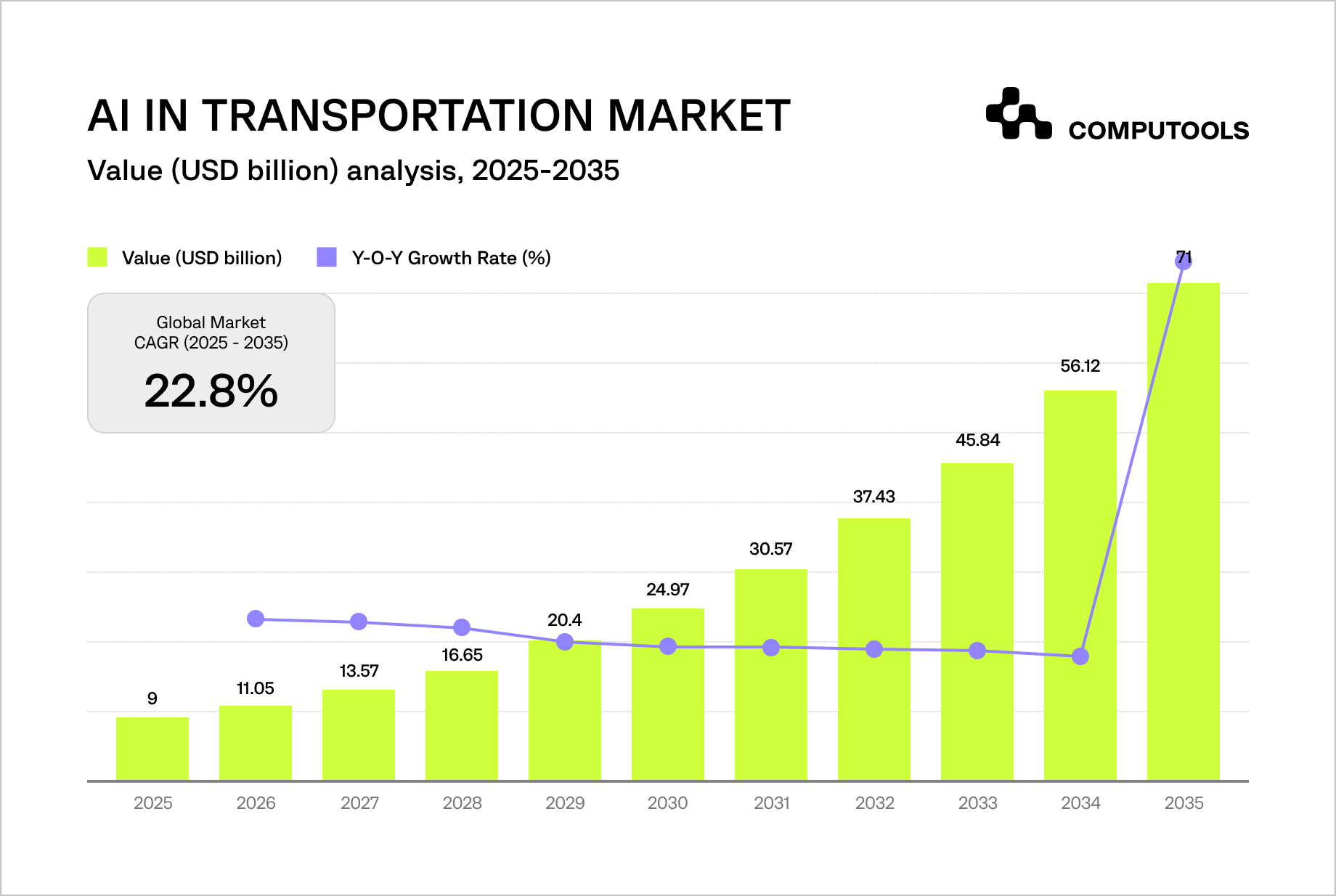
AI in trucking operations is moving from back-office analytics into daily execution as the wider AI in transportation market grows from USD 9 billion in 2025 to a projected USD 71 billion by 2035, with a 22.8% CAGR.
For carriers, this growth reflects a practical operational shift: AI is already supporting dispatch, routing, tracking, document handling, and exception management in workflows where slow decision-making leads to missed loads, delays, higher costs, and lower asset utilization.
In trucking, that pressure is visible in dispatch workflows, communication gaps, and slow decision cycles.
Why manual trucking operations are reaching their limit
The growth of AI in the transportation industry underscores the urgency with which carriers, logistics providers, and fleet operators need faster systems for dispatch, routing, tracking, and back-office coordination. In trucking, that pressure shows up in overloaded dispatch workflows, slow decision cycles, fragmented communication, and manual document handling.
The scale of the industry makes the problem harder to manage manually. In the U.S., trucking generated $940.8 billion in gross freight revenue in 2022, with 13.5 million registered trucks over 10,000 pounds and 3.5 million truck drivers moving freight across the market. Most carriers also operate with limited internal capacity: 97% of for-hire trucking companies have 10 power units or fewer, which makes every dispatcher hour, every delayed update, and every missed coordination step more expensive.
Artificial intelligence in logistics is gaining traction because many delays begin before the truck moves. Dispatchers still coordinate drivers, loads, customer updates, exceptions, and documents across TMS platforms, ELD data, load boards, emails, phone calls, spreadsheets, and customer portals. Every manual handoff adds time. Every delayed answer increases the risk of missed loads, weaker asset utilization, late deliveries, and billing delays.
Manual processes also limit growth. A carrier can add more trucks, lanes, or customers, but dispatch work does not scale cleanly when every update, exception, and document still needs human attention. As volume increases, manual coordination leads to longer response times, missed exceptions, higher administrative load, and inconsistent service quality.
Trucking operations automation has become a practical priority for carriers that need to scale without adding more manual back-office work. For many teams, the first automation priorities are the workflows that create the most daily pressure: dispatch coordination, shipment updates, route changes, and document processing.
What AI already handles in trucking operations
AI systems are already embedded in daily trucking workflows and take over tasks that previously required constant manual input. The biggest impact shows up in dispatch coordination, routing decisions, communication, and document handling, where speed and consistency directly affect margins.
1. Load matching and dispatch
Modern AI dispatch software for carriers processes driver availability, location, hours of service, equipment type, lane history, and pricing conditions in real time. Dispatch teams get ready-to-execute load assignments or ranked options instead of manually checking multiple systems. This cuts response time and reduces missed loads, especially in high-volume or time-sensitive lanes.
2. Real-time routing and adjustments
Routing decisions are no longer static. Trucking route optimization AI continuously updates routes based on traffic conditions, weather, road restrictions, and facility delays. The system recalculates ETAs and suggests adjustments while the shipment is in transit, which helps avoid cascading delays across the schedule.
3. Communication and tracking
Routine communication is increasingly automated, with AI providing shipment updates, estimated arrivals, and alerts without dispatcher involvement. This ensures drivers, customers, and teams get consistent updates, reducing calls and aligning shipment status.
4. Document processing
Back-office tasks are automated with AI, extracting data from bills of lading, proof of delivery, invoices, and rate confirmations, and converting unstructured documents into records. This reduces manual entry, speeds billing, and lowers error risk.
Across these workflows, AI reduces the number of manual touchpoints required to move a shipment from planning to delivery. Fewer manual steps mean faster execution, more consistent operations, and better use of fleet capacity.
AI is already supporting dispatch, tracking, and communication workflows. Similar automation patterns are used in maritime logistics, as discussed in our article on AI Agents in Maritime Logistics: Automating Vessel Operations, Cargo Monitoring, and Dispatch Decisions.
How AI in trucking operations changes the dispatcher’s role
AI in trucking operations shifts the dispatcher’s workload from constant coordination to controlled decision-making. The change comes from how daily tasks are handled. Load assignment, routing updates, status tracking, and document processing are no longer tied to manual actions for each shipment.
Dispatchers used to manage every step directly: checking load boards, calling drivers, updating customers, reacting to delays, and handling paperwork across multiple systems. This created a continuous stream of small tasks competing for attention. As shipment volume grows, this model leads to slower responses, missed updates, and uneven service quality.
With AI-powered fleet operations, most routine steps are handled automatically. The system processes incoming data, updates shipment status, flags deviations, and provides recommended actions. Dispatchers work with structured information instead of raw inputs from calls, emails, and disconnected tools.
The focus shifts to decisions impacting cost, timing, and service. Dispatchers oversee operations via a centralized view, intervening only when conditions change or a decision needs human judgment.
This shift also improves coordination across systems. AI aligns data from TMS, telematics, and customer-facing tools, reducing the need for manual reconciliation. Fewer gaps between systems lead to more consistent execution and fewer delays caused by miscommunication.
Operations become less dependent on repetitive manual actions, with clearer shipment visibility and more control over exceptions.
Why does speed directly affect carrier profitability
Speed in trucking impacts finances: delayed dispatch can miss loads, late route adjustments extend delivery, and slow document workflows delay invoicing post-delivery.
AI fleet management solutions help carriers reduce these gaps by processing operational data faster than manual teams can. The system can compare driver availability, equipment status, location, route conditions, and delivery windows in real time. Faster decisions allow dispatchers to assign loads sooner, respond to disruptions earlier, and keep trucks moving instead of waiting for manual coordination.
Route and schedule changes impact profitability. If a truck delays at a facility, misses a delivery window, or takes an inefficient route, the carrier loses productive hours that could be used for another load. AI logistics optimization supports better planning by identifying risks before they disrupt the schedule and recommending the next best action based on current conditions.
Utilization depends on how quickly a carrier turns capacity into revenue. AI reduces empty time, improves routes, and keeps dispatch focused on margin-impacting decisions. Faster execution enables moving more freight with the same fleet, staff, and base.
Speed enhances service reliability by providing accurate ETAs, early delay warnings, and clear shipment visibility. Relying on manual calls and delayed system updates makes service inconsistent. Automated tracking and alerts enable carriers to address issues early, avoiding complaints, penalties, or missed business.
Routing directly affects utilization, delivery time, and fuel costs. Similar scheduling logic appears in ports and terminals, which we cover in our article on How to Develop a Berth Booking System for Marinas and Ports.
How carriers can keep control over AI-driven operations
1. Automation in trucking needs clear limits
Carriers should define which decisions the system can execute automatically, which actions require approval, and which exceptions must always be reviewed by a dispatcher or operations manager.
2. Rules and thresholds create that control layer
A carrier can set limits for rate changes, route deviations, customer notifications, detention risks, driver availability, and delivery windows. The system can act on routine cases while sending higher-risk decisions to a human reviewer.
3. Human override remains critical
Dispatchers need the ability to adjust assignments, reject recommendations, change priorities, or pause automated actions when customer requirements, driver context, or operational constraints are not fully reflected in the data.
4. Visibility matters
Teams should be able to see why the system recommended a load, changed an ETA, flagged an exception, or prioritized one route over another. Clear reasoning, logs, and audit trails help carriers monitor performance, investigate errors, and improve decision rules over time.
5. Strong implementations also depend on data quality
AI uses information from TMS, telematics, ELDs, customer portals, rate data, and shipment history. Inaccurate or outdated data leads to weak recommendations, so carriers need validation rules, data cleanup, and regular monitoring before expanding automation across more workflows.

Want to cut dispatch delays, reduce empty miles, and automate repetitive trucking workflows? Talk to our team to map out your AI implementation strategy.
The cost of delaying AI adoption in trucking
1. Delaying automation keeps carriers stuck in slow, manual tasks like dispatch, results in fragmented communication, and delays updates, increasing back-office work. As competitors automate, the gap in response, reliability, and cost widens.
2. Margin pressure from fuel, driver availability, detention risks, customer expectations, and rate changes limits room for waste. Manual workflows incur hidden costs from missed loads, delays, repeated calls, data entry, and slow billing.
3. Supply chain AI for trucking gives carriers a way to connect dispatch, tracking, route changes, customer communication, and freight documentation into a faster operating flow. Companies that postpone this shift continue to manage each function separately, which slows down decisions and makes exceptions harder to control.
4. Slow operations damage customer trust as brokers, shippers, and logistics partners expect accurate ETAs, updates, and quick responses. Carriers lacking visibility become harder to work with, especially on time-sensitive lanes.
5. Delayed adoption increases future costs, as reliance on disconnected tools and inconsistent data makes automation more difficult, requiring data cleanup, workflow redesign, training, and system integration.
The first visible gap usually appears in response time: automated teams can confirm loads, update ETAs, and process exceptions faster, while manual teams continue switching between calls, emails, portals, and spreadsheets.
Where сarriers should start with AI implementation
Carriers do not need to automate every workflow at once. The strongest starting points are the areas where manual work creates daily delays and measurable costs: dispatch coordination, shipment tracking, document processing, and exception management.
- A practical rollout should begin with one high-friction workflow. Dispatch is often the first candidate because it connects driver availability, load assignment, customer requirements, route timing, and margin control. Tracking can follow when teams need better ETA accuracy, automated updates, and earlier alerts about delays. Document processing is another strong entry point because it directly affects billing speed, administrative workload, and payment accuracy.
- Reliable implementation depends on integration with existing systems. AI has to work with TMS platforms, ELDs, telematics, load boards, customer portals, accounting tools, and historical shipment data. Companies that use logistics software development services can connect these systems into a single operating flow rather than adding another isolated tool that dispatchers still have to manage manually. In practice, this often replaces fragmented tools with a single layer of logistics automation software that supports dispatch, tracking, and document workflows without duplicating effort.
- Pilots help carriers reduce risk before scaling. A pilot can focus on one lane, one region, one customer group, or one workflow with clear KPIs: response time, load acceptance speed, empty miles, ETA accuracy, document processing time, dispatcher workload, and billing cycle duration.
Once the pilot shows measurable value, carriers can expand automation into adjacent workflows. Dispatch automation can connect with tracking. Tracking can connect with customer communication. Document processing can connect with invoicing and claims. Scaling works best when each new layer improves the operating flow instead of adding complexity for the team.
Route planning is often one of the first areas where carriers expect a measurable impact. We cover how optimization tools improve routing decisions and fleet utilization in our article, “Route Optimization Software: A Must-Have Tool for Modern Logistics Businesses.”
Key takeaway: AI is becoming the operational layer of trucking
AI is moving into the core of daily trucking workflows where decisions are made and executed. Dispatch, routing, tracking, communication, and document handling increasingly run through automated systems that process data faster and more consistently than manual teams.
Operations increasingly depend on real-time inputs from telematics, TMS data, shipment status, and external conditions. Fewer manual touchpoints reduce delays, improve coordination, and keep workflows stable under higher load.
This approach is shaping how modern ground transportation software is designed. Dispatch, routing, tracking, and back-office workflows operate as a connected system instead of separate tools that require manual coordination between teams.
Companies that continue to rely on manual coordination face slower response times, higher administrative load, and less consistent service. As expectations for real-time visibility and fast decision-making grow, these gaps become harder to offset through pricing changes or additional staff.
AI is becoming a core layer in how trucking operations run. It supports decisions, executes routine actions, and connects systems that were previously managed separately.
Why choose Сomputools as an AI implementation partner
Computools helps logistics and transportation companies implement AI in real operational workflows, not only in isolated models or prototypes. Our work focuses on execution: dispatch support, tracking automation, fleet visibility, document workflows, alerts, and operational decision layers that connect with existing systems.
The company has been on the market for 12+ years, has delivered 400+ projects worldwide, and has completed 20+ logistics and transportation projects. This experience covers ground transportation, railway fleet monitoring, maritime platforms, cargo visibility, vehicle-sharing systems, and AI-supported operational automation.
In one AI case, Computools developed a multi-channel AI agent platform that automated more than half of routine communication, reduced response times by up to 90%, and helped scale peak-period operations without increasing headcount. The same implementation logic applies to trucking companies that need AI to reduce repetitive communication, support dispatch teams, and maintain control over workflows at scale.
Computools also has practical transportation experience. For a Western European rail operator, the team developed a real-time cargo fleet positioning system using IoT technology, MQTT-based data transmission, and instant alerts for deviations in safety parameters, such as volume, pressure, and temperature. This experience can support use cases such as predictive maintenance for trucking fleets, condition monitoring, and automated exception alerts.
In maritime logistics, Computools developed Navis Horizon, a real-time cargo tracking platform that consolidated AIS/GPS data, automated cargo status updates, and introduced an AI-powered assistant for dispatchers, customers, and port operations.
The project reduced manual dispatch operations by 40% and improved shipment incident resolution time by 18%. This broader expertise also supports maritime software development services for companies working across port, cargo, and multimodal transportation environments.
Computools provides AI development services for carriers that need automation tied to real operational workflows: dispatch, tracking, document handling, alerts, and exception management. Implementation can start with a focused pilot, then scale after measurable ROI while preserving transparency, human oversight, and clear operational rules.
For transportation companies with connected assets, Computools also provides IoT development services for fleet visibility, condition monitoring, sensor-based alerts, and real-time data exchange. These capabilities support business process automation across dispatch, tracking, maintenance, and back-office workflows without turning the system into another disconnected tool.
Choosing the right partner affects how reliably AI can be integrated into daily operations. We cover relevant providers in our article on the Top 20 Maritime Software Development Companies Globally.
Conclusion
AI adoption in trucking now depends on how well carriers can turn automation into controlled execution. The strongest results come from focused use cases: faster dispatch, better exception handling, cleaner document workflows, and more reliable visibility across daily operations.
Carriers that adopt freight management AI solutions can reduce manual load, improve response time, and scale operations without losing control over decisions. As smart trucking technology becomes part of standard fleet operations, the gap between manual and AI-assisted carriers will become harder to ignore.
If you are planning to introduce AI into your trucking operations or want to move beyond isolated tools toward a connected operational system, write to info@computools.com.
Computools
Software Solutions
Computools is an IT consulting and software development company that delivers innovative solutions to help businesses unlock tomorrow.