
THE AUTHOR:

There’s a fundamental shift happening in restaurant operations. First, static scheduling isn’t viable anymore. Second, as guest demands become more immediate, operators are starting to balance bookings with walk-ins to maximize earnings, turning every available seat into a potential source of profit. This explains the demand for an intelligent restaurant reservation system that integrates with daily operations, data, and the guest experience.
Key trends shaping restaurant booking software in 2026 and beyond
Market studies point to a set of changes that influence the architecture and deployment of reservation systems in 2026 and the years ahead.
| Trend | Key Statistics & Signals | Build Implication |
| AI-Driven Demand Forecasting & Table Optimization | • AI-enabled restaurant reservation software predicts peak demand periods with 90% accuracy. • ~ 38% of high-end restaurants implement AI-based yield management. | Build engines that allow customization of inputs, create flexible time slots, optimize dynamically, and allow real-time management. |
| Fully Integrated Restaurant Ecosystems | • 78% of modern systems are built on cloud infrastructures. • 60%+ of operators plan to invest in integrated platforms. • increasing POS–reservation integrations. | Develop integrated systems with live data interchange across POS, CRM, and operations. |
| Mobile-First & Contactless Experience | • 72% of reservations were completed on mobile devices. • 64% of restaurant owners experienced an increase in demand for no-contact dining. | Design with UX in mind to allow for mobile browsing, instant reservations, virtual waiting lists, and integration with QR and contactless payment systems. |
| Personalization & CRM Integration | • Companies that deliver effective personalization can experience up to a 40% boost in revenue. • There is high demand for personalization in the fine dining segment. | Create unified guest profiles, preference tracking, and CRM-driven reservation logic. |
AI forecasting, integrated systems, mobile-first design, and personalization are some important trends in the restaurant booking software industry. They are changing back-end operations and guest experiences. Our projects, including Tap App, illustrate many of these changes. Let’s take a closer look.
Tap App case: streamlining multi-venue restaurant ordering
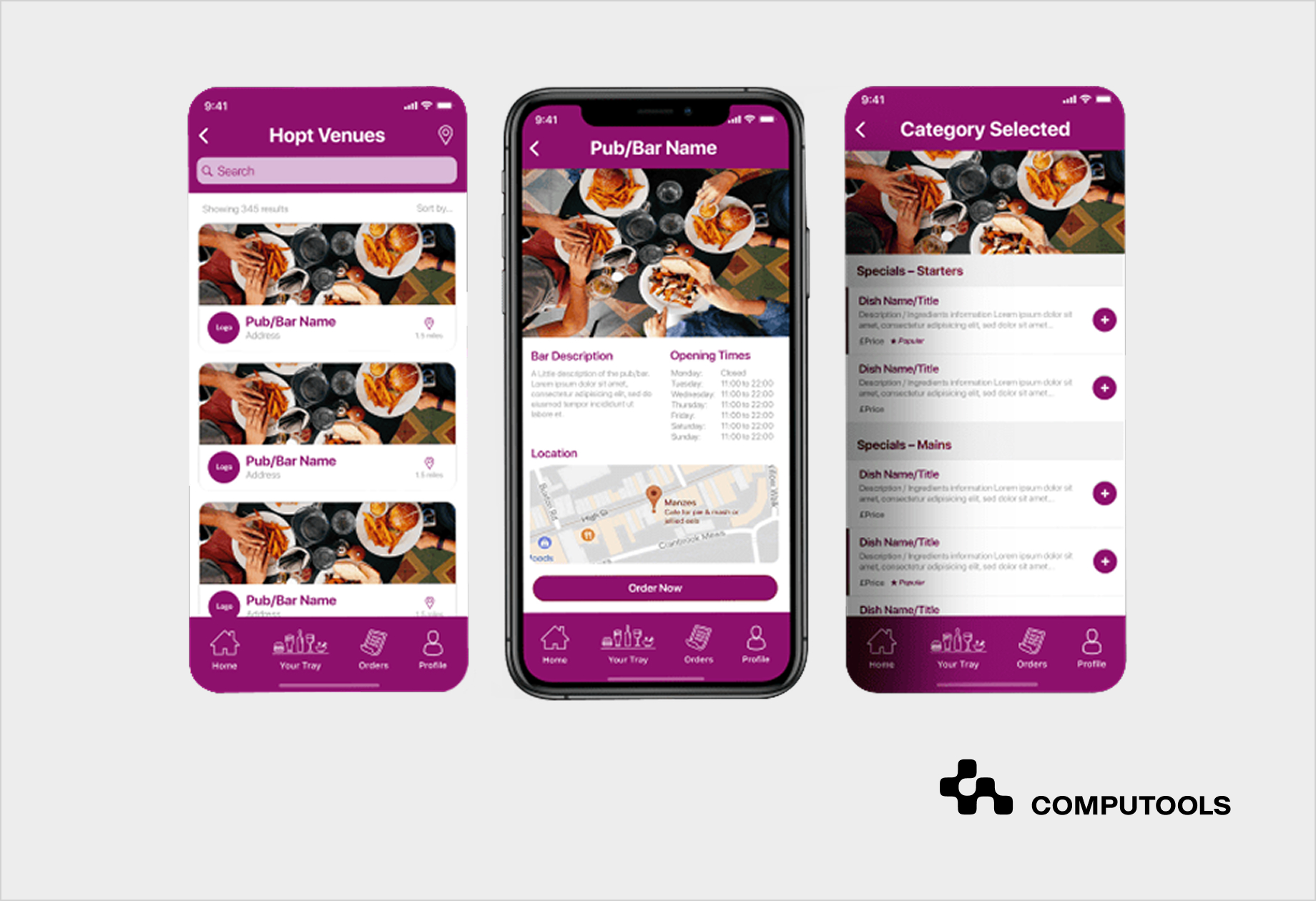
Tap App is a multi-venue restaurant ordering and booking app in the UK. Despite a short time frame, Computools successfully deployed an easy-to-use, flexible restaurant booking platform compatible with IOS and Android.
Business Challenge
The client faced the problems of a short timeline, diverse restaurant needs, little use of digital products, and no promotional website, all of which needed to be addressed with a flexible yet powerful solution.
Solution Highlights
- Seamless cross-platform experience. Built using React Native, the client’s app is offered on both Android and iOS using the same codebase, which minimized development time and maximized performance.
- Flexible integration. The application allows for the customization of menus, ordering procedures and operational flows for each restaurant.
- Secure payments & ordering. The system integrates with popular payment services, which allows it to process off-site and on-site orders together with tips, all quickly and securely.
- Real-time insights. Restaurant operators have the data for performance and cost to control the app offerings.
Impact
- Top-line growth increased by 7% due to cross-selling.
- 85% reduction in unfulfilled or modified orders thanks to better ingredient management and order tracking.
Why Computools
The client selected Computools for our extensive experience in multi-platform development, in-depth knowledge of hospitality business practices, and ability to deliver a stable, high-quality solution in a short timeframe. The collaboration included the development of the application end-to-end, QA services, launch support, and post-launch app updates.
These are the tangible results that demonstrate the ability of integrated restaurant reservation management software to reorganize business processes. But what is the secret to making it efficient? We will explain this in the following sections.
For restaurants exploring digital ordering, Computools also provides guidance on how to build a restaurant menu app with QR ordering and how to develop a food ordering app.
Core components and features of a real-time restaurant reservation system
Real-time booking platforms help operators manage demand, guest flow, and table availability.
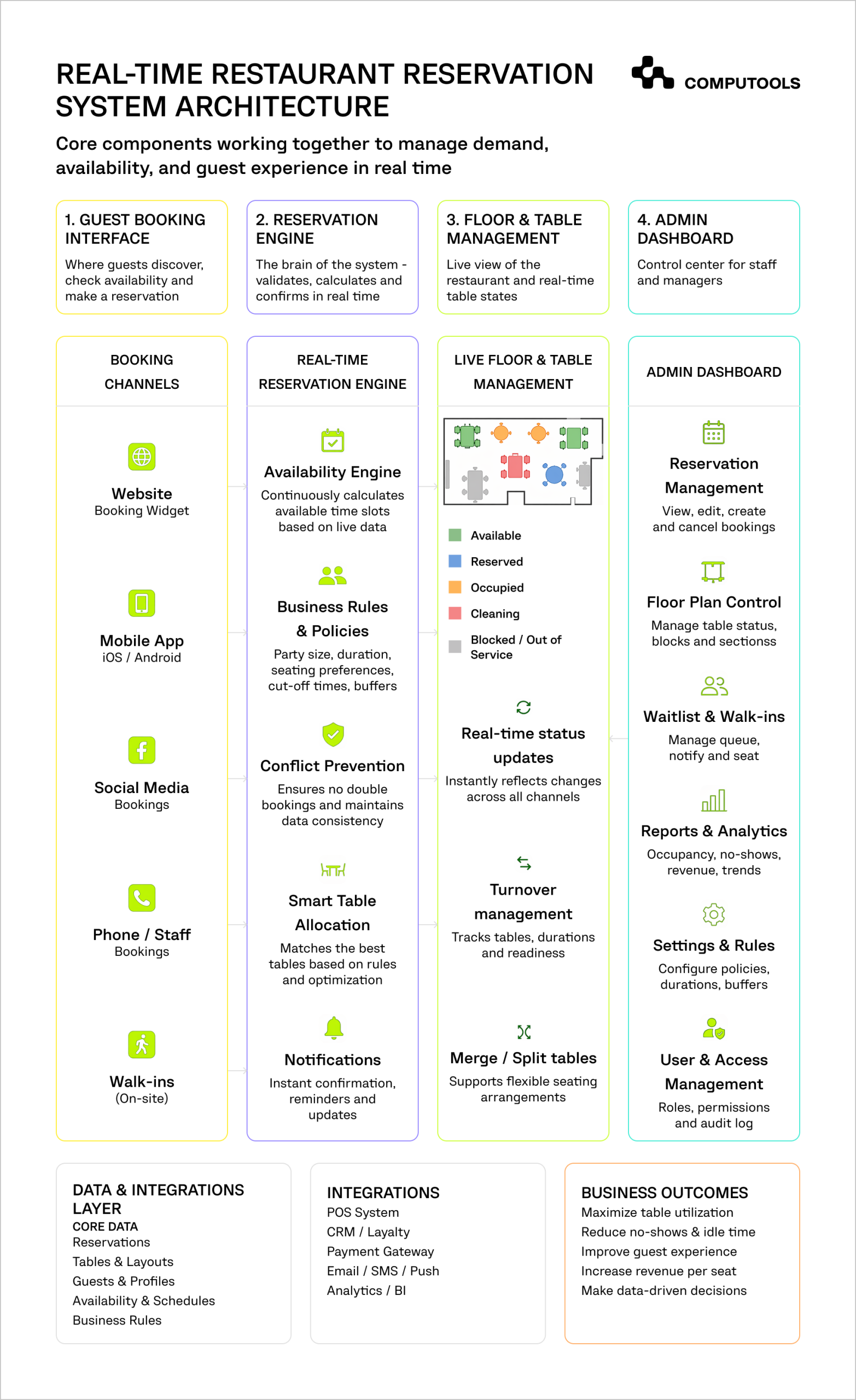
At its core, an online restaurant reservation system consists of four primary layers:
- The guest interface includes a web and app client that enables end-users to choose their reservation times and the size of the party.
- The reservation engine – a set of algorithms (rules and logic) that manage table availability and resolve booking conflicts.
- Floor and table management gives operators monitoring capability over a real-time restaurant layout and over the table status.
- An admin panel helps staff manage rules and overrides for reservations and interpret the system’s performance.
With these components, operators have complete control over the booking system and the flow of guests.
Real-Time Availability as the Core Mechanism
Instead of booking predefined slots, the system measures availability dynamically based on:
- Present status of tables: occupied, reserved, available and needs cleaning.
- New reservations and walk-in guests.
- Anticipated table turnover.
Guest-facing and internal interfaces are used to ensure every booking is up to the state of the dining venue.
Operational Capabilities
A restaurant scheduling and booking system should incorporate the following features for reliable performance in the real world:
- Availability engine allowing slots to be recalculated in real time.
- Smart table assignment by group size and optimum timing.
- Wait list and walk-in management to efficiently distribute planned and unplanned demands.
- Channel synchronization to provide consistent booking placements regardless of if the booking is made via the restaurant, online, or mobile.
Revenue and Experience Drivers
Modern booking engines impact revenue and guest satisfaction through:
- Tools that require deposits and send confirmations to reduce no-show rates.
- Last-minute cancellations are minimized through reminders.
- Targeted communications reduce cancellations and encourage repeat visits.
The system, at this level, is more than a scheduling mechanism. It’s also a revenue management and customer intelligence solution.
Restaurant reservation system architecture
A real-time table reservation system for restaurants operates as a synchronized data flow between booking channels, core logic, and venue operations. Instead of storing fixed availability, the algorithms continuously recalculate it based on live conditions.
1. Backend Foundation for Ensuring Data Consistency
The heart of the platform is a relational database that stores:
- Unique time slots with associated reservations
- Table layouts and capacities
- Profiles of the guests and their preferences
- Business rules (durations, buffers, seating logic).
The system uses transactional control (ACID principles) to avoid simultaneous booking conflicts. When users try to reserve a spot at the same time, the engine handles requests one at a time. Only the first query is confirmed.
This principle is non-negotiable. Without strict consistency, real-time availability quickly becomes unreliable.
2. Reservation Engine as The Decision Layer
This is the core logic layer of the system. It is responsible for:
- Calculating available time slots
- Prioritizing and validating incoming booking requests
- Imposing business logic (duration, table, and size logic)
- Preventing double bookings.
Every user request passes through this layer, where availability is recalculated in real time before confirmation.
3. Real-Time Synchronization Layer
Modern reservation systems use an event-driven architecture to maintain system alignment.
It enables the following mechanisms:
- Creation, modification, or cancellation of a booking triggers an immediate system-wide update.
- Changes are communicated to all active interfaces over an API or WebSocket.
- Booking channels, staff dashboards, and floor management tools stay synchronized.
Availability remains up-to-date under any circumstances – an online booking, a walk-in seated by a host, or an early table clearance.
4. Availability and Allocation Logic
Availability is dynamic and constantly recalculated based on different factors, including:
- Capacity and layout of tables
- Party size and preferences
- Reservation schedule
- Expected dining duration and turnover.
Once the system accounts for all this context, it can determine optimal booking options and match the party with the appropriate table.
Advanced implementations could also deal with:
- Table merging and splitting
- Adjustable seating durations
- Dynamic reallocation as other conditions change.
How to build a digital reservation system for restaurants
Restaurant booking system development goes beyond the UI and the basic logic implementation. It must reflect live operations and be able to embed state-driven workflows and concurrency-safe transactions.
1. Define Operational Logic
The first step is to describe the operations of the restaurant and create a clear system of rules that the platform must implement.
This should include:
- Table entities and zones (indoor, terrace, bar, etc.), as well as which tables can be grouped.
- Capacity rules where table configurations are matched to party sizes.
- Turnover logic where booking duration is determined by time of day or service type.
- Operational constraints where reservations must be spaced apart, or there are cut-off times.
These rules should be stored as configurable variables, which allow operators to modify the system’s logic without the need for redeployment.
2. Build the Reservation Engine
Creating the reservation engine requires the ability to assess the availability of spaces and request submissions in real time.
This typically involves:
- Slot generation
- Availability calculation
- Buffers and constraints
- Conflict prevention
- Real-time validation.
The key here is consistency under concurrency. This system needs to ensure the accuracy of the availability in handling peak-time requests. For example, Tap App’s powerful engine simultaneously processes hundreds of requests across multiple restaurants without the risk of double booking. This allows restaurants to confirm reservations at any time, especially during peak hours.
3. Develop Floor Management
Restaurant reservation app development requires the real-time utilization of the restaurant’s physical layout.
This is implemented as a state-driven layer:
- A digital table map representing the layout and relationships between tables.
- Continuous state updates of the table from available, reserved, occupied, and cleaning.
- Real-time staff actions of either seating, clearing, or blocking the table, triggering immediate system updates.
This ensures that availability is always based on live operational data, not just scheduled bookings.
4. Create the Guest Booking Flow
The guest-facing layer must balance the complexity of the backend with a simple, fast interface.
- Design with mobile in mind.
- Minimize the steps involved in filing a reservation.
- Queries must be instantly processed with backend validation to ensure the guest receives an accurate reservation confirmation.
From a technical perspective, the frontend acts as a thin layer over the reservation engine, always relying on live validation rather than cached availability. For instance, Tap App’s modern cross-platform interface allows real-time updates across orders, notes, payment and tips. This resulted in increased booking speed, higher customer adoption, and decreased errors.
5. Add Integrations and No-Show Controls
At this stage, the restaurant table booking system becomes part of a broader ecosystem and starts driving measurable business outcomes.
Key integrations include:
- Point of sales (POS) systems
- Customer Relationship Management (CRM) systems
- Payment systems
- Notification systems.
Architecturally, these integrations are best implemented as loosely coupled, event-driven services, allowing the solution to scale and evolve without breaking core logic.
We have achieved significant operational improvements by integrating Tab App with POS, CRM, and payment gateways to automate order confirmations. This resulted in a 85% decrease in unfulfilled and modified orders.
UX principles for guests and staff
The platform has to be both fast and accurate to accommodate the two sides of its user base: guests and staff.
For Guests: Fast, Clear, and Frictionless
Booking should be as easy and quick as possible. Hesitation kills conversions.
Designing an effective guest interface involves:
1. Minimal steps
A booking journey must be designed so that a guest can complete it in only 3 steps: select date → choose time → confirm. Every other step, such as lengthy forms or logins, should be optional.
2. Transparent availability
The system must be designed to show only available options. Displaying unavailable time slots creates frustration and drop-offs.
3. Mobile-first experience
Most guests will book their tables through their mobile device. The interface should be designed with that in mind and be optimized for small screens, fast interactions, and minimal input.
For Staff: Speed and Operational Clarity
The staff interface should be as clear and quick as possible.
Elements of the staff interface should include:
1. One-tap status updates
Changing a table status, be it seated, cleared, or reserved, must be achieved in one step, with no additional, unnecessary screens.
2. Clear visual floor plan
Staff should have a clear and instant understanding of the layout and status of the floor at a glance.
3. No manual reconciliation
The status of the tables and the bookings should sync within the system automatically, with no need for staff to check or cross-check.
Computools pairs mobile and web development services to ensure responsive and conversion-centric user experiences. Within the Tap App project, smart architectural and design choices allowed cross-sell and order management improvements, with a subsequent 7% increase in revenue.

Launch your restaurant table reservation system in 1–3 months instead of years. Eliminate no-shows and double bookings, and turn every available table into a predictable revenue opportunity.
Suggested tech stack for developing custom restaurant reservation software
The exact stack is dictated primarily by specific business and tech demands, but most real-time reservation systems are built with technologies like the following:
Back-end
Java, Node.js, or Go to cope with high concurrency booking logic.
Database
PostgreSQL or MySQL to ensure transactional consistency and to prevent conflicts.
Real-time Layer
WebSockets or event-driven messaging systems (e.g. Redis, Kafka) to propagate system changes instantaneously.
Front-end
React or similar frameworks to deliver fast, mobile-first user booking experiences.
Integrations
POS, CRM, and payment services connected via REST or GraphQL APIs.
Cloud Infrastructure
AWS, Google Cloud, or Azure to prioritize reliability and scalability.
Always base your choice on architecture built with real-time, transactional, and integration safety in mind. The tools are of secondary importance.
Why clients choose Computools for building restaurant reservation systems
Peak hours, walk-ins, demand spikes, late arrivals. This is where a restaurant reservation system can either keep things together or create friction at every table. Partnership with Computools always leads to the first outcome, not the second. We excel in travel and hospitality software development services, where booking logic, real-time availability, and multi-channel demand have to work as one.
1. Built on Real Engineering Scale
With 250+ engineers and 400+ delivered projects, Computools builds systems where there is no room for failure:
- Platforms designed to handle high booking volume and peak-hour pressure.
- Strong focus on data consistency and real-time accuracy.
- Experience delivering complex, multi-layer solutions.
This means the reservation engine keeps working when demand spikes, not just when things are quiet.
2. Deep Domain Understanding of HoReCa Operations
Computools combines strong engineering credentials and domain knowledge gained through software development services for HoReCa, where systems must reflect real operational pressure.
- Booking logic that aligns with tables, turnover, and service flow.
- Supports walk-ins, peak demand, and dynamic peak-seating.
- Understanding of front-of-house and back-of-house coordination.
The platform functions like a skilled and experienced host rather than a calendar that shows appointments.
3. Architecture That Connects Everything
A restaurant table management system only delivers value when it is fully integrated.
Computools develops solutions where:
- Reservations, POS, and CRM operate on a common data layer.
- Availability refreshes simultaneously across all channels.
- Integrations are designed from the outset, rather than as afterthoughts.
Our approach closes the conventional divides between booking, service, and customer data.
4. Strong Expertise in Mobile Development
In most modern restaurants, the booking experience often begins and ends on a mobile device.
A strong track record of mobile app development services empowers Computools to deliver applications that:
- Create fast and frictionless booking flows.
- Showcase real-time availability without delays and inaccuracies.
- Integrate directly with backend reservation logic.
Users get an instant and reliable mobile booking experience, which is exactly what they expect.
5. Designed to Drive Revenue, Not Just Manage Bookings
For years now, the main target of a reservation system has been to fill as many tables as possible.
However, our solutions contribute to revenue generation, helping to:
- Reduce no-shows through deposits and automation.
- Increase table utilization through smarter allocation logic.
- Personalize guest experiences.
In these cases, the system becomes a revenue optimization layer, not just a booking interface.
6. Structured Delivery That Reduces Risk
Computools addresses this with a structured approach that contains:
- Detailed project scoping and roadmap development.
- Early alignment on business logic and system architecture.
- Phased delivery with a focus on value and predictability.
This minimizes rework and performance gaps within the system when delivered.
Final thoughts
Building a modern restaurant reservation system goes beyond the realm of software. The solution should serve as a strategic tool to streamline operations as well as guest experience and positively impact the revenue. Projects like Tap App demonstrate how real-time, integrated platforms transform complex restaurant workflows into measurable business results.
Our expertise extends beyond restaurants. We also provide travel booking platform development that interface with hospitality operations.
Interested in improving reservations for your venue? Partner with Computools to construct a booking system that is adaptable, flexible, and complementary to all facets of your business. Reach out to our team at info@computools.com.
Explore our comprehensive research on the top restaurant POS software development firms, highlighting industry leaders, key innovations, and the latest trends shaping modern restaurant technology.
Computools
Software Solutions
Computools is an IT consulting and software development company that delivers innovative solutions to help businesses unlock tomorrow.