
THE AUTHOR:

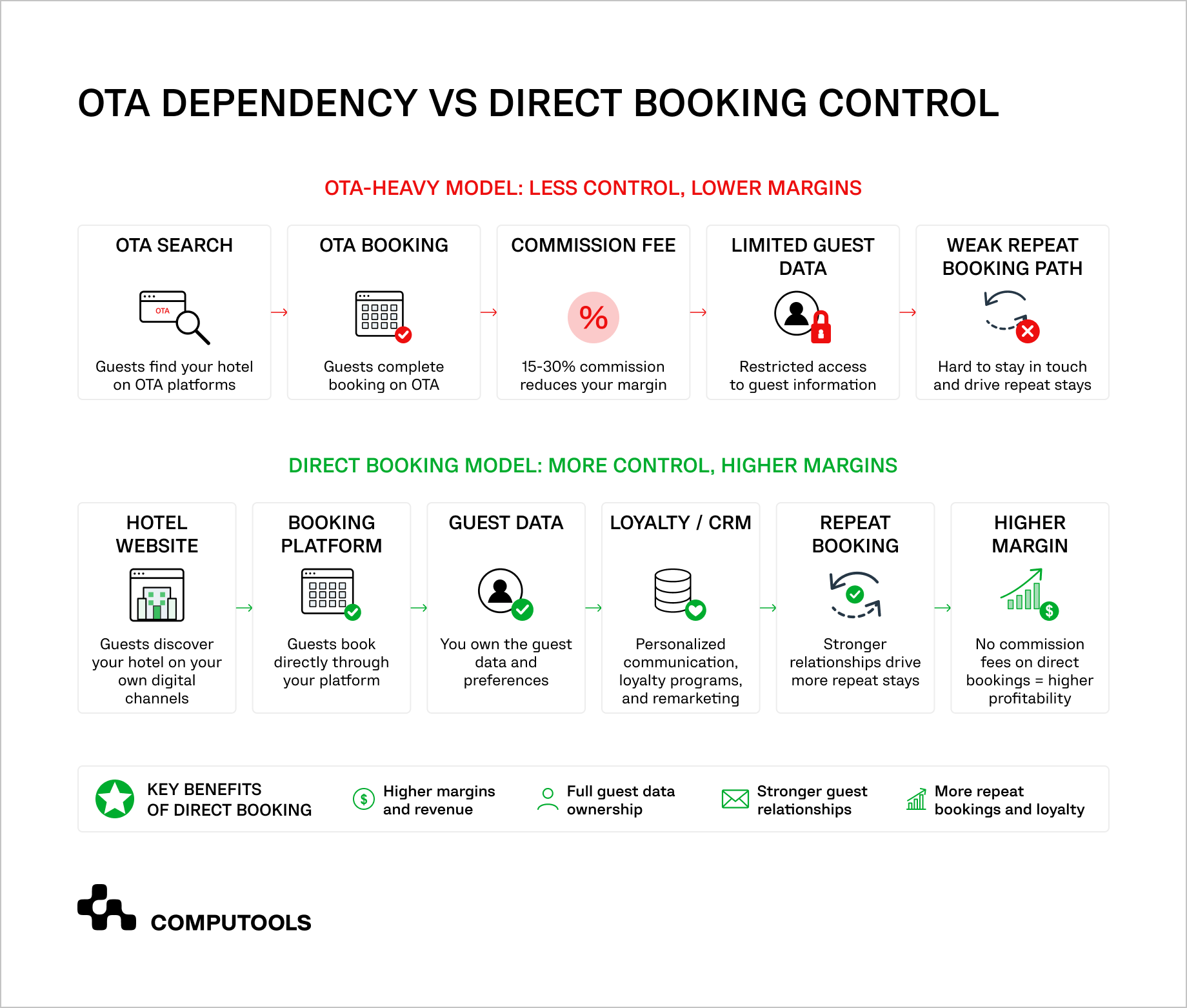
OTAs are essential to hotels, allowing fast access to their guests. They provide presence, search traffic, mobile experience, and booking systems that hotels struggle to create on their own in the early stages. This is especially helpful for independent hotels, resorts and smaller chains. But the direct booking vs OTA question becomes critical when third-party platforms stop being an acquisition channel and, instead, become operators’ primary source of revenue.
When hotels receive most of their reservations through external booking channels, they pay high commissions, up to 30%, depending on the platform, location, and type of hotel (Cloudbeds). They also lose access to their customer data and often earn revenue only by competing on pricing. Hoteliers also have to follow OTAs’ rules that shape visibility, pricing, cancellation policies, and guest communication.
This article explains when hotels should continue using OTAs, when they need their own direct booking platform, what such a platform should include, and how a custom booking system can help shift revenue from rented traffic to owned guest relationships.
Why hotels depend on OTAs and when it becomes a problem
OTAs effectively provide hotels with a way to fill rooms quickly. A customer looking to book a hotel in Vienna, Barcelona, or Dubai is likely to begin by browsing a booking site such as Booking.com, Expedia, Agoda, Trip.com, or a metasearch channel, rather than the website of an individual operator. From an immediate perspective, this creates clear short-term advantages.
| OTA advantage | Reason why hotels use it |
| Large customer base | OTAs attract high-intent users who are searching and booking accommodation. |
| Quick presence | Hotels come up in search results without organic traffic. |
| Built-in booking flow | OTAs manage search, comparisons, reviews, payment, and booking confirmations. |
| Mobile access | Travelers are likely to make reservations using the OTA apps on their mobile devices. |
| Global reach | Smaller hotels are able to attract international customers. |
This model works fine when OTAs facilitate additional demand. It becomes a business risk when they control the majority of bookings.
The 2025 distribution data highlights that OTA dependency continues to impact operators’ profitability and control. According to D-EDGE, costs associated with direct distribution stand at around 3.5%, while OTAs charge between 12% and 28%. This suggests that a hotel direct booking strategy can improve the per-reservation margin.
In addition, rate parity continues to be a pressure point. World Parity Monitor reveals that in 75% of rate searches, at least one OTA offered a lower price than the hotel’s website.
For operators, OTAs will continue to bring demand. The challenge is to find the right balance of controlling guest data, pricing, margin, and repeat bookings, especially when dependence on third-party services becomes critical.
The main downsides of heavy OTA dependency
1. High commission costs
A 12-28% commission means a 12–28% drop in profit for every reservation. For example, a $200 booking made through an OTA with a 20% commission costs the hotel $40, not including operational costs.
2. Fragmented guest data
Hotels typically receive a limited amount of guest data from OTA reservations. This complicates direct communication with guests, developing loyalty programs and personalized offers, as well as mechanisms for repeat bookings. HOTREC, in particular, has criticized Booking.com for not providing guest data to hotels.
3. Reliance on third-party regulations
Hotels are required to comply with OTA rules regarding ranking, cancellations, visibility payments, and advertising. Alterations on a platform’s side can influence the number of reservations a property receives.
4. Price-based competition
Booking sites group hotels together, and guests have very little information to compare. Determining which one to book often comes down to room prices and reviews. As a result, hotels have to discount rates rather than build on their brand and value through loyalty, packaged deals, and service.
5. Ineffective direct customer engagement
If a guest finds, books, pays, and communicates via an OTA, the latter controls the majority of the customer journey. This means the hotel simply delivers the stay, and the OTA controls the opportunity for the next booking.
Direct booking vs OTA: when hotels need their own booking platform
A direct booking platform is not necessary for every hotel. A small property with limited repeat demand, simple pricing, and low digital traffic may go with a ready-made booking engine.
Operators should consider hotel reservation system development when OTA dependency starts limiting growth.
| Signal | What it means | What a direct booking platform can solve |
| Most of a hotel’s bookings come from OTAs | With every booking, distribution costs increase | Take back ownership of a portion of the demand |
| Most repeat guests still come through OTAs | There are insufficient targeted marketing strategies | Develop email, loyalty, and remarketing campaigns |
| Guest info is incomplete and disparate | Guest personalization is not effective | Integrate guest data and booking histories |
| There is a lack of revenue diversification | Revenue is reliant on room sales | Create and sell bundled offerings of rooms and amenities; add packages, upgrades, dining, spa, parking, and local experiences |
| Multiple properties use different tools | Brand and reporting are inconsistent | Centralize booking logic across the group |
| Dynamic pricing is difficult. | The hotel cannot manage offers by segment. | Add dynamic rates, promo codes, and direct-only incentives |
The goal is not to remove OTAs completely. They will likely remain a significant revenue stream for most hotels. To reduce OTA commissions for hotels, the optimal distribution channel strategy is the following. Use third-party services to gain initial reservations, but invest in a hotel booking engine solution to retain customers and capture high-margin repeat visits and customer data.
For hotel chains, direct booking requires centralized control with property-level flexibility. Computools explains this approach in the guide on how to develop a multi-property reservation system for hotel chains.
What features should a direct booking system have?
There is no need for excessive features in a booking platform for hotels. The focus should be placed on functions that drive conversions, aid revenue management, and cultivate direct relationships with guests.
1. Essential booking functionality
| Feature | Practical Application |
| Real-time booking availability | Allows guests to see accurate and up-to-date information pertaining to the availability of rooms, the dates, rates, booking restrictions, and other parameters. |
| Dynamic pricing | Automatically adjusts rates based on various factors, including occupancy, demand, season, and other pricing rules. |
| Secure payment processing | Supports card payments, deposits, refunds, tokenization, and fraud checks. |
| Mobile-first UX design | Makes booking fast on smartphones, where many travelers compare and reserve. |
| Cross-property search | Enables hospitality groups to provide a unified booking process across all their locations. |
| Multi-room comparison | Allows guests to view and select options based on room type and amenities, views, and packaging. |
2. Guest engagement tools
| Feature | Function |
| Loyalty programs | Reward repeat guests and encourage direct rebooking. |
| Promotional codes | Supports direct-only campaigns, seasonal and time-bound offers, and partner discounts. |
| Personalized offers | Present the guest with personalized upgrades, packages, and services. |
| Automated messaging | Sends post-booking confirmations, pre-arrival messages, reminders, and post-stay surveys. |
| Conversion recovery | Targeted messaging for users who started but did not complete a booking. |
3. Integrations
| Integration | Importance |
| PMS | Keeps room inventory, bookings, guest profiles, and operational data aligned. |
| CRM | Facilitates segmentation, retention, and personalized outreach to guests. |
| Channel manager | Synchronizes availability and pricing across OTAs and direct channels. |
| Payment systems | Processes deposits, refunds, payments in multiple currencies, and secure checkouts. |
| Analytics tools | Measures funnel, revenue, traffic, and campaign outcomes. |
4. Data and analytics
A direct booking platform tracks more than just reservations made. It can shed light on the source of demand, the points at which website users fall off, the offers that elicit the best response, and the segments of guests that return.
Useful analytics include:
- booking funnel performance;
- source and campaign tracking;
- repeat guest behavior;
- abandoned booking patterns;
- average booking value by channel;
- upgrade and package conversion;
- booking lead time;
- cancellation trends;
- loyalty member activity.
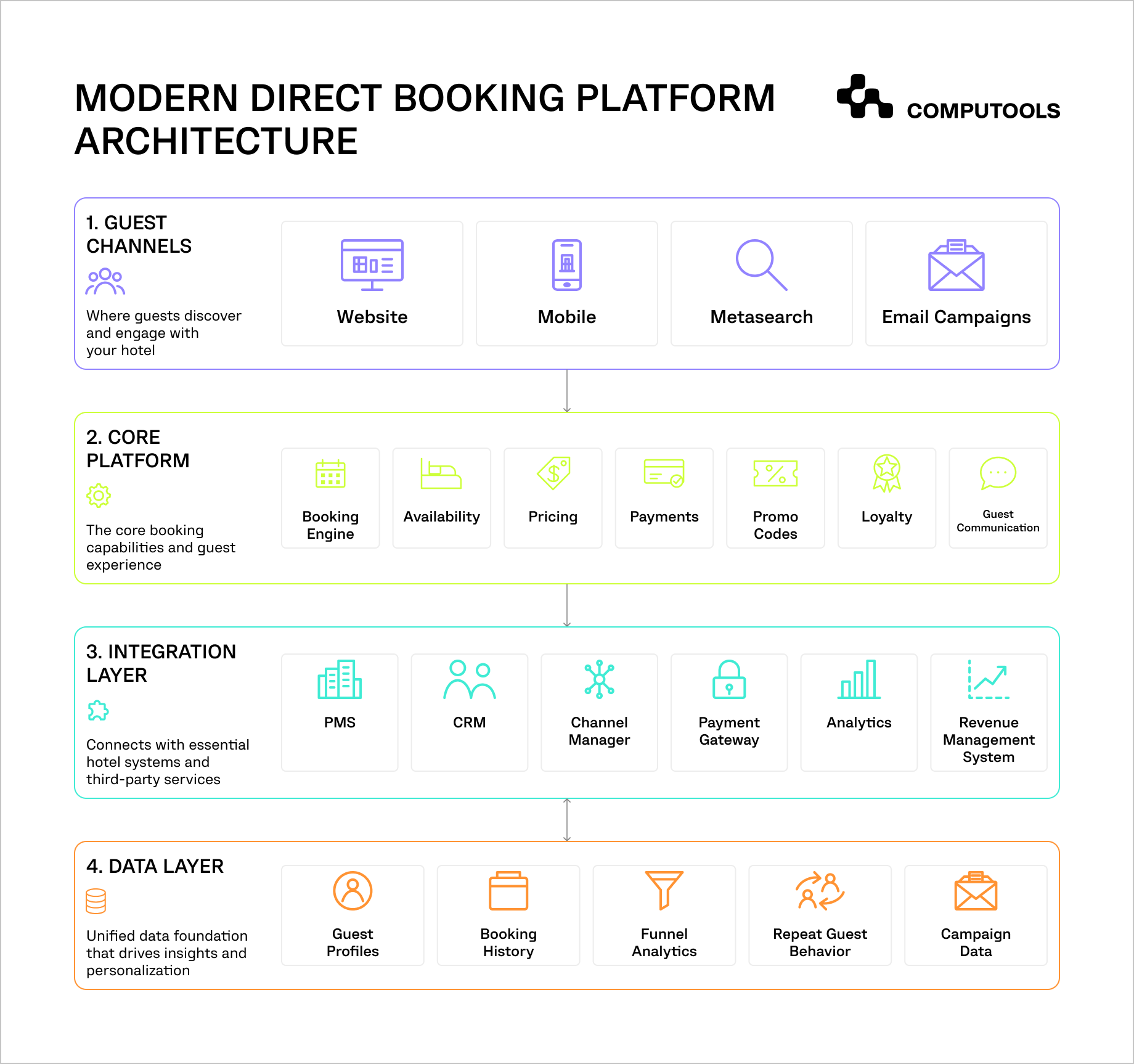
A direct booking platform should connect availability, pricing, payments, guest communication, and analytics in one flow.
We cover the technical and business logic behind this process in the guide on how to build a hotel booking engine for direct reservations.
How custom booking platforms increase hotel revenue
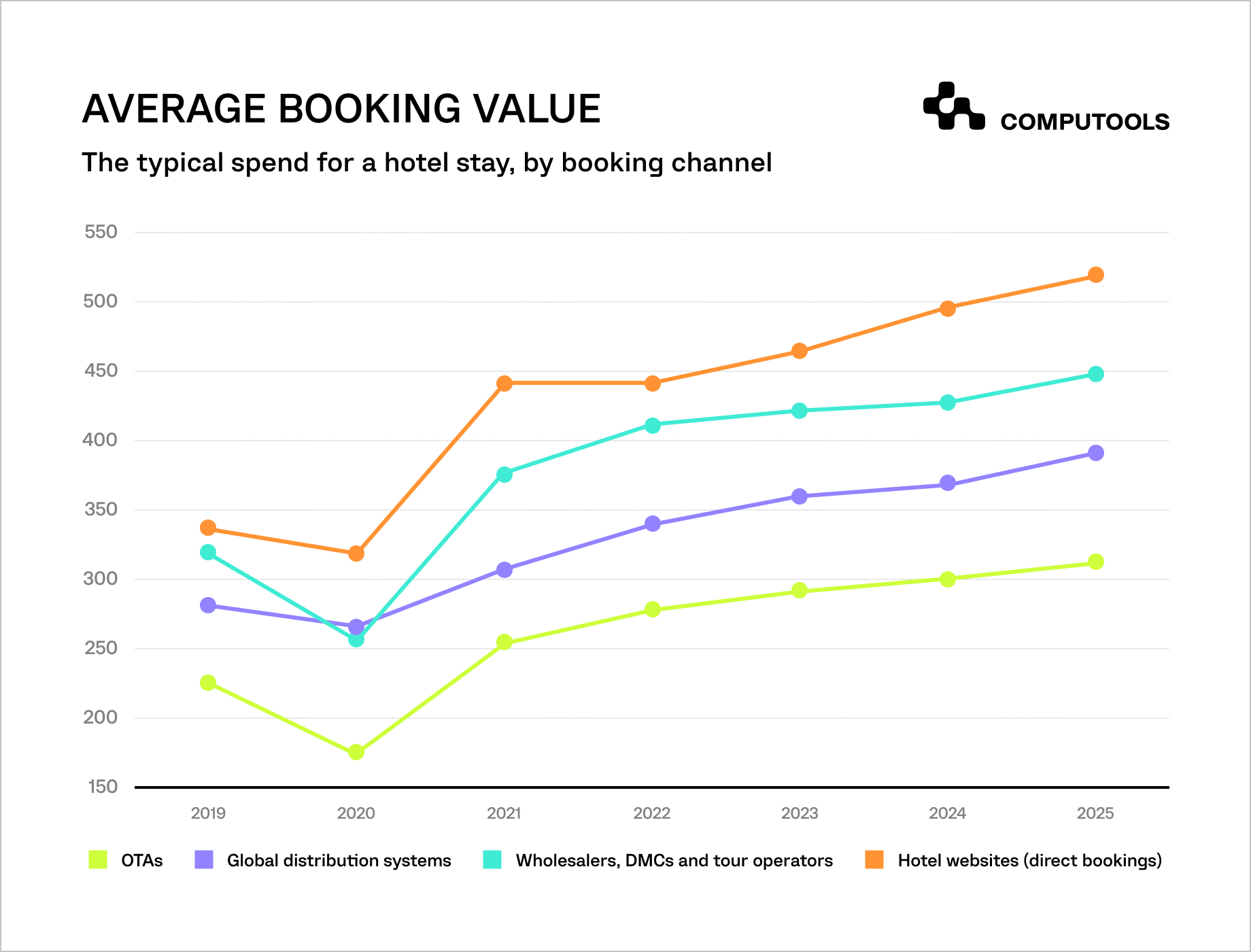
According to SiteMinder’s report, the average booking value made through a property’s site was $516, whereas bookings made through an OTA accounted for $312. Furthermore, in 90% of the markets, direct hotel reservations were in the top three revenue-generating channels.
The direct booking vs OTA data proves that investing in direct booking technology helps hotels capture more profit per reservation. The benefits of direct hotel booking platforms compared to OTAs are the following:
1. Lower distribution costs
All reservations made via an online travel agency come with a commission payment. Direct booking for hotels still incurs costs in SEO, online paid ads, metasearch advertising, website optimization, and customer relationship management, but operators can control these costs.
For example:
| Booking value | OTA commission | Cost per OTA booking |
| $200 | 15% | $30 |
| $200 | 20% | $40 |
| $200 | 25% | $50 |
When a hotel tracks its demand and shifts it to a direct booking, the profit margin increases, even if occupancy remains flat.
2. Higher conversion rates
A custom hotel booking platform can resolve many friction points of the customer journey that OTAs and even generic booking engines leave behind due to their limited capabilities.
Some of those friction points can be:
- fewer checkout steps;
- localized payment methods;
- faster mobile booking;
- clear room comparison;
- direct-only perks;
- saved guest details for returning users;
- flexible packages;
- visible cancellation terms.
The platform can also match the hotel’s brand promise. A luxury resort, business hotel, wellness retreat, and family hotel should not all use the same booking journey.
3. More repeat bookings
OTAs excel at customer acquisition and direct booking engines are best for customer retention. After a guest completes a reservation, the hotel can automate their preferred communication channel to send:
- upsell emails before arrival;
- customized recommendations for their stay;
- post-stay feedback requests;
- loyalty promotions;
- special offers for their birthdays and anniversaries;
- campaigns to encourage a return visit;
- seasonal offers;
- corporate or group booking campaigns.
In such a way, the direct booking solution serves its purpose as a revenue and retention mechanism.
4. Better control over pricing and branding
A direct booking system allows a hotel to better manage the pricing and distribution of rooms and services with a strong degree of independence from OTAs and their ranking and placement algorithms.
Operators benefit from various offers and campaigns:
- direct bookings only deals;
- special rates for loyalty program members;
- promotions for advanced purchases;
- last-minute deals;
- discounts for longer stays;
- corporate deals;
- packaged offerings;
- seasonal offers;
- and deals that promote specific properties.
This strategy allows a hotel to compete for guests based on the perceived value of the offering rather than the lowest price available.
5. Stronger customer journey ownership
A hotel can control the entire customer lifecycle through the direct booking process. This includes the path from the initial touchpoint and different reservation options to the payment and communication processes. At every stage of the journey, hotels can suggest add-ons to enhance the customer’s experience and encourage repeat visits.
For hotel chains, this control becomes even more valuable because guest behavior can be analyzed across locations, brands, and segments.
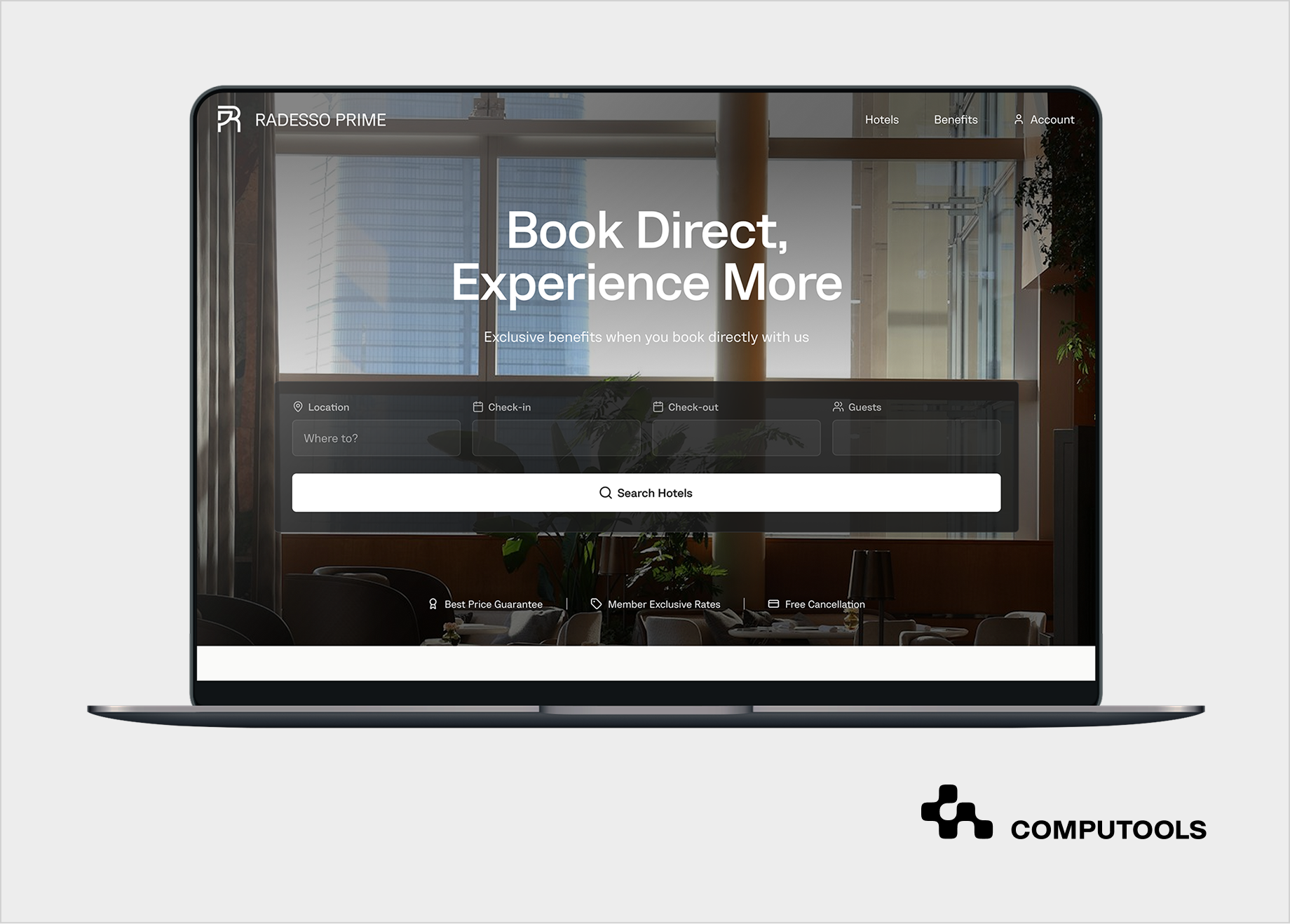
Computools’ Radesso Prime case shows the commercial impact. After the web booking platform was introduced, direct bookings grew from 10% to 55% within six months, which helped achieve an even more desirable direct distribution model.
Technologies supporting hotel booking platform development
A hotel booking solution does not need excessive complexity. It needs the right tech base to support conversion, integrations, pricing, and guest engagement.
1. Artificial intelligence and personalization
Artificial Intelligence is used to support smarter guest offerings. However, AI-powered features should address specific revenue challenges:
- recommend rooms and packages;
- make personalized upsell offers;
- suggest optimal pricing;
- analyze booking behavior;
- segment guests;
- predict guest churn and the likelihood of repeat bookings.
For example, an upsell offer for a returning weekend guest may be a spa package along with a later checkout time. A business guest may be interested in a parking space and breakfast, in addition to a more flexible cancellation policy.
2. Cloud infrastructure
Cloud technology will help hotels manage seasonal booking spikes, campaign traffic, and multi-property access. It also helps consolidate data, increases the speed of system deployment, provides secure backups, and allows for easier scalability.
This is critical for hotels with:
- seasonal booking surges
- campaigns that only occur at one property;
- operations that encompass multiple properties;
- international guests;
- high mobile traffic;
- frequent price changes.
3. API-first architecture
A booking platform is usually part of a larger ecosystem. It will require integrations with the hotel’s PMS, CRM, channel manager, payment gateway, analytics, email tools, and sometimes revenue management software.
API-first architecture makes these connections easier to manage and expand over time.
4. Automation
A reservation journey involves a lot of stages that automation can help with.
These tasks include:
- sending booking confirmations;
- updating the status of payments;
- dealing with cancellations;
- sending guest reminders and pre-arrival messages;
- generating invoices;
- modifying bookings;
- updating the CRM;
- running follow-up campaigns.
For hoteliers, this becomes part of hotel digital transformation that reduces repetitive work and keeps guest communication consistent.

Stop paying OTA commissions on every booking. Launch your own hotel booking platform in 1–3 months, not years, and turn direct reservations into a higher-margin growth channel.
Build vs buy: why hotels choose custom development
Ready-made SaaS booking engines can be useful. They are faster to launch, usually cheaper at the start, and often enough for hotels with simple booking logic. But they become limiting when operators need more control.
When SaaS booking engines are not enough
| SaaS limitation | Business risk |
| Limited customization | The booking journey looks generic and does not match the hotel brand. |
| Vendor lock-in | The hotel depends on the vendor’s roadmap, pricing, and integration rules. |
| Weak integration flexibility | PMS, CRM, payment, and analytics flows may remain fragmented. |
| Limited pricing logic | Complex rate plans, packages, and segment-based offers are hard to manage. |
| Poor multi-property support | Hotel groups struggle with centralized management and local flexibility. |
| Restricted data ownership | The hotel cannot fully use guest and behavioral data. |
| Scaling constraints | The platform may not support long-term business expansion. |
Why hotels choose custom booking platforms
No two hotels are the same, and a tailor-made booking solution allows them to create a booking process that reflects their individual business needs.
The benefits include:
1. Ownership of all data
Each hotel retains control of the data they choose, including guest profiles, booking history, customer preferences, and repeat booking patterns.
2. Flexible business rules
Operators can control their revenue via rules around pricing, inventory, special packages, loyalty programs, promo codes, and restrictions.
3. Custom integrations
The platform can interface with the property’s existing IT solutions without requiring the hotel to conform to the vendor’s business processes.
4. Scalability for hotel chains
A tailor-made booking solution allows hotel chains and hospitality groups to centralize services while maintaining the autonomy of each property.
5. Branded user experience
Hotels can now create a booking solution to match their brand identity and target customer, whether that is a premium positioning, family, corporate (B2B focused), wellbeing, or a holiday resort.
Custom development is especially relevant for:
- multi-property hotel chains and hospitality groups;
- high-end resorts;
- venues with large customer bases;
- growing hotel groups;
- operators that generate high repeat guest traffic;
- hospitality businesses that have multiple upsell and booking package strategies;
- brands that have strong loyalty programs.
Radesso Prime case: from OTA dependency to direct booking growth
The Radesso Prime project illustrates the benefit a hotel group can gain from a custom direct booking platform. Our solution allowed the client to minimize their reliance on the third-party channels without fully excluding OTAs from the distribution network.
The problem
An Austrian hotel chain relied heavily on OTAs. Around 70–80% of reservations came from external platforms, while direct reservations represented only 10%. At the same time, OTA commission fees of 15–25% were reducing margins.
This reflects a common problem for the hospitality business: the property may get consistent bookings, but lose the entire customer relationship and revenue control.
Why the OTA-heavy model slowed growth:
- High commission costs on a large share of reservations.
- Little control over guest communications.
- An inefficient direct rebooking channel.
- An inability to offer incentives for direct deals.
- No access to customer data.
- Dependence on third-party platforms and policies.
This ultimately made growth more costly. An increase in bookings did not necessarily improve profitability.
Our solution
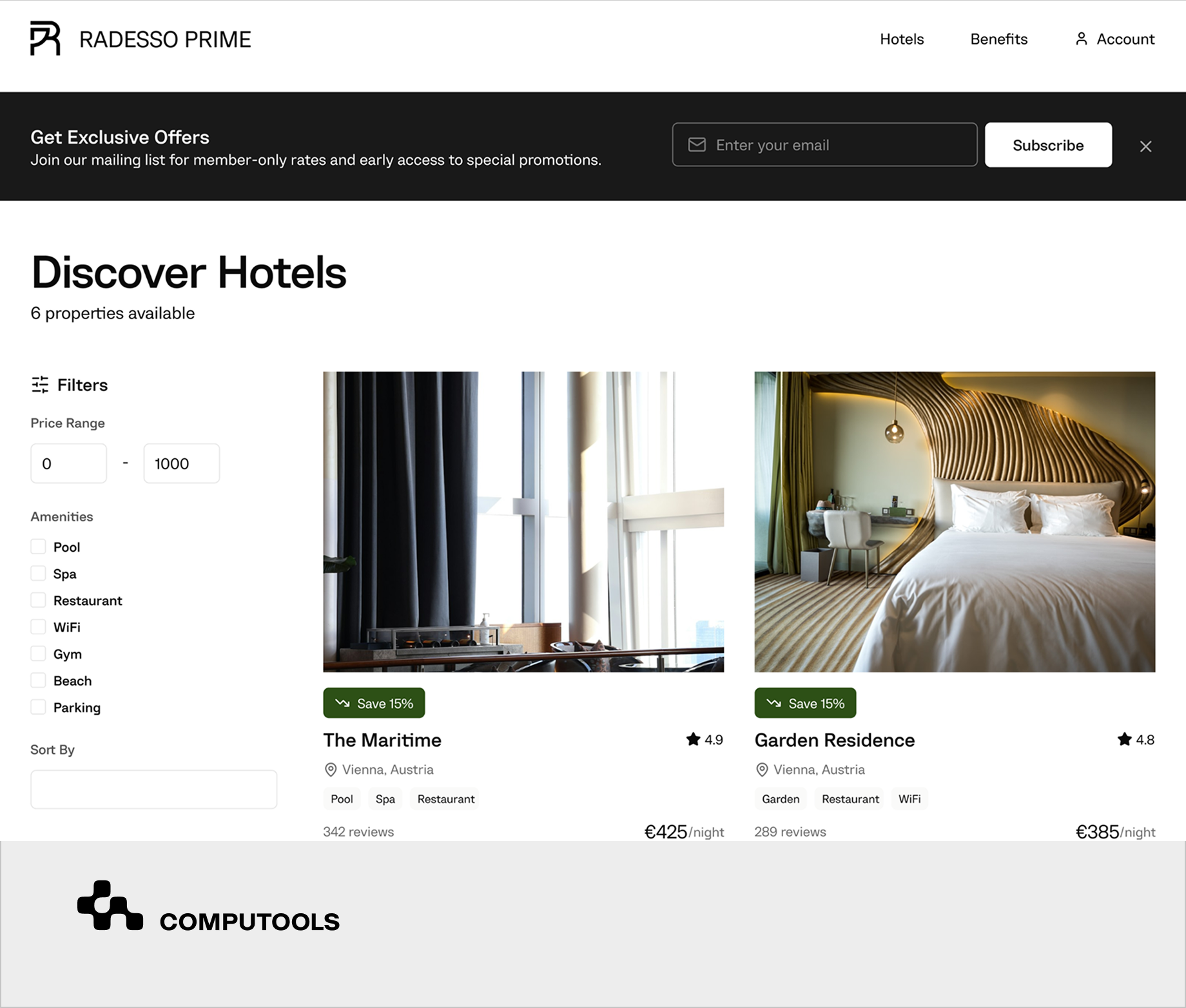
Computools developed a custom booking platform for direct reservations. This solution improved every step of the booking flow, from property overview and room selection to pricing and the all-important final step of closing the sale. The whole customer journey now took place on the hotels’ websites, enabling guests to appreciate the benefits of booking directly.
The platform also supported direct-booking incentives, offering lower rates, flexible terms, free upgrades, and bundled offers. Unlike general marketing offers, these deals were strategically positioned in the reservation flow, the final step in the decision-making process for the guests.
To assist the hotel group with its operations, Computools designed an adaptable content and booking architecture. The platform enabled the client to manage property-specific pages, room descriptions, promotional offers, and location-based content from a single system.
Additionally, we added analytics and tracking to monitor traffic sources, booking funnel performance, user behavior, and conversion events.
Business results
The client’s distribution model experienced a positive transformation, with direct bookings rising from 10% to 55% within 6 months. The pressure from OTAs was lifted, the hotel group gained control over the guest journey, and was able to establish stronger relationships with guests.
The key result was a major shift in booking mix:
| Metric | Before | After |
| OTA reservation share | 70–80% | Reduced dependency |
| Direct booking share | 10% | 55% in six months |
| OTA commissions | 15–25% | Lower commission exposure |
| Guest communication | Limited | Stronger direct communication |
This case shows the real value of a direct booking platform for hotel revenue optimization strategies. It changes how the venue attracts guests, communicates with them, manages revenue, and protects margins.
Why Computools for hotel booking platform development
Computools helps hotels build direct booking platforms that increase owned reservations, reduce commission pressure, and give hospitality teams more control over guest data, pricing, and retention. The company’s experience in travel and hospitality software development services makes it relevant for operators that need more than a standard booking widget.
1. Hospitality domain expertise
Hotel booking engines are not simple checkout systems. They have to support availability rules, rate plans, cancellation logic, multi-property structures, seasonal demand, guest communication, and channel synchronization. We understand these operational details and design solutions around how hospitality businesses actually work.
2. Experience with guest-facing digital products
A direct booking platform has to feel fast, clear, and trustworthy for guests. If the flow is confusing, users return to OTAs because they already know how those systems work.
Computools applies its web development services to create reservation journeys with clear room pages, simple date selection, transparent pricing, secure checkout, and easy access to direct-booking benefits. This helps hotels reduce friction at the most important point: the moment when a guest decides whether to book directly or leave.
For hotels that need stronger engagement before, during, and after the stay, Computools can also support mobile app development. A mobile channel can help with direct rebooking, loyalty access, digital check-in, push notifications, room upgrades, in-stay services, and post-stay communication.
3. HoReCa and revenue growth use cases
Hotels often need to connect room bookings with other revenue streams: restaurants, bars, wellness services, events, parking, transfers, and local experiences. This is where Computools’ software development services for HoReCa can support upsell and cross-sell flows across the guest journey.
For example, a guest booking a weekend stay can see breakfast, dinner, spa access, airport transfer, or late checkout offers before payment. This improves average booking value and gives properties more control over non-room revenue.
4. Integration and platform architecture
A hotel booking solution has to connect with the existing technology stack. Computools can integrate platforms with PMS, CRM, channel managers, payment systems, analytics tools, revenue management systems, and marketing platforms.
With API-first architecture, we help hotels avoid fragmented workflows and build a system that can scale across properties, regions, and brands.
5. Data, analytics, and personalization
Direct booking platforms become much more valuable when hotels can understand how guests behave. Computools’ data engineering services can help structure booking, guest, campaign, and revenue data into a usable foundation for decision-making.
We also apply AI development services to support smarter recommendations, predictive pricing logic, personalized offers, guest segmentation, and automated retention workflows.
6. Full-cycle delivery
Our company supports the full delivery cycle: discovery phase, business analysis, UX/UI design, architecture, backend and frontend development, integrations, analytics setup, software testing, launch, and support.
For hotel chains, resorts, and growing hospitality groups, this means the platform is not limited by a generic SaaS template. It can be built around a unique revenue model, brand standards, guest journey, operational workflows, and long-term distribution strategy.
Computools is also included in the overview of the best travel booking platform development companies, which can help hospitality businesses compare potential partners before starting a custom project.
Final thoughts on a direct booking vs OTA dilemma
OTAs will remain important for hotel distribution. They give hotels reach, visibility, and access to travelers who may never discover the property through direct channels.
But long-term growth depends on more than visibility. Hotels need control over guest relationships, booking data, pricing, loyalty, communication, and profit per reservation.
A direct booking platform helps operators build that control. It stands among OTA alternatives for hotels and does not replace them entirely. The solution gives hospitality brands a stronger owned channel, reduces excessive commission exposure, and turns repeat demand into a direct revenue source.
For hotel chains, resorts, premium brands, and growing hospitality groups, a custom booking platform quickly becomes a strategic revenue asset. Radesso Prime increased direct reservations from 10% to 55% in six months. Let’s discuss what a custom booking system could achieve for your hotel group. Contact our team at info@computools.com.
Computools
Software Solutions
Computools is an IT consulting and software development company that delivers innovative solutions to help businesses unlock tomorrow.