
THE AUTHOR:

How the berth planning process works and why planning is becoming more complex
The berth planning process depends on far more variables than a vessel’s scheduled arrival time and berth availability. Operations teams must simultaneously account for vessel positions, changes in estimated time of arrival (ETA), cargo characteristics, berth readiness, crane and workforce availability, yard congestion, weather conditions, tides, tug and pilot availability, as well as truck and rail schedules. A change in any of these parameters can affect several subsequent port calls.
For ports, a delay means more than additional vessel waiting time. According to the World Bank’s 2024 Container Port Performance Index analysis, container ships spend about 75% of their total port time at berth on average, while the remaining 25% is spent at anchor and in arrival operations, highlighting the operational impact of berth readiness and arrival coordination.
Modern planning therefore relies on integrated port operations data, including AIS and GPS signals, predicted ETAs, TOS data, yard status, equipment availability, weather and tide information, inland transport schedules, and documentation status. When these data sources are consolidated within a single operational environment, teams can identify conflicts earlier, adjust the port scheduling workflow, and reallocate berths and resources before a disruption develops into a vessel queue.
This article examines which data supports effective berth planning, how that data moves through a modern port architecture, where AI and predictive analytics create practical value, and how integrated platforms help reduce bottlenecks, shorten vessel turnaround time, and limit unproductive waiting.
What is berth planning?
Berth planning determines where and when each vessel will be handled and how the required terminal and marine resources will be coordinated around that call. It combines vessel compatibility, expected workload, service duration, infrastructure constraints, and resource availability into a schedule that can be executed safely and efficiently. This makes berth scheduling a coordination task across vessel movements, terminal capacity, and supporting services within a coordinated operational schedule.
A typical workflow starts with vessel schedules and preliminary ETAs. Planners check berth compatibility, including vessel dimensions, draft, and infrastructure restrictions, estimate handling time, build the sequence of calls, and align resources such as pilots, tugs, cranes, and yard capacity. As new information arrives, the port scheduling workflow is reassessed, and only the affected calls and assignments need to be updated.
Several stakeholders contribute to vessel berth planning. The Port Authority oversees vessel traffic, navigational safety, and access to port infrastructure. The Terminal Operator manages berth readiness, cargo handling, equipment, and terminal resources. Shipping Lines provide schedules, ETA updates, vessel specifications, and cargo information. Pilots and Tug Operators support safe arrival, maneuvering, berthing, and departure, while Yard Planning aligns storage and handling capacity with expected loading and discharge volumes.
Because these teams control different parts of the same port call, coordination depends on timely access to the same operational information. A plan remains reliable only while vessel timing, berth status, terminal capacity, and resource availability stay aligned.
What causes bottlenecks in port operations
Bottlenecks emerge when actual vessel movements, berth readiness, yard capacity, and resource availability diverge from the assumptions behind the operating schedule. These constraints are interconnected: a late vessel can create a berth conflict, an unavailable crane can extend service time, and a congested yard can slow discharge even when the berth itself is ready. As a result, disruptions in one part of port operations can propagate through several subsequent calls.
1. ETA uncertainty
ETA changes can result from delays at previous ports, weather, changes in vessel speed or route, and conditions on the approach to the port. A late arrival may overlap with the next planned berth window, while an early vessel may still have to wait if the berth, pilot, tug, or required terminal resources are unavailable. Even a limited deviation can therefore require planners to resequence vessels and revise resource assignments.
2. Yard congestion
An available berth does not necessarily mean that the terminal is ready to receive cargo. As yard capacity becomes constrained, additional container movements and reshuffles can slow the transfer of cargo between the quay and storage blocks and reduce discharge productivity. UNCTAD has documented situations in which container yards operating at capacity slowed vessel processing because cargo could not be discharged until storage space became available. This makes yard visibility an important part of terminal operations management. Planners need to assess whether projected discharge volumes can be absorbed before confirming that a berth window is operationally feasible.
3. Equipment availability
Service plans assume that a defined number of quay cranes, yard machines, horizontal transport units, and operators will be available when the vessel arrives. A crane failure, staffing gap, or equipment shortage reduces actual handling capacity and extends the time required to complete the call. Longer service time increases berth occupancy and can shift the starting time for vessels scheduled to use the same infrastructure next.
4. Weather and tides
Weather and hydrological conditions can affect both vessel arrival and terminal service time. High winds may restrict crane operations, poor visibility or severe weather can affect navigation and pilotage, and deep-draft vessels may depend on specific tidal windows. UNCTAD’s Port of Hamburg case illustrates how storms, vessel schedule delays, and high-tide restrictions can combine to create bottlenecks across both berth and yard operations.
5. Cross-team coordination
Planning also breaks down when Port Authorities, Terminal Operators, Shipping Lines, pilots, tug operators, and yard teams work from different versions of operational information. An updated ETA may already be available to the carrier but remain absent from the terminal resource plan, while a berth-readiness change may reach marine-service teams too late. IAPH has identified fragmentation and misalignment in port-call data as an industry problem and is promoting standardized data exchange to improve coordination.
For example, in our case, Navis Horizon addresses this coordination gap by consolidating shipment and carrier updates into a shared operational view, helping dispatchers identify delays earlier.
What data helps ports make better berth decisions?
Accurate berth planning depends on current vessel, terminal, yard, weather, and resource information. Together, these inputs help planners verify arrival timing, berth readiness, expected service duration, and whether the terminal can handle the planned cargo volume.
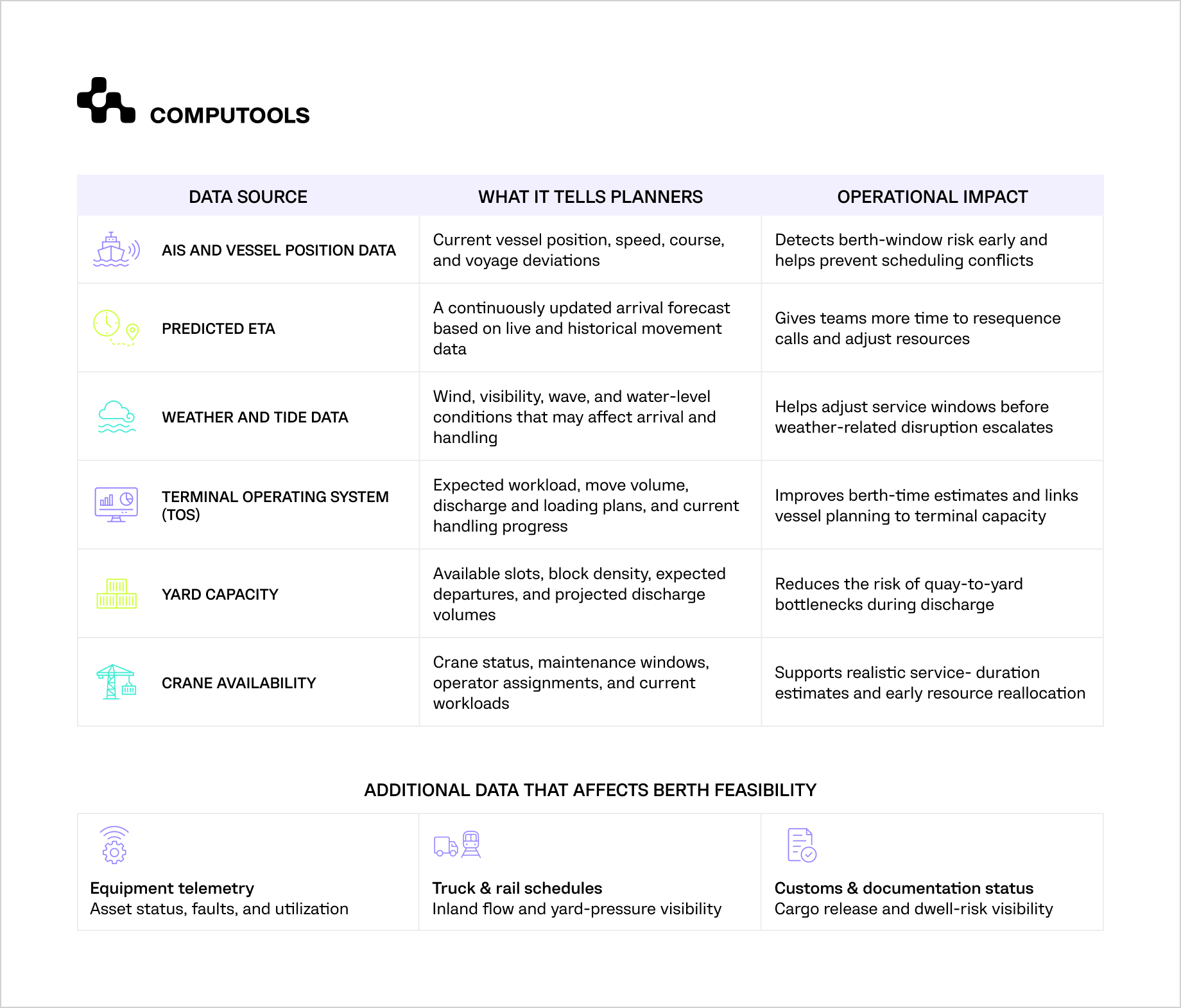
1. AIS and vessel position data
AIS vessel tracking provides current vessel position, speed, course, and navigational status. For planners, the operational value lies in identifying deviations from the expected voyage. A vessel that slows down, changes course, or falls behind schedule may no longer fit its assigned berth window, creating potential conflicts with later calls.
This type of integration can turn isolated tracking signals into a broader operational view. In Navis Horizon, Computools combined AIS, GPS, and carrier-event data in a single interface that automatically detects status changes and potential delays. Dispatchers gained a current view of cargo movements without manually collecting updates from carrier portals, port messages, and spreadsheets.
2. Predicted ETA
A static ETA becomes less useful as voyage conditions change. Predictive models continuously recalculate the expected arrival based on current movement, previous events, and historical patterns, giving planners a more realistic basis for upcoming decisions.
An updated prediction creates additional response time. If a vessel is likely to miss its assigned window, planners can evaluate following calls, available resources, and alternative sequencing before the vessel reaches the port. The operational value increases when predictive outputs are connected directly to dispatcher workflows and live shipment data.
Navis Horizon follows this model: Computools uses live and historical shipment data to forecast delays and detect anomalies, helping dispatchers identify potential disruption earlier.
3. Weather and tide data
Weather and hydrological conditions determine whether the operating plan can be executed as expected. High winds may restrict quay crane activity, poor visibility can affect navigation and pilotage, and vessel draft may make arrival or departure dependent on suitable water levels.
Weather forecasts, wind conditions, visibility, waves, and tide information therefore need to be evaluated against the operating schedule. When a restriction is expected, planners can identify the affected calls and resources early enough to adjust sequencing or service windows rather than responding after operations have already stopped.
4. Terminal Operating System data
The Terminal Operating System (TOS) provides operational context that vessel-position data cannot supply. Depending on the terminal, it can contain vessel workloads, container moves, yard inventory, discharge and loading plans, and current handling progress.
These records help estimate how long a vessel is likely to require the berth. Two vessels with similar arrival times may need very different service windows because of differences in move volume, cargo distribution, and terminal resource requirements. Connecting vessel information with TOS records allows planners to base schedules on expected workload rather than arrival time alone.
5. Yard capacity
Yard conditions determine whether discharged cargo can continue moving away from the quay. Planners need visibility into available slots, block density, expected container departures, and projected discharge volumes before confirming that the terminal can support a planned call.
If forecasts show that a block will approach capacity when the vessel arrives, teams can revise the allocation strategy, prepare alternative storage areas, or adjust the sequence of operations. This reduces the risk of a vessel reaching the berth while the yard is unable to accept cargo at the required rate.
6. Crane availability
Estimated service duration is reliable only when the planned crane capacity is actually available. Crane status, maintenance schedules, operator assignments, and current workloads show whether the resources assumed in the plan match real terminal capacity.
If a scheduled crane becomes unavailable or remains occupied by a previous vessel, the expected completion time changes. Detecting the constraint early gives planners an opportunity to reassign equipment or adjust the sequence of calls before the delay propagates further through the schedule.
7. Equipment telemetry
Telemetry provides real-time information on equipment status, utilization, faults, and operating conditions. When crane, yard vehicle, or handling-equipment performance starts to deviate from plan, teams can identify the constraint before it affects vessel service and adjust resource assignments accordingly.
8. Truck and rail schedules
Landside transport schedules show how quickly containers are expected to leave or enter the terminal. A mismatch between vessel discharge volumes and available truck or rail capacity can increase yard pressure, so planners need these schedules when assessing whether the terminal can support upcoming cargo flows.
9. Customs and documentation status
Cargo may be physically available but still blocked by customs holds, incomplete documentation, or missing release approvals. Visibility into clearance status helps teams identify containers that may remain in the terminal longer than expected and account for their impact on available yard capacity and planned operations.
How modern port systems turn data into berth decisions
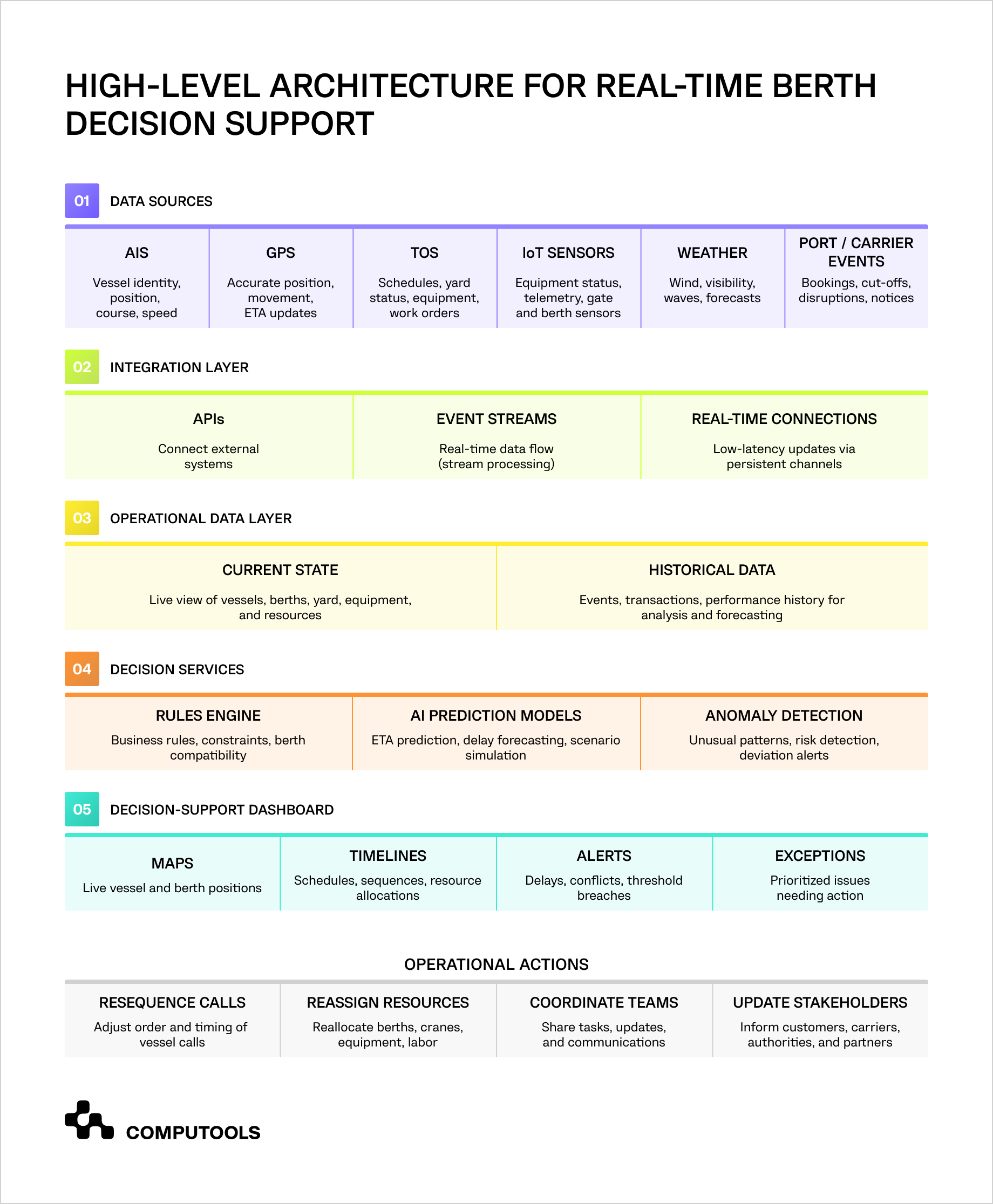
A real-time planning platform needs more than connections to AIS, GPS, TOS, and IoT sources. It requires an architecture that can ingest heterogeneous operational events, reconcile them into a consistent state, run prediction and constraint logic, and deliver changes to planners with sufficiently low latency to support intervention.
The first layer handles data ingestion. Vessel-position feeds, terminal records, equipment telemetry, weather services, and carrier or port events may arrive through APIs, streaming interfaces, sensor gateways, or persistent real-time connections. These sources use different schemas, identifiers, update intervals, and timestamp conventions, so incoming events need to be validated, mapped to common entities, deduplicated, and ordered before downstream services can use them reliably. For ports operating fragmented legacy environments, software engineering services can connect these sources through APIs and shared processing layers while preserving the operational systems teams already rely on.
A shared operational data layer then maintains the current state of vessels, terminal resources, and relevant events while preserving historical records for forecasting and auditability. This layer should reconcile planned and actual timestamps, associate events with the correct vessel or call, and expose consistent data to downstream maritime operations software. Without that normalization, prediction models may operate on stale, duplicated, or misaligned inputs.
Above the data layer, processing services combine deterministic rules with predictive analytics. Rules can identify hard constraints such as berth compatibility, equipment availability, or operational restrictions, while predictive models evaluate uncertainty and estimate the downstream impact of changing operational conditions. For vessel traffic management, this creates a decision layer that combines probabilistic forecasts and vessel-position data with fixed operational constraints.
The decision layer converts these outputs into planner-facing actions. Instead of displaying every incoming event, the system prioritizes exceptions, identifies affected calls and resources, and updates maps, timelines, alerts, and operational status in real time. A useful dashboard should show the current state, the predicted impact of a change, and the decisions that require human review. Role-based access and event histories also preserve accountability when several teams act on the same operational plan.
Navis Horizon provides a practical example of how these layers work together in one platform. Computools designed real-time AIS/GPS aggregation and integrated multiple carrier APIs and port-event systems into a unified stream. Go services process high-frequency tracking data, PostgreSQL stores shipment events, timeline updates, logs, and tracking history, while Python-based LSTM models forecast delays and detect anomalies from live and historical information. WebSockets push status and event changes directly to dispatcher and customer interfaces without manual refresh.
The same architecture can support a different planning environment. HubMarine integrates AIS data with vessel parameters, permits, sailing history, and mapping information to support berth and marina management. Machine-learning functionality helps determine optimal vessel placement, while IoT-based maps show vessel type and location, and historical operational data supports real-time adjustments.
These projects illustrate how maritime software development services can connect vessel feeds, terminal systems, predictive models, and planner interfaces within one operational architecture.
How AI turns port data into predictive berth decisions
AI and predictive analytics are most useful when they help planners anticipate what is likely to happen next rather than simply report the current state. Models can detect arrival deviations, forecast capacity pressure, assess resource conflicts, and recalculate feasible operating scenarios as conditions change. For port operations optimization, this creates additional time to intervene before one disruption affects several vessel calls or terminal resources.
1. Predictive ETA
Predictive ETA models combine current vessel movement with historical voyage patterns, previous events, weather conditions, and other available signals to continuously refine expected arrival times. The practical advantage is earlier detection of likely delays, giving planners time to assess whether the existing sequence remains feasible and which subsequent calls or resources may be affected.
Navis Horizon demonstrates this approach in practice. Computools implemented Python-based LSTM models that analyze live and historical shipment information to forecast delays and detect anomalies. Predictive alerts are delivered directly to dispatchers, connecting forecasting with operational workflows and response. The platform reduced dispatcher workload by 40% and accelerated shipment incident resolution by 18%.
Also, AI development services add practical value by connecting predictive models to live tracking feeds, event processing, alerts, interfaces, and the workflows through which teams evaluate and act on predictions.
For broader applications of AI across vessel operations, cargo monitoring, and dispatcher workflows, see our guide to AI agents in maritime logistics.
2. Dynamic berth allocation
A berth assignment can become unsuitable after a change in arrival time, service duration, equipment availability, vessel draft restrictions, or weather conditions. Dynamic allocation allows the system to reevaluate feasible alternatives as these constraints change. The calculation can consider vessel dimensions, draft, berth characteristics, expected workload, service windows, and resource availability. Planners receive a set of operationally feasible options and can assess how each one would affect subsequent calls and resource commitments.
HubMarine applies the same multi-constraint planning logic in marina operations. Its machine-learning functionality supports vessel placement using vessel characteristics, historical information, and available space, while AIS integration provides current vessel data. The case shows how placement decisions can account for several operational constraints at once rather than rely on berth availability alone.
For a deeper look at berth assignment rules, vessel-fit checks, availability logic, and exception handling, see our guide to developing a berth booking system for marinas and ports.
3. Resource planning
Changes in vessel timing also affect cranes, pilots, tugs, workforce, and yard equipment. A schedule that remains feasible from a berth perspective may still fail if the required resources are committed elsewhere when the vessel arrives. Predictive resource planning evaluates these dependencies before execution. If one call is expected to take longer than planned, the system can identify which assets or teams will remain occupied and which later operations will be affected. Planners can then redistribute resources, change sequencing, or coordinate revised service times before the conflict reaches execution.
The same forecasting supports better berth utilization by showing how expected delays, extended handling times, and resource constraints are likely to affect available capacity over the next several hours or shifts.
4. Congestion forecasting
Congestion usually results from several constraints converging at the same time. A vessel delay may coincide with high yard density, reduced crane capacity, adverse weather, or another arrival that has already consumed the schedule buffer. Forecasting models can combine these variables to identify periods when operational pressure is likely to exceed available capacity. Instead of waiting for a vessel queue or yard blockage to appear, teams can see which calls, resources, or terminal areas are exposed and how long the constraint may persist.
This supports port logistics optimization by giving teams time to adjust vessel sequence, prepare alternative yard capacity, reassign equipment, or coordinate changes with external stakeholders before disruption propagates across the terminal.
5. Real-time schedule optimization
Port scheduling software can use material operational events to trigger focused recalculation of affected vessel sequences, berth windows, and resource assignments. Prediction has limited value if the operating plan remains static after a significant event. Real-time optimization recalculates the affected part of the schedule when an arrival estimate changes, equipment becomes unavailable, a berth is released, or weather creates a new restriction.
The system updates the current operational state, identifies affected calls and resources, evaluates feasible alternatives, and presents revised options to the planner. Vessel scheduling software can therefore support faster dependency analysis while keeping the final operational decision with the human team.
This event-driven approach also avoids unnecessary full-schedule recalculation. Minor updates can remain informational, while material deviations trigger focused re-optimization of the vessels, resources, and time windows that are actually affected.
6. AI use cases at a glance
| Use case | Main inputs | Decision supported | Operational effect |
| Predictive ETA | Vessel movement, historical voyages, weather, operational events | Reassess arrival windows and downstream dependencies | Earlier detection of potential delays |
| Dynamic placement | Vessel dimensions, draft, available locations, workload, restrictions | Select or revise a feasible berth | Fewer assignment conflicts |
| Resource planning | Cranes, pilots, tugs, workforce, yard equipment | Reallocate resources around revised vessel timing | More stable marine terminal operations |
| Congestion forecasting | Arrivals, service duration, yard pressure, equipment status, weather | Identify upcoming capacity constraints | Earlier mitigation before queues form |
| Real-time optimization | Live events and updated operating constraints | Resequence calls and revise assignments | Faster response to schedule disruption |
Together, these AI capabilities give planners a forward-looking view of vessel arrivals, resource demand, and capacity constraints. The result is faster response to changing conditions, fewer cascading conflicts, and a more stable operating schedule across berth, yard, and marine services.

Launch your berth planning and port operations platform in 1–3 months, not years, and give port teams the data and tools to coordinate vessels, berths, cargo, and resources with fewer bottlenecks and less manual work.
Best Practices for Reducing Bottlenecks in Ports
Even an accurate initial plan can become outdated when arrival estimates shift, a previous vessel occupies the berth longer than expected, yard capacity tightens, or equipment becomes unavailable. Reducing bottlenecks therefore depends on more than building a good schedule once. Ports need systems that detect material changes, evaluate their downstream impact, and update operational decisions throughout the port call.
1. Real-time visibility
Planners need a shared view of the current state of vessels, berths, yard capacity, and operational resources. AIS and GPS feeds should be evaluated alongside TOS statuses, equipment telemetry, weather conditions, and operational events. The dashboard should prioritize changes that can invalidate the plan, including revised arrival estimates, unfinished handling operations, equipment failures, navigational restrictions, and capacity constraints.
The Maritime and Port Authority of Singapore applies this principle through the digitalPORT@SG Just-In-Time Planning and Coordination Platform. It provides advanced real-time information on vessel schedules and supports coordination of arrival, departure, pilotage, towage, and other marine services. MPA reported in 2026 that more than 150 port users and service providers across the container, general cargo, and bulk sectors had joined the platform since its 2024 launch.
2. Cross-system integration
Visibility has limited value when each team operates from a different version of the same event. Vessel movement, terminal workload, berth status, nautical services, and landside logistics frequently sit in separate systems controlled by different organizations. Integration needs to synchronize critical events and identifiers so that a change in one workflow becomes available to the teams responsible for dependent operations.
The Port of Rotterdam illustrates the scale of this coordination problem in feeder operations. In 2025, average in-port waiting time for feeder vessels reached 12.9 hours, up 44.5% year over year, even though feeder calls declined by 10.3%. The Port Authority identifies multi-terminal rotations and the absence of a shared planning system as important coordination challenges. Its Feeder and Berth Pilot brought competing stakeholders together to test joint planning and controlled transparency between feeder operators and terminals.
For ports operating fragmented technology stacks, logistics software development services can provide the API and integration layers required to connect existing terminal, vessel, equipment, and logistics systems without replacing the entire operational environment.
3. Event-driven planning
Schedule reviews should not depend only on fixed planning cycles. A material event should trigger an assessment of the part of the plan it affects. Relevant triggers include a significant arrival-time change, delayed or completed cargo handling, berth release, equipment failure, weather restriction, revised tug or pilot availability, and changes in cargo status.
Event-driven logic first identifies dependencies: which vessels, resources, and time windows are affected by the new information. Port management software can then update operational states, create exceptions, recalculate affected activities, and surface decisions that require planner intervention. This avoids rebuilding the entire schedule after minor updates while ensuring that meaningful disruptions are handled quickly.
Singapore’s JIT platform follows the same operational principle by using updated vessel schedules to coordinate port resources and marine services around actual arrival requirements. MPA states that the platform helps reduce anchorage waiting and improve ship turnaround by supporting more precise arrival and service planning.
4. Scenario modeling
When several feasible responses exist, planners need to understand their consequences before changing the live schedule. Scenario modeling can compare what happens if a delayed vessel keeps its original berth, moves to another location, or is resequenced behind another call.
The model should consider service duration, vessel draft, berth restrictions, crane and workforce availability, yard pressure, and dependencies across following calls. In complex dock scheduling, this allows alternatives to be compared by their wider operational impact, including effects on subsequent calls, resources, and terminal capacity.
The Port of Antwerp-Bruges is developing this capability through APICA, its digital twin. The platform combines real-time information from cameras, sensors, radar, and other sources within a 3D operational environment. The Port Authority is extending APICA toward holistic nautical-chain planning, more predictive operations, and more efficient deployment of people and resources.
5. Continuous re-optimization
Once a revised scenario is selected, the plan still needs to be monitored. Another arrival change, equipment-status update, or capacity constraint may invalidate a decision made only minutes earlier. Continuous re-optimization should use defined thresholds for material deviations so that planners are alerted only when a change can affect capacity, resource commitments, or subsequent calls. The system should identify material deviations, estimate their downstream impact, and prioritize the exceptions that require action. Human planners retain responsibility for operational decisions while the platform accelerates dependency analysis and comparison of feasible alternatives.
This moves port digital transformation beyond digitizing the current operating picture toward systems that help teams anticipate change, coordinate responses, and maintain schedule stability under continuously changing conditions.
How data-driven maritime platforms work in practice
Navis Horizon and HubMarine address two different operational problems: fragmented cargo visibility in port logistics and inefficient vessel placement and berth coordination in marina operations. In both projects, Computools connected operational data with workflows that reduced manual work, improved visibility, and gave teams more time to respond to changing conditions.
Navis Horizon: from fragmented shipment data to predictive decision support.
A port logistics operator in Hamburg relied on carrier portals, port messages, spreadsheets, and manual status checks to track shipments. Dispatchers spent substantial time collecting and reconciling updates, while customers frequently contacted support for shipment information. The fragmented process slowed incident resolution, created inconsistent communication, and contributed to SLA breaches.
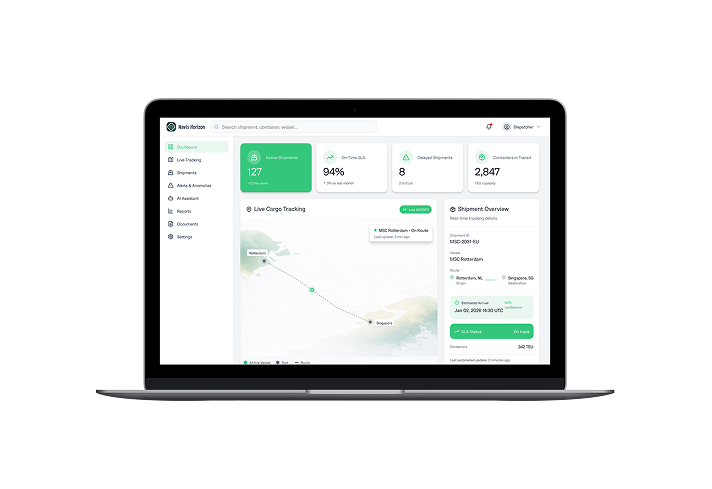
Computools consolidated AIS, GPS, carrier-event data, carrier APIs, and port-event systems into one operational platform. Automated status updates replaced part of the manual monitoring workload, while predictive models analyze live and historical shipment information to identify likely delays and anomalies. Dispatchers receive alerts, summaries, and shipment details in the same interface, allowing them to investigate exceptions before they develop into larger operational disruptions.
The platform was delivered in iterative phases with regular testing and incremental releases. Computools also worked directly with the client’s operations team to integrate the new workflows with minimal disruption to ongoing activities. This allowed functionality to be reviewed and adjusted as operational requirements became clearer instead of postponing validation until full rollout.
The implemented solution reduced dispatcher workload by 40%, accelerated shipment incident resolution by 18%, increased customer satisfaction by 23%, and provided 100% transparency in cargo status updates. The client also reported fewer SLA penalties and improved overall reliability.
For a broader view of how fragmented carrier, port, and tracking data can be consolidated into a unified operational flow, see our guide to automating shipment status management across maritime supply chains.
HubMarine: improving vessel placement and berth coordination
HubMarine had already tested generic marina management systems, but they did not provide the vessel-specific information and workflows required for its operations. Marina teams needed access to vessel data that was not normally public, while reservations depended on time-consuming communication between boat owners, marina staff, and the platform. Unclear movement information also created conflicts and potential safety issues.
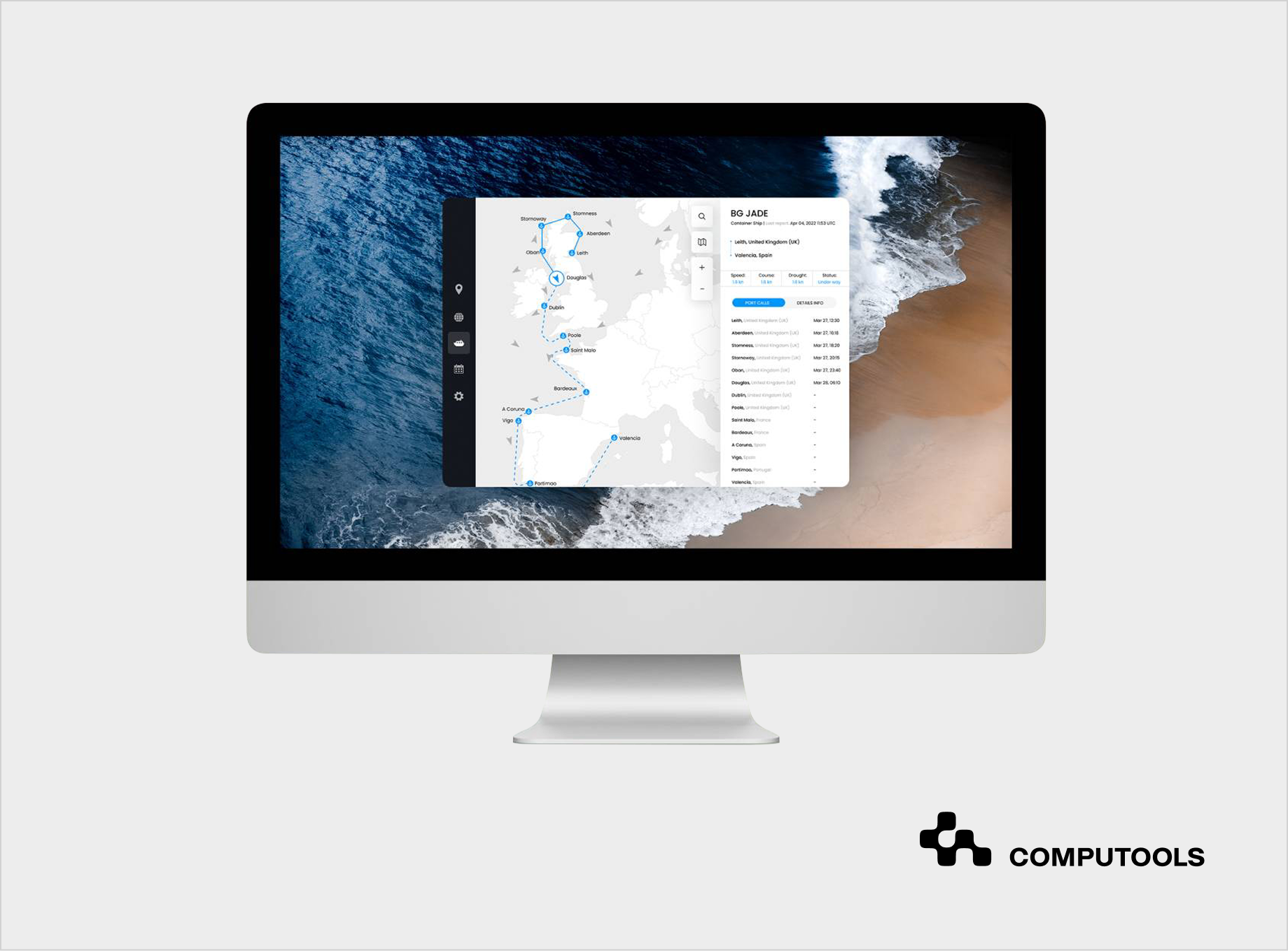
Computools integrated the platform with AIS and built planning workflows around vessel parameters, permits, sailing history, and mooring locations. Custom maps show vessel type and position, giving marina operators and harbor authorities a clearer operational view. Analytics use information from previous operations to recommend real-time changes, while machine learning supports optimal vessel placement and more efficient use of marina space.
IoT development services connected physical vessel information with reservation, navigation, and planning workflows, reducing reliance on separate monitoring tools.
The resulting platform reduced communication and berth pre-booking time by up to 75% and improved transparency between boat owners, marina operators, and port authorities.
Together, these projects show the practical scope of maritime software development services: integrating fragmented operational data, validating workflows with users, applying analytics where they reduce manual decision-making, and connecting technical changes to measurable operational results.
To sum up
Effective port planning depends on how quickly teams can detect a meaningful deviation, understand its downstream impact, and adjust vessel and resource decisions. Connected data, predictive models, and event-driven planning support more consistent vessel turnaround optimization by reducing avoidable waiting and preventing local disruptions from becoming schedule-wide bottlenecks.
For port and terminal operators, the priority is to modernize these workflows around measurable operational constraints, validate changes in phases, and expand automation where it produces clear improvements in response time, visibility, and resource use.
Computools
Software Solutions
Computools is an IT consulting and software development company that delivers innovative solutions to help businesses unlock tomorrow.