
THE AUTHOR:

Healthcare organizations are beginning to develop care gap management software as a solution to the need to integrate patient data, quality measures, outreach, and clinical operational workflows into a unified system. With the challenge of improving quality scores, the growing workload of administrative duties, and the burden of providing evidence of positive impacts on patient outcomes, the needs of Medicare Advantage plans, Medicaid managed care organizations, and healthcare service providers continue to grow.
The business environment behind care gap management is changing quickly. The CMS is introducing new expectations for payers and providers to increase the use of standardized APIs to exchange healthcare information and improve access to patient data. The Final Rule pertaining to Interoperability and Prior Authorization from the CMS outlines additional expectation frameworks for payer data, new requirements related to FHIR-based APIs, and prior authorization, pushing organizations towards modern healthcare technology ecosystems.
For 2026, MA-PD contracts are rated on up to 43 quality and performance measures, yet only about 40% of contracts earned four stars or higher. Quality performance has direct financial implications. Medicare Advantage Organizations are evaluated via CMS Star Ratings, which determine both bonus payments and market position. Preventive screenings, chronic disease management, medication adherence, and member experience measures all depend on the ability to identify missing care activities and coordinate timely interventions.
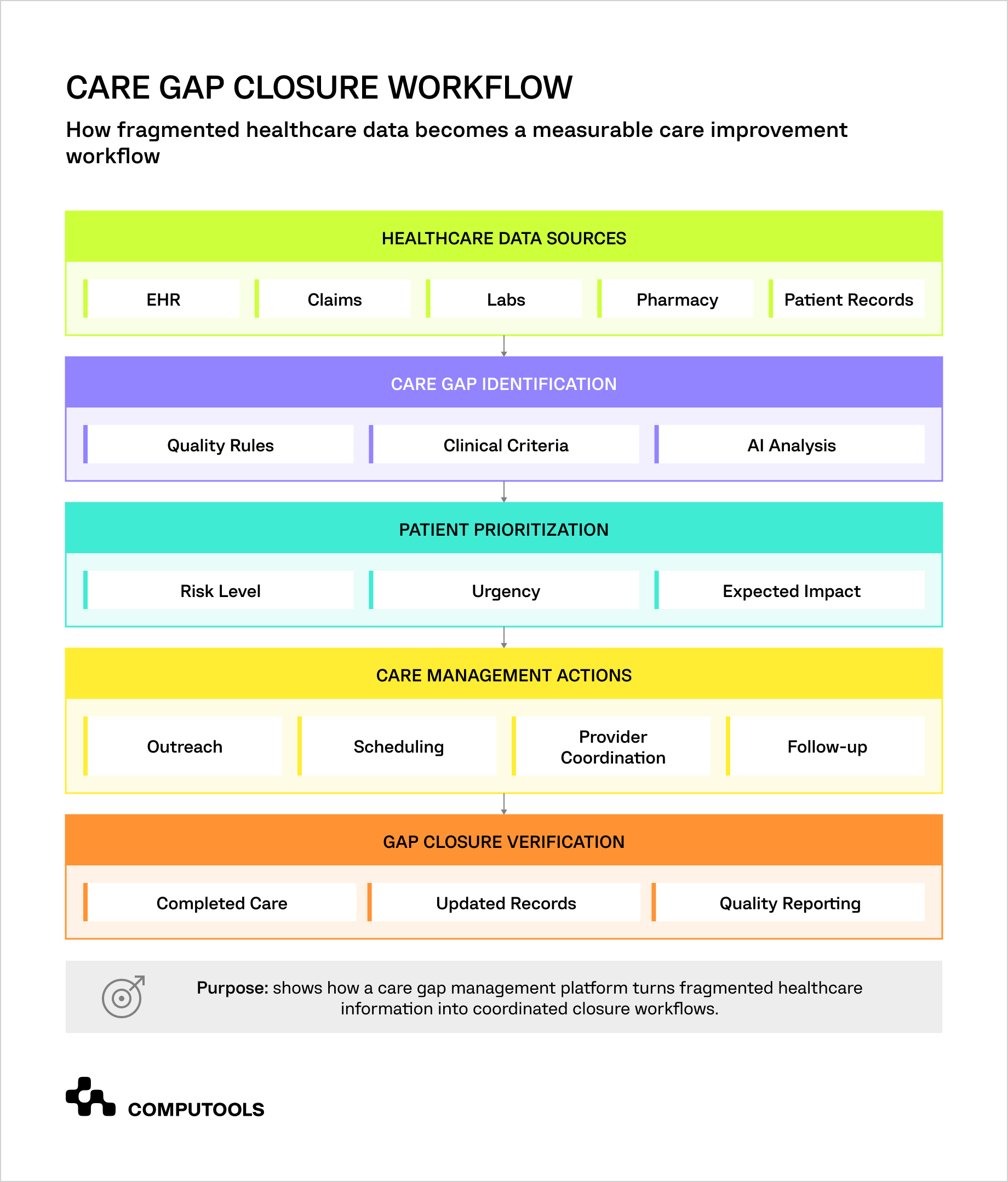
Healthcare organizations still rely on inefficient, disjointed workflows to manage care gaps. Patient data may be distributed across several systems, including electronic health records, claims, labs, pharmacies, and outreach platforms. Care teams spend a considerable amount of time finding eligible patients, validating information, contacting members, and documenting completed engagements.
A modern care gap system becomes part of the wider healthcare operating model.
It connects:
- patient care gap identification;
- clinical and claims data;
- risk prioritization;
- outreach automation;
- provider coordination;
- quality reporting;
- analytics and forecasting.
The goal is to create a system that supports closing gaps in care through measurable workflows. A successful platform allows healthcare organizations to understand which patients require attention, what action should happen next, who owns the intervention, and whether the gap was successfully resolved.
Essential features of medical care gap management software
| Core capability | Business value |
| Patient care gap identification | Detects overdue screenings, follow-ups, and chronic care actions earlier. |
| Risk-based prioritization | Focuses teams on patients with the highest clinical or quality impact. |
| Automated outreach workflows | Reduces manual coordination and speeds up gap closure. |
| Healthcare data integration | Connects EHR, claims, lab, pharmacy, and payer data in one workflow. |
| Quality analytics | Tracks closure rates, measures performance, and provider activity. |
| AI-assisted recommendations | Supports next-best-action decisions using structured patient data. |
This article explains how to develop care gap management software, including architecture decisions, healthcare integrations, AI capabilities, security requirements, and practical development steps for Medicare and Medicaid programs.
Recommended reading:
For a broader view of how healthcare organizations structure patient-facing digital workflows, read How to Build a Patient Engagement Platform. It covers communication, personalization, scheduling, and engagement tracking across the patient journey.
Medocentra: a practical example of how to develop care gap management software
A care gap management system should solve operational problems caused by fragmented data and slow documentation processes across healthcare organizations and address challenges related to manual coordination and limited visibility into patient progress. Computools addressed similar issues in the Medocentra project, where the goal was to improve healthcare workflows through a connected digital platform.
Client context
Medocentra is a US-based healthcare technology company that offers support for Medicare, Medicaid, and private health plan programs. The company helps with the management of complex healthcare operations, such as patient engagement, clinical documentation, coding, and the preparation of claims.
The client aimed to develop a platform that would support multiple healthcare activities and provide secure access to sensitive patient data.
Business challenge
Healthcare workflows involved multiple systems and teams. Patient information was distributed across healthcare databases, EHR systems, scheduling tools, and operational platforms.
This created several challenges:
- limited visibility into patient journeys;
- manual coordination between clinical and administrative teams;
- delays in documentation processing;
- inefficient information exchange between systems;
- increased risk of coding and claims errors.
For organizations managing Medicare and Medicaid populations, these challenges directly affect quality performance, operational costs, and the ability to track healthcare outcomes.

Computools solution
Our team developed a healthcare platform that centralized patient workflows and connected different operational processes through secure integrations.
The solution included:
- healthcare data collection and normalization;
- integrations with external healthcare systems;
- structured patient data management;
- automated documentation workflows;
- coding validation processes;
- claims preparation support;
- role-based access control;
- audit logging and security monitoring.
The software architecture relied on healthcare interoperability standards, including HL7 and FHIR-based data exchange, allowing information to move between connected systems while maintaining consistent patient records.
The platform also introduced automation capabilities that reduced manual processing and improved workflow visibility for healthcare teams.
Business result
The platform improved operational efficiency across healthcare workflows:
- up to 50% reduction in manual effort;
- up to 3x faster visit-to-claim processing;
- up to 35% reduction in coding errors;
- up to 25% fewer claim rejections;
- up to 20% reduction in missed appointments;
- up to 25% improvement in provider utilization.
The Medocentra project demonstrates an important principle for care gap management software development. Healthcare improvement depends on connecting data, workflows, and operational decisions into one system.
Explore a related healthcare platform model:
How to Build a Telehealth Platform for Hospitals looks at how hospitals connect clinical workflows, scheduling, patient access, integrations, and operational coordination in one digital environment.
How to develop care gap management software
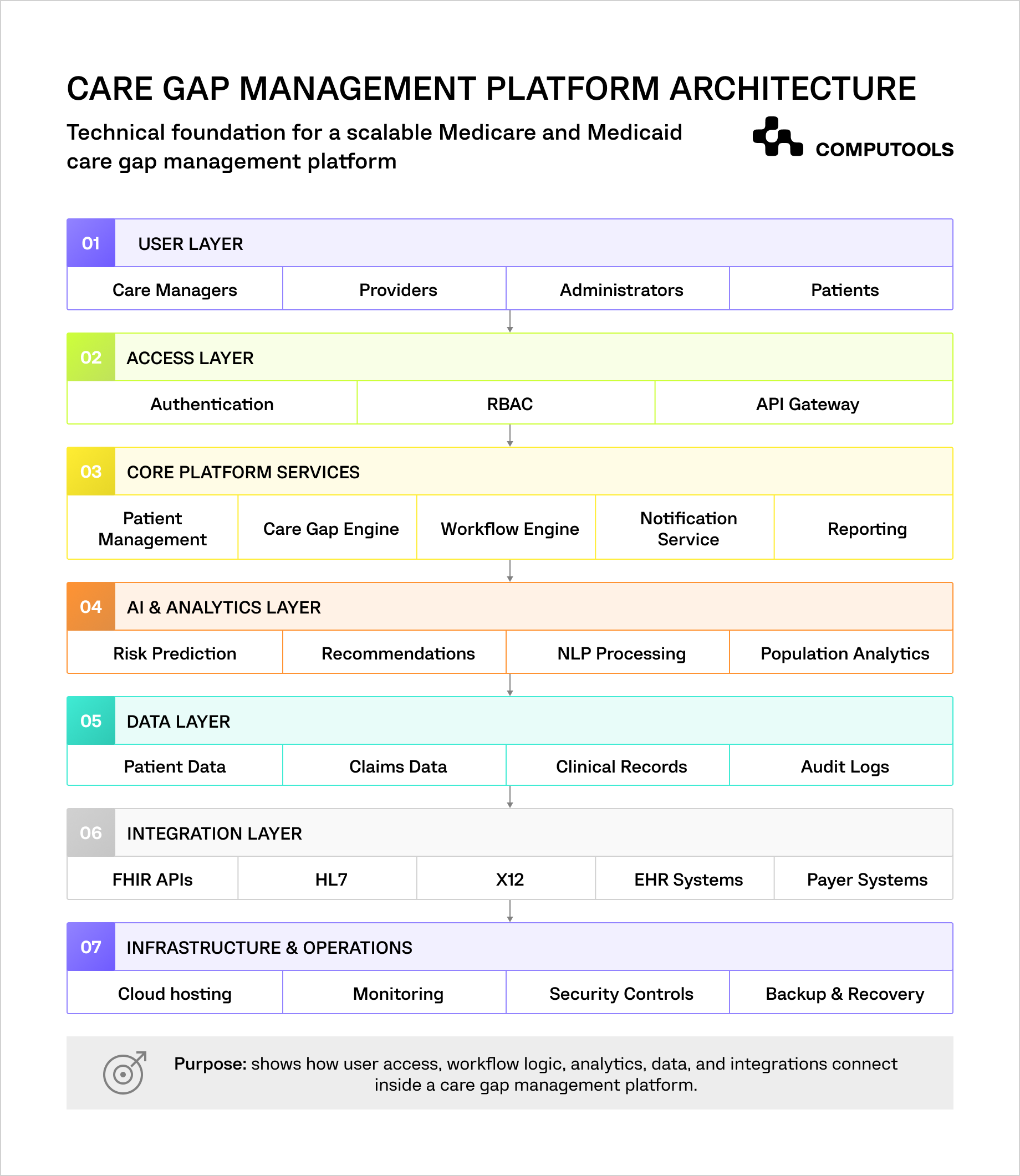
To develop care gap management software, healthcare organizations need to define how the system will identify gaps, prioritize patients, coordinate actions, connect data sources, and track results.
Step 1. Define care gap workflows and quality objectives
The first decision when developing a care gap platform is defining what business outcomes the system should improve. Healthcare organizations need clear objectives before selecting technologies or designing interfaces.
A Medicare or Medicaid care management platform may focus on:
- preventive screening completion;
- chronic disease monitoring;
- medication adherence;
- annual wellness visits;
- risk-based outreach;
- provider performance improvement.
The system design should start with the complete care gap lifecycle: Patient identification → Risk evaluation → Recommended intervention → Outreach → Appointment or treatment → Documentation → Gap closure verification → Reporting.
This workflow establishes the required data structures, user roles, automation rules, and reporting.
For example, a diabetes-specific care gap may require a platform to identify patients, review previous lab results, set outreach tasks, schedule appointments, track required lab tests, and update quality metrics reporting.
Such a system would require a framework built on rules that allow for quality adjustments. Medicaid.gov reports 73,526,272 Medicaid and CHIP enrollees in May 2026, including 66,388,522 Medicaid beneficiaries. Healthcare environments need to manage varying populations, programs, and quality measures. Having a flexible rules engine allows teams to modify rules without an extensive implementation.
If this stage is skipped, healthcare organizations implement systems that indicate missing care activities but lack the functionality to support closure workflows.
Step 2. Build a unified healthcare data architecture
A care gap management platform depends on accurate, connected healthcare data. The main architectural challenge is bringing information together from systems that were designed for different purposes.
Typical data sources include:
- electronic health records;
- claims systems;
- laboratory systems;
- pharmacy databases;
- provider directories;
- patient engagement platforms;
- scheduling systems.
The architecture should include several layers.
Data integration layer
This layer collects information through:
- HL7 interfaces;
- FHIR APIs;
- X12 healthcare transactions;
- secure file exchanges;
- database connections.
FHIR-based integration has become increasingly important as healthcare organizations move toward standardized data exchange. CMS interoperability initiatives continue to push payers and providers toward API-based access and information sharing.
Data normalization layer
Healthcare data often contains inconsistencies, such as different patient identifiers, duplicate records, different terminology systems or incomplete documentation.
The platform should normalize data before it reaches analytics or workflow modules.
Important functions include:
- patient identity matching;
- clinical terminology mapping;
- duplicate detection;
- data validation.
Operational data layer
The platform should store information required for daily workflows:
- patient profiles;
- identified care gaps;
- intervention history;
- outreach activity;
- provider assignments;
- closure status;
- audit records.
In the Medocentra project, Computools implemented healthcare data collection and structured storage capabilities to support reliable workflows across multiple systems. This approach is also essential for organizations building healthcare quality improvement software that depends on consistent patient information.
For additional guidance on healthcare data architecture:
Read How to Build a Healthcare Data Platform for a practical view of data ingestion, normalization, interoperability, governance, and analytics foundations.
Step 3. Design patient care gap identification and prioritization logic
Identifying care gaps is only the first part of the process. Healthcare organizations need a system that determines which patients require attention first and what intervention has the highest potential impact.
A care gap analytics software module should combine clinical criteria, quality measures, patient history, risk indicators, previous interventions and provider information.
The platform should support configurable rules such as:
- patients overdue for preventive screenings;
- members with uncontrolled chronic conditions;
- patients missing follow-up visits;
- medication adherence risks;
- high-risk populations requiring additional support.
A prioritization engine can rank patients based on factors such as:
- clinical urgency;
- likelihood of closure;
- health risk;
- intervention complexity;
- available care resources.
As an example, two patients may have the same overdue screening. One of those patients may only need a reminder, while the other may need assistance with scheduling, provider coordination, and additional follow-up. The objective of the platform should be to help the team allocate resources to the most impactful areas.
AI can also help with this by identifying patterns among large populations of patients. However, AI has its limits due to the data it is provided with. Insufficient data leads to unpredictable results and inferior operational decisions.
Step 4. Create automated care gap closure workflows
Identifying missing care activities does not improve outcomes by itself. Healthcare teams need workflows that move patients from identification to completion.
A care gap closure software solution should coordinate actions between:
- care managers;
- nurses;
- physicians;
- outreach specialists;
- administrative teams;
- patients.
Core workflow capabilities include:
Task management
The platform assigns responsibilities, tracks deadlines, and records completed actions.
Example:
A patient identified as overdue for colorectal cancer screening receives an outreach task assigned to a care coordinator. The coordinator contacts the patient, schedules the appointment, and updates the workflow status.
Automated communication
The system can support:
- SMS reminders;
- email notifications;
- patient portal messages;
- appointment reminders.
Escalation rules
If a patient does not respond, the platform can automatically:
- create a follow-up task;
- notify a supervisor;
- assign the case to another team member.
Documentation tracking
Every interaction should be recorded:
- outreach attempts;
- patient responses;
- completed interventions;
- provider notes;
- closure evidence.
A well-designed workflow reduces manual tracking and gives healthcare teams visibility into where patients are within the care process.
For another perspective on software that supports ongoing patient care:
Explore How to Build a Digital Therapeutics Platform to see how clinical logic, patient engagement, outcome tracking, and structured health data work together in digital health products.
Step 5. Integrate provider, payer, and healthcare systems
A care gap management solution becomes valuable when it connects the systems that already support patient care. Healthcare organizations rarely operate from one data source. Currently, patient information, quality metrics, claims, activity, and communications are scattered across different platforms.
The integration strategy must determine systems that require real-time/live data synchronization vs ones that can be set at an interval to synchronize.
Common integrations include:
- electronic health records (EHRs);
- claims processing systems;
- payer platforms;
- laboratory information systems;
- pharmacy databases;
- CRM systems;
- scheduling platforms;
- patient portals.
Build an integration layer with healthcare standards
The architecture should include an integration layer that manages:
- FHIR APIs for modern healthcare data exchange;
- HL7 interfaces for clinical messages;
- X12 transactions for claims and administrative data;
- API authentication;
- synchronization monitoring;
- error handling workflows.
The integration layer must preserve data lineage. Healthcare software must track the system of origin, when the data was last modified, and which system provided the source data.
Take, for instance, a quality measure regarding the unscreened patient. The solution must indicate if the information was extracted from the claims, provider encounters, or lab data.
Within Medocentra, Computools developed healthcare system integrations and structured workflows that interconnect and align operational processes. Similar integration patterns are important when developing a care gap management application because accurate decisions depend on consistent information from multiple healthcare sources.
Avoid disconnected workflows
A common implementation mistake is creating another dashboard that requires employees to manually transfer information into existing systems.
A successful platform should allow data to move in both directions:
- retrieve patient information;
- identify care gaps;
- create tasks;
- update completion status;
- send results back to connected systems.
This reduces duplicate work and improves the reliability of quality reporting.
Step 6. Add AI and analytics capabilities for smarter care management
Modern healthcare organizations are adding AI and analytics to improve prioritization, reduce administrative workload, and support proactive interventions. AI should operate as a decision-support layer built on validated healthcare data.
A healthcare care gap management platform can include several advanced capabilities.
AI-powered patient prioritization
Traditional rules identify patients who meet certain criteria. AI models add additional context by analyzing patterns across:
- medical history;
- previous interventions;
- utilization patterns;
- risk factors;
- social determinants of health.
The system can prioritize patients based on:
- urgency;
- probability of completing an intervention;
- expected health impact;
- required resources.
Example:
A care team managing thousands of members may receive a ranked list showing which patients are most likely to benefit from immediate outreach.
Predictive analytics
Predictive models can identify patients who may develop future care gaps.
Examples:
- predicting missed follow-up appointments;
- identifying members at risk of uncontrolled chronic conditions;
- detecting populations with declining engagement.
This supports preventive action before quality issues appear.
Natural language processing for clinical documentation
Healthcare information often exists in unstructured notes. NLP tools can analyze documentation and identify relevant information, such as:
- completed screenings;
- medication changes;
- clinical observations;
- missing documentation.
This reduces manual chart review.
Smart recommendations
AI-powered recommendations can suggest:
- appropriate outreach methods;
- next clinical action;
- recommended follow-up timeline;
- relevant care programs.
The system should present recommendations with clear explanations and maintain human decision control for clinical workflows.
Care gap analytics software
Analytics capabilities should provide operational visibility through:
- closure rates;
- measure performance;
- patient segmentation;
- provider comparisons;
- outreach effectiveness;
- quality trends.
For Medicare Advantage and Medicaid organizations, these support value-based care analytics by connecting daily activities with measurable healthcare outcomes.
Planning AI capabilities for healthcare?
How to Design HIPAA-Compliant AI Architecture examines PHI handling, model access, data isolation, auditability, security controls, and governance for AI systems operating with healthcare data.
Step 7. Build Security, Compliance, and Reliability Into the Architecture
Healthcare platforms manage highly sensitive patient information, making security a core architectural requirement from the beginning.
Security controls should protect patient data while maintaining reliable access for authorized users.
Access management
The platform should include:
- role-based access control;
- user authentication;
- permission management;
- minimum-necessary access rules.
Different users require different capabilities:
- care managers manage assigned patients;
- physicians access clinical information;
- administrators configure workflows;
- executives view aggregated analytics.
Data protection
Technical requirements include:
- encryption at rest and in transit;
- secure API communication;
- key management;
- database protection;
- backup processes.
Auditability
Healthcare organizations need complete visibility into system activity.
Audit logs should capture:
- user access;
- record changes;
- workflow updates;
- data exchanges;
- administrative actions.
This supports compliance reviews and improves operational accountability.
Reliability and availability
Care teams depend on these systems during daily operations. Downtime can interrupt patient outreach, reporting, and quality initiatives.
The architecture should include:
- cloud infrastructure monitoring;
- automated backups;
- disaster recovery plans;
- performance monitoring;
- scalable infrastructure.
In the Medocentra project, our team implemented security practices including encryption, access controls, audit trails, and security testing processes to support healthcare workflow reliability.
Security directly affects business performance. Strong protection reduces operational disruptions, protects patient trust, and decreases risks associated with data incidents.
For a broader security perspective:
Read Cloud Security in Healthcare Businesses for practical considerations around cloud infrastructure, access management, healthcare data protection, monitoring, integrations, and business continuity.
Step 8. Test performance and optimize after launch
Healthcare organizations should treat deployment as the beginning of continuous improvement. Care gap workflows evolve as quality requirements, patient populations, and operational priorities change.
QA Testing should cover several aspects:
| Testing area | What to verify | Key checks |
| Data accuracy testing | Patient and quality data remain correct across the platform. | Patient matching, care gap calculations, quality measure logic, data synchronization. |
| Integration testing | Connected systems exchange data reliably. | API availability, data exchange accuracy, error recovery, synchronization speed. |
| Workflow testing | Operational processes work correctly from identification through closure. | Patient outreach, provider assignment, escalation, care completion, reporting. |
| Performance testing | The platform remains responsive as patient volumes and concurrent usage increase. | Response time, data processing speed, reporting performance, system availability. |
In the Medocentra project, Computools team designed the platform to support:
- 500,000–1 million patient records;
- more than 10 million annual clinical and operational events;
- over 1,000 concurrent users.
These scale requirements demonstrate why architecture decisions matter early in development. A system that works for a small pilot may struggle when expanded across multiple health plans or large Medicaid populations.
After launch, organizations should continue improving the platform through:
- workflow analytics;
- user feedback;
- performance monitoring;
- AI model evaluation;
- integration expansion.

Launch a care gap management platform for Medicare and Medicaid programs within 1–3 months, identify high-priority care gaps earlier, improve outreach efficiency, and increase quality measure performance without adding manual workload for care teams.
Why choose Computools for care gap management software development
Computools designs tailored systems to reduce manual coordination, improve care gap closure visibility, and give healthcare organizations stronger control over quality performance and operational costs. Care gap management requires a combination of healthcare workflow knowledge, secure data architecture, integration expertise, and scalable engineering.
Our healthcare software development services support healthcare workflows, interoperability requirements, secure data management, and operational scalability.
Our experience in healthtech software development covers systems that coordinate complex care processes, connect external healthcare platforms, and turn fragmented operational data into usable information for clinical and management teams. This gives organizations a clearer view of patient status, intervention progress, and quality performance.
For hospitals and provider networks, hospital software development services support platforms that connect clinical operations with scheduling, administration, patient engagement, and reporting. This reduces handoffs between teams and makes it easier to track care activities through completion.
Computools’ technical foundation includes:
- Scalable backend architecture to support growing patient populations, larger event volumes, and expansion across programs or locations.
- Secure cloud environments to protect sensitive health data and reduce the risk of service disruption.
- Healthcare integrations to connect EHRs, payer systems, labs, pharmacy platforms, and scheduling tools so teams work with current information.
- Web development services to provide role-specific interfaces for care managers, providers, administrators, and patients.
- AI development to support patient prioritization, documentation review, predictive risk analysis, and next-action recommendations.
- Data engineering to design structured, reliable data pipelines for care gap detection, analytics, reporting, and quality measurement.
Computools also connects the platform with the wider healthcare operating model, including quality management, patient engagement, provider workflows, analytics, reporting, and workflow automation. This makes it possible to measure how individual interventions affect closure rates, staff workload, service capacity, and value-based care performance.
The result is a care gap platform that gives teams clearer priorities, reduces repetitive work, improves visibility into unresolved gaps, and supports expansion without adding the same level of administrative overhead.
Conclusion: develop care gap management software that supports healthcare operations
Organizations developing Medicare and Medicaid technology need systems that connect data, workflows, and quality goals. A successful care gap management system does more than identify missing services. It coordinates patient outreach, supports care teams, improves reporting accuracy, and creates visibility into healthcare performance.
The strongest solutions combine:
- reliable healthcare data architecture;
- interoperability;
- automated workflows;
- AI-assisted decision support;
- secure access controls;
- scalable infrastructure.
Build a scalable care gap management platform that connects quality goals with daily healthcare operations. Reach out to our team at info@computools.com to plan secure healthcare workflows, integrations, and AI-powered analytics for Medicare and Medicaid programs.
Computools
Software Solutions
Computools is an IT consulting and software development company that delivers innovative solutions to help businesses unlock tomorrow.