
THE AUTHOR:

Ticket booking platform failures largely happen all at once, not gradually. A poorly designed service can quickly show off its weak spots once thousands of guests storm the platform to buy tickets for a highly anticipated event shortly after its announcement. Users may experience overloaded servers, a broken checkout flow, double-booked tickets, and failed payments.
That’s why a ticket booking platform development is less about features and more about control. It should allow for controlling traffic, availability, transactions, and user flow when demand peaks. In this guide, we explain step-by-step how to design a high-load system that stays stable when it matters most.
Key trends shaping ticket booking platform development in 2026 and in the future
A high-load ticket booking system now has to manage demand, traffic, fraud, pricing, and mobile-first user behavior in real time.
1. Peak Demand Is Becoming More Intense
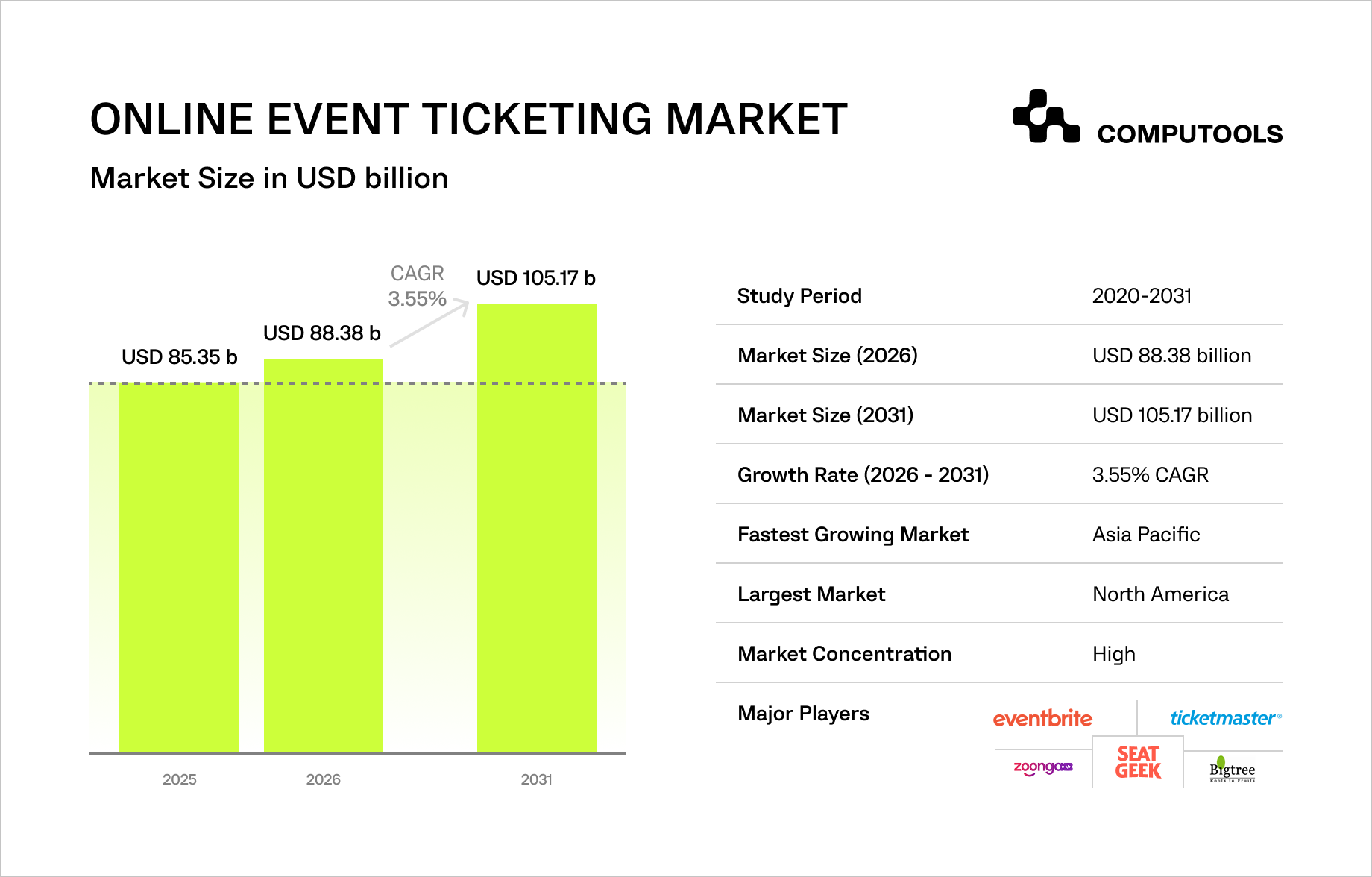
PwC estimates that the entertainment and media industry revenue will reach $3.5 trillion by 2029. Live events are named among the key growing segments. This will further challenge event ticket booking software to accommodate more users over time and more pressure during major releases.
Build implication: design for sudden spikes from the start.
2. Mobile Is Now the Main Channel
Mobile experience prevails. According to Mordor Intelligence, mobile channels made up 58.4% of the online event ticketing market in 2025, and are projected to increase their share at a 4.42% CAGR.
Build implication: the entire process of event discovery, seat selection, payment, ticket storage, transfer, and must function seamlessly on mobile devices.
3. Virtual Queues As Part of Core Infrastructure
Cloudflare suggests using waiting rooms in event ticketing software solutions to orderly place users in the queue for purchasing. Such controlled access reduces infrastructure strain during system overload, which typically happens due to high-demand registration.
Build implication: apply the queue logic before designing the booking flow.
4. AI and Personalization Are Entering Ticketing Workflows
As per Deloitte’s 2026 Global Sports Industry Outlook, many sports organizations will likely implement AI agents into many operations, including ticketing. Fans, in their turn, favour personalized, location-based, flexible, and dynamically priced offers and merchandise.
Build implication: construct a data layer to support tailored recommendations, audience segmentation, dynamic offers, and demand forecasting.
5. Bot Traffic Is a Serious Risk
Malicious bots represented 37% of all internet traffic for 2025 (up from 32% the previous year), according to the Imperva 2025 Bad Bot Report. Broader industry research also highlights an increasing trend of AI-driven bot activity to commit fraud against digital businesses.
Build implication: ticket reservation system development should include anti-bot protection, rate limiting, queue filtering, account checks, and purchase limits.
Core features of a high-load ticket booking system
A ticketing software for large events must handle user demand without a performance dip. Components must be adaptable to spikes, sustain consistency, and bounce back from failures, keeping a seamless experience.
| Component | Description | What matters under load |
| Event Catalogue & Discovery | Facilitates listing, categorization, search and filtering of events. | • Page load times (content is cached) • Search and filtering scalability • Ability to address the increased traffic during major event announcements. |
| Inventory Engine | Manages seats, zones, ticket types, and availability in real time. | • Strong (no overselling) consistency • Real-time updates across all channels • Support for quotas (presales, partners, and VIP allocations). |
| Seat Map & Availability Service | Shows users the layout of seats and availability. | • Reduced heavy calls to the real-time database. • Partial updates (refresh) rather than a full page reload • Availability states must be clear (available, sold, and locked). |
| Virtual Queue | Controls user access to the booking system during peak periods. | • Gradual user admission • Stability of positions in a queue • Protection against refresh abuse and bot entry. |
| Booking Engine | Manages selection of seats, temporary holding, and booking confirmations. | • Atomic seat locking • Time-limited reservations (TTL) • Automatic release of unpaid tickets • Prevention of double booking. |
| Payment System | Processes transactions and integrates with payment providers. | • Idempotent requests (no duplicate charges) • Safe retries and fallback logic • Clear order states (pending, paid, failed) • Reliable webhook handling. |
| Ticket Generation & Delivery | Generates tickets post-booking. | • Secure QR/barcode generationInstant delivery via email, app, or wallet • Duplication and fraud counter-measures. |
| Admin & Control Panel | Event, pricing, and operation management for organizers. | • Visibility into sales and availability in real-time • Pricing, releases, and limits management • Ability to intervene during live sales (pause, adjust, reallocate). |
| Fraud & Bot Protection | Restricts abuse and guarantees fair distribution of tickets. | • Rate limiting and adaptive traffic management • Controlled bot detection and scoring • Purchase limits and verification flows. |
| Analytics & Monitoring Layer | Evaluates the system’s overall performance, demand, and health. | • Real-time metrics for traffic, conversions, and errors • Booking flow drop-off analysis • Alerts for anomalies and system stress. |
Ticket booking platform development for high-traffic events should consider this single question: Will the system still work when thousands of guests try to use it at the same time?
High-load ticket booking in practice
Building for high traffic and transactional volume directly impacts how a platform performs when real users arrive. A good example of this is the Multitrading ticket booking solution.
1. From Low Capacity to High Load-Friendly
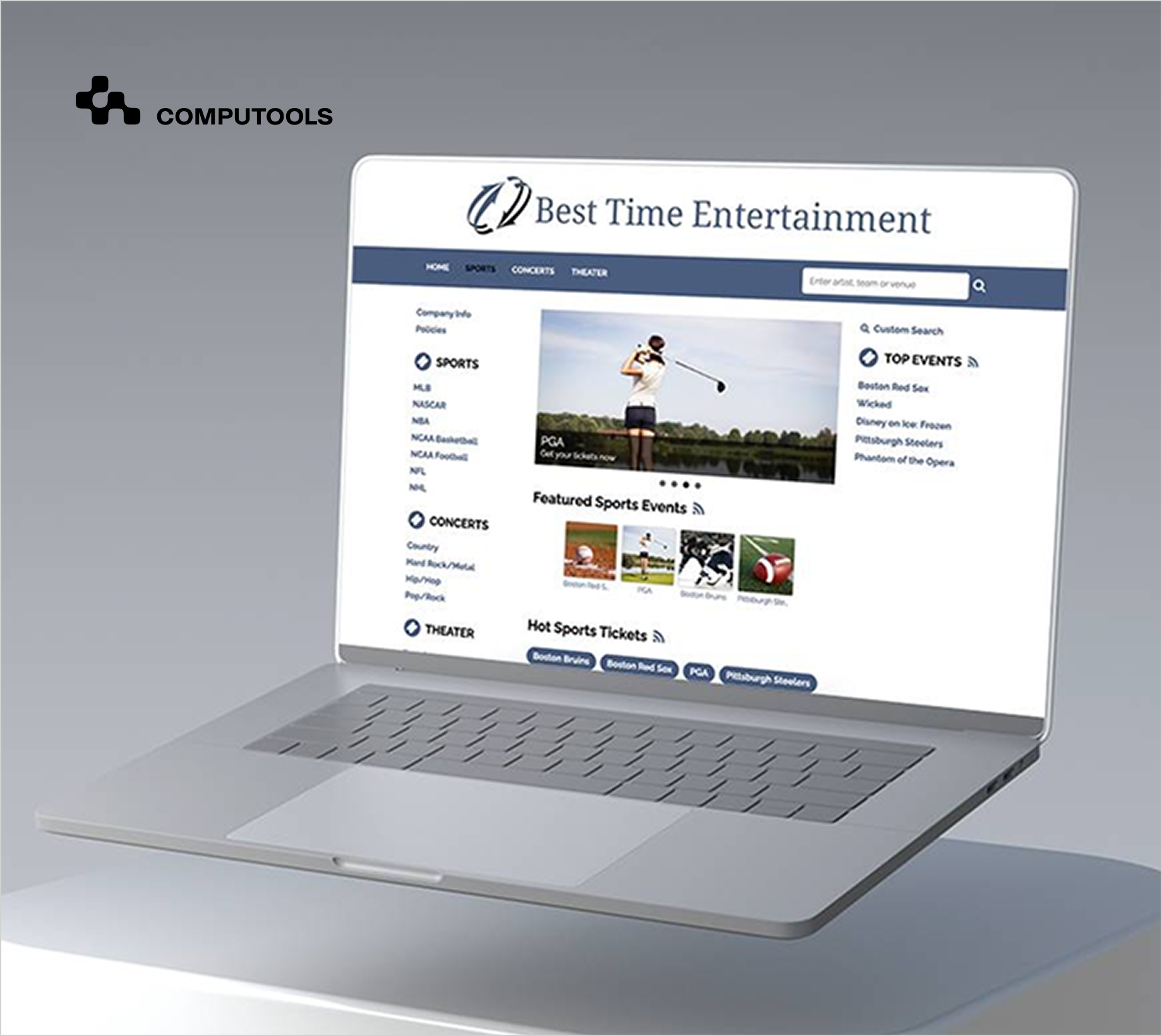
Multitrading is an entertainment startup selling tickets to sporting, concert, and theatre events. Over time, their system could not cope with the increasing volume of customer engagement and transactions. As a result, the reservation process became slow, with a frequent booker drop-out and sales loss as a result.
To tackle this problem, Computools re-engineered the entire system to focus on greater performance, scalability, and real-time processing.
2. High-Performance Architecture Under Load
The new platform was designed as a multi-threaded web application, capable of handling high volumes of simultaneous requests. Capitalizing on technologies like C#, Task Parallel Library (TPL), and MongoDB, the system was optimized for concurrency and horizontal scaling.
Key improvements aimed to achieve:
- Reduced latency in the ticket booking flow to under 5 seconds.
- Faster response times during high traffic.
- Stable performance under concurrent user load.
- Efficient handling of multiple booking requests in parallel.
This agile change kept the platform responsive despite sudden engagement spikes.
3. Real-Time Booking and Data Processing
The solution also benefited from additions such as seamless real-time collection and storage of system data, multiple integrations of external systems via APIs, refined booking logic and adaptation to user behavior.
After flow improvements and the removal of system inefficiencies, the time to view and purchase tickets was critically optimized, which is an important factor during high-demand sales.
4. Business Impact
The technical improvements translated directly into measurable outcomes:
- Shorter waiting times for users.
- Smoother ticket booking experience.
- Increased customer satisfaction.
- Higher user engagement and spending.
How to build a custom ticket booking platform step-by-step
A ticketing system development should tackle the risk of overloading, double booking, transaction failures, customer drop off, and other operational issues during critical use.
Step 1. Design the Ticketing Model Around Real Event Logic
First of all, determine the rules of selling and managing tickets. The platform must accommodate assigned seating, general admission, ticket zones, VIP packages, early-bird sales, and presale codes, as well as allocation to partners and reserved quotas.
Once starting development, it must be clear how all of these flows are going to function, because the rules surrounding inventory will affect other aspects, such as seat maps, pricing, sales, various checkout, sales and fraud control.
Step 2. Engineer for High Load From Day One
The ticketing platform architecture must be flexible enough and consist of distinct layers for traffic control, booking, payment, inventory, and analytics.
Some of the core elements will be:
- Edge protection via a CDN and WAF.
- API gateway for safe and controlled access.
- A cache layer to absorb read-heavy loads.
- Dedicated booking and inventory services.
- Asynchronous processing via request queues.
- A relational database for the consistency of transactions.
- Monitoring and alerting tools.
The goal of such design is to keep critical operations protected while lighter tasks run asynchronously.
At scale, this is similar to managing bookings across multiple hotels. Check how to develop a multi-property reservation system for a more detailed view.
Step 3. Introduce a Virtual Waiting Room
A virtual waiting room prevents sudden spikes in traffic to the booking engine. Instead of having everyone hitting the backend at the same time, users are admitted in controlled batches.
A well-balanced queue system should create a positive user experience through the use of stable queue tokens, wait time estimation, logic, bot filtering, and smooth transition into seat selection.
Step 4. Implement a Reliable Seat Locking Mechanism
Seat locking is a critical feature in the development of event management and ticketing software. When a user picks a seat, the system temporarily holds it until the purchase is completed.
The typical flow of seat locking is as follows:
Select seat → lock inventory → create order → process payment → confirm booking → issue ticket.
In the event of an unpaid reservation, employ atomic operations, lock expiry, and unpaid ticket auto-releasing. These steps will ensure double booking does not occur in the system.
In practice, refining booking logic and synchronizing it with real-time data processing was a key part of the Multitrading upgrade. This helped eliminate booking conflicts and improved transaction reliability during peak demand.
Step 5. Keep Payments Safe
Payments pose the most significant risk of system failure under high demand. Customers will likely refresh the interface, attempt checkout multiple times, experience session timeouts, and submit the payment more than once.
To account for the above, the platform should be equipped with idempotency keys, clear order statuses, retry frameworks, and support reliable webhook processing. Payment success and transition to a confirmed booking occur only when the inventory is confirmed.
Step 6. Optimize Real-Time Availability
Users should be able to see the availability of tickets, however, the system shouldn’t access the main database every time they open or refresh a seat map.
To not overwhelm the database, employ a combination of caching, lightweight availability updates, WebSockets where necessary, and fallback polling. This will ensure that accurate availability is shown without placing undue stress on the platform.
For example, Multitrading also introduced real-time data collection and faster availability updates. The upgrade reduced delays in the booking flow and improved responsiveness during peak usage.
This works similarly to restaurant systems, where tables are held for a limited time. Find a full description in this guide on how to build a restaurant table reservation system.
Step 7. Add Anti-Bot and Fraud Protection
High-demand events attract bots, creation of fake accounts, bulk buying attempts, and ticket resale. Fraud protection should be built into the architecture from the start, not added after abuse becomes prevalent.
Some useful controls include rate limiting, device fingerprinting, CAPTCHA at certain risk points, verified access codes, account checks, purchase limits, and suspicious behavior detection.
Step 8. Support Pricing Logic and Promotions
Modern event ticketing platform solutions should incorporate pricing logic, which includes things like presales, early-bird and tiered offerings, price adjustment based on demand, promotional codes, group packages, and controls to meet upper limits established by the event organizer.
The pricing should be easily adjustable, giving the organizers enough flexibility to customize campaigns without additional engineering.
Step 9. Design Checkout for Speed and Pressure
Checkout needs to stay as simple as possible, given that guests may have limited time to complete the purchase and secure their selected seats. Use the mobile payment option, reduce the number of required steps, display the timer for purchase confirmation and make all transaction fees clear.
A streamlined, high-capacity checkout process should be transparent and resilient to repeat attempts.
Step 10. Prepare for Launch Day
Once the platform is developed, quality assurance should take place before it goes live to prove it can meet peak demand ticketing scenarios. Test all aspects from simulated traffic spikes, queuing behavior and seat locking conflicts to payment retry scenarios, bot activity and database contention.
Have monitoring dashboards, alerts, and rollback plans and incident response procedures actively ready. Most systems won’t fail in the development stage; they will fail in peak time demand.
Suggested architecture for a scalable ticket booking platform
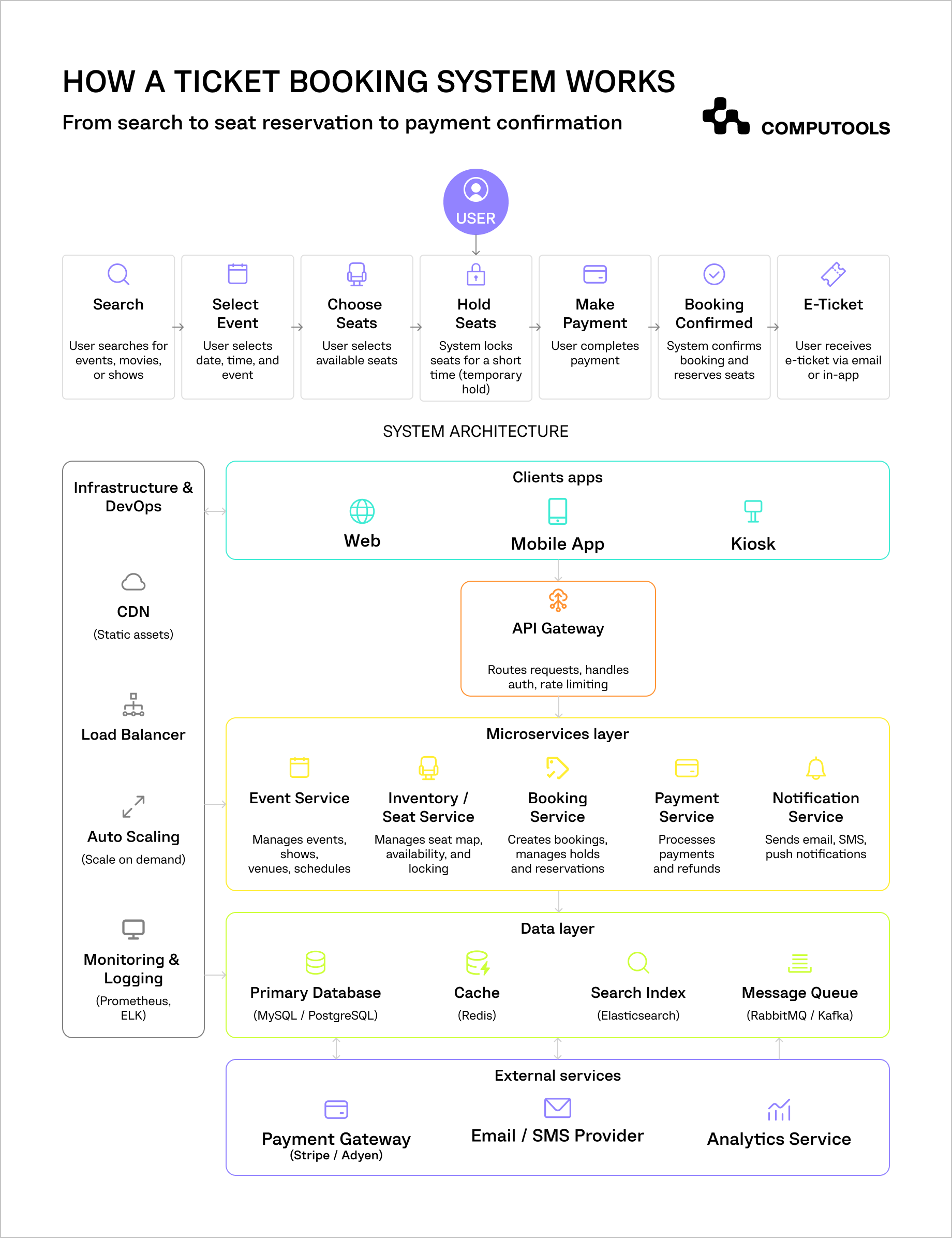
For a high-load solution, it is better to isolate components to allow for traffic control, booking logic, payment processing, and ticket delivery. This prevents one excessive component from crashing the system.
An architecture diagram is presented below:
User → CDN/WAF → Virtual Waiting Room → API Gateway → Booking Services → Inventory Database / Cache / Payment Provider / Ticket Delivery
At the edge, a content distribution network (CDN) and a Web Application Firewall (WAF) are used to distribute static content, filter and direct client requests to the booking engine, as well as to reduce the strain on backend services. During heavy request loads, a virtual waiting room can be implemented to further control and manage the flow of queries.
All services behind the API gateway can split into core categories:
- An event catalog to handle event pages, schedules, and search requests.
- An inventory service to manage seat availability, zones, and ticket limits.
- A booking engine, responsible for reservations, seat locks, and order states.
- A payment service to manage payment processing, retries, and webhook handling.
- A ticket delivery for distribution of QR codes, mobile tickets, and confirmations.
- An analytics module to perform the analysis of demand, conversion, errors, and the operational aspects of the system.
The most sensitive part of the architecture is the connection between inventory locking and payment confirmation. A ticket should not be emailed to a user unless the inventory has been locked, payment has been completed, and order status has been confirmed.
To keep the platform stable under load, implement caching for high-read load operations, message queues for non-critical operations, and monitoring to keep latency, errors, queue behavior, and failed payments in check during peak times.
This layered approach reflects what was implemented in the Multitrading platform, where a multi-threaded architecture and optimized request handling allowed the system to process large volumes of simultaneous bookings without performance degradation.
A similar architecture is used in hotel booking engines that manage real-time availability – see how it works in detail in a hotel booking engine development guide.

Want to launch an event platform that sells thousands of tickets in minutes – not lose customers during peak demand? Talk to our team and get a development estimate.
Why businesses choose Computools for ticket booking platform development
Booking systems need to be responsive, especially when demand spikes and revenue is at stake.
Computools builds custom reservation platforms as high-load, transactional systems rather than standard web applications. That difference defines how the services perform under pressure.
1. Deep Experience with High-Load Transactional Systems
With 250+ engineers and 400+ delivered projects, Computools brings proven experience in travel and hospitality software development services to building systems that handle real-time peaks in guest activity and concurrent use to the maximum.
2. Proven Reliability and Quality Standards
Along with our ISO 9001 and ISO 27001 certifications, Computools provides strong data protection and reliable delivery. For ticketing solutions, this means uninterrupted performance, protected payment and personal information, predictable development and implementation.
3. Strong Mobile Expertise for Real-Time Ticketing
Adoption of a ticket booking system for concerts and festivals heavily depends on mobile UX. Users perform searches, purchases, and ticket scans, all on their devices. With dedicated mobile app development services, we deliver solutions that:
- Manage high traffic volumes.
- Offer a quick and smooth checkout experience.
- Safely support digital tickets and integrate QR and e-wallets.
- Provide high performance and reliable access in low connectivity situations.
4. AI Integration for Smarter Ticketing
Booking systems are becoming increasingly sophisticated. With AI development services, Computools helps integrate:
- Demand forecasting
- Personalized recommendations
- Dynamic pricing logic
- User behavior analysis.
Traditionally, ticketing services can only respond to existing demand. We engineer systems able to manage and optimize demand.
5. Integration That Works Under Load
Event management and ticket reservation software embeds a bunch of different third-party services, such as payment processing, APIs, analytics, and others. Deep integration by Computools lets the systems remain operational under high request volume, exchange information in real time and maintain the direct booking path without disruption.
This is especially critical in complex domains like heritage tourism software development, where platforms often combine ticketing with content, experiences, and location-based services.
6. Focused on Business Impact
Over many Computools projects, the impact is evident in hard business metrics. In Tap App, ordering, payment, and venue changes were synchronized in real-time, resulting in a revenue increase of 7% and a decrease of 85% in order mistakes. This maximized operational accuracy and improved conversion rates.
In SMARTCITY, the developed platform was intended to support real-time and location-specific interactions. As user activity grew, the system supported continuous engagement, driving discovery and long-term monetization.
In Radesso Prime, the focus was on clarity and control across operations. By bringing fragmented workflows into a single system, the platform enabled quicker decisions and more efficient service delivery.
Although the contexts differed, the patterns were the same:
- Conversion is supported by performance.
- Consistency is a measure of trust.
- Speed is a source of revenue.
This is where strong engineering, supported by expert web development services, ensures the platform continues to perform under real demand.
Final thoughts
During peak demand, ticket reservation platforms are expected to do a lot. In the blink of an eye, the system must:
- Organize users into groups to prevent stress on the backend.
- Block seats and prevent any chances of a double booking.
- Process payments smoothly and without system delays.
- Maintain perfect synchronization on every sales channel.
- Remain stable and responsive on mobile and web interfaces.
- Failing any of these breaks the buying moment. And when that moment is gone, so is the revenue.
For ticketing businesses, performance isn’t a technical metric. It’s conversion, trust, and brand reputation, all happening in real time. Planning to develop ahigh-load ticket booking system? Contact our team at info@computools.com.
For a wider perspective on today’s vendor landscape, you can also check out our overview of the top 25 travel & hospitality software development companies.
Computools
Software Solutions
Computools is an IT consulting and software development company that delivers innovative solutions to help businesses unlock tomorrow.