THE AUTHOR:

Hotels that want to increase direct hotel bookings are dealing with a commercial issue: OTA-heavy distribution reduces margin, weakens guest ownership, and makes repeat acquisition more expensive.
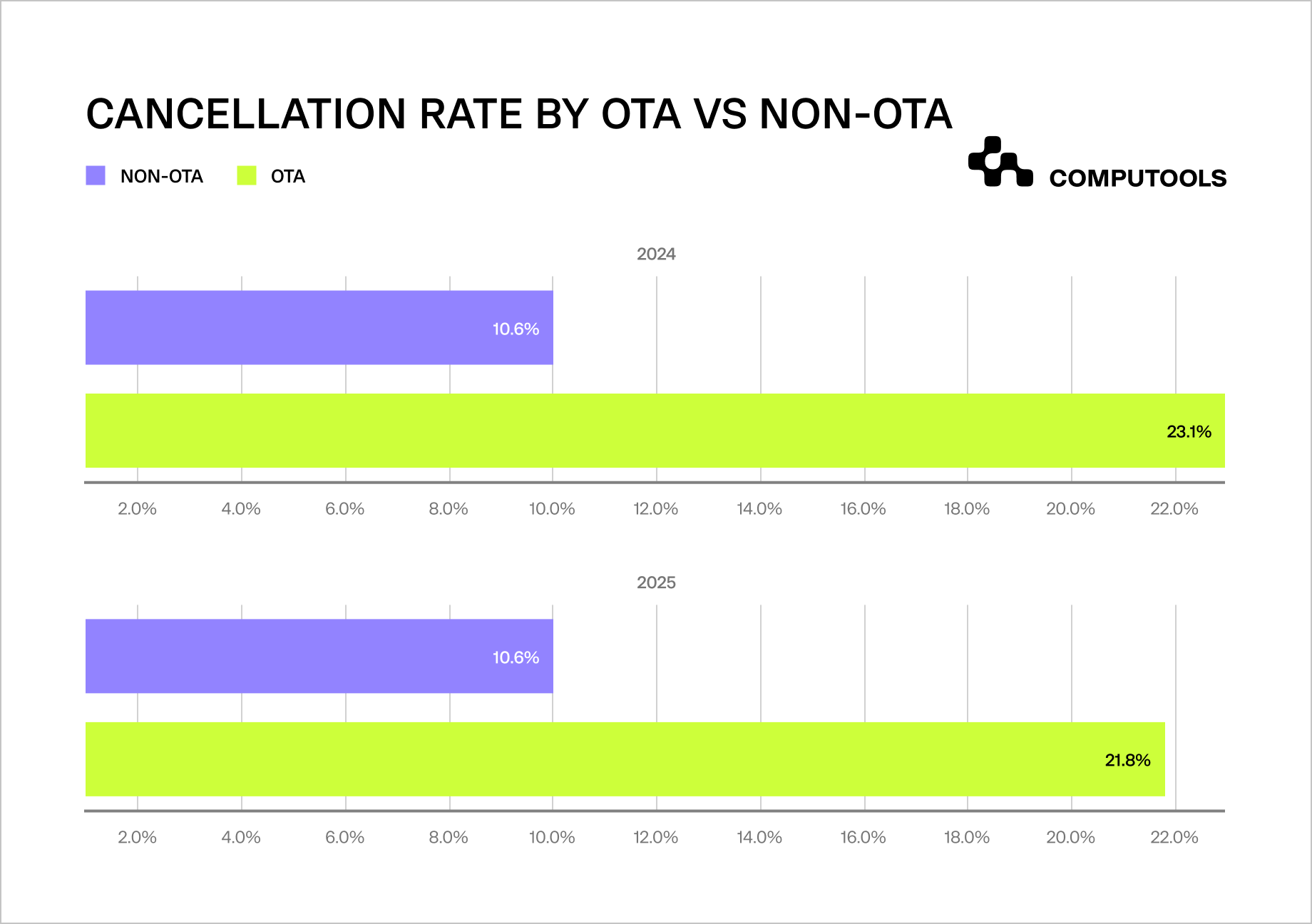
In 2025, OTAs accounted for 63.4% of independent hotel bookings, with some markets approaching 80% OTA share. OTA bookings also carried a higher cancellation risk: 21.8% were canceled, compared with 10.6% for direct bookings.
Commission pressure makes this dependence more expensive. Major OTAs commonly charge hotels 15–25% per booking, and some commission models can reach 30% or more, especially when hotels pay for stronger visibility or participate in preferred placement programs. Overall distribution remains fragmented, with direct online bookings and OTA reservations each around 21%, alongside GDS, group, and offline channels. While direct channels grow, they still compete with intermediaries rather than replacing them.
What does this mean for hotels? Channel control shapes how much revenue hotels keep, how much guest data they own, and how predictable future bookings become. OTAs drive demand but also reduce margins, increase cancellation risk, and limit access to guest data. Hotels that want to reduce OTA dependence need to strengthen their own booking channels, improve conversion on their brand websites, and build direct relationships to lower repeat-acquisition costs.
How Computools helped increase hotel direct reservations
Computools helped an Austrian hotel group increase hotel direct reservations by turning its website into a stronger owned booking channel. Before the project, most reservations came through OTA platforms, which created rising commission pressure and limited control over guest relationships. The client needed more than standard web development services: the platform had to support direct acquisition, booking conversion, guest data capture, and repeat-stay communication.
The team developed Radesso Prime, a custom hotel booking web platform focused on direct reservations. The solution included a redesigned booking flow, clearer property and room pages, direct-only offer communication, SEO and AEO support, marketing integration, and retention mechanics.
Computools also connected booking logic with analytics and guest communication workflows, using business process automation to reduce manual work across acquisition, follow-up, and repeat booking activities.
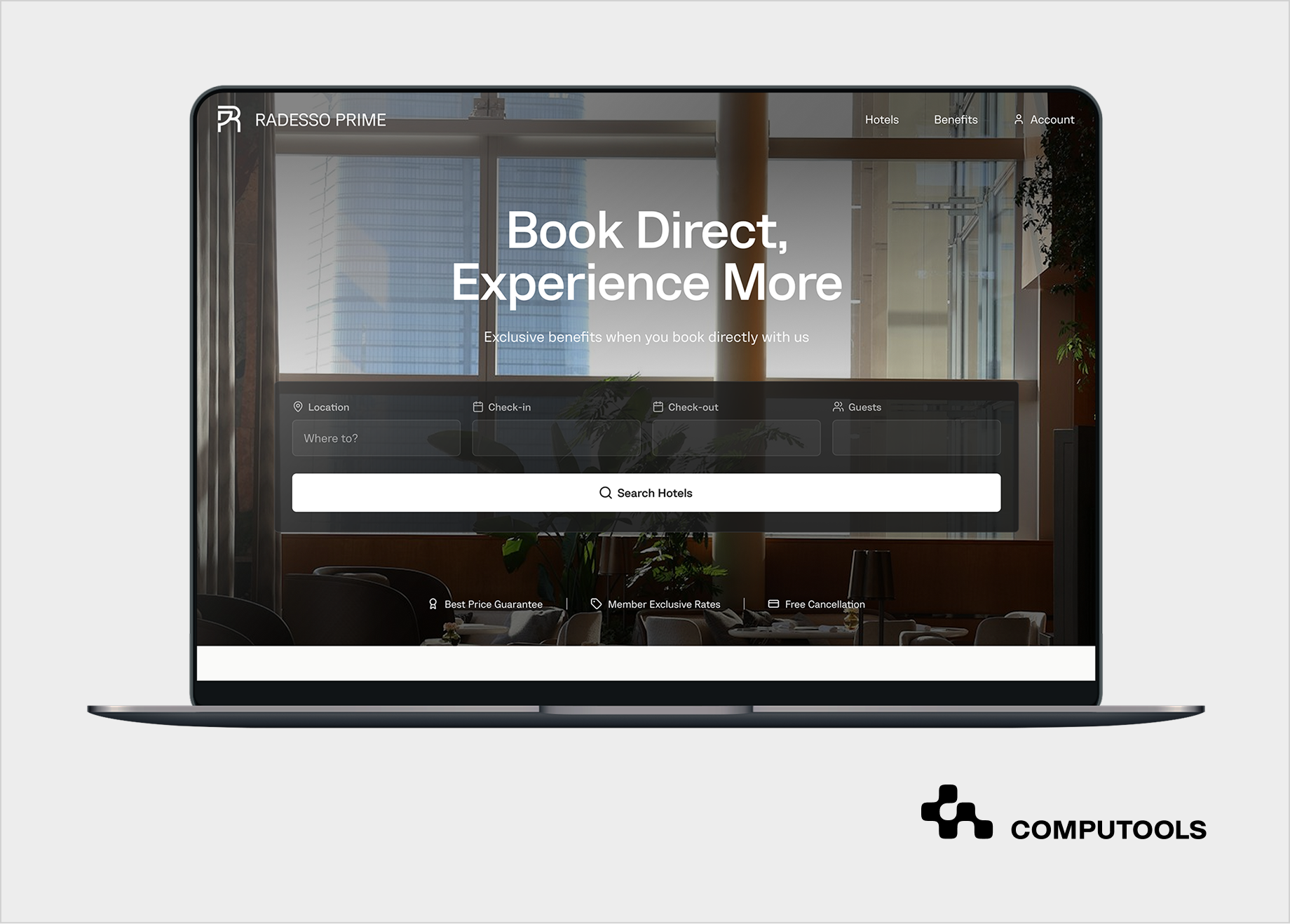
In about six months, the share of direct bookings grew from roughly 10% to 55%. This reduced OTA commission pressure, gave the hotel group stronger control over guest acquisition, and created a more balanced channel structure for future growth.
Our experience with hotel booking platforms shows how hotels can reduce OTA commissions and increase direct reservations by improving booking flows, strengthening direct offers, capturing guest data, and implementing retention mechanics. Below is a practical step-by-step guide based on real implementation work.
Step-by-step guide: how to increase direct hotel bookings and reduce OTA dependence
Step 1. Audit your current booking mix and acquisition costs
A direct booking strategy starts with a commercial audit. Hotels need to understand current channel performance before changing the website, pricing, or marketing setup. For hotels, the path to higher direct revenue begins with understanding where bookings come from, how much each channel costs, and which guest segments can be shifted into owned channels first.
This gives the team a practical baseline for deciding where to invest first, which barriers to remove, and how to increase direct hotel bookings without relying on broad, unfocused marketing activity.
In our Radesso Prime project, we began by reviewing the client’s current distribution structure. The hotel group had stable occupancy and sufficient demand, but most reservations came through OTAs. On paper, the business seemed healthy, but in reality, the channel mix caused commission pressure and reduced the client’s control over guest relationships.
The audit focused on several areas:
First, we reviewed the booking source structure. We separated reservations by channel: OTA, direct website, direct calls, repeat guests, paid search, organic traffic, and other acquisition sources. This helped show whether the hotel relied on OTAs for new demand only or also paid commissions to guests who already knew the brand.
Second, we assessed acquisition cost. OTA commissions had to be compared with the cost of direct acquisition through SEO, paid search, metasearch, email campaigns, and retargeting. A direct booking channel is not free, because hotels still invest in traffic, content, ads, technology, and retention. The difference is that these investments build owned assets instead of sending the same guest relationship back to a third-party platform.
Third, we looked at booking behavior. The team checked where users dropped off, which pages attracted qualified traffic, how room information was presented, and whether the website gave guests enough confidence to complete a reservation directly. This showed that the existing website was not working as a full sales channel. It supported brand discovery, but the booking path was not strong enough to compete with the speed and familiarity of OTA platforms.
Fourth, we reviewed repeat-stay potential. This was important because repeat guests are among the easiest groups to move from OTAs to direct channels. If a guest has already stayed at the property and had a good experience, the hotel should not have to pay commission again to win the next booking. In the client’s case, the audit showed that guest data, follow-up communication, and retention logic were underused.
Finally, we defined the baseline for future measurement. The client needed to know the starting point before any platform changes could be evaluated. That baseline included the direct booking share, OTA booking share, commission exposure, cancellation patterns, conversion rate, and repeat booking behavior.
This audit shaped the rest of the project. Instead of treating direct bookings as a vague marketing ambition, we turned them into a measurable business target: shift qualified demand from high-commission channels into the hotel’s own booking environment without damaging occupancy.
Step 2. Rebuild the booking flow on your website
A hotel website should guide users from initial visit to reservation smoothly, avoiding unnecessary steps or friction.
Hotel website booking optimization focuses on reducing hesitation at every stage of the booking journey: property selection, room comparison, rate choice, extras, payment, and confirmation. If any of these steps feel unclear or slow, users tend to leave and complete the reservation through OTA platforms, where the process feels more predictable.
The booking flow should be structured around real user decisions.
Guests typically want to understand:
- whether the property fits their trip;
- what room options are available;
- what the final price includes;
- how flexible the cancellation policy is;
- how quickly they can complete the booking;
- whether booking directly offers any advantage.
If this information is fragmented or hidden, conversion drops. Strong booking flows surface key details early: room types, rates, included services, cancellation conditions, taxes, fees, and direct booking benefits.
In the Radesso Prime project, the booking experience was redesigned around a continuous reservation path. The original site supported browsing but did not support decision-making. The updated flow connected property pages, room selection, and booking steps into a single structured journey.
Mobile behavior was treated as a primary scenario. A large share of traffic came from mobile devices, but the existing booking flow was not optimized for smaller screens. The updated interface simplified navigation, reduced form complexity, and improved speed, which helped retain high-intent users.
A booking flow that supports direct reservations typically includes:
1. availability search visible on entry;
2. fast room comparison;
3. clear direct booking benefits;
4. transparent pricing and cancellation terms;
5. short and structured booking forms;
6. trust signals near payment;
7. confirmation and follow-up logic;
8. tracking across the funnel.
The technical layer supports this experience. Booking systems need to handle availability in real time, maintain consistent pricing, and integrate with analytics and marketing tools. Without this, improvements in design do not translate into higher conversion.
For the client, restructuring the booking flow turned the website into a functional sales channel. Users could move from discovery to reservation without leaving the site, which reduced reliance on external platforms.
If you are working with multiple properties or planning to scale your booking operations, explore our guide on how to develop a multi-property reservation system for hotel chains, where we break down centralized booking logic, availability management, and cross-property coordination.
Step 3. Make a direct booking, the stronger choice
Direct booking needs a clear value advantage for the guest. Hotels gain more control and lower commission costs when guests book through owned channels, but the user still makes the decision based on convenience, trust, price clarity, and flexibility
The comparison between direct booking vs OTA usually comes down to price clarity, flexibility, and perceived risk. OTAs win when the booking process feels faster, more transparent, or more reliable. The hotel’s website should highlight the benefits of direct booking during the reservation process, making its value clear when guests choose a room and finalize their booking.
A strong direct offer can include:
- flexible cancellation;
- free breakfast or parking;
- early check-in or late check-out;
- room upgrade options;
- loyalty benefits;
- exclusive packages;
- added value without public rate cuts
The offer should appear where the booking decision happens: room cards, rate selection, checkout, and abandoned booking follow-ups. If guests see direct benefits too late, the message has less influence on conversion.
In the Radesso Prime project, direct-only benefits were built into the booking logic rather than as separate marketing text. The platform made these advantages visible throughout the reservation process, helping users understand why booking through the hotel’s website was more useful than returning to OTAs.
Rate clarity matters. Guests should easily see what’s included, if taxes or fees apply, and cancellation terms. Clear conditions reduce hesitation and build trust in the direct channel.
A good direct booking proposition should answer four questions:
1. What do I get if I book here?
2. Is the total price clear?
3. Can I cancel or change the stay?
4. Is the booking secure?
The strongest direct strategies combine value, clarity, and timing. The hotel does not need to offer every possible benefit. It needs to show the right advantage at the point where the guest is ready to book.
Step 4. Capture and use guest data
A hotel cannot build a sustainable direct channel without structured guest data. OTA bookings often limit access to customer relationships: the hotel receives the reservation but may not always have the full context needed for future communication, segmentation, or repeat-stay marketing.
For direct channels, guest data should be captured and used across the full booking lifecycle:
- source of traffic;
- search dates and selected property;
- room type and rate plan;
- booking value;
- stay purpose;
- cancellation behavior;
- repeat booking history;
- email engagement after the stay.
This gives the hotel a clearer understanding of who books directly, which guests are likely to return, and which segments should receive specific offers. For example, business travelers may respond to flexible weekday rates, while leisure guests may react better to seasonal packages, upgrades, or longer-stay incentives.
In the Radesso Prime project, guest data capture was treated as part of hotel customer acquisition strategies, not as a separate CRM optimization task. The platform was designed to collect booking and behavioral data to support follow-up communication, repeat-stay offers, and better campaign attribution.
The technical structure mattered, requiring booking data, website behavior, marketing sources, and guest communication to function as a unified system. With proper data engineering, the hotel could move from disconnected channel reports to a usable data layer for direct sales and retention.
This step helped the client understand which guests were worth targeting again, where bookings were coming from, and how direct communication could reduce the need to reacquire previous guests through OTAs.
Step 5. Connect marketing to booking performance
Direct booking growth depends on the quality of traffic and the website’s ability to convert it. Hotel digital marketing strategies should lead users into a booking path that matches their intent, instead of sending more visitors to the homepage.
For hotels, the main acquisition sources usually include:
- organic search;
- paid search;
- metasearch platforms;
- Google Hotel Ads;
- retargeting;
- email campaigns;
- social media;
- branded and local travel queries.
Each channel should have a clear role. Organic search can attract users researching destinations and accommodation options. Paid search can capture high-intent demand. Metasearch can help hotels compete with OTAs at the comparison stage. Retargeting can bring back users who checked rooms or rates but did not complete the booking.
In the Radesso Prime project, marketing was connected to the reservation journey. Search traffic and paid campaigns were directed to relevant property, offer, and room pages instead of generic entry points. This reduced unnecessary steps and helped users continue from search intent to booking decision.
The platform also needed proper tracking. The hotel needed to understand which campaigns drove completed reservations, which sources drove low-intent traffic, and where users abandoned the funnel. Without this level of visibility, marketing spend can increase while direct revenue remains weak.
A stronger direct acquisition setup should track:
- landing page performance;
- funnel drop-off by step;
- conversion rate by device;
- cost per direct booking;
- revenue by campaign;
- repeat booking behavior.
This gives marketing and revenue teams a shared view of performance. Campaigns can then be adjusted based on booking value rather than surface-level engagement. For the client, this helped turn digital marketing into part of the booking system rather than a separate traffic-generation activity.
For a broader view of booking platforms and how different vendors approach conversion, integrations, and scalability, explore our research on the best travel booking platform development companies shaping the market.
Step 6. Build repeat booking and retention flows
Direct growth stabilizes when repeat guests stop returning through OTA channels. Direct booking marketing for hotels focuses on post-stay communication, timing, and relevant offers that make the next reservation easier to complete through the hotel’s own channel.
Retention should be structured as a sequence, not a single email:
- confirmation and pre-arrival communication;
- in-stay messaging (optional, depending on the property);
- post-stay follow-up within a defined time window;
- targeted offers based on stay history;
- seasonal or event-based campaigns;
- reminders aligned with typical rebooking cycles.
In the Radesso Prime project, retention flows were built using guest data collected during booking and stay. Communication was segmented by stay type, length, and booking behavior. Returning guests received different offers than first-time visitors, with a shorter path back to booking.
The content of these messages matters less than timing and relevance. A generic discount sent too late performs worse than a simple, well-timed reminder with clear value. For example, business travelers may respond to weekday availability reminders, leisure guests may respond to seasonal packages, repeat guests may respond to loyalty benefits or upgrades.
The goal is to reduce friction for the next booking. Guests who already know the property do not need the same level of explanation. They need a clear, step-by-step path back to the reservation.
Retention flows should also connect to booking logic. If a guest clicks a link in an email, they should land on a pre-filled or simplified booking path whenever possible. This reduces effort and increases completion rates.
For the client, retention became a measurable source of direct revenue. Repeat bookings were moved from OTA channels into the hotel’s own system, lowering acquisition costs and improving overall profitability without increasing traffic volume.
Step 7. Align pricing and availability across channels
Pricing inconsistencies break direct conversion faster than any UX issue. If a guest sees a better deal on an OTA, the booking flow on the hotel website becomes irrelevant, no matter how well-designed it is.
This is where hotel revenue management strategies directly affect channel performance. Pricing, availability, and conditions need to be aligned across all platforms while still giving the hotel room to promote direct bookings.
Key areas to control:
1. rate parity across OTAs and direct channels;
2. clear inclusion of taxes, fees, and services;
3. availability synchronization in real time;
4. cancellation policies that match or improve OTA terms;
5. direct-only benefits that do not violate OTA agreements;
6. consistency between what is shown in search, landing pages, and booking flow.
In the Radesso Prime project, pricing logic was built into the system. The platform supported flexible rate rules and allowed the client to adjust conditions without updating each channel separately.
This reduced operational errors and prevented situations where:
- a room appeared unavailable on the website but was listed on an OTA;
- pricing differed between platforms;
- cancellation terms created confusion;
- guests hesitated because of unclear conditions.
The setup allowed controlled advantages for direct bookings, letting the hotel offer added value during booking without competing via public discounts, and maintaining base rates.
From a technical perspective, this required reliable integration between the booking system, internal management tools, and external distribution channels. This layer was implemented through software engineering services designed to support consistent data exchange and system stability as the platform scaled.
When pricing and availability are aligned, the direct channel becomes a viable alternative instead of a secondary option. Guests can complete the booking without checking multiple sources, improving conversion and reducing leakage back to OTAs.
Step 8. Track performance and improve continuously
Direct booking growth depends on consistent measurement. Changes in design, offers, or campaigns only matter if they affect completed reservations. Improve hotel conversion rates by treating the booking journey as a measurable system rather than a fixed flow.
The tracking setup should cover the full funnel:
- search and landing page entry points;
- interaction with room pages and rate selection;
- steps inside the booking process;
- drop-off points before payment;
- completed reservations;
- cancellations and modifications;
- repeat booking behavior.
Each stage should have defined metrics. This allows the team to see where users hesitate, which channels bring qualified traffic, and how different segments behave across devices.
In the Radesso Prime project, analytics was connected to the booking logic and marketing channels. The client could track how users moved from search to reservation, which campaigns led to completed bookings, and where conversion dropped.
This visibility made it possible to test and adjust specific elements:
- room presentation and layout;
- placement of direct booking benefits;
- booking form structure;
- messaging inside the checkout flow;
- landing page variations for different campaigns.
Small changes often had measurable effects. For example, simplifying form fields or clarifying rate conditions reduced drop-offs at the final stage. Adjusting how offers were presented improved decision speed.
Continuous improvement relies on short feedback cycles. Instead of large redesigns, the team made incremental updates based on real behavior, evaluating each change by booking conversion, not just engagement.
This approach turned the booking platform into an evolving system. Conversion improvements accumulated over time, supporting the steady growth of the direct channel without relying on single large campaigns.
Step 9. Scale direct bookings while reducing OTA reliance
Direct channels should grow without cutting off OTA traffic completely. The goal is to reduce OTA commissions hotels pay over time by shifting repeat and high-intent bookings into owned channels, while still using OTAs for discovery.
Scaling requires coordination across product, marketing, and operations:
- keep OTAs for first-time visibility in competitive markets;
- convert returning guests into direct users through retention flows;
- route high-intent traffic from search and metasearch directly to the hotel website;
- prioritize campaigns that bring booking-ready users;
- extend direct booking logic across all properties in the portfolio.
In the Radesso Prime project, scaling meant applying the same booking structure, pricing logic, and user experience across multiple properties. The system needed to support multiple locations and demand patterns while maintaining a consistent booking journey.
As booking volume grew, operational processes had to keep up. Confirmation flows, guest communication, and internal coordination were structured to reduce manual work and avoid delays. This helped the team manage higher demand without adding complexity.
Scaling direct bookings shifts channel mix gradually. OTAs attract new guests, while repeat and high-intent bookings shift to the hotel’s channel. This reduces commissions and increases control over revenue and relationships.
If your business also operates in the HoReCa space beyond hotel bookings, explore our guide on how to build a restaurant table reservation system with real-time availability, covering reservation logic, availability management, and user flow design.

Want to increase direct bookings by up to 60% and stop giving OTAs a massive cut of your revenue? Contact our team and get a strategy built for your hotel.
Key benefits of increasing direct hotel bookings
Direct reservations remove OTA commission from each transaction. This increases net revenue without changing pricing or occupancy. For hotels with stable demand, even a moderate shift toward direct channels supports direct hotel sales growth and improves overall profitability.
1. Full control over guest relationships.
Direct bookings give hotels access to guest data and communication. This includes pre-arrival messaging, upsell offers, post-stay follow-ups, and repeat booking campaigns. When bookings come through OTAs, this relationship is limited. With direct channels, the hotel can build long-term engagement instead of reacquiring the same guest through third-party platforms.
2. Better conversion through the booking experience.
Booking decisions depend on clarity and speed. Hotel website UX for bookings affects how easily users can compare rooms, understand pricing, and complete a reservation. A structured booking flow reduces hesitation and prevents users from leaving the website to check other platforms.
3. More predictable and stable revenue.
Direct channels give hotels more control over pricing, availability, and communication. This reduces dependence on external platforms and helps stabilize revenue over time. Instead of reacting to OTA visibility and ranking changes, hotels can manage their own demand and booking flow.
4. Stronger long-term positioning.
A consistent shift toward direct bookings improves the hotel’s operations. Marketing, pricing, and guest communication are connected within a single system rather than spread across multiple external platforms. This creates a foundation for further growth without increasing reliance on commission-based channels.
What are the common mistakes hotels make when trying to reduce OTA dependence?
1. Treating direct bookings as a marketing task only
Many hotels rely on traffic, paid campaigns, or seasonal offers to drive direct booking growth, but this often fails when the booking process, pricing, and retention are weak. Successful hotel direct booking strategies require coordination across marketing, revenue, UX, and tech. Growth relies on system effectiveness, not campaign volume.
2. Keeping a weak booking engine
A slow or unclear reservation process cuts conversions, even with strong demand. Guests may leave at room selection, rate comparison, or checkout if the flow seems less reliable than an OTA. Without proper optimization, the hotel website can’t compete on speed, pricing clarity, mobile usability, or payment confidence. The hotel booking engine optimization should support the commercial strategy, not just the reservation process.
3. Competing only through lower prices
Lower prices attract attention but don’t strengthen direct channels. If the booking process is unclear or offers less flexibility than OTAs, guests may still prefer third-party platforms. Combining transparent pricing with added value – such as flexible cancellations, upgrades, loyalty benefits, or exclusive packages – protects margins and provides guests with a compelling reason to book directly.
4. Ignoring repeat guests
Repeat guests are easy to convert to direct channels, but many hotels treat them as new customers. Without post-stay communication and retention efforts, returning guests often rebook through OTAs, incurring repeated commission costs for loyal guests. Post-stay communication encourages this audience to book directly with the hotel.
5. Letting channel information fall out of sync
Pricing, availability, cancellation terms, and room descriptions must remain consistent across channels. If users find different information on the hotel website and OTA platforms, trust drops quickly. Channel misalignment pushes guests toward the platform that feels clearer and safer. For direct channels to work, the hotel website must present accurate rates, real availability, and booking conditions without confusion.
6. Measuring traffic instead of booking outcomes
Traffic volume doesn’t indicate direct booking performance. Hotels must track user journeys from landing pages to room selection, checkout, payment, and reservations. Without this, teams focus on surface metrics rather than revenue. Conversion rate, cost per booking, abandonment points, and repeat bookings better reveal what drives direct sales.
Why choose Computools for direct booking growth
Computools works with hotels and travel businesses that need a practical strategy to increase direct hotel bookings without OTAs, built around booking flow, pricing logic, guest data, and marketing performance.
Radesso Prime is one example, but not the only one. In hospitality, we also delivered Costavira RMS, a revenue management platform that improved pricing decisions and increased room revenue by 21% within six months.
For Tap App, a HoReCa product, we built a mobile ordering platform that simplified restaurant operations, increased user engagement, and automated key workflows. These projects reflect our broader experience in software development services for HoReCa, where booking, pricing, service delivery, and customer interaction need to work together without manual overload.
Beyond hospitality, our work in travel includes SmartCity, a location-based platform that connects users, services, and tourism infrastructure in a single digital environment. This experience strengthens our travel and hospitality software development services, especially for products that require scalability, real-time interaction, and integration with multiple external systems.
Computools has over 12 years of experience, delivered 400+ projects globally, completed 40+ projects in travel, hospitality, and HoReCa, and has a team of 250+ engineers. The company also holds a 4.9 rating on Clutch based on 90+ reviews.
If you are planning to strengthen your direct booking channel or reduce your dependence on OTAs, write to info@computools.com.
Conclusion
Hotels can reduce their dependence on OTAs when direct booking becomes easier, clearer, and more valuable to guests. A stronger website, better booking flow, guest data capture, retention logic, and channel control help hotels keep more revenue and build direct relationships instead of paying commission on every repeat stay.
Computools
Software Solutions
Computools is an IT consulting and software development company that delivers innovative solutions to help businesses unlock tomorrow.