



THE AUTHOR:

Oil and gas businesses are under growing pressure to make operations safer, more predictable, and easier to control. Exploration teams need better visibility into field data. Pipeline operators need faster ways to detect risks. Refineries need systems that reduce downtime and improve planning. Executives need reliable data instead of disconnected reports, spreadsheets, and legacy platforms that slow decisions down. This is why the market for oil and gas software development companies has become more strategic.
Top 25 oil & gas software development companies:
1. Computools
2. Accenture
3. IBM
4. Capgemini
5. Cognizant
6. Infosys
7. Tata Consultancy Services (TCS)
8. Wipro
9. HCLTech
10. DXC Technology
11. SLB
12. Halliburton Landmark
13. Baker Hughes
14. AVEVA
15. AspenTech
16. SoftServe
17. EPAM Systems
18. Luxoft
19. Innowise
20. Andersen
21. ScienceSoft
22. BairesDev
23. Chetu
24. Exoft
25. CimpleO
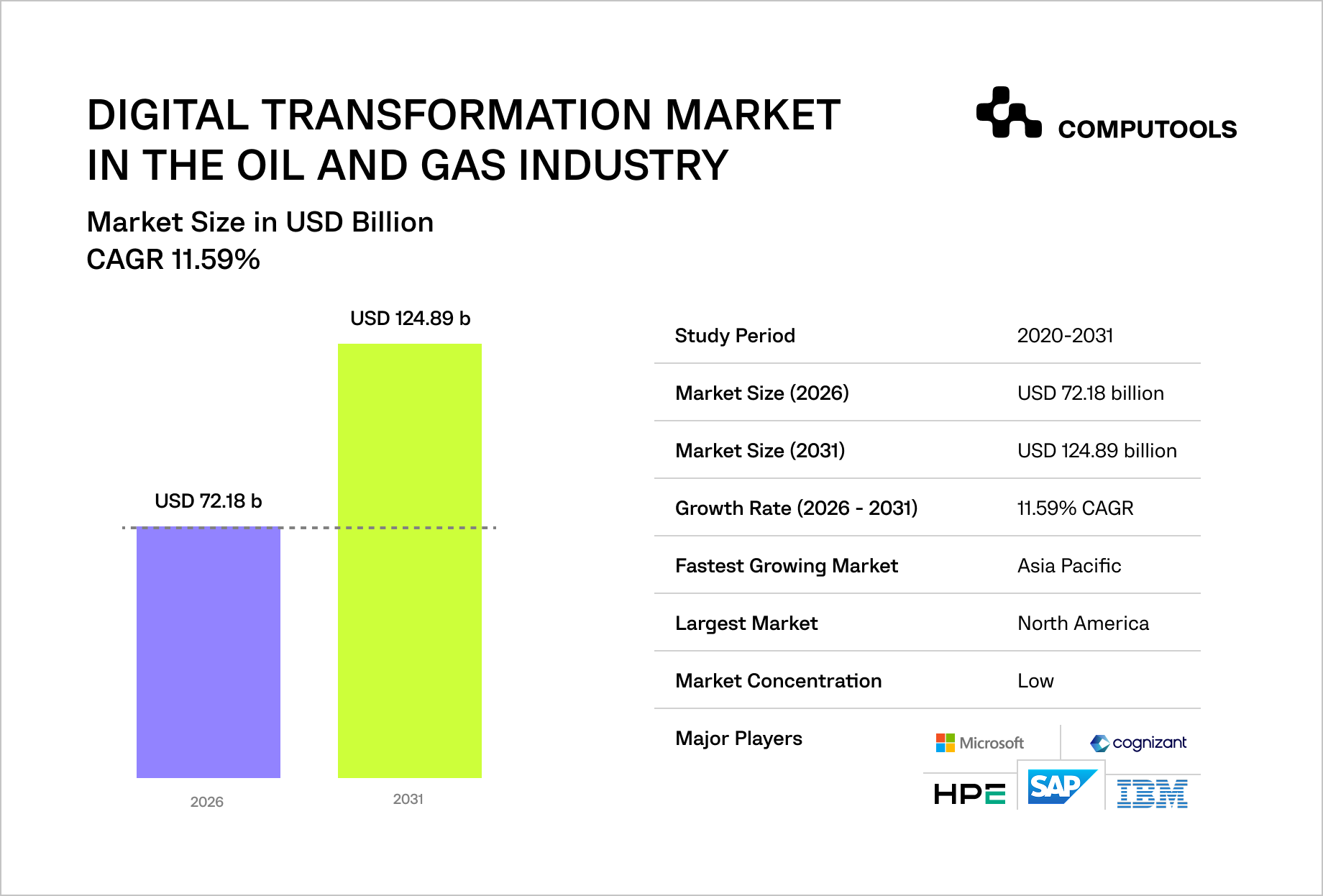
In 2025, software represented 44.53% of digital transformation in oil and gas, while IoT occupied a 26.37% technology share. The AI in the oil and gas industry and ML solutions market are also on the rise, with a projected 13.01% CAGR through 2031. Clearly, the industry players are more interested in the integration of technology, real-time data, tools and business systems.
The drive for better oil and gas software solutions is also a response to increased regulatory and environmental demands. The IEA reported that the energy industry accounted for 145 Mt of methane emissions in 2024. Of this, oil contributed an estimated 45 Mt and gas nearly 35 Mt. For operators, this makes software for leak detection and emissions tracking, asset tracking, predictive maintenance and reporting critical.
This creates the pressing need for operators to have leak detection software, emissions monitoring, and reporting, as well as predictive maintenance and asset tracking.
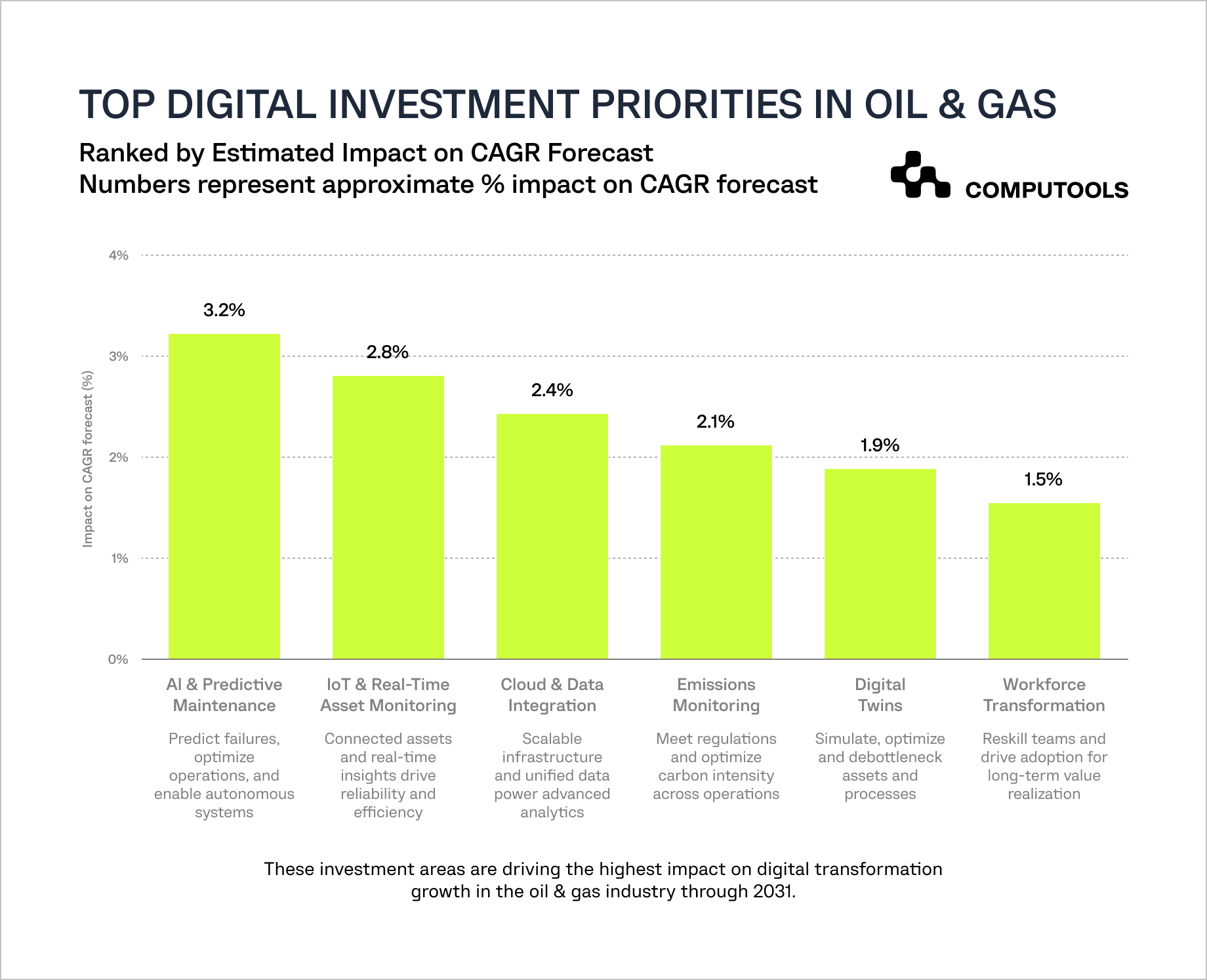
At the same time, each company has different assets, field conditions, workflows, compliance, integration, and reporting needs. Building a drilling optimization platform, a pipeline monitoring software, a refinery dashboard, and a field service application will require different technical and industry expertise.
This article reviews the best 25 oil and gas software development companies to assist energy businesses in making the right choices for custom platforms, system modernization, as well as AI, IoT, data analytics, mobile apps, ERP integrations, asset management, and operational software. This list includes custom software development companies, as well as enterprise technology vendors and oilfield software specialists, with a focus on upstream, midstream, and downstream workflows.
As energy companies move from basic digitization to performance optimization, many are also investing in platforms that reduce energy waste, improve equipment efficiency, and support sustainability goals.
Computools explains this approach in its guide on how to build an energy optimization system for sustainable operations.
How we selected the top oil and gas software development companies
We evaluated oil and gas technology companies by their fit for real industry work: field operations, asset-heavy systems, legacy integrations, industrial data, AI, IoT, compliance, and measurable operational impact.
| Selection criterion | What we evaluated | Why it matters for oil and gas companies |
| Oil and gas experience | Working directly with oil and gas, energy, utilities, industrials, and asset-heavy environments. | Vendors must understand field workflows, production assets, exposure to safety and operational risks. |
| Custom software capability | Building custom platforms, mobile apps, dashboards, and integrations. | Oil and gas companies frequently require tailored systems for their specific assets, data, and reporting. |
| Technical expertise | AI, IoT, cloud, data analytics, GIS, SCADA, ERP, mobile apps, digital twins. | Oil and gas and gas software relies on connected data, automation, and real-time information. |
| Integration experience | Ability to connect legacy systems, field devices, enterprise platforms, and industrial tools. | Most operators work with mixed technology environments and cannot replace everything at once. |
| Operational impact | Ability to support outcomes such as lower downtime, faster reporting, better asset visibility, and stronger compliance. | Software should improve business and operational performance, not only digitize existing tasks. |
| Global delivery capacity | International teams, enterprise delivery models, and long-term support. | Oil and gas companies are typically multi-regional, multi-asset, and multi-regulatory. |
| Public proof | Case studies, industry pages, service descriptions, client examples, or recognized expertise on review platforms like Clutch. | Public evidence makes vendor evaluation more transparent and reliable. |
Leading 25 oil and gas software development companies
The oil and gas software development companies below were selected based on their industry experience, technical expertise, integration capabilities, operational impact, and ability to support complex energy environments across upstream, midstream, and downstream operations.
1. Computools
Computools is a strong flagship choice for energy companies looking to turn fragmented operational data into systems that support faster decisions and better asset performance. Our oil and gas software development expertise covers real-time asset monitoring, predictive maintenance, pipeline monitoring, infrastructure inspection, production optimization, ESG reporting, workforce safety, and capital expenditure management.
For operators managing wider energy infrastructure, Computools’ energy software development services and electric power software development experience add value in areas such as grid-connected assets, energy consumption tracking, equipment monitoring, and operational planning. Our web development services and mobile app development services help turn these systems into usable dashboards, field apps, reporting portals, and technician tools.
Computools is particularly relevant for operators looking to connect SCADA, IoT sensors, GIS platforms, ERP systems, maintenance records, and field data into a single operational environment. Our data engineering, AI development, and IoT development services strengthen use cases such as anomaly detection, production forecasting, sensor-based monitoring, predictive maintenance, and real-time performance analytics across upstream, midstream, and downstream operations.
Computools’ energy-sector experience reinforces this fit. For MeterSnap, the team developed an AI- and computer-vision-powered mobile app for one of Africa’s largest utility companies. The solution automated electricity meter inspections, supported offline use, validated readings with geolocation, connected meter IDs with customer IDs, and helped reduce fraud in field data collection. For oil and gas operators, this proves our company can build inspection and verification tools that protect data accuracy in remote, asset-heavy environments.
For Winder, Computools developed a tailored solution to protect critical energy infrastructures. The system combined multiple devices, performed real-time calculations, and used predictive analytics to enhance safety and the efficiency of resource and operations management. This experience supports dealing with pipeline systems, plants, storage facilities, and field locations where rapid risk identification and the secure coordination of devices are needed.
In the Green Energy project, we created a secure portal for energy-saving programme applications, equipment financing, user roles, and data processing. The system automated loan processing and enhanced user engagement in alignment with sustainability objectives. For oil and gas enterprises, this demonstrates that Computools can build controlled multi-role systems for contractors, compliance teams, financing processes, and energy transition projects.
Best for: custom operational platforms, predictive maintenance, asset monitoring, field service management, pipeline operations, and AI-driven optimization.
2. Accenture
Accenture is better suited for large oil and gas enterprises that need broad digital transformation rather than a single software offering. Its energy line of business supports upstream, integrated gas, downstream, fuels retail, and oilfield engineering services. The company works with technology strategy, cloud, data, AI, cybersecurity, operations, sustainability, supply chain, and enterprise software modernization. Because of this breadth, Accenture is especially well-aligned with companies that need to redesign how technology supports global energy operations.
Accenture’s value is strongest when the project involves multiple business units, legacy systems, regulatory requirements, and operational change. It’s a good choice for complex transformation programs with heavy consulting, governance, and implementation needs.
3. IBM
IBM is a strong fit for oil and gas companies that need enterprise-grade software, AI, automation, hybrid cloud, asset management, and ESG data capabilities. For oil and gas, IBM’s tech includes the Maximo Application Suite for asset management and predictive maintenance, watsonx for AI, Envizi for ESG and reporting, and automation tools for business processes. This offering makes IBM the best choice for companies with large portfolios of physical assets, distributed assets, and heavily structured reporting.
IBM works well where maintenance planning, asset performance, sustainability data, and enterprise governance need to be connected. IBM’s strength is its enterprise ecosystem, which makes it suitable for companies that already run complex IT environments and need stable, scalable IT infrastructure.
4. Capgemini
Capgemini offers oil and gas clients a way to unify engineering, operations, data, and enterprise IT. The company has a wide range of industry-related services that include AI, digitization, analytics, digital twins, cyber security, cloud architecture, IT/OT convergence, asset management, and predictive maintenance, IoT, supply chain and real-time inventory initiatives.
As an oil and gas IT services provider, Capgemini is helpful for companies with legacy systems and fragmented data, operations stretched across the upstream, midstream, and downstream domains. Its strength is the ability to combine oil and gas software consulting, engineering, enterprise IT, and industrial transformation in one program.

Launch your oil & gas software solution within 1–3 months instead of years. Unlock the speed, visibility, and control to shape the energy market.
5. Cognizant
Cognizant is a practical option for oil and gas companies that need digital solutions across upstream, midstream, downstream, and commercial operations. Its software development for the oil and gas industry includes upstream technology services, remote surveillance, pipeline inspection, refinery operations, distribution, retail energy workflows, and commodity trading analytics. This gives Cognizant a broader industry fit than companies focused only on field applications or only on enterprise IT.
The company is useful for businesses that need measurable operational improvements from technology programs. Cognizant shares examples around allocation and revenue generation accuracy for petroleum and gas, SAP architecture cost savings, Oracle ERP Cloud for tank storage operations, and an AI-powered virtual assistant for an energy provider. For buyers, the strongest fit is a company that needs to modernize existing business and operational systems while improving accuracy, automation, and cost control.
6. Infosys
Infosys has one of the most comprehensive oil and gas portfolios amongst suppliers of IT services. Its oil and gas application development include the digital oilfield, GIS services, production management and reporting, drilling operations management, hydrocarbon accounting, petrotechnical support, reservoir engineering, pipeline integrity and scheduling, risk management and energy trading, OSDU data platform services, and refinery and logistics support. In addition, Infosys has services related to oil and gas retail solutions such as point of sale, loyalty management, and EHS solutions, as well as Oracle pre-configured options.
Having such comprehensive offerings Infosys is a distinct advantage for oil and gas customers that require industry-specific solutions in multiple areas of the value chain.
7. Tata Consultancy Services
TCS is a strong fit for large oil and gas organizations that need digital transformation across the full value chain. Its oil and gas transformation materials focus on using digital technologies to improve upstream, midstream, and downstream performance. The company’s work is relevant to connected operations, data-led decision-making, automation, asset performance, business resilience, and enterprise modernization.
TCS is most useful when software development is part of a broader transformation agenda. For example, an oil and gas enterprise may need to modernize legacy systems, standardize operational data, improve asset reliability, and support digital workflows across multiple countries or business lines. TCS can support this type of program because it combines technology delivery, process transformation, enterprise architecture, and long-term governance. It is a stronger fit for enterprise-scale modernization than for small standalone product builds.
8. Wipro
Wipro remains an excellent choice for oil and gas enterprises requiring extensive innovation in systems, data, cloud, and operations. Its focus areas of oil and gas business service offerings include data and digital operating models, process transformation, enterprise applications, and technology modernization. Wipro is relevant to companies that face challenges and problems caused by disconnected systems, inconsistencies in reporting, and fragmented workflows in different business units or across different geographies.
As an enterprise oil and gas software developer, the company fits buyers that need to improve how information moves through the business. Wipro can work across application modernization, data platforms, cloud migration, and operational process redesign. It is strongest when the project requires scale, integration, and long-term IT transformation.
9. HCLTech
HCLTech is especially relevant for oil and gas companies focused on enterprise asset management, data management, cloud computing, IT/OT services, and energy transition programs. ISG recognized HCLTech as a Leader across four oil and gas service quadrants: enterprise asset management, data management and cloud computing, next-generation IT/OT services, and energy transition services. This gives the company a strong position in asset-heavy and infrastructure-heavy environments.
HCLTech is a good fit for operators who need to connect operational technology with enterprise systems. HCLTech’s strength is its combination of software engineering, IT services, industrial operations knowledge, and modernization capacity.
10. DXC Technology
DXC Technology fits energy companies that need to modernize existing applications, cloud infrastructure, analytics environments, and IT operations. Its oil and gas positioning covers software development, applications, cloud, data, analytics, AI, and industry IT services. This makes DXC relevant for companies with mature technology estates that need modernization, support, integration, and operational stability.
DXC is a practical choice when the main challenge is improving a complex IT environment rather than building a highly specialized oilfield product.
11. SLB
SLB is one of the strongest specialized upstream and oilfield software development companies. Its portfolio covers subsurface characterization, data and analytics, wellbore interpretation, digital drilling, production operations, production assurance, pipeline integrity, midstream software, emissions reduction, digital operations, AI, and cloud-based oilfield platforms. This makes SLB highly relevant for technical users such as geoscientists, reservoir engineers, drilling engineers, and production teams.
SLB is best suited for companies that need deep domain functionality. Its strength is the depth of oilfield expertise behind the software. Buyers who need technical accuracy in subsurface, well, and production workflows will usually find SLB more relevant than a general IT vendor.
12. Halliburton Landmark
Halliburton Landmark is a good match for teams looking for tailored upstream oil and gas software solutions to support segments of geoscience, drilling, reservoir management, production, and field development. Its Landmark portfolio includes DecisionSpace 365, iEnergy Hybrid Cloud, reservoir solutions, drilling workflows, production software, and subsurface data environments. This makes the company especially relevant for oil and gas businesses that need software designed for technical field and subsurface workflows.
Compared to others, Landmark is better suited for domain-centric upstream workflows. The target customer is typically an oil operator or an oilfield service provider, where a greater emphasis is on oilfield data, integration, accuracy, and domain models rather than on the breadth of enterprise software.
13. Baker Hughes
Baker Hughes is an ideal partner for oil and gas companies emphasizing asset management and reliability, protection of machinery, process improvement, and corporate sustainability. Baker Hughes’ Cordant platform integrates various applications, devices, data, and services to aid in the development of an asset strategy, elimination of defects, optimization of processes, and management of energy and emissions. Given this, Baker Hughes is especially applicable to companies with a high level of asset intensity, where the reliability of equipment is essential for safe, economical, and effective production.
This company is also a good fit for businesses that are trying to advance from more reactive work practices and maintenance toward a higher level of predictive, data-centric asset management. Examples include refinery management software, AI predictive maintenance software, asset management solutions for oil and gas and technology for LNG facilities, offshore operations, and/or pipelines.
14. AVEVA
AVEVA is an industrial software provider focusing on the needs of oil and gas companies that require operational visibility, digital twins, engineering data, and process simulations, in addition to advanced analytics and plant-level intelligence. Its solutions are well-suited for downstream and process-driven enterprises that need to integrate engineering, operations, maintenance, production, and asset data across multiple plants and facilities.
AVEVA serves customers that have established complex industrial infrastructures, and need software to provide the next layer of visibility, simulation, and control. For example, a refinery or petrochemical company could use AVEVA to design and monitor processes, make maintenance decisions, and develop a more integrated digital twin of plant assets.
15. AspenTech
AspenTech fits companies looking for process modeling, asset performance, AI and operational optimization. Its custom oil and gas software applies to production settings where engineers seek to model processes, enhance reliability, optimize asset performance, and make planning decisions based on industrial data. This likely applies to environments such as refineries, petrochemical facilities, production facilities, and other operations that are process-oriented.
AspenTech’s value is clearest where small operational improvements can create large financial impact. For example, a refinery may use AspenTech software to optimize process performance, reduce energy use, improve equipment reliability, and support safer operational decisions. The company is less of a custom software development vendor and more of a specialized industrial software provider for advanced engineering, performance, and optimization use cases.
16. SoftServe
SoftServe is a good choice for operators that need consulting-led engineering around AI, IoT, big data, emissions, asset integrity, and field operations. Its oil and gas expertise includes production optimization, intelligent exploration, energy data platforms, methane monitoring, emissions data management, AI for HSE, computer vision inspection, seismic data interpretation, and robotics-enabled inspection. This gives SoftServe a strong position in advanced technology programs that need practical operational use.
The company is especially relevant for operators that want to use AI and data in real field workflows. It is also useful for companies trying to connect innovation spending to production, safety, compliance, and cost outcomes.
17. EPAM Systems
EPAM is a strong engineering partner for companies that need cloud-native platforms, data products, AI systems, commercial solutions, OSDU-related work, and enterprise modernization. Its Energy & Resources practice reports 100+ clients, 1,700+ consultants, 20+ years in energy, 250+ commercial solutions designed or engineered. This makes EPAM relevant for both energy operators and energy software businesses.
As an energy sector software development firm, EPAM fits companies that need strong engineering capacity with industry context. For example, an oilfield services company may need to modernize a technical platform, while a trading team may need a CTRM-related solution or analytics product. Exploration and production businesses may need data platforms, cloud engineering, AI workflows, or OSDU implementation support.
18. Luxoft
Luxoft is a good fit for oil and gas companies that need domain-heavy software engineering for exploration, geology, geophysics, subsurface workflows, and production software. Its oil and gas practice focuses on developing and modernizing industry-specific solutions where data processing, technical accuracy, and domain knowledge matter. This makes Luxoft relevant for companies with internal oilfield software products or complex upstream applications.
The company applies when a project extends beyond the bounds of general application development. For example, a client may need to augment legacy geoscience IT, refine seismic data workflows, create IT solutions in the cloud, and employ AI and machine learning to the exploration and production data.
19. Innowise
Innowise fits companies that need custom oil and gas software development with a broad delivery scope. Its services cover oil and gas application development, modernization, software redesign, performance optimization, business process automation, pipeline tracking, SCADA software development, engineering solutions, and production optimization. This gives Innowise a practical position among vendors that support operational platforms and internal systems.
The company is a good match for buyers that need flexible engineering capacity without the structure of a large enterprise consultancy. For example, an oil and gas business may need to rebuild an outdated internal system, add pipeline tracking features, create dashboards for production data, automate back-office workflows, or modernize software connected to industrial systems.
20. Andersen
Andersen is relevant for companies looking for custom software around asset management, rig operations, machinery rental, extraction, field service, reservoir management, GIS, industrial IoT for oil and gas, machine learning, and AI-based systems. Its oil and gas positioning is strongest for operational software that supports asset visibility, equipment workflows, geospatial data, and field-team coordination.
The company fits buyers that need industry-oriented development teams for platforms that sit close to daily operations. For example, Andersen may be relevant for building field service tools, GIS-enabled asset systems, reservoir-related platforms, IoT dashboards, or machine learning solutions for production and equipment data.
21. ScienceSoft
ScienceSoft is one of the more specific custom software providers in this list. It has worked in oil and gas IT since 2010 and covers cloud, IIoT, big data, advanced analytics, VR, AR, exploration and production systems, oil and gas data analytics, operational analytics, equipment performance analytics, HSE analytics, reservoir modeling, remote operations centers, predictive maintenance, and field service. This makes it relevant for companies that need software tied to both technical and business operations.
Its portfolio includes examples such as software for pipeline joint lifecycle management, AI-powered document processing for a Gulf drilling company, drill bit defect detection, oil well monitoring, well-log reporting automation, and remote monitoring of oil storage tanks. ScienceSoft is a strong fit for companies that need a custom development partner for analytics, monitoring, automation, and operational software, especially when the project requires practical engineering rather than a large transformation program.
22. BairesDev
BairesDev is a good match for energy companies that need nearshore engineering capacity for custom oil and gas applications. Its services target exploration companies, refineries, energy corporations, government agencies, and research institutions. The company is useful when a buyer already has a defined product or modernization need and requires experienced developers, QA specialists, cloud engineers, data engineers, or application teams to speed up delivery.
BairesDev is especially relevant for North American companies that want development support in close time zones. Its strength is delivery capacity, which makes it more suitable for execution-heavy projects than domain-specific oilfield consulting.
23. Chetu
Chetu is relevant for operators looking for development support across upstream, midstream, and downstream workflows. Its services include reservoir monitoring, SCADA, extraction software, production reporting, accounting tools, ERP systems, and operational platforms. This makes Chetu a practical option for companies that need tailored modules, integrations, or extensions around existing oil and gas systems.
The company is best suited for buyers who have a specific software requirement and need vendor capacity to build or customize it. Chetu’s strength is broad development coverage across many business functions rather than deep specialization in one technical oilfield segment.
24. Exoft
Exoft is a focused choice for oil and gas companies that need custom software around pipeline integrity, asset management, monitoring systems, well data management, and failure analysis. Its positioning is practical and operations-oriented, which makes it suitable for companies that need better control over infrastructure, asset condition, and engineering data workflows.
Exoft is most relevant for buyers who need a smaller, focused development partner rather than a large oil and gas digital transformation company. Exoft’s strongest fit is custom software for asset-heavy operational workflows.
25. CimpleO
CimpleO excels in real time industrial monitoring and IoT in oil and gas applications. Their solutions offer real time RFID asset tracking, IoT sensors for pipeline and process monitoring, cloud based telemetry with anomaly alerts, digital twins, and operations management platforms that provide scheduling with task assignments, compliance and safety checklists, and performance reports.
CimpleO is especially useful for clients who need monitoring software for pipelines, valves, vehicles, teams and equipment as well as multi-location operations. Their main strength is the custom software development for the industrial sector using real time data, and IoT-based operational workflow and control.
How to choose the right oil & gas software development company
From the start, identify the goals, the systems, and the workflows that need improvement.
1. Match the Vendor to Your Operations
Different segments of the value chain mean different types of expertise. Drilling, production and reservoir systems knowledge may be needed by upstream companies. Midstream operators may require systems for pipeline monitoring, leak detection and asset integrity. Refining operations, logistics and inventory systems may be required by downstream companies.
2. Prioritize Integration and Data Expertise
Most oil and gas projects involve SCADA, ERP, GIS, IoT sensors, maintenance systems, and legacy applications. Strong vendors can integrate these environments without disrupting operations and build the data foundation required for analytics, forecasting, and automation.
Consider the role of SCADA, ERP, GIS, IoT and maintenance systems and legacy software. Good vendors will integrate these systems and construct the data architecture needed to perform analytics, forecasting as well as automation without interrupting the day-to-day business operations.
Computools covers this topic in more detail in its article on Big Data in the oil and gas industry.
3. Evaluate AI and IoT Capabilities
AI and IoT create value when tied to operational outcomes. Look for experience with predictive maintenance, anomaly detection, inspection automation, production forecasting, and emissions monitoring. The strongest partners can demonstrate measurable improvements in uptime, reporting speed, asset visibility, or maintenance efficiency.
4. Consider Field Readiness
Software should work where the operations are conducted. For mobile and field applications, consider the support of offline use, geolocation, the ability to take pictures, permission and access based on roles, notifications, and rapid sync in low connectivity situations.
5. Review Security and Long-Term Support
Because oil and gas systems support critical and regulated operations, elements such as secure design, infrastructure, access, and control, along with built audit evidence and compliance-ready reports, go beyond “nice to have” and become must-haves.
If you want to see a wider perspective on where the value of AI lies in energy operations, see Computools’ guide AI in the energy industry.
Final thoughts
Developing oil and gas software has become a growing focus for companies. Businesses no longer see this as a way of meeting a technical requirement, but as a way of strategically improving control. The aim is to lessen the manual processes and connect the field and office staff. Systems also need to support compliance and make operational data more accessible and usable.
Each project calls for a different development partner. For large corporations, this may mean requiring global providers for organizational transformation. Upstream teams may source specialized oilfield platforms. Meanwhile, pipeline operators, producers, and energy infrastructure players often need bespoke systems tailored to their assets, workflows, and data collection.
Computools fits this third category. Partnering with Computools is especially beneficial because of our talent and expertise in energy management software, artificial intelligence, the Internet of Things, mobile development, web development, data engineering, and more. Computools is an appealing choice for companies looking to modernize and optimize their internal operations by developing tailored systems.
If your company needs improved asset tracking, field data collection, predictive maintenance, pipeline visibility, ESG reporting, operational analytics, and advanced visualizations, Computools can help you turn operational complexity into a controlled software roadmap. For consultation, reach out via email at info@computools.com.
Computools
Software Solutions
Computools is an IT consulting and software development company that delivers innovative solutions to help businesses unlock tomorrow.