
THE AUTHOR:

There are about 104,000 actively operating museums around the globe. Each has its own unique collections, audiences, budgets, and varying degrees of technology. This creates a large and varied market for museum software development companies.
Its diversity demands museum software solutions that range from affordable and modular software packages for small regional heritage museums to large-scale platforms for national museums that house millions of collections, as well as multi-regional networks and larger heritage organizations.
Top 20 museum software development companies:
1. Computools
2. Cogapp
3. Digirati
4. Keepthinking
5. Fabrique
6. Q42
7. Art Processors
8. Bluecadet
9. Local Projects
10. Bravoure
11. Surface Impression
12. Made by Many
13. Futured
14. Minsky
15. Interactive Knowledge
16. NOUS Digital
17. Most Idea
18. Mad Systems
19. Exhibition Technologies
20. Cuberis
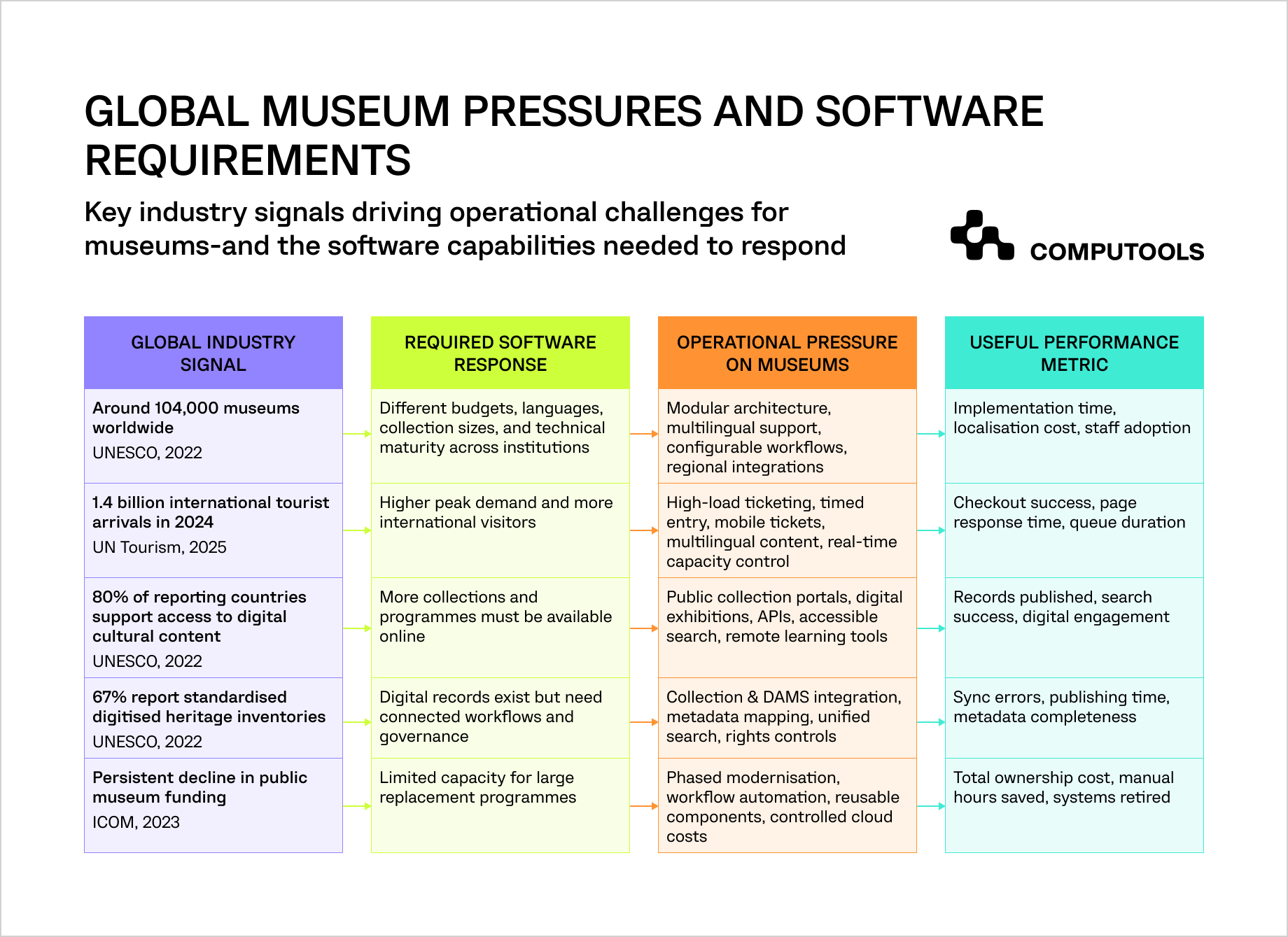
Major destination museums that serve international clients call for software packages that offer multilingual support, as well as timed admissions, group reservations, mobile ticketing and QR code entry, flexible cancellation and real-time capacity controls. Museum ticketing software now needs to integrate with museum CRM software, memberships, donations, events, retail, email marketing, access control, and museum visitor management software. When the various systems are isolated, staff deal with more manual tasks, visitors are given conflicting information, and management is unable to connect the data to analyze revenue, engagement, and attendance.
Digital collections are also moving from isolated publishing projects to permanent institutional infrastructure. UNESCO reports that 80% of participating Member States have introduced measures to improve access to and discoverability of domestic digital cultural content, while 67% report having a standardised inventory system for digitised cultural heritage collections.
Museum digitization requires integration of multiple systems such as museum collection management software, digital asset management, preservation repositories, rights management tools, research databases, search indexes, public websites, and external cultural data service APIs. Effective museum data management may require controlled vocabularies, multilingual metadata, data permissions, media relationships, and API governance.
Organizations may require custom cultural heritage software when existing collection systems cannot support modern search, online exhibits, 3D assets, open data, or integrations without significant modifications.
At the same time, many institutions must modernise under tight financial constraints. ICOM’s worldwide research on museum funding identifies a persistent decline in public support across multiple regions and museum models. This makes large, one-stage replacement programmes difficult to justify and increases the importance of phased museum digital transformation.
Museums need modular software architecture that allows them to replace a public website, introduce APIs, improve collection search, or automate one workflow without immediately retiring every legacy system. Museum workflow automation can reduce duplicate data entry, manual reporting, repetitive exhibition updates, and disconnected approval processes. Cloud cost controls, reusable components, open standards, documented integrations, staff-managed content, and reliable data-export options also help institutions reduce long-term dependence on one vendor.
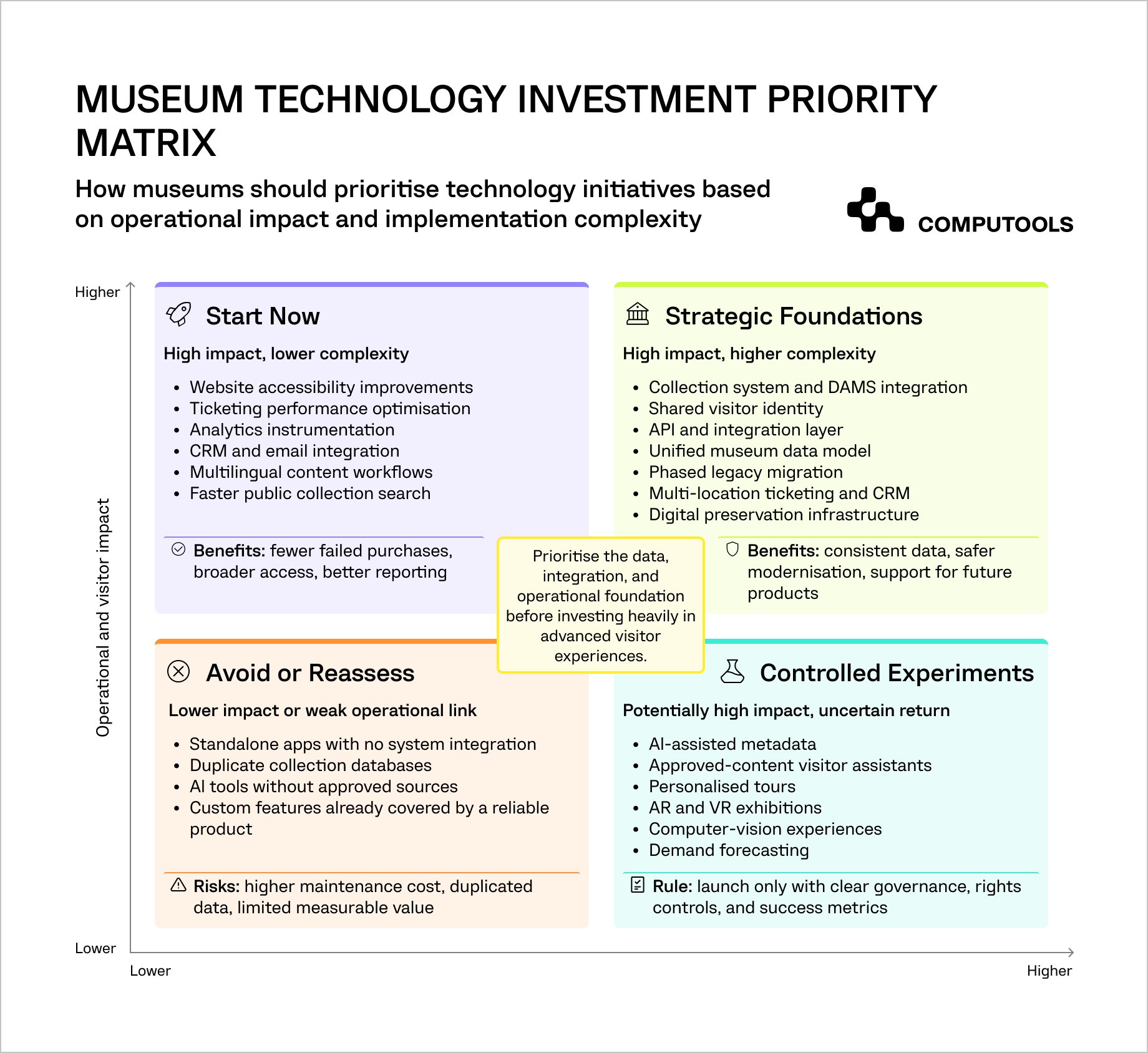
Emerging technology creates further opportunities. Museums are starting to use AI for metadata suggestions, transcription, multilingual search, image classification, accessible-content preparation, visitor recommendations, demand forecasting, and assistants restricted to approved institutional sources. Each use case requires curator review, rights controls, traceable source material, access restrictions, and audit records.
The same principle applies to the digital museum experience more broadly. Interactive museum software, mobile guides, indoor navigation, online collections, and a virtual museum platform should connect to the institution’s content and operational systems rather than become isolated digital exhibits. Strong museum visitor engagement depends on accessible design, relevant content, stable performance, multilingual delivery, and analytics that show how people use each service. Heritage preservation technology must also protect original records, provenance, rights information, and long-term access while making collections easier to explore.
This comparison therefore focuses on museum software developers that can design, build, modernise, and integrate complete digital environments. Individual museum projects serve as evidence of this experience, but the ranking evaluates each provider’s overall service coverage, technical strengths, industry knowledge, global delivery capacity, and suitability for different types of museum programmes.
Selection methodology for museum software development companies
We assessed museum software development companies by their ability to deliver custom engineering for museum operations, collections, and visitor experiences. The research prioritised official company websites, service pages, technical documentation, and published museum or cultural heritage work. Individual projects were used to verify sector experience, but the ranking reflects each provider’s broader museum software development services, technical capabilities, delivery model, and suitability for complex programmes.
| Selection criterion | What we evaluated |
| Museum-sector experience | Work with museums, galleries, archives, libraries, cultural organisations, heritage sites, and visitor attractions. |
| Custom engineering | Ability to build tailored web, mobile, backend, cloud, data, and interactive systems. |
| Museum workflow knowledge | Understanding of collections, exhibitions, ticketing, memberships, donations, education, visitor services, and digital publishing. |
| Platform coverage | Experience with public websites, museum management software development, collection platforms, CRM, ticketing, mobile guides, kiosks, analytics, and operational tools. |
| Integration capability | Connections with collection systems, DAMS, payment services, access control, POS, CRM, CMS, marketing, and analytics platforms. |
| Modernisation expertise | Legacy assessment, API development, data migration, cloud adoption, and phased platform replacement. |
| Data and AI | Search, metadata enrichment, reporting, recommendations, automation, and controlled AI applications. |
| Accessibility | Accessible web, mobile, multimedia, navigation, and interactive experience design. |
| International delivery | Support for multilingual platforms, multiple venues, regional requirements, and distributed teams. |
| Long-term support | Testing, monitoring, documentation, staff training, maintenance, and continuous improvement. |
Museums that operate within cultural districts or tourism destinations may also need to connect their collections and events with transport, local attractions, accommodation, and city services.
Our guide to building a smart tourism platform for urban destinations explains how geolocation, attraction content, itinerary planning, bookings, payments, analytics, and personalized recommendations can work within one visitor environment.
Museums can apply this approach to cultural routes, city passes, joint exhibitions, and partnerships with nearby heritage sites.
20 museum software development companies leading the global industry
The ranking below balances direct sector knowledge with the ability to build reliable custom museum software. It includes cultural technology specialists, digital product studios, interactive experience developers, and broader engineering companies capable of delivering integrated museum IT solutions.
1. Computools
Computools provides travel and hospitality software development services for museums, heritage sites, cultural institutions, and tourism authorities. We help organisations connect ticketing, collections, visitor services, analytics, and legacy systems.
The company combines heritage tourism software development with broader experience in high-load reservations, mobile engagement, data platforms, and phased modernisation. This service range covers visitor platforms, guided-tour applications, cultural asset systems, multilingual booking, interactive maps, kiosks, analytics, and connected exhibition tools.
Computools has 250+ engineers, 400+ delivered projects, ISO 9001 and ISO 27001 certifications, and Microsoft and AWS Partner status. The company can support architecture, development, integration, migration, testing, and post-launch improvement within one delivery model.
Keep ticketing stable during peak demand
Computools builds museum ticketing software with real-time availability, temporary reservation holds, capacity limits, group bookings, payment integrations, QR tickets, and automated notifications.
For Multitrading, the company developed a high-load reservation environment designed to process millions of requests while supporting external integrations and reducing latency. The same architecture can help museums maintain reliable sales during exhibition launches, seasonal peaks, and partner campaigns.
Our experience in software development services for HoReCa, and land-based casino software development strengthens the team’s expertise in engineering visitor profiles, secure payments, loyalty, access control, and transaction-heavy operations.
Connect the visit before, during, and after entry
Museums often use separate tools for discovery, ticket purchase, navigation, interpretation, and post-visit communication. Computools connects these stages through a public website, visitor account, guided-tour application, interactive map, and shared content layer.
Our web development and mobile app development services support:
- Multilingual exhibition information;
- Digital tickets and visitor accounts;
- Audio and multimedia tours;
- Indoor or outdoor navigation;
- Offline content;
- Cultural routes;
- Personalised recommendations.
The SMARTCITY project proves relevant experience in location-based discovery and mobile engagement. Computools can adapt this approach to museum districts, open-air museums, archaeological parks, nearby heritage attractions, and personalised cultural itineraries.
Replace conflicting reports with one data model
Compare ticket revenue, membership conversion, repeat visits, exhibition demand, app activity, and online collection use within one dashboard. Computools connects these sources through a shared museum data management layer that standardises visitor identifiers, calculations, filters, time zones, and reporting rules.
For Profitento, we integrated a hotel’s PMS, channel manager, booking engine, CRM, POS, OTA, spa, restaurant, pricing, and guest data within one revenue platform. Teams gained a single view of demand, customer segments, direct bookings, channel performance, packages, and upsell opportunities. Within six months, forecast accuracy improved by 32%, direct bookings grew by 24%, guest lifetime value increased by 17%, and upsell revenue rose by 14%.
Modernise legacy systems without risking collection data
Older collection, archive, and document systems may contain decades of records, custom fields, media relationships, rights information, and staff knowledge. Replacing them in one release can disrupt daily operations and increase migration risk.
Computools can modernise these environments in stages by:
1. Adding APIs around existing systems;
2. Replacing outdated public interfaces;
3. Introducing faster collection search;
4. Migrating selected records and media;
5. Consolidating identity and access;
6. Retiring duplicated functions gradually;
OpsCore Hospitality demonstrates this phased approach within a complex travel environment. We first mapped fragmented workflows across front desk, housekeeping, maintenance, staffing, and management. Then connected them through shared task routing, role-based dashboards, escalation rules, and operational analytics, releasing the modules in stages. The platform reduced operating and labour costs by 20%, accelerated request processing by 70%, and increased housekeeping efficiency by 30%.
Through AI development services, Computools can also add metadata suggestions, transcription, multilingual search, image classification, and approved-content visitor assistants. Curatorial review, source references, rights controls, and audit logs can remain part of every workflow.
Best for: Museums seeking one engineering partner for custom platforms, integration, data, visitor products, and modernisation.
2. Cogapp
Cogapp provides digital accessibility for museums, libraries, and cultural services. The company’s 40 years of experience enable them to offer remarkable service in user-centered strategy and design, and the development of both websites and mobile applications. Cogapp’s work ranges from online collections, metadata and search services, and cloud infrastructure to ticketing, membership and donation systems, as well as DAM and collection solutions.
The company is particularly strong where institutions need to publish hundreds of thousands of records without exposing the complexity of their internal databases. Its Refinery Services support scalable enrichment and presentation pipelines for large digitised collections. Work for institutions such as the Metropolitan Museum of Art, MIT Museum, and the Natural History Museum of Denmark supports this wider capability.
Best for: Large museums with complex metadata, several internal systems, and ambitious online collection requirements.
Consideration: Its public portfolio places greater emphasis on collections and audience access than on back-office museum operations.
3. Digirati
Digirati focuses on the digital systems and infrastructures for museums, archives, libraries, higher education and research institutions. The team brings together a variety of skills including UX, software engineering and IT services, data management, as well as the design of applications and digital infrastructures for service integration. They also offer digital preservation services, IIIF hosting, and annotation and crowdsourcing middleware.
The company is well suited to institutions whose digital assets sit across disconnected collection, archive, library, and preservation systems. Its open and IIIF-native components can reduce duplicated development while leaving room for tailored collection websites, exhibitions, publications, research interfaces, and teaching tools. These digital solutions have been implemented at the Victoria and Albert Museum (V&A), universities, libraries, and some Indigenous cultural collections.
Best for: Museums that need interoperable collection infrastructure, APIs, IIIF, digital preservation, or research platforms.
Consideration: They focus less on commercial features like high-traffic admissions, memberships, and retail.
4. Keepthinking
Keepthinking combines digital design for the museum sector with collection and content technology. Their Qi technology unifies collection management, digital asset management, e-commerce, multilingual content, translation workflows, and public web publishing. Keepthinking also offers information architecture, UI and UX design, development, accessibility, data migration, and post-project support.
This model can help close the technical gap between internal collection records and external storytelling. Museum staff can manage objects, media, and editorial content for more unified digital publications within the same space, rather than multiple dissociated databases and websites. For over twenty years, Keepthinking has partnered with museums, foundations, archives, and cultural institutions.
Best for: Museums that want an integrated collection, DAMS, CMS, and public website systems.
Consideration: Buyers seeking technology-neutral architecture should assess how strongly the proposed solution depends on Qi.
5. Fabrique
Fabrique is a strategic design and development agency with substantial subject matter expertise in museums and cultural heritage. Its services include digital strategy, service design, branding, UX, web development, online collections, mobile experiences, interactive installations, virtual exhibitions, ticket journeys, and digital storytelling.
The company reports more than 50 international museum websites, applications, tours, identities, and installations. This breadth gives it experience with both institution-wide digital identities and focused audience products. Its museum work includes collection discovery, high-resolution imagery, immersive narratives, multi-institution platforms, and services that connect the online journey with a physical visit.
Best for: Museums prioritising strong public experiences, collection discovery, storytelling, and coherent digital design.
Consideration: Complex programmes may involve separate technical partners, so backend and integration responsibilities should be defined early.

Launch your custom museum software platform within 1–3 months instead of years, and increase visitor engagement while automating ticketing, collections, memberships, and daily operations without expanding administrative costs.
6. Q42
Q42 develops technically demanding web and mobile products for museums, cultural organisations, education, and other sectors. Its museum capabilities include native iOS and Android applications, multimedia tours, indoor navigation, ticket access, online collections, image search, accessibility, headless architecture, and reusable website frameworks.
The company has experience connecting collection content with the visitor’s location and physical journey. It has also developed shared technology that allows several museums to reuse a maintainable and accessible foundation while retaining their own content and identity. Its work with the Rijksmuseum, Naturalis, Museum.nl, and the National Gallery supports this technical focus.
Best for: Museums requiring high-quality mobile products, navigation, online collections, or experimental digital services.
Consideration: Q42 often works alongside specialist design agencies, requiring clear coordination between partners.
7. Art Processors
Art Processors provides experience strategy, visitor journey design, software engineering, QA testing, media production, exhibition technology, content systems, and continuing optimization for museums, galleries, libraries, attractions, and public spaces.
Its capabilities extend beyond individual applications. The company can connect ticketing, virtual queues, location-aware content, audio, mobile interfaces, interactive displays, computer vision, real-time analytics, AV systems, and content management. Its Pladia platform adds tools for publishing and managing experiences across visitor devices and venue installations. Long-running museum relationships show experience supporting technology after the initial opening.
Best for: Museums seeking one partner for mobile experiences, exhibition software, content, and physical-digital integration.
Consideration: Its strongest experience lies in visitor and exhibition technology rather than collection administration.
8. Bluecadet
Bluecadet creates digital tools and interactive systems designed for museums and cultural institutions. Its digital offerings include websites, mobile and web tools, augmented installations, digital signage, and interactive content. Work involves the integration of other technologies such as AI and sensors and the interaction of content with physical spaces.
The company is particularly relevant where software must function within an architectural or gallery environment rather than on a standard screen alone. Its teams can combine content, interaction design, technical development, and spatial planning to create connected experiences. Museum work includes public websites, collection-based interactives, children’s galleries, AI-supported discovery, and large digital displays.
Best for: Museums combining public digital products with ambitious in-gallery installations.
Consideration: Large-scale installations in public museum spaces may require coordination with architects, AV integration specialists, fabrication specialists, and exhibition staff.
9. Local Projects
Local Projects creates interactive and participatory experiences for museums, memorials, science centers, and cultural and public projects. The team’s capabilities include experience design and strategy, MVP development, interaction design, digital exhibits, large touch systems, augmented reality, sensors and personalized devices, collection interfaces, and physical-to-digital storytelling.
The studio is strongest when technology forms a central part of a gallery or institution’s visitor model. Its systems have allowed visitors to collect objects, create personal tours, explore digitised collections, contribute opinions, and continue engaging after leaving the museum. Its portfolio includes major art, history, design, and science institutions.
Best for: Large museums planning signature interactive galleries or institution-defining visitor experiences.
Consideration: Its approach may be too extensive for a small website, standard mobile guide, or limited integration project.
10. Bravoure
Bravoure is a digital agency with a focus on the arts and culture sectors, including museums as well as the music and entertainment industries. It integrates many practices from research and digital strategy to design and product improvement.
Bravoure’s museum solutions emphasize adaptable digital platforms that integrate museum collections and exhibitions as well as editorial content, community participation, and contemporary themes. This makes the company relevant to institutions that want digital participation rather than one-way publishing. It also brings transferable experience in memberships, content platforms, events, and audience retention. Bravoure reports more than 15 years of work across culture and entertainment.
Best for: Museums building participatory archives, community storytelling, or content-rich audience platforms.
Consideration: Its public evidence is stronger in audience engagement than in collection administration or enterprise integration.
11. Surface Impression
Surface Impression creates user-friendly, web-based platforms for museums, galleries, libraries, and other cultural institutions. Some of the services offered are web design, digital collections, data services, the International Image Interoperability Framework (IIIF), virtual exhibitions, advanced search functionality and content design. They also provide digital accessibility services, such as audits and user testing.
Surface Impression recognizes the gaps that exist between collection databases and web-based public traffic. They offer digital solutions for researchers and casual visitors that include wide-ranging access features, as well as deep-zoom and faceted image browsing. Accessibility of their services and solutions is a high priority, and they incorporate it in all of their work.
Best for: Small and mid-sized institutions that need accessible websites, online collections, or IIIF-based experiences.
Consideration: Buyers should verify capacity for large transactional platforms involving admissions, payments, CRM, and real-time operations.
12. Made by Many
Made by Many offers a fusion of services that include research, strategy, service design, UX, product engineering, experimentation, and organisational change. This is a good fit for organizations that wish to improve how teams plan, deliver, measure, and regularly update their services, rather than design a one-off web-based service.
Its cultural experience shows an ability to connect public platforms with commercial objectives, collection access, internal tools, and new working practices. The company can also draw on broader experience launching and scaling digital products in other industries. Its transformation programme for the Victoria and Albert Museum provides the main public proof of its museum capabilities.
Best for: Large institutions undertaking organisation-wide museum digital transformation.
Consideration: Its specialist museum portfolio is narrower than that of agencies dedicated exclusively to culture and heritage.
13. Futured
Futured is a mobile and web product company with direct experience building applications for museums and cultural institutions. Its capabilities include native iOS and Android engineering, product design, augmented reality, indoor positioning, BLE beacon networks, content management, analytics, and long-term application development.
The company is particularly suitable for museum app development where navigation, location-aware interpretation, interactive collection content, and AR must operate within a large physical venue. It has also created AR technology that cultural institutions can use to bring archive materials and stories into public spaces.
Best for: Museums requiring native visitor applications, AR, indoor navigation, or location-based experiences.
Consideration: Its public museum work is concentrated on mobile products rather than complete institutional platforms.
14. Minsky
Minsky is a multidisciplinary digital agency offering strategy, UX, web design, development, accessibility, API architecture, integration, IT infrastructure, user testing, and automation. Its cultural work demonstrates particular strength in bringing several museum systems together within one public digital environment.
The agency has connected collection platforms, DAMS, CRM, ticketing, email, analytics, and content management tools. This can reduce manual copying while preserving curatorial control over collection records. Its experience also covers multilingual websites, visitor applications, IIIF images, podcasts, virtual tours, and sustainability-focused web engineering.
Best for: Museums that need an accessible website or application connected to existing collection and visitor systems.
Consideration: Its delivery capacity may be better suited to focused or mid-sized programmes than extensive global transformations.
15. Interactive Knowledge
Interactive Knowledge designs purpose-oriented solutions for museums and educational and civic public service organizations. They provide a variety of services including the development of websites, mobile and web apps, as well as the design of touchscreens, kiosks, interactive maps, and data visualizations. They also offer digital services for exhibitions, content strategy, and integration of external systems.
Interactive Knowledge helps different age groups and levels of understanding interact with academic, scientific, and historical knowledge as well as collection content. They help plan gallery visits and provide in-gallery content as well as ticketing solutions, navigation systems, and simple staff-controlled mobile content systems that are bilingual and accessible.
Best for: Museums and educational historic sites that contain digital content and require effective and engaging content display.
Consideration: Its portfolio emphasises learning and visitor interaction more than operational or collection management systems.
16. NOUS Digital
NOUS Digital specialises in digital mediation for museums and cultural institutions. Drawing on more than twenty years of experience in the museum industry, it offers a range of solutions that include multimedia guides, web and mobile applications, interactive media, immersive experiences, 3D content, equipment, training, and visitor services.
Its cloud-based NOUS Conductor content management system allows museum staff to control content from a central location and distribute it to mobile devices, temporary loan equipment, museum websites, and exhibition-integrated installations.
The headless architecture supports multilingual content and different interface designs across multiple venues. The company has delivered visitor tools for museums in Europe, the Middle East, and other international markets.
Best for: Museums replacing traditional audio guides with flexible multilingual digital interpretation.
Consideration: Its solution is platform-led, so buyers should clarify the limits of customisation and data portability.
17. Most Idea
Most Ideas delivers custom software and mobile applications, enterprise platforms and APIs, reporting and automation tools, and offers technical consulting and systems integration. It was founded in 2005 and claims to have experience with more than 400 projects.
Its primary museum work relates to operational software to provide ticketing, QR access, control of gates and permissions, sales to B2B partners, reporting and payments, and digital visibility. These capabilities make it relevant to high-traffic museums and immersive attractions that need admission and reseller workflows rather than collection publishing alone. The company also provides maintenance planning, error monitoring, backup, cybersecurity services, and performance improvement.
Best for: Museums requiring custom ticketing, access control, partner distribution, or museum automation.
Consideration: Its publicly documented museum portfolio is narrower than those of established cultural technology specialists.
18. Mad Systems
Mad Systems designs, engineers, integrates and commissions technology for museums, science centers, visitor attractions, and other public spaces. This includes V infrastructure, show control, interactive installations, and digital signage, along with multilingual media and accessibility, RFID, and monitoring, and approved AI.
The company focuses on the design of systems with long operational lifecycles and software-based upgrades, as opposed to software serving short-term exhibitions. The architecture allows for the control of displays, audio, lighting, mobile devices, interactive media, and other third-party systems across an entire venue. It also offers tools for role-based staff control and automated verification of exhibit performance.
Best for: New museums, gallery renovations, and large exhibitions requiring reliable physical-digital infrastructure.
Consideration: It is an exhibition and venue technology specialist rather than a conventional web, CRM, or collections developer.
19. Exhibition Technologies
Exhibition Technologies develops the software for museum and exhibition installations in Cape Town. Their services include the production of interactive 3D environments and games, immersive and responsive displays, and hardware integration for custom visitor experiences.
They have extensive experience within the industry, having completed over 50 installations globally. Their previous projects have included public installations at science and cultural museums, world expos, and exhibition spaces. They have also developed software for use with a variety of input devices and displays, as well as for physical museum exhibits.
Best for: Museums requiring custom interactive museum software, simulations, touchscreen apps, or 3D exhibits.
Consideration: Exhibition Technologies focuses on the integration of gallery software and hardware, and does not provide ticketing, CRM, or collections management services.
20. Cuberis
Cuberis builds and supports WordPress-based digital platforms for cultural institutions. The company’s services include digital content strategy and architecture as well as user experience and visual design integration. It also supports collections, memberships, donations and promotions, as well as analytics, and optimization based on feedback.
Their museum-specific model provides institutions with a maintainable public website, as opposed to a large custom enterprise system. The team understands how websites must communicate exhibitions, events, collections, education, donations, memberships, and institutional storytelling without overwhelming the visitors or organizational staff.
Best for: Museums that require a low-maintenance website that can be managed by staff and includes collections and engagement functionality.
Consideration: Its WordPress focus may not suit complex operational systems, native applications, or large custom data platforms.
Museums can also learn from the wider heritage technology market, where providers combine collection access, digital interpretation, visitor applications, ticketing, data integration, and preservation tools.
Our comparison of heritage tourism software development companies in Europe examines how specialised cultural technology firms and broader engineering providers support museums, heritage sites, archives, and tourism authorities.
How to choose a museum software development company
The right museum technology company should understand both software architecture and the daily realities of museum operations. A strong partner should be able to connect collections, visitor services, ticketing, memberships, donations, content, analytics, and in-gallery technology without creating another isolated system.
Use the following areas to compare museum software development companies.
| Evaluation area | What to verify | Questions to ask |
| Museum experience | Repeated work across collections, exhibitions, ticketing, visitor services, or digital interpretation | Which museum workflows has your team supported directly? |
| Custom engineering | Ability to build tailored platforms rather than configure standard products | Which parts of the proposed solution will be custom-developed? |
| System integration | Experience connecting collection databases, DAMS, CRM, ticketing, payments, CMS, and analytics | Which system will remain the source of truth for each type of data? |
| Migration capability | Processes for cleaning, mapping, testing, and transferring historical data | How will you validate migrated records, media, rights, and relationships? |
| Accessibility | Experience with accessible web, mobile, multimedia, kiosks, and navigation | How will users with disabilities participate in testing? |
| Global readiness | Support for languages, currencies, regional hosting, payments, and privacy rules | How will the platform handle several countries or museum locations? |
| Scalability | Ability to handle large collections and traffic peaks | What load will the platform support during a major exhibition launch? |
| Long-term support | Monitoring, updates, incident response, documentation, and staff training | Who will support the system after launch, and under what service levels? |
Museums comparing mobile development partners should examine backend engineering, system integration, accessibility, scalability, analytics, and support rather than judging providers only by interface design.
Computools’ review of hospitality mobile app development companies provides additional criteria for assessing providers that build booking, loyalty, payment, and guest-experience applications connected to operational systems.
Final thoughts
The best museum technology partner varies with each individual project. Many cultural specialists have deep knowledge regarding collections, accessibility, and standards. Studios that focus on interaction are better for projects involving immersive galleries and mobile guides. Large consultancies are well-suited for large, complex international projects.
For museum automation, integrations and data platforms, custom engineering companies are usually a better option. Let’s have a quick look at the companies ranked in this article.
| Rank | Company | Best for | Relevant industry evidence |
| 1 | Computools | Integrated custom platforms and modernisation | Heritage, visitor, ticketing, data, web, mobile, and AI capabilities |
| 2 | Cogapp | Complex online collections and museum websites | Decades of work with major museums and cultural institutions |
| 3 | Digirati | Cultural data infrastructure and IIIF | Deep specialisation in collections, APIs, preservation, and research platforms |
| 4 | Keepthinking | Unified collection and public content platforms | Collection management, DAMS, web publishing, and digital design |
| 5 | Fabrique | Museum strategy and public digital experiences | More than 50 international museum websites, apps, tours, and installations |
| 6 | Q42 | Advanced museum apps and collection interfaces | Native mobile, navigation, search, accessibility, and reusable museum frameworks |
| 7 | Art Processors | Visitor experience and exhibition technology | Full-service museum experience design and software engineering |
| 8 | Bluecadet | Interactive installations and digital products | Extensive museum website, exhibition, AR, and AI work |
| 9 | Local Projects | Large-scale interactive museum environments | Personalised, participatory, and collection-connected experiences |
| 10 | Bravoure | Participatory cultural platforms | Strategy, UX, development, storytelling, and community engagement |
| 11 | Surface Impression | Accessible online collections | Cultural websites, IIIF, collection data, exhibitions, and accessibility |
| 12 | Made by Many | Institution-wide digital transformation | Product strategy, service design, platforms, and organisational change |
| 13 | Futured | Native museum apps and AR | Mobile engineering, indoor navigation, analytics, and augmented reality |
| 14 | Minsky | Integrated museum websites and applications | Collection, DAMS, CRM, ticketing, and API integration |
| 15 | Interactive Knowledge | Educational and interpretive digital products | Museum websites, apps, kiosks, touchscreens, and system integration |
| 16 | NOUS Digital | Multilingual digital museum guides | PWAs, native apps, CMS, spatial audio, and interactive media |
| 17 | Most Idea | Ticketing and museum operations | Custom booking, QR access, B2B sales, reporting, and integration |
| 18 | Mad Systems | Long-life in-gallery technology infrastructure | AV, show control, accessibility, personalisation, and venue systems |
| 19 | Exhibition Technologies | Custom interactive exhibit software | Real-time 3D, multi-touch, hardware integration, and immersive installations |
| 20 | Cuberis | Museum websites and collection publishing | Museum-focused WordPress platforms, collection integration, and staff training |
The right museum software company should understand both the technical architecture and the institution’s operating model. It should know which systems can remain in place, which workflows need automation, and where custom development will deliver a clear operational or visitor benefit.
Organisations should look more holistically when assessing potential partners beyond just an appealing portfolio. The proposed team must be able to outline the integration between ticketing, CRM, membership, donation, collection and digital asset systems, websites and mobile applications, and the analytics framework. It is critical to assess data ownership, accessibility, and the controls around migration and support, and the long-term cost expense for the maintenance of the platform.
Computools helps museums, heritage sites, and cultural organisations replace fragmented digital tools with one connected technology environment. Our company designs and modernises visitor platforms, mobile apps, cloud systems, integrations, analytics, and AI solutions that improve access to collections, simplify staff workflows, and support better operational decisions.
Computools
Software Solutions
Computools is an IT consulting and software development company that delivers innovative solutions to help businesses unlock tomorrow.