
THE AUTHOR:

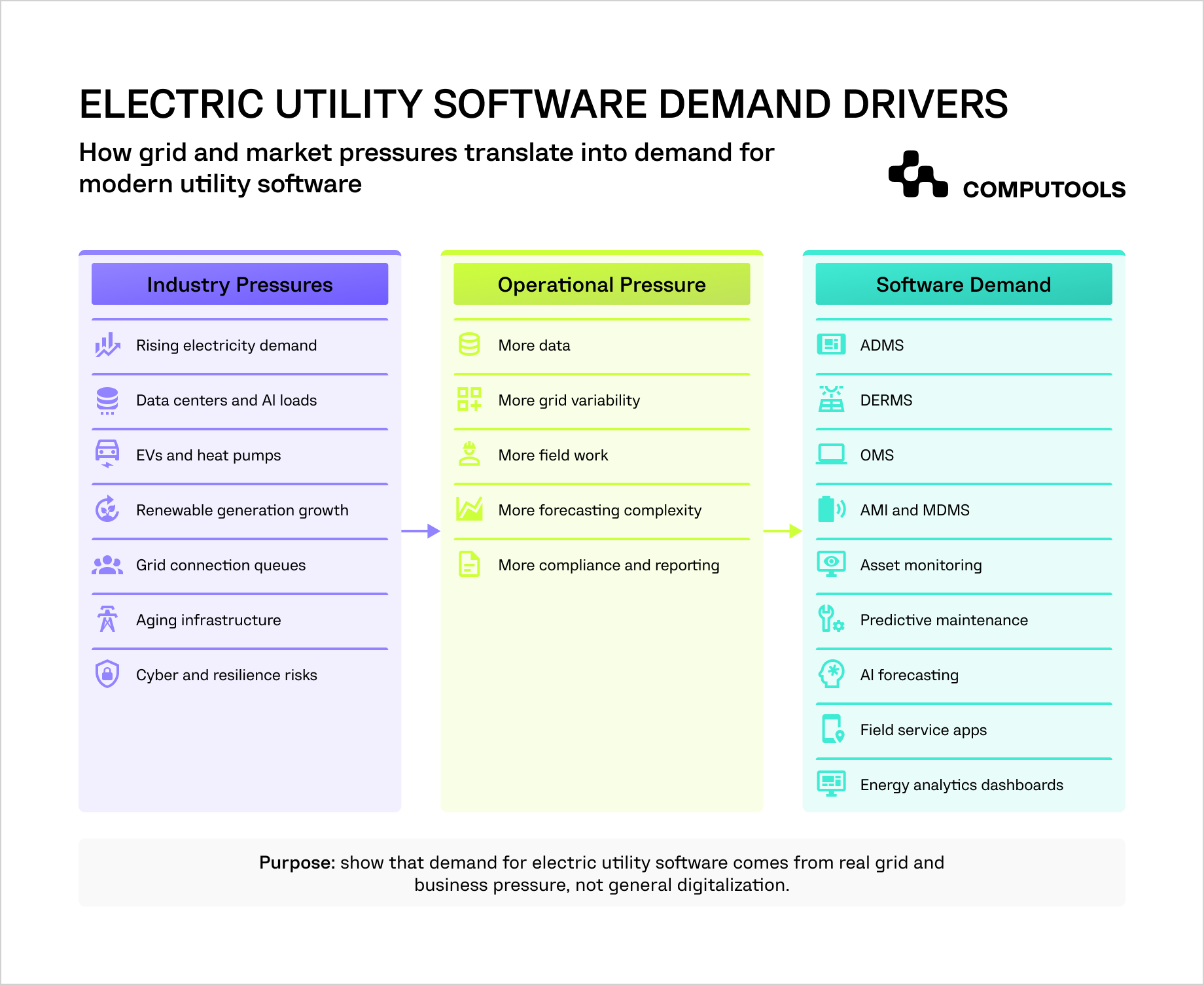
For electric power utility software development companies, electricity management software is becoming a critical component of grid capacity planning. While traditionally considered a back office component, such solutions are becoming essential due to three factors: the rapid growth of electricity demand, the increased variability of electricity generation, and the growing number of controllable grid edge resources controllable assets at the grid edge.
Large AI and cloud data centers further complicate matters because they often locate specific areas, connect to the grid in large, single requests, and have stringent uptime requirements.
The International Energy Agency forecasts global electricity demand to grow by an average of 3.6% per year between 2026 and 2030. That growth is coming from industry, electric vehicles, air conditioning, data centres, and broader electrification. For utilities, this means the load curve is becoming harder to forecast with traditional planning tools. Large AI and cloud data centres add another challenge because their demand can be concentrated in specific regions, connected in large blocks, and tied to strict uptime requirements.
The grid itself has become a limiting factor. The IEA notes that over 2,500 GW of renewable, storage, and large-load projects are on hold in the grid connection queues across the globe. This issue isn’t solely the lack of construction. This stagnation relates to the software as well. Utilities need connection management, hosting capacity, and digital twin applications, geospatial and grid simulation tools, and automated workflows to determine the safe connection of new generation, storage, EV charging, and great demand to the network.
At the operational layer, utilities are transitioning from passive network management to active grid orchestration. Smart meters, IoT sensors, distributed solar, batteries, EV chargers, heat pumps, and commercial flexible loads are creating millions of new data points and control signals. This is driving the need for advanced distribution management and energy resource management systems, outage management, meter data management, virtual power plants, predictive maintenance, and operational dashboards with AI-enhanced decision-making and real-time capabilities.
20 best electric power utility software development companies:
1. Computools
2. Accenture
3. Capgemini
4. IBM
5. Siemens Grid Software / Siemens
6. GE Vernova
7. Schneider Electric
8. Hitachi Energy
9. Oracle Utilities
10. SAP
11. Itron
12. Landis+Gyr
13. Kraken Technologies
14. Fluentgrid
15. Tata Consultancy Services (TCS)
16. Infosys
17. Wipro
18. Cognizant
19. EPAM
20. ELEKS
The impacts of these trends will be felt in the way electric utilities choose technology partners. A billing system, customer portal, field service app, asset platform, or grid analytics tools can no longer be thought of as individual systems. Software must have the ability to interface with multiple systems and partner products, including SCADA, GIS, ERP, CRM, AMI, IoT, and additional systems and software. Partners must understand the cloud, AI, data and how to engineer them, as well as consider the interoperability of multiple services and software, real-time analytics, and the risk of operating power infrastructure.
With the correct electricity utility software development partner, utilities can automate, connect OT and IT, gain situational awareness, reduce the time to respond to an outage, and lay the digital groundwork needed for the future of the grid.
We analyze and compare 20 power sector software developers around the world. This includes firms that develop custom software, enterprise products and technologies, energy technology software providers, smart grid software companies, and companies that assist utility transformation.
How we selected the electric power utility software development companies
We evaluated companies based on several practical criteria:
| Selection criterion | What we evaluated |
| Electric utility experience | Work with power utilities, grid operators, energy retailers, transmission and distribution companies, or asset-heavy energy businesses |
| Electric utility software development capability | Ability to build, customize, integrate, implement, or modernize utility software systems |
| Utility workflow coverage | Support for grid operations, billing, customer service, AMI, outage management, asset management, DERs, field service, analytics, or reporting |
| Technical expertise | AI, IoT, cloud, data platforms, cybersecurity, GIS, SCADA, ERP, CRM, AMI, and enterprise integrations |
| Integration experience | Ability to connect legacy systems, field devices, grid platforms, metering infrastructure, and enterprise tools |
| Global delivery capacity | Ability to support utilities across regions, regulatory environments, and enterprise technology landscapes |
20 leading electric power utility software development companies
1. Computools
Computools is a strong choice for electric utilities, grid operators, renewable energy companies, energy retailers, and infrastructure businesses that need software built around real operating conditions.
With 12+ years of expertise in the energy industry, 40+ custom energy software products delivered globally, and 20+ tailored electric power utility software projects completed for leading industry players, the company helps connect fragmented utility workflows, improve asset visibility, reduce manual reporting, and give operational teams faster access to the data they need for planning, maintenance, outage response, and compliance.
Clients report up to 2× faster field operations and up to a 65% reduction in equipment downtime, helping utilities improve service reliability, increase asset utilization, and accelerate operational decision-making.
Build Around Grid Assets, Metering Data, and Regulated Workflows
Computools provides energy software development services for firms working with distributed assets, metering data, regulated processes, and critical infrastructure. For utilities, we engineer platforms for grid monitoring, outage tracking, asset management, smart metering, AMI data processing, field service coordination, predictive maintenance, customer portals, energy analytics software, and operational reporting.
We apply strong expertise in electric power software development to designing smart grid management, ETRM systems, DER visibility, asset performance, outage management, cybersecurity, and utility data platforms.
Connect Legacy Systems Without Forcing a Full Replacement
Computools is especially relevant for power companies that cannot replace legacy systems all at once. Many utilities already depend on SCADA, GIS, ERP, CRM, CIS, AMI, spreadsheets, vendor tools, and field applications. The challenge our clients face is the absence of a reliable operational layer between them.
Computools builds integration-first platforms that collect data from meters, sensors, substations, field devices, enterprise systems, and user interfaces, then turn it into alerts, dashboards, workflows, reports, and predictive models.
Prove Value Early, Then Expand the Platform
The company’s phased delivery approach is useful for utilities that need visible results without committing to a long transformation program upfront. A project can start with one high-impact workflow. This helps lower execution risk and gives operational teams value earlier.
Give Control Rooms and Field Teams the Same Operational Picture
Computools web development services support control room dashboards, customer portals, reporting systems, and management interfaces. Our mobile app development services cater to field technicians, inspection teams, maintenance crews, and operations managers who need work orders, asset records, outage updates, photos, checklists, and alerts outside the office.
IoT development services help connect smart meters, sensors, substations, field equipment, distributed energy assets, and monitoring devices into reliable data flows.
Data engineering helps structure and connect AMI, IoT, billing, asset, maintenance, and operational datasets, while AI development supports predictive maintenance, anomaly detection, load forecasting, risk scoring, automated recommendations, and faster triage.
Reduce Downtime With Predictive Energy and IoT Experience
Relevant Computools case experience strengthens this positioning. In the Drone Analytics project, the company worked with a global sustainable energy supplier on AI-powered analysis for predictive maintenance, helping reduce downtime and improve turbine performance.
Energy asset monitoring and optimization work for Winder covered real-time calculations, connected energy devices, predictive algorithms, risk detection, and infrastructure visibility. The E-Feller case also shows Computools’ ability to build IoT-based platforms with web and mobile components, real-time tracking, structured data flows, and measurable operational impact.
Modernize Utility Workflows Without Losing Operational Control
For electric power companies, Computools is a practical fit when the business needs flexibility, domain-specific logic, and tailored development. The best-fit projects are custom energy software solutions that connect IT and OT environments, improve asset and grid visibility, reduce manual work, and turn operational data into decisions teams can act on.
2. Accenture
Accenture is also relevant when a utility needs to combine technology delivery with business consulting. For example, a power utility may need to modernize customer operations, improve outage communication, introduce AI into service processes, and migrate legacy applications at the same time.
Accenture partners with electric, gas, and water utility clients to deliver large-scale transformation programs. The company is well-positioned to support enterprise utility companies with their consulting and system implementation needs, as well as cloud migration, AI adoption, and changes to operating models and customer experiences, including energy transition programs and digital transformation in electric power industry initiatives.
For enterprises, Accenture can help with the breadth of initiatives around modernizing the grid, digital customer services, data and analytics, workforce transformation, and operating models to support the ambitious goal of net-zero emissions. It is often a better solution for larger utilities with complex and integrated multiple business units and a long-term transformation roadmap.
Accenture also adds value when a utility company will benefit from the simultaneous implementation of technology and business consulting. A good example of this is when a utility company needs to modernize customer operations and services, improve and automate communications of outages, and modernize the service operations by migrating applications from legacy solutions.
3. Capgemini
Capgemini assists companies in the energy and utility sector with digital transformation, foundational technology, AI, business process automation, data and smart grid initiatives. It is well suited for utility companies requiring a global strategic partner with consulting, engineering and implementation expertise.
Capgemini has experience with utility programs including grid and customer software modernization, operational and application-related analytics, and technology enterprise delivery and sustainability efforts.
It is well suited for large scale firms that need to transition from disconnected systems to integrated digital operations, including customer, data, and automation tools, as well as asset and cloud-based utility application services.
Capgemini is a good fit for projects that require the alignment of technology, business processes and changes in the organization.
4. IBM
IBM supports power and utility companies with AI, automation, data management, asset management, customer engagement, and IT consulting services. For operators that require enterprise-grade technology and established systems, IBM is an excellent choice.
IBM is a valid option for electric utilities looking to enhance reliability of their assets, automate their business processes, and modernize their support applications, and strengthen their decisions and data using AI.
One of IBM’s utility operational advantages is its focus on asset-heavy operations. Electric power utilities have a multitude of assets including sub-stations, field and generation assets, and software that assists in planning maintenance of these assets.
IBM is an excellent choice for utilities looking for a mature enterprise technology provider with a strong focus on data, AI, and automation, and the management of assets.
5. Siemens Grid Software
Siemens Grid Software is one of the most relevant providers for grid operations, electricity distribution management software, and utility control systems. Its software supports advanced distribution management, energy operations management, DER integration, outage management, SCADA functionality, and grid visibility.
For electric utilities, Siemens is a strong choice when the core problem is operational grid control. This includes managing distribution networks, improving reliability, integrating renewables, and giving operators a better view of grid status.
Siemens is particularly useful for utilities moving toward more active distribution networks. As more solar, storage, EV charging, and distributed assets connect to the grid, utilities need software that can support more dynamic decision-making.
Siemens is best suited for utilities that need proven grid operations software rather than a fully custom-built platform.

Launch your electric power software platform within 1–3 months instead of years. Unlock the speed, intelligence, and scalability needed to shape the future of the energy industry.
6. GE Vernova
GE Vernova provides grid software for electric utilities through its GridOS portfolio. The company focuses on grid orchestration, distribution operations, grid planning, DER management, field execution, and operational data.
GE Vernova is a strong option for utilities facing high grid complexity. This includes utilities dealing with renewable integration, extreme weather, changing demand patterns, aging infrastructure, and distributed energy resources.
Its positioning is especially relevant for companies that want to move beyond separate operational tools and toward more unified grid orchestration. That means planning, monitoring, control, outage response, and field activity can work in a more coordinated way.
GE Vernova is best suited for power utilities that need advanced grid software from a provider with deep electricity infrastructure expertise.
7. Schneider Electric
Schneider Electric provides electric utility software through its EcoStruxure portfolio, including ADMS, grid operation software, outage management, SCADA, and DER management capabilities.
The company is a strong option for utilities that need operational control, grid reliability tools, and scalable grid management systems. Schneider Electric is especially relevant for distribution utilities that need to improve outage response, monitor networks, manage grid events, and support the transition to cleaner energy.
For smaller and medium-sized utilities, Schneider Electric also offers grid operation software designed to provide advanced distribution management capabilities without unnecessary complexity.
Schneider Electric is a good fit when the project is tied to grid automation, distribution management, control room operations, and operational resilience.
8. Hitachi Energy
Hitachi Energy offers electric power generation software and enterprise technology for utilities across grid and generation management, asset and work management, energy portfolio management, and grid automation.
The company is a strong choice for utilities that need software connected to physical power infrastructure. Its solutions support operational resilience, asset lifecycle management, workforce planning, AI predictive analytics, cybersecurity, and grid operations.
Hitachi Energy is relevant for electric utilities that want to connect asset data, grid operations, work management, and planning. This is especially important for companies that manage large infrastructure networks and need to improve reliability under growing demand and extreme weather conditions.
Hitachi Energy is best suited for utilities that need software supported by deep grid engineering and power infrastructure expertise.
9. Oracle Utilities
Oracle Utilities provides software for customer service, billing, meter data, analytics, network management, and utility operations. Its portfolio includes platforms for customer information systems, customer cloud service, meter-to-cash processes, and advanced distribution network management.
Oracle is a strong choice for utilities that need to modernize customer operations and core business systems. Electric utilities often rely on customer information systems, billing platforms, meter data systems, outage communication, service orders, and payment workflows. Oracle covers many of these areas through established utility-specific products.
Oracle Utilities is especially relevant for large utilities that need a connected customer and operations platform, strong data management, and enterprise reliability.
It is a good fit for utilities that want proven software rather than custom development from scratch.
10. SAP
SAP develops utilities software for enterprise processes, customer operations, billing, finance, asset and workforce management, as well as business sustainability.
SAP is often the choice of large companies that need to manage business operations, customer segments, and compliance for multiple business and geographic operations. For electric utilities, SAP supports the entire meter-to-cash workflow as well as asset accounting, procurement, E/RP, field operations, and service and operations workflows.
SAP is particularly applicable when a software project is part of a larger enterprise modernization project. For example, a utility may want to fuse their disparate billing, finance, customer and asset work order data into a more integrated business solution.
SAP is particularly applicable for large electric utilities requiring enterprise process control with long-term stability of the software platform.
11. Itron
Itron is involved in many different markets, which include smart energy, advanced metering infrastructure (AMI), edge computing, meter data, as well as analytics, and distributed intelligence. Itron assists electric utilities with incorporating visibility at the customer level and control at the distribution level.
Itron is a prime choice for utilities wishing to increase their AMI returns. Smart metering and communication devices produce an abundance of operational data that is of no value to utilities without the supporting software.
Itron offers support for a variety of use cases including but not limited to outage detection, grid reliability, visibility of distributed energy resources, consumer engagement, and real-time intelligence of the grid, as well as management of distributed energy resources (DER) along with grid intelligence.
Further, Itron is the best solution for those utilities looking to enhance visibility along the grid edge, integrate metering data with operations, as well as prepare for a future with more distributed and decentralized control of the electric grid.
12. Landis+Gyr
Landis+Gyr builds and provides its clients with software and services used with smart metering, utility IoT platforms, smart infrastructures, and grid edge technologies.
Landis+Gyr is appropriate when projects are focused on metering and energy data, connected edge devices, and device-to-enterprise solutions. The company helps utilities integrate data and devices with operational choices.
Landis+Gyr would be a good choice for electric utilities with interests focused on the enhancement of metering, corporate reliability and customer programs, as well as the incorporation of meter data for energy efficiency.
This company is the best choice for electric utilities with interests in the combination of smart metering, data, and utility-based software.
13. Kraken Technologies
Kraken Technologies supplies an operating tool for utilities, originally derived from Octopus Energy’s platform. Energy retailers use it to manage customer accounts, billing, service operations, and to integrate data, flexibility, and AI-based workflows.
Kraken serves energy suppliers and utilities looking to replace disjointed and fragmented operations and customer systems with a unified operating environment. Kraken provides support for customer service, billing, product management, domestic asset control, grid-scale asset optimization, and flexible energy programs.
For electric power utilities, Kraken serves the business model when retail energy, customer engagement, flexible and dynamic tariffs, and digital-first service operations are the core elements.
Kraken is best suited for utilities that want a modern utility operating system rather than separate tools for billing, CRM, and service operations.
14. Fluentgrid
Fluentgrid develops utility software for customer information systems, meter data management, AMI, billing, customer lifecycle management, and smart grid data.
The company is especially relevant for utilities that need strong CIS and MDMS capabilities. Its software helps utilities process meter data, validate and structure it, support billing determinants, manage customer operations, and connect AMI with downstream systems.
For electric utilities, Fluentgrid is a practical option when the project focuses on metering, billing, customer operations, and data flow across the utility organization.
Fluentgrid is best suited for utilities that need specialized utility platforms rather than broad enterprise consulting.
15. TCS
Tata Consultancy Services partners with energy and utility organizations to advance cloud migration, digital core modernization, and managed and consulting services. They also assist with application modernization, as well as customer experience and operational technology programs. TCS is a good choice for large utilities needing global delivery and long-term IT support.
Electric utilities have complicated IT environments, including legacy software, custom applications, vendor platforms, and processes that are subject to regulation. TCS modernizes systems, enabling incremental improvements and avoiding full-scale transformations.
TCS is particularly applicable to utility organizations with need for cloud migration, application management, and data modernization, as well as customer experience platforms and large-scale transformations. TCS is best for enterprises that require stable managed services and a broader scope of delivery.
16. Infosys
Infosys provides IT consulting and digital services for water, gas, and power utilities. The company supports utility transformation through AI, cloud, data, application services, process modernization, and digital operations.
For electric utilities, Infosys is relevant when the project involves legacy modernization, distributed energy resource integration, predictive analytics, customer experience, smart meter operations, and secure digital platforms.
Infosys is a strong option for utilities that need a technology partner capable of connecting IT infrastructure, people, data, and applications. It can support both business-facing and operations-facing utility systems.
The company is best suited for utilities looking for a large consulting and technology partner with strong delivery capacity and AI-focused modernization experience.
17. Wipro
Wipro works with electric, gas, and water utilities on digital transformation, consulting, application development, infrastructure management, customer experience, data platforms, and business process services.
For electric utilities, Wipro can support projects related to customer applications, asset analytics, forecasting, application modernization, smart utility operations, and low-carbon transformation.
The company is particularly relevant for utilities that need to modernize operations while keeping legacy systems running. Many power utilities cannot replace everything at once, so they need partners that can integrate old and new systems safely.
Wipro is best suited for utilities that need a mix of consulting, engineering, data, application services, and long-term support.
18. Cognizant
Cognizant’s digital offerings for electric utilities comprise customer account management systems, billing and invoicing, credit and payment solutions, service order management, product and service platforms, smart metering rollout support, and a customer self-service suite.
Improving customer operations and modern business processes for electric utilities is its core capability. In particular, the company can build solutions for billing exceptions, accuracy, and self-service, as well as new energy products.
Cognizant is also a good choice when looking to modernize a customer experience suite and support advanced utility technologies such as cloud, AI and IoT, and grid modernization.
19. EPAM
EPAM provides software engineering, product development, AI, cloud, data, analytics, and digital transformation services for energy and resources companies.
EPAM is relevant for utilities that need custom software engineering rather than a predefined utility platform. This can include data platforms, analytics products, internal tools, AI systems, trading platforms, operational dashboards, and digital customer products.
For electric utilities, EPAM can be a strong choice when the project requires advanced engineering skills, product thinking, and integration with existing enterprise systems.
EPAM is best suited for utilities and energy companies that need high-quality software engineering capacity for complex digital products.
20. ELEKS
ELEKS provides energy software development services for utility companies, with a focus on stable, secure, and efficient energy supply. Its services cover custom software, real-time monitoring, power system management, data security, analytics, and tailored utility solutions.
ELEKS is a strong option for electric utilities that need custom platforms or modernization support around power quality, supply reliability, operational monitoring, and secure data flow.
The company is especially relevant when a utility needs software tailored to specific power system workflows rather than a broad enterprise package.
ELEKS is best suited for utilities that need a custom software development partner with energy domain experience and strong software engineering delivery.
Best electric power utility software development companies by project type
| Project type | Strong options |
| Custom electric utility software | Computools, ELEKS, EPAM |
| Grid operations and ADMS | Siemens, GE Vernova, Schneider Electric, Hitachi Energy, Oracle Utilities |
| CIS, billing, and customer service | Oracle Utilities, SAP, Fluentgrid, Kraken Technologies, Cognizant |
| AMI and grid edge intelligence | Itron, Landis+Gyr, Fluentgrid |
| Enterprise utility transformation | Accenture, Capgemini, IBM, TCS, Infosys, Wipro, Cognizant |
| AI and data-driven utility operations | Computools, IBM, Capgemini, EPAM, Infosys, Wipro |
| Asset management and field operations | IBM, Hitachi Energy, SAP, Schneider Electric, Computools |
For a broader view of vendors serving the energy sector, see Computools’ guide to top 30 energy software development companies.
What electric power utility and energy management software should include
A modern electric utility software system should support more than one department. The strongest solutions usually connect operational, customer, asset, and data workflows.
Key capabilities include:
- Grid monitoring and operational dashboards
- Outage detection and outage management
- Asset tracking and predictive maintenance
- AMI and meter data management
- Customer information systems
- Billing and payment workflows
- Field worker mobile apps
- DER and renewable integration
- EV charging load visibility
- Forecasting and demand planning
- Regulatory and ESG reporting
- Cybersecurity and access control
- Integration with SCADA, GIS, ERP, CRM, and AMI systems
- BI dashboards and AI-based analytics
The exact feature set depends on the utility’s role. A distribution utility may prioritize ADMS, OMS, AMI, field operations, and grid visibility. A retail energy provider may need billing, customer accounts, dynamic tariffs, and digital service channels. A transmission operator may need asset management, grid planning, and operational resilience tools.
Utilities that want to reduce waste, improve asset utilization, and optimize energy use should also evaluate whether their software stack supports forecasting, automated recommendations, energy consumption analysis, and operational scenario planning.
Computools explains this direction in its guide on how to build an energy optimization system for sustainable operations.
How to choose an electric power utility software development company
Begin with the operational issue and avoid categorizing vendors right away. Before choosing a utility management software company, clarify five points:
1. Which workflows need improvement?
2. Which systems must be integrated?
3. What data is available, and where does it come from?
4. Which processes require real-time visibility?
5. Which outcomes should the software improve?
For example, a utility that wants to reduce outage response time may need ADMS, OMS, smart meter data, field crew mobile tools, and customer notifications working together. A company that wants to improve asset performance may need IoT data, maintenance history, predictive analytics, and work order integration.
AI is also becoming a stronger selection factor. Utilities increasingly use AI for predictive maintenance, load forecasting, anomaly detection, outage prediction, asset risk scoring, and automated reporting.
Computools covers these use cases in more detail in its article on AI in the energy industry.
The best partner is the one that understands both the software layer and the utility operation behind it.
Why choose Сomputools for electric power utility software development
Computools is a strong fit for electric power utilities and energy companies that need software shaped around their assets, teams, and operational model.
The company can design and develop custom platforms for asset tracking, field data collection, predictive maintenance, pipeline and grid visibility, ESG reporting, operational analytics, customer portals, and advanced visualization.
Its expertise in AI, IoT, mobile development, web development, cloud platforms, data engineering, and system integration is especially useful for utilities working with mixed technology environments, including renewable energy software development and power grid software development.
Computools is also a practical option when a utility needs to modernize in phases. Instead of replacing every system at once, the company can help build middleware, dashboards, mobile apps, data platforms, and integrations that improve operations step by step.
For electric utilities, this approach helps reduce manual work, improve visibility, connect field and office teams, and turn operational data into better decisions.
Final thoughts
Electric power utilities are under pressure to modernize, but every company starts from a different point. Some utilities need advanced grid operations software. Others need billing modernization, meter data systems, customer portals, asset analytics, or custom internal platforms.
Choosing the best partner among the electric power utility software development companies depends on the project scope. Large enterprise transformations may require Accenture, Capgemini, IBM, TCS, Infosys, Wipro, or Cognizant. Grid operation projects may call for Siemens, GE Vernova, Schneider Electric, Hitachi Energy, or Oracle Utilities. Metering and grid edge projects may fit Itron, Landis+Gyr, or Fluentgrid. Custom development projects may be better suited to Computools, ELEKS, or EPAM.
For utilities that need tailored software, practical integration, AI-driven analytics, IoT capabilities, and long-term modernization support, Computools can help turn complex energy operations into connected digital systems.
Computools
Software Solutions
Computools is an IT consulting and software development company that delivers innovative solutions to help businesses unlock tomorrow.