
THE AUTHOR:

The industry demand for AI concierge development for hotels reflects the disruptions and challenges at the operational level, such as the expected need for faster service, the labor shortage, fragmented hotel systems, and growing request volumes across WhatsApp, SMS, web chat, mobile apps, and other channels.
According to AHLA, 65% of surveyed US hotels reported staffing shortages in 2025, with front-desk roles among the hardest positions to fill. Meanwhile, eviivo found that 58% of travelers preferred communicating with accommodation providers through SMS, WhatsApp, or email links over hotel apps.
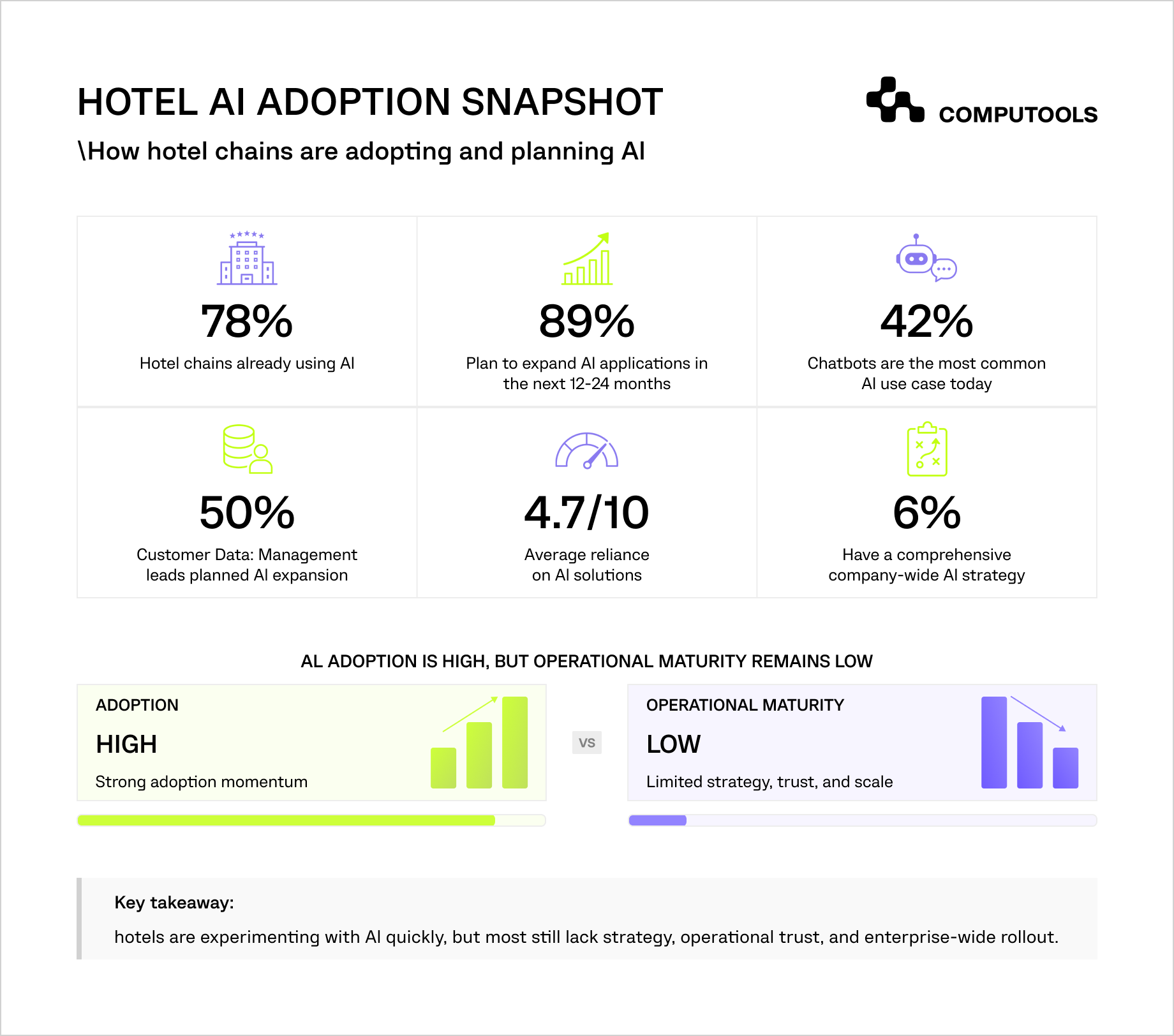
Current conditions in the hospitality sector are moving operators to adopt AI technologies faster. h2c’s 2025 global study reports that 78% of chains currently use AI, and 89% plan to invest more in AI applications in the following 12-24 months. Chatbots are the most common use case, but the same research shows that hotel operators increasingly evaluate AI based on integration with existing systems, reduction of repetitive work, and measurable revenue impact. At this point, a basic AI chatbot for hotels becomes insufficient.
An AI concierge for hotels must go beyond providing hours for the breakfast offering and the Wi-Fi code. To be productive, the AI must recognize the guest and the reservation, interpret the request, call upon real-time or dynamically updated knowledge bases, offer an appropriate course of action based on business policy, route tasks to the correct departments, manage the request, address unanticipated issues and exceptions, and update the guest.
When integrated with the hotel’s PMS, CRM, POS, housekeeping, maintenance, spa, restaurant, payment systems, and the loyalty program, AI concierge software for hotels covers a significant part of the venue’s operation and revenue cycle activities.
Consequently, the need is to create a software solution architecture that combines conversational AI for hotels with structured data, workflow rules, secure system access, and real-time operating context. This article explains how to design that architecture, automate guest requests safely, integrate the concierge with hotel operations, add AI capabilities that support service and revenue, and measure whether the system produces a real business return.
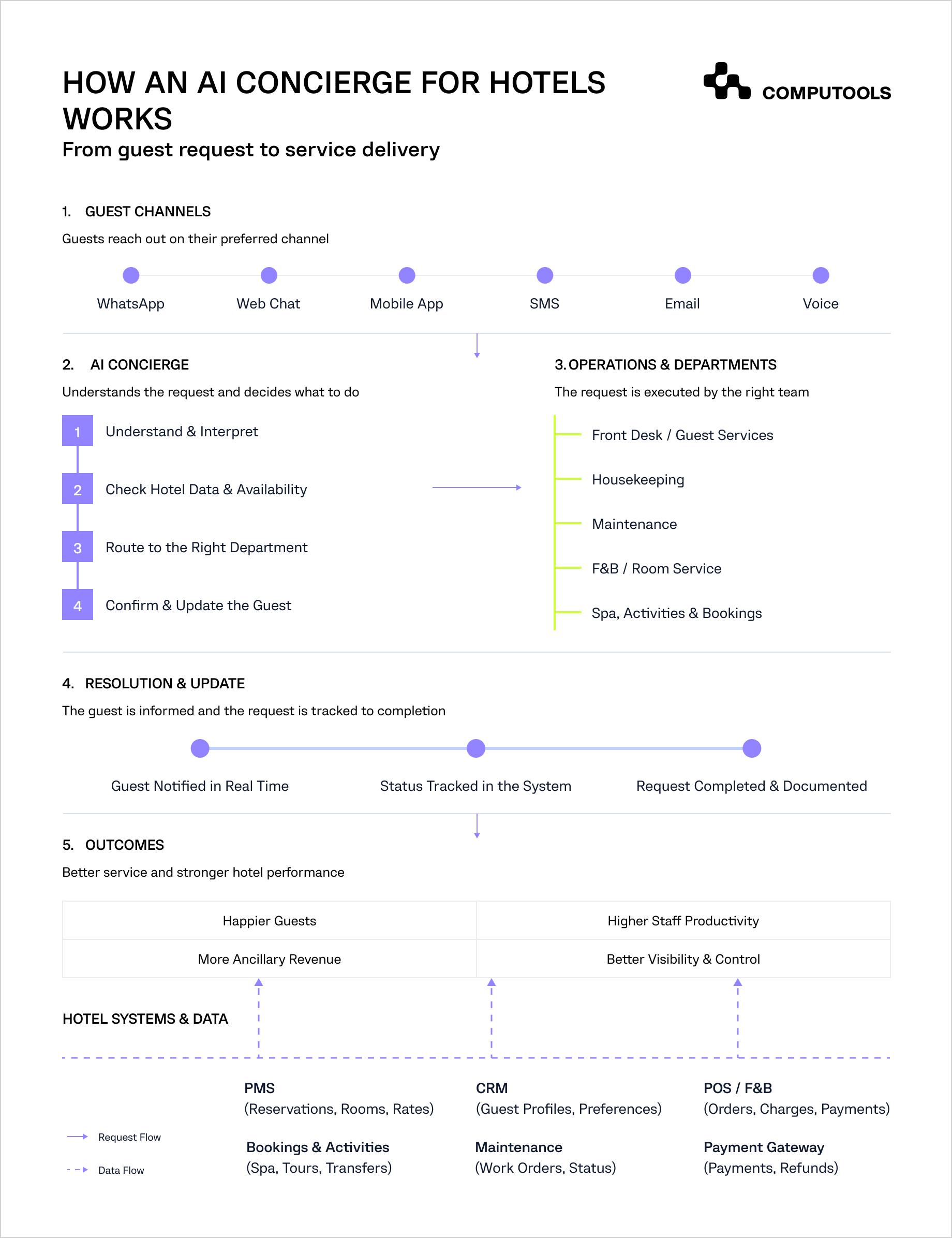
What an AI concierge for hotels should automate and what should stay with staff
Not all guest interactions should be fully automated. The automation system should be able to reliably execute a series of tasks based on rules and should be reserved for requests that are high in volume and repetitive. Requests that are sensitive, exceptional, or financially significant should remain under staff control.
| Guest request | Recommended handling |
| Wi-Fi password or breakfast hours | AI answers automatically. |
| Extra towels or toiletries | AI creates and tracks a housekeeping task. |
| Room-service request | AI connects with the ordering or POS workflow. |
| Late checkout | AI checks policy, availability, price, and guest eligibility. |
| Spa or restaurant booking | AI checks live availability and initiates the reservation. |
| Maintenance issue | AI records and routes the request; staff perform the work. |
| Complaint or negative sentiment | AI detects the issue and escalates with conversation context. |
| Refund or compensation request | Staff approval required. |
| Medical, safety, or security issue | Immediate escalation to trained staff. |
The boundary should depend on risk, operational complexity, data confidence, and financial impact. A low-risk request can often be completed automatically, while an unusual complaint or refund may require judgment that should not be delegated to the model.
This approach keeps AI concierge software for hotels useful without giving it more authority than the business can safely control. It also lets hotel teams expand automation gradually as workflows, data quality, and performance become more predictable.
How OpsCore connected AI guest requests with hotel operations
The value of an AI concierge is evident when guest communication is integrated with the operation of a hotel. For OpsCore Hospitality, Computools has built a hotel operations software that minimizes the manual burden across guest service, housekeeping, maintenance, staffing, and management workflow processes.
Client context
The hotel’s overreliance on phone calls, chat, notes, and passes resulted in guest instructions being unnecessarily routed to the front desk and then to housekeeping, maintenance, and/or other operational services. It caused extra steps and made it difficult for managers to understand how long it would take to fulfill requests.
Business challenge
The problem extended beyond communication. Each guest request introduced a number of operational actions that required the task to be understood, defined, assigned, monitored, and even communicated to a superior in some cases. Such manual workflows affected maintenance requests, room preparation, staffing decisions, and other daily operations.
As request volumes increased, the hotel faced several risks:
- slower guest response times;
- missed or duplicated requests;
- unclear task ownership;
- excessive front-desk workload;
- limited visibility into departmental performance;
- higher labor and operating costs.
Computools solution
Computools developed OpsCore as a connected operational platform. The system combined AI-automated concierge services with workflow management for housekeeping and maintenance services as well as analysis for workforce optimization and management.
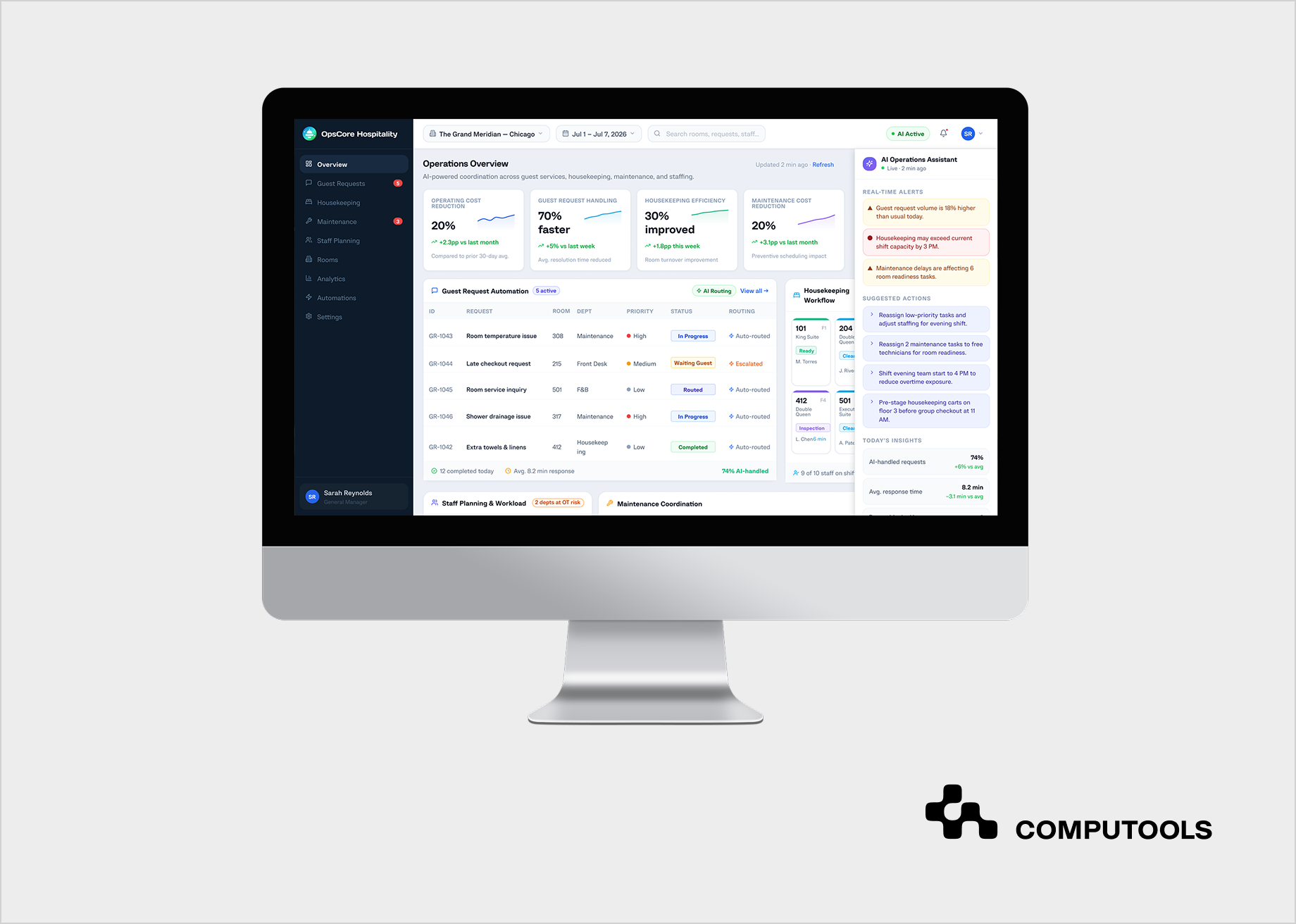
The AI layer was able to interpret messages, identify requests, provide answers, and understand when a problem required forwarding to a staff member. Operational requests were transformed into structured tasks and forwarded to the appropriate department. There, employees were able to manage requests, status, and task completion via task management software designed for their department.
The solution was created using Next.js and React on the staff-facing side. Backend workflow and request routing capabilities were created using Node.js and NestJS. For operational data, which included employee records, guest requests, maintenance tasks, and KPIs, our team used PostgreSQL. Python and FastAPI supported AI and predictive functionality, while the OpenAI API was used for conversational interactions, request classification, and escalation logic. The infrastructure used AWS, Docker, and Terraform to support controlled deployment and scalability.
This architecture meant the concierge did not operate separately from hotel workflows. A guest message could become a tracked operational action with an owner, status, priority, and completion record.
Business result
Within three months, the hotel reported improvements in several areas:
| Operational metric | Result |
| Guest request processing | 70% faster |
| Housekeeping efficiency | +30% |
| OPEX | −20% |
| Labor costs | −20% |
| Maintenance costs | −20% |
These results show where hotel guest service automation creates the most value. Faster answers matter, but the larger operational effect comes from reducing manual transfers, connecting departments, and giving management a clearer view of how work moves through the property.
The same principle should guide hotel AI concierge development. Before selecting models or designing chat interfaces, businesses need to define which guest requests the system can handle, what actions it is allowed to execute, and how every request should move through the hotel’s operational systems.
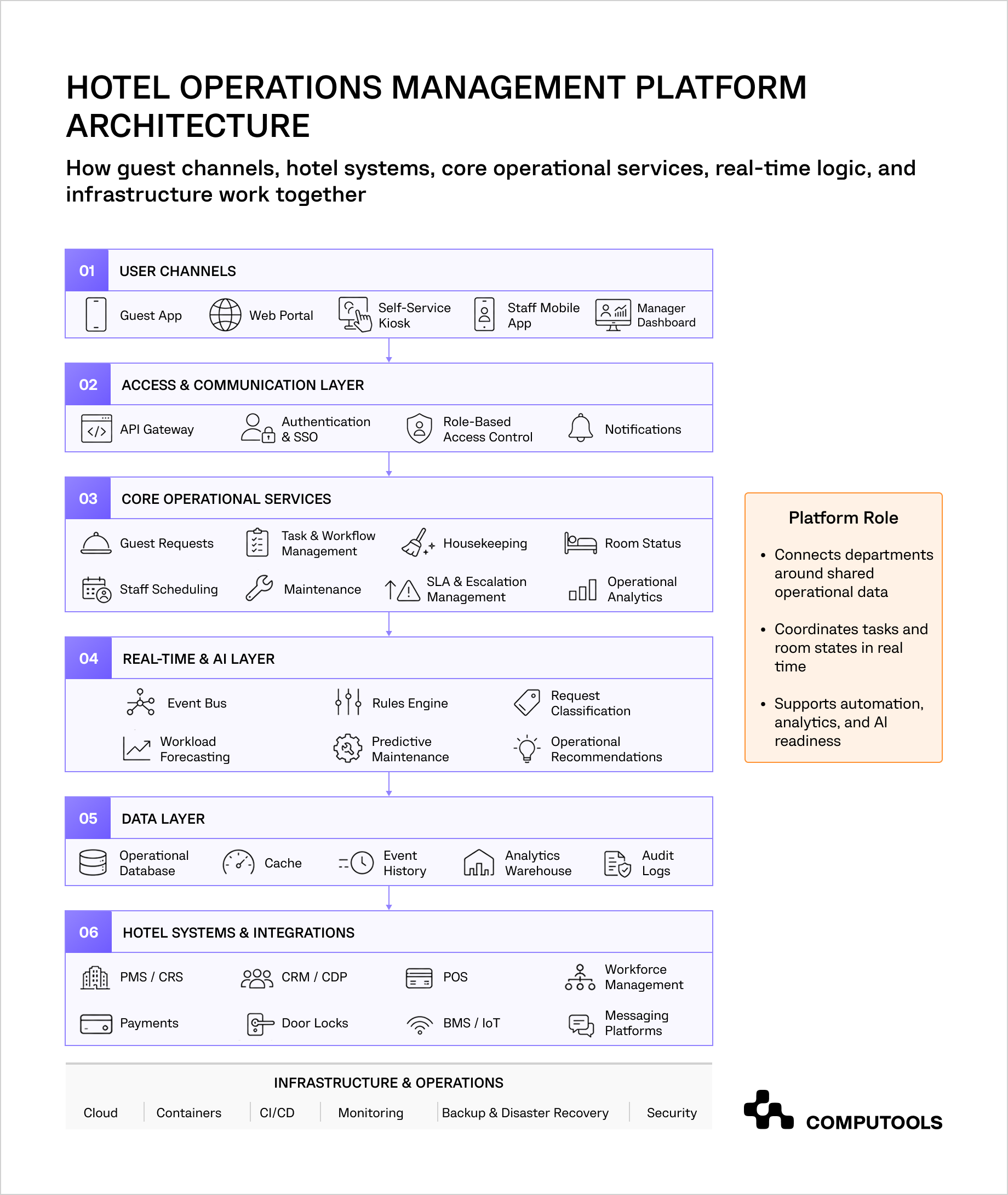
How to develop an AI concierge for hotels
Building an effective AI concierge starts with defining operational rules. Before selecting an LLM, decide what the system can answer, which actions it can execute, what data it needs, and when staff approval is required.
Step 1. Define what the AI can answer, request, and execute
Start by grouping guest requests by the level of automation they require.
| Request type | Examples | System behavior |
| Information | Wi-Fi, breakfast hours, parking | Retrieve verified information and respond. |
| Operational | Towels, housekeeping, maintenance | Create and route a task, then track completion. |
| Commercial | Late checkout, upgrade, spa booking | Check availability, pricing, and eligibility before execution. |
| Sensitive | Refund, complaint, emergency | Escalate to authorized staff. |
This distinction is central to reliable guest request management. Answering a question may require only a knowledge lookup, while changing a reservation can involve PMS data, hotel policies, availability, pricing, and housekeeping capacity.
The backend should define permitted actions for each intent, such as:
answer → provide information.
create_task → open a service request.
reserve → start a booking workflow.
charge → initiate an approved payment action.
escalate → transfer the case to staff.
For example: guest reports broken air conditioning → AI identifies maintenance intent → checks for duplicate requests → creates a task → assigns priority → routes it to maintenance → updates the guest → escalates if the SLA is missed.
Without set boundaries, hotel guest request automation may lead to incorrect promises, unauthorized actions, and complicate the work of employees.
The first deliverable should therefore be an intent-and-action matrix that outlines the necessary data, authorized actions, department, level of authentication, SLAs and escalation rules for each major guest request.
Step 2. Build a structured hotel data layer
An AI concierge is only as reliable as the data behind it. Before expanding automation, connect the systems that contain the information needed to answer questions and execute requests.
The core data usually includes:
- guest and reservation data from the PMS;
- loyalty and preference data from CRM;
- restaurant and room-service information from POS;
- room status and housekeeping workload;
- maintenance requests;
- spa and amenity availability;
- hotel policies, opening hours, and service descriptions;
- pricing and availability for paid services.
A shared data model captures entities such as guest, reservation, room, request, service, department, and transaction. This prevents the concierge from receiving different versions of the truth from different systems.
For example, the system would need to check the guest profile, along with the departure date, next arrival, the room, the hotel policy and price, and what housekeeping is able to do in order to make a late checkout offer.
Without structured and engineered data, hospitality AI-powered hospitality software would not be able to make intelligent suggestions, which would result in a poor guest experience at the venue. This becomes especially important for hotel groups operating across several properties.
Our article on building a hotel RMS system for multi-property hotel chains looks more closely at centralizing property, demand, pricing, and revenue data across locations.
Step 3. Separate conversational AI from business execution
The LLM should interpret what the guest wants, but it should not control hotel systems directly. A safer architecture separates conversation from operational execution.
A typical flow looks like this: guest channel → conversation layer → intent detection → hotel context → policy engine → workflow or API action → hotel system.
Consider a guest asking: “Can I keep my room until 3 p.m.?”
The AI identifies a late-checkout request, but the backend should handle the actual decision:
1. identify the reservation;
2. check availability and hotel policy;
3. verify housekeeping and occupancy constraints;
4. calculate any fee;
5. request guest confirmation;
6. update the reservation after approval;
7. notify affected teams.
This structure gives hotel AI concierge development clear control points. Business rules stay in backend services, while the model focuses on language, intent, and context.
It also reduces the risk of hallucinated prices, unauthorized reservation changes, or actions based on outdated information.
Step 4. Connect guest requests with operational workflows
A guest request is not complete when the AI sends a response. The system must make sure the requested service is actually delivered.
Each operational request should become a structured task containing fields such as:
- guest and room;
- request category;
- responsible department;
- priority;
- owner;
- SLA;
- current status;
- escalation level.
A typical workflow could be: received → classified → assigned → accepted → in progress → completed.
If the guest reports an air-conditioning problem, for example, the concierge can classify the issue, check whether a duplicate request exists, create a maintenance task, notify the guest, and escalate it if the response deadline is missed.
In the OpsCore Hospitality project, our team applied this type of shared routing logic across guest requests, housekeeping, and maintenance workflows. Connecting communication with execution contributed to a reported 70% reduction in guest request processing time.
This connection is what turns hotel request management from messaging automation into an operational system that managers can monitor and improve.
Similar coordination problems appear in food-service operations, where an order may depend on staffing, inventory, preparation, and delivery timing.
Computools catering operations workflow guide explains how these dependencies can be managed as one connected process.
Step 5. Support multiple guest channels through one conversation layer
Guests may contact the hotel through WhatsApp, SMS, web chat, a mobile app, OTA messaging, or voice. These channels should connect to one backend rather than operate as separate service systems.
The concierge should maintain a shared guest identity and conversation context across channels. For sensitive actions, such as changing a reservation or charging a service to the room, the system should require additional verification.
A practical architecture is: guest channel → identity matching → conversation service → reservation context → AI orchestration → hotel systems.
This design allows for intelligent automated guest communication without requiring guests to use a single channel. It also provides staff with one record of the communication and interactions taken.
For a hotel AI assistant, adaptability across different channels is important since the same request may be initiated in a web chat prior to arrival, but may be continued through WhatsApp during the stay.
If you are also deciding how much of the digital guest journey should remain under hotel control, read our article on direct booking vs. OTAs for a closer look at guest data ownership, distribution costs, and direct revenue.
Step 6. Add AI features that improve service and revenue
Once the core request workflows are stable, hotels can add more advanced hospitality AI solutions.
| Capability | Practical use | Business effect |
| Request classification | Detect intent, urgency, and department | Reduces manual routing |
| Multilingual support | Process requests in multiple languages | Expands automated service coverage |
| Personalized recommendations | Match offers with guest preferences and stay context | Supports ancillary revenue |
| Sentiment detection | Identify frustration or complaints | Triggers earlier staff intervention |
| Demand forecasting | Predict request volume from occupancy and historical patterns | Improves staffing decisions |
| AI-assisted responses | Draft replies for complex cases | Reduces staff handling time |
Personalization should use live operational data. For example, the concierge should not promote late checkout only because a guest bought it before. It should check the availability of rooms, the room turnover, and how hard housekeeping is working.
This applies to spa appointments, restaurant bookings, transfers, and room upgrades. AI guest service automation provides the most value if recommendations are based on what the hotel can fulfill. AI can only personalize offers and automate decisions if the reservation, guest, and operational data is clean and structured.
Pricing introduces another layer of real-time logic. Our guide to building dynamic pricing software for hotels explains how occupancy, booking pace, demand, and market data feed automated rate decisions.
Step 7. Control security, permissions, and AI actions
The concierge should have different permissions for answering questions and executing business actions.
A guest can ask almost anything, but the AI should only perform actions explicitly permitted by backend rules.
Important controls include:
- guest authentication for sensitive requests;
- role-based API permissions;
- encryption of guest data;
- PII masking and data minimization;
- audit logs for AI-triggered actions;
- rate limits and abuse detection;
- structured model outputs;
- confidence thresholds;
- staff approval for refunds, compensation, and other high-risk actions.
The LLM (AI language model) should never have full access to the PMS, payment system, or guest data.
As an example, an AI response may recommend a refund, but the approval of this request needs to be made by a hotel staff member before any financial transaction is done.
These measures protect guest data, reduce incorrect transactions, and provide reliable hotel guest service automation for day-to-day venue operations.
Step 8. Test the full request lifecycle and optimize after launch
Testing should cover more than whether the AI generates a good response. Hotels need to verify that requests are classified correctly, actions reach the right systems, tasks are completed, and failures are recovered without losing guest requests.
Key test areas include:
- intent and entity recognition;
- API and integration failures;
- duplicate request prevention;
- task routing and escalation;
- multilingual conversations;
- unauthorized action attempts;
- peak-load performance;
- fallback to staff when AI confidence is low.
Load testing is especially important during periods such as check-in, breakfast service, conferences, or sold-out weekends when many guests may send requests at once.
Post launch, monitor operational and commercial KPIs, including automation rate, first response time, request completion time, SLA breaches, staff handling time, escalation rate, cost per resolved request, ancillary conversion, and guest satisfaction.
Do not base your evaluation of the system solely on the automation rate. A concierge who automates message responses but routes requests to an incorrect service is still a burden. After the launch, the goal should be to evaluate how the hotel guest experience automation reduces wait times and increases fulfillment, as well as how it improves operational and financial metrics of the venue.

Launch your AI hotel concierge in 1–3 months, not years, and give guests 24/7 support for requests, services, and recommendations while reducing front-desk workload and speeding up response times.
Why hotels choose Computools for AI guest service automation
An AI concierge should solve specific hotel problems: reduce front-desk workload, shorten request processing, prevent missed service tasks, support upselling, and improve visibility across guest operations. Computools achieves this by connecting guest communication with service workflows, hotel data, revenue logic, and the systems employees already use.
Through travel and hospitality software development services, we connect AI with PMS, CRM, POS, housekeeping, maintenance, booking, payment, and revenue systems. For properties with complex food and service operations, our software development services for HoReCa support ordering, reservations, staff coordination, and service-capacity workflows.
Heritage tourism software development extends the concierge with destination guidance, attraction discovery, and personalized recommendations.
The company’s technical scope combines AI development services with web development services and mobile app development services to build guest channels, staff interfaces, backend services, AI orchestration, and secure integrations.
Our experience extends beyond AI services to the hotel workflows, data flows, and commercial processes that determine whether automation delivers business value.
OpsCore Hospitality turned guest messages into coordinated housekeeping, maintenance, and workforce workflows.
Profitento connected hotel data with forecasting, segmentation, direct bookings, and upselling, showing how better data supports both service and revenue decisions.
In Tap App, ordering, payments, and operational monitoring worked as one process, a relevant model for concierge scenarios where a guest request needs to trigger an actual service rather than end with a chat response.
The result is a hotel AI assistant that turns guest conversations into coordinated hotel actions, moving requests faster, reducing staff intervention, matching offers with real service capacity, and supporting growth across properties and channels.
Final thoughts
An AI concierge for hotels will have more business value when it performs more functions than just message reduction. For example, a guest asking for late checkout should trigger an availability and policy check. A maintenance complaint should become a tracked task with an SLA and escalation path. A spa or dining request should connect with live capacity before the system promotes or confirms the service.
Hotels see numerous benefits from automation. Staff spend less time manually sorting and closing requests, and managers get valuable data on request trends, where and when service demand spikes, and which guest interactions lead to more profits.
The standard for measuring this automation should be completion time, staff time, escalation, SLA misses, and ancillary conversion. These elements measure how valuable automation really is for a hotel.
Automating the fulfillment of guest requests should be management’s biggest concern when implementing this type of system. High-volume requests can also serve as a good starting point, and automation can be built on from there.
Computools
Software Solutions
Computools is an IT consulting and software development company that delivers innovative solutions to help businesses unlock tomorrow.