
THE AUTHOR:

Hotels that plan to develop a hotel demand forecasting system in 2026 and beyond are working with a very different technical baseline than a few years ago. BCG reports that AI-based hotel revenue systems increasingly combine booking pace, competitor rates, flight capacity, search trends, events, sentiment, and weather, then use these signals to support pricing, inventory, and distribution decisions.
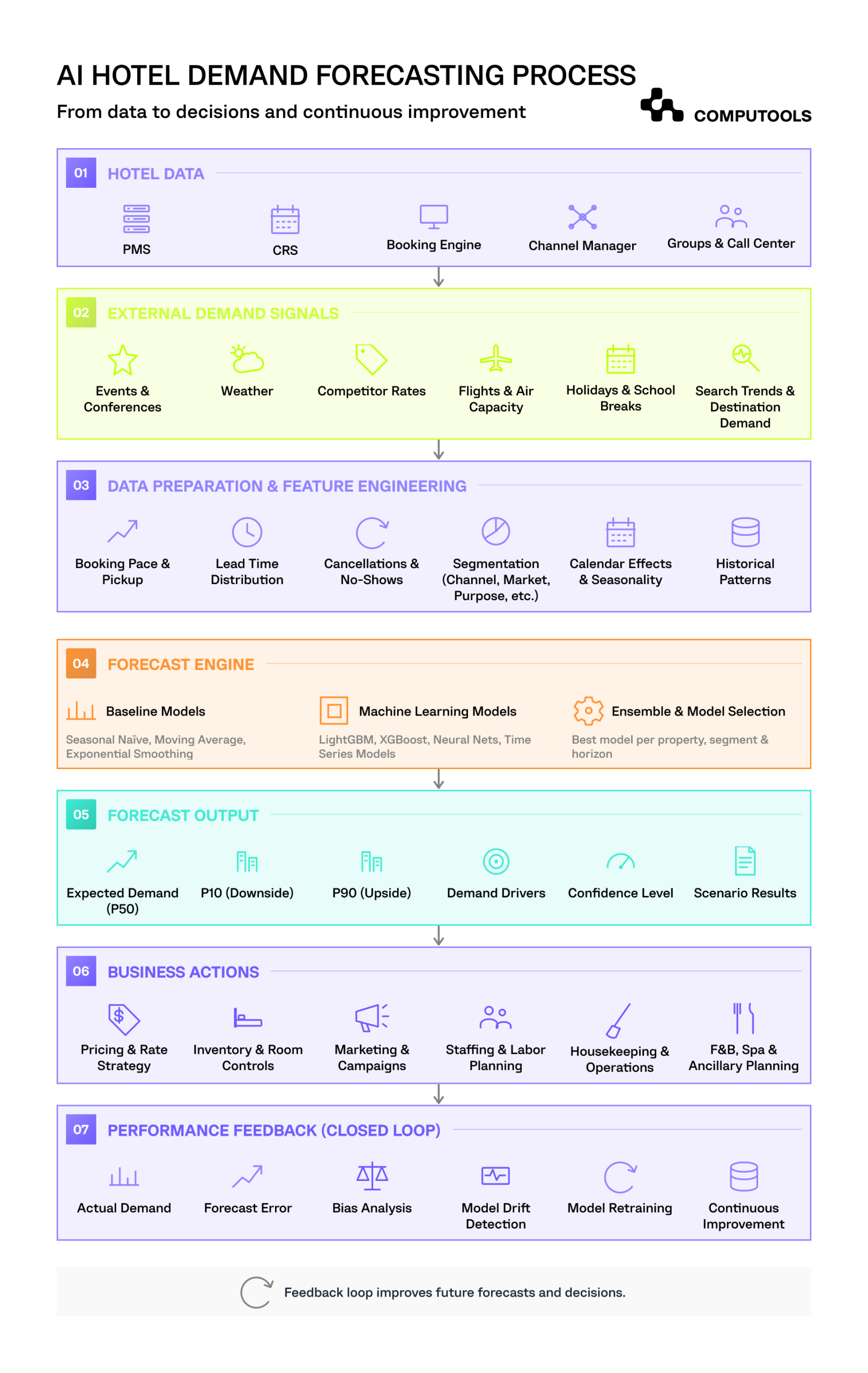
Amadeus’ Travel Dreams 2026 research shows how closely forecasting is becoming tied to commercial operations: 40% of surveyed hoteliers use AI for competitor and market intelligence, 39% for dynamic pricing and revenue management, and 38% for occupancy forecasting and labor scheduling. Hotel demand forecasting software therefore needs to do more than predict occupancy. Its output should influence rates, channel allocation, campaigns, staffing, and other revenue decisions.
Forecasting technology is also moving toward multi-model approaches. 2026 research comparing statistical, machine-learning, neural-network, and hybrid methods found that ensemble and hybrid models can outperform single-model forecasting in hotel demand scenarios. This pushes AI hotel demand forecasting toward model comparison, horizon-specific logic, external data, uncertainty ranges, and continuous performance monitoring.
Essential functions of an AI hotel demand forecasting platform
| Capability | What it does |
| Multi-source demand ingestion | Combines PMS, CRS, booking engine, channel manager, RMS, CRM, group sales, competitor rates, events, weather, flight capacity, and destination signals. |
| Point-in-time reservation history | Preserves booking creation, modification, cancellation, reinstatement, and stay events instead of storing only the latest reservation state. |
| Booking-pace and pickup analysis | Tracks how demand develops by stay date, lead time, room type, channel, and segment. |
| Multi-model forecasting engine | Compares statistical, gradient-boosting, neural, and hybrid models by property and forecast horizon. |
| Probabilistic forecasting | Produces expected demand together with ranges such as P10, P50, and P90. |
| Event and external-signal intelligence | Measures how concerts, conferences, holidays, weather, air capacity, and local market activity may affect demand. |
| Scenario forecasting | Model situations such as competitor price changes, flight reductions, event cancellations, or sudden demand spikes. |
| Segment and room-type forecasting | Predicts demand by room category, market segment, source channel, group business, or other relevant dimensions. |
| Dynamic pricing intelligence | Connects predicted demand with booking pace, remaining inventory, competitor rates, and pricing rules. |
| Need-date detection | Identifies dates likely to underperform plan or budget. |
| Cancellation and no-show prediction | Estimates expected booking loss before the stay date. |
| AI-assisted forecast explanation | Explains why demand changed using approved hotel and market data. |
| Automated anomaly detection | Flags unusual pickup, data-feed failures, booking spikes, or abnormal channel behavior. |
| Decision alerts and workflow automation | Triggers alerts, forecast recalculation, approval requests, or campaign actions when thresholds are crossed. |
| Forecast accuracy and bias monitoring | Compares forecasts with actual results by property, horizon, room type, and segment. |
| Model drift and MLOps controls | Tracks data drift, model versions, retraining, shadow testing, and rollback. |
The main constraint remains data quality. BCG notes that fragmented PMS, CRM, POS, and other hotel systems still make it difficult to create a complete business view. For this reason, modern hospitality demand forecasting should be designed as part of the wider revenue and operations architecture.
This article explains how to structure the data foundation, forecasting architecture, AI models, decision workflows, integrations, security, and MLOps required to turn demand predictions into practical hotel decisions.
For a closer look at how hotels structure rate decisions around changing demand, see the breakdown of dynamic pricing for hotels. It covers the commercial logic behind pricing strategies and the technology that supports them.
Profitento: hotel demand forecasting software case
A useful example is Profitento, an AI-assisted hotel revenue optimization platform developed by Computools for a US coastal resort with 420 rooms, suites, spa services, restaurants, wedding business, conferences, family travel, and highly seasonal demand.
Client context
The resort’s peak occupancy was solid, but profitability varied by room type, package, booking channel and ancillary service. Changes in demand occurred with the school holiday, long weekends, local events such as weddings and weather. The data and systems to help staff work around revenue challenges were fragmented in the PMS, OTAs, competitor-rate dashboards, booking engines, CRMs, spa and restaurant software, and, unfortunately, in various spreadsheets.
Business challenge
Revenue managers often recognized demand changes after commercially important inventory had already been sold at outdated prices. Revenue managers were able to identify demand shifts, but often it was after bookable inventory had been sold at outdated prices. Pricing decisions also became more time-intensive due to a high OTA exposure that negatively affected net revenue. Neither a separate booking interface nor a hotel revenue forecasting software would have addressed the problem, because the forecast had to integrate with pricing, channel management, guest data, packages and system workflow.
Computools solution
Computools created Profitento as a connected revenue decision environment. Python supported forecasting, pricing scenarios, cancellation and no-show prediction, segmentation, package-demand analysis, and recommendation logic. FastAPI exposed forecast requests, pricing recommendations, guest-data workflows, and integrations.
PostgreSQL stored booking history, room categories, pricing rules, guest profiles, channel performance and related revenue data, while Redis provided booking and pricing data retrieval at a faster rate across the dashboards and forecasting workflows.
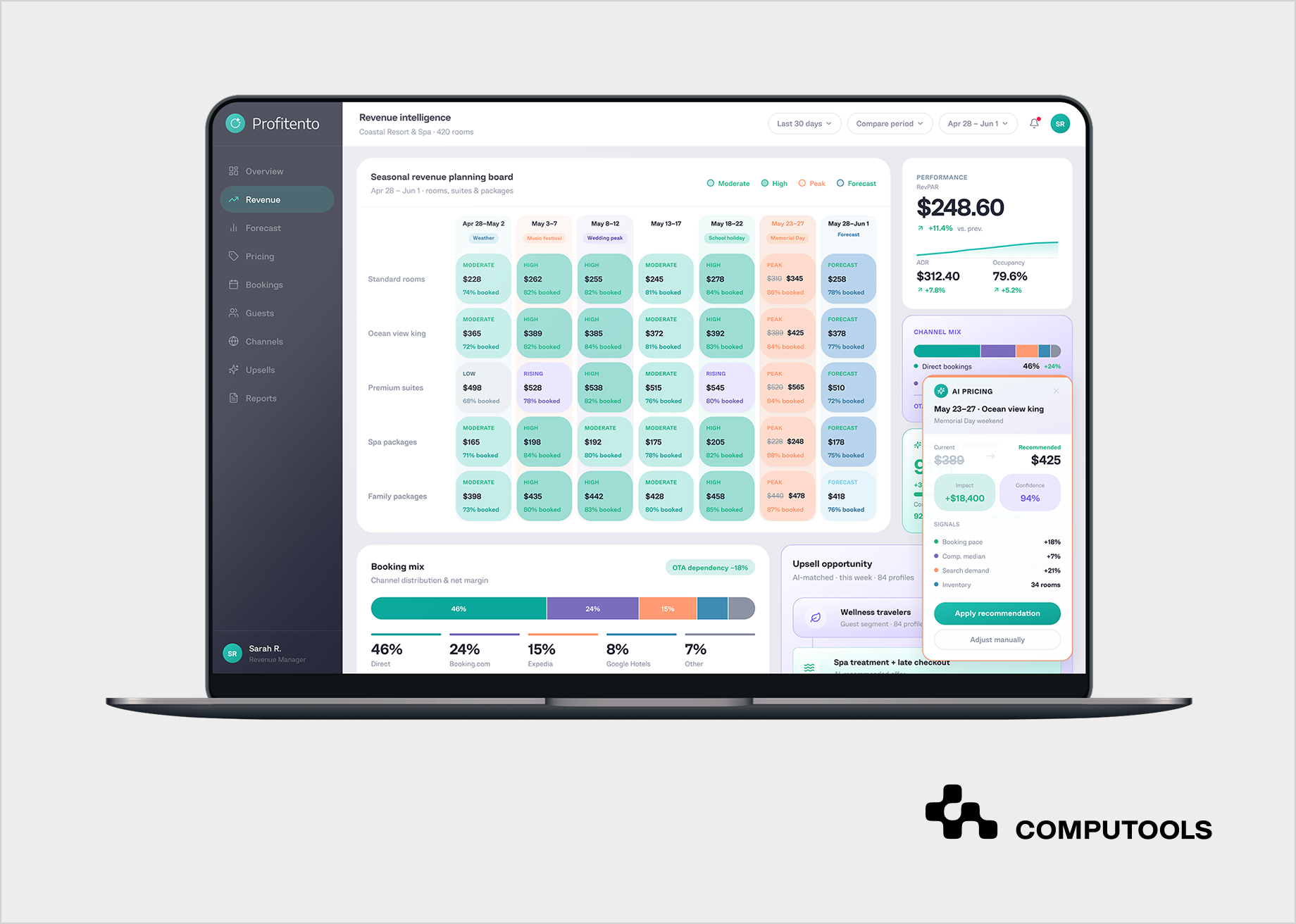
The platform integrated Opera PMS, SiteMinder, the hotel’s direct booking channel, OTA, CRM, and POS systems, spa and other services. Revenue managers were able to analyze the bookings, pickup, ADR, RevPAR, competitive activity, cancellation risk, OTA reservations, and demand for packages within a single Revenue Command Center.
Pricing recommendations used booking pace, competitor prices, available inventory, cancellation risk, seasonality, room category, package demand, and OTA exposure, while managers retained approval authority.
Business result
Within six months:
- forecast accuracy improved by 32%;
- RevPAR increased 11.4%;
- ADR rose 7.8%;
- occupancy increased 5.2%;
- direct bookings grew 24%;
- OTA dependency declined 18%;
- guest lifetime value improved 17%;
- upsell revenue increased 14%.
The case shows an important development principle: forecast accuracy produces commercial value when the prediction reaches the workflows where teams actually control prices, inventory, channels, labor, and campaigns.
If the technical side of automated pricing is relevant to your roadmap, Computools guide on how to build dynamic pricing software for hotels explains the architecture, data flows, pricing rules, and automation behind these systems.
A guide to developing hotel demand forecasting software
A practical development process starts with business decisions and data quality, then moves into model design.
Step 1. Define the decisions the forecast needs to support
Before selecting models, define what the hotel demand forecasting system needs to predict and what teams will do with the result.
Most of the time, property-level occupancy isn’t enough. Forecasts for stay dates, room categories, market segments, source channels, rate plans, lengths of stays, group or transient business are helpful for revenue managers. Operations personnel are more interested in arrivals, departures, occupied rooms, room turns, and projected service demand.
Forecasting horizons should be related to different types of decisions.
One approach might be to use:
- 0–14 days: pricing, room controls, staffing, housekeeping, and campaigns.
- 15–90 days: revenue strategy, channel allocation, promotions, group displacement, and inventory planning.
- 90–365 days: budgeting, seasonal staffing, commercial planning, and portfolio forecasting.
An important distinction is the difference between booked occupancy and unconstrained demand. When a room has been sold, reservation history ceases to capture how many additional guests wanted the room. For hotel occupancy prediction, models must include the concept of censored demand. Otherwise, the strongest occupancy dates may be perceived to be weaker.
Define model KPIs at the same stage. Track WAPE or MAE, forecast bias, prediction-interval coverage, and error by forecast horizon. Avoid assessing the entire portfolio with one accuracy percentage because a model may look accurate overall while performing poorly for a particular property, room category, or demand segment.
Step 2. Build a point-in-time demand data layer
AI performance depends on what the model knew at the moment a forecast would actually have been generated.
The data layer should connect the PMS, CRS, booking engine, channel manager, RMS, CRM, group sales, and selected ancillary systems. External signals may include competitor prices, holidays, local events, destination demand, weather, flight capacity, search activity, and market benchmarks.
Do not store only the latest state of each reservation. Preserve booking events or historical snapshots: created → modified → rate changed → room changed → cancelled → reinstated → stayed/no-show.
This point-in-time structure prevents data leakage during training. If a historical training record contains a cancellation that was not known on the original forecast date, the model receives information from the future and backtesting becomes misleading.
Create common identifiers for property, stay date, booking date, room category, rate plan, market segment, source market, channel, package, and group. Automated validation should flag duplicated bookings, missing dates, invalid inventory, stale API feeds, changed segment mappings, and property timezone errors.
BCG identifies fragmented PMS, POS, CRM, F&B, spa, and loyalty data as a major barrier to hotel AI and reports that many hoteliers still spend significant time combining information from disconnected systems. Clean, structured data is therefore a development requirement.
Profitento followed the same principle. Computools team mapped and cleaned data across PMS, channel management, booking, CRM, POS, OTA, spa, and revenue sources before applying forecasting and pricing logic.
Step 3. Design architecture for scheduled and event-driven forecasting
The software architecture should distinguish between calculations that can run on schedules and demand changes that require a faster response.
Historical feature reconstruction, long-horizon forecasting, portfolio reporting, and model retraining fit batch pipelines. Booking creation, cancellations, large group-block changes, inventory updates, unusual pickup, or major event changes may trigger forecast recalculation through queues or event streams.
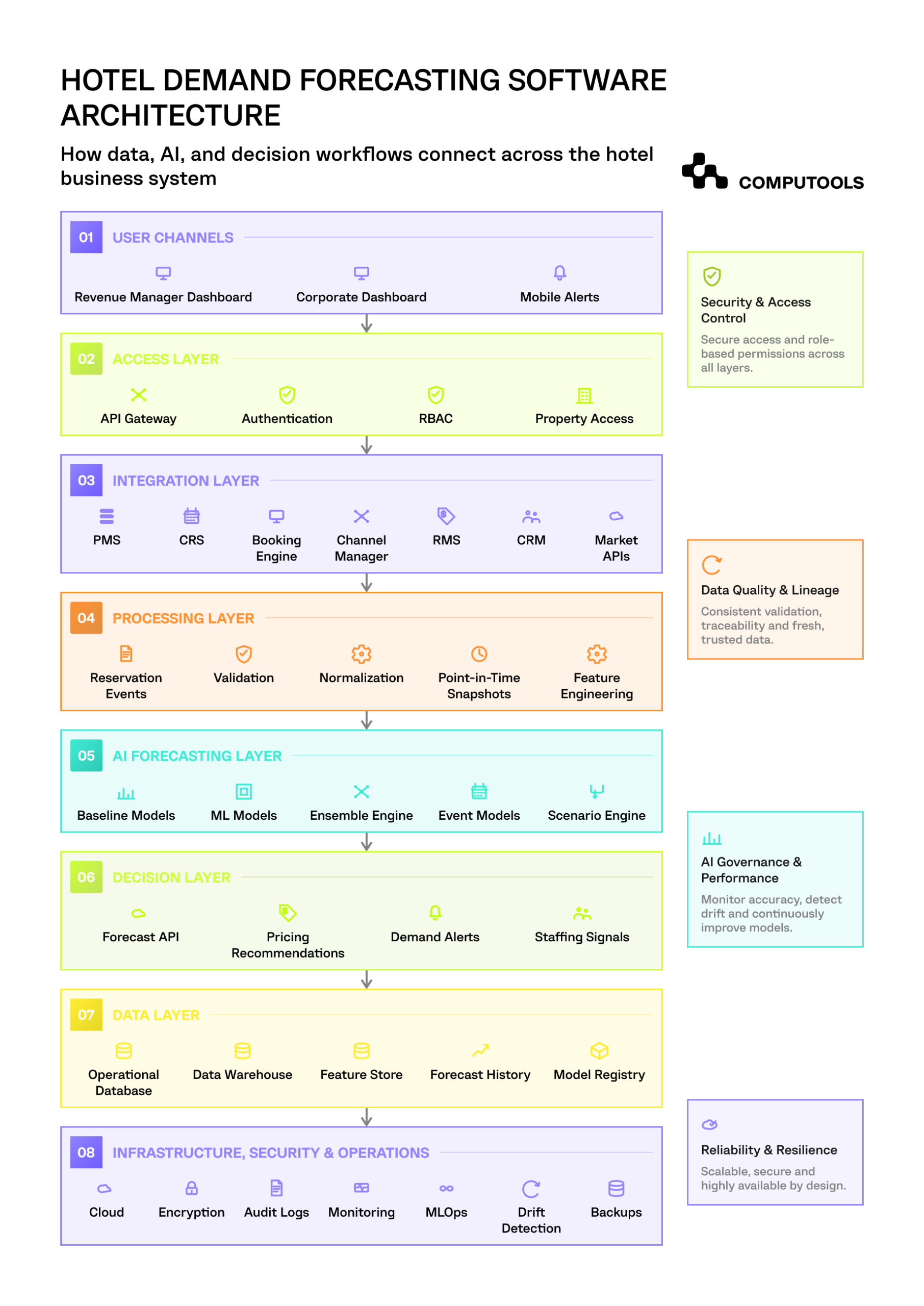
A practical architecture for hotel occupancy forecasting software can follow this flow: hotel and market APIs → ingestion → raw storage → validation and normalization → feature layer → forecasting service → forecast store → decision APIs → revenue and operations applications.
The model service should not be buried inside one dashboard. Expose forecasts through controlled APIs so the same output can feed pricing, staffing, marketing, and management reporting.
A forecast record may include:
property_id
forecast_date
stay_date
room_type
segment
predicted_demand
lower_bound
upper_bound
model_version
Multi-property deployments also require tenant isolation, property-specific calendars, currencies, room structures, local market definitions, and correct timezone handling.
In Profitento, our engineers used FastAPI between its React interface, forecasting logic, and third-party hospitality systems. Redis supported quick retrieval where revenue teams needed current data without repeatedly recalculating the same information.
Step 4. Test a model portfolio instead of committing to one algorithm
Effective machine learning for hotel demand forecasting starts with comparison.
Establish simple baselines first, such as seasonal naive forecasting, moving averages, exponential smoothing, or classical time-series methods. Then compare them with gradient-boosting models such as LightGBM, XGBoost, or CatBoost and, where data volume supports them, neural or temporal models.
Different approaches often perform better at different horizons. A gradient-boosting model may work well for near-term demand where booking pace and external features carry strong information, while another model may handle longer seasonal patterns better. The system can select models by property and horizon or combine them in an ensemble.
Recent hospitality research comparing statistical, ensemble, neural-network, and hybrid approaches found that a hybrid LightGBM-neural-network configuration produced the strongest results among the models evaluated. The result supports testing model combinations rather than assuming one architecture will dominate every property and forecast horizon.
For hotel demand prediction using AI, produce uncertainty ranges instead of one number. A P10/P50/P90 forecast tells the revenue manager whether an expected 82% occupancy level is relatively certain or sits inside a much wider demand range.
Generative AI should have a different role. LLMs are useful for explaining forecast changes, querying approved revenue data, and producing scenario summaries. They should not replace numerical forecasting models merely because conversational AI is easier for users to interact with.
Step 5. Add event, competitor, and destination signals
Historical booking patterns are weakest when the next demand event has no close historical match.
Modern hotel demand prediction software detects demand through internal datasets along with external signals (e.g. concerts, conferences, sporting events, school holidays, weather, flight schedules, search demand, competing rates, destination traffic, and changes to the supply of local hotels).
SiteMinder’s survey supports the importance of events. 63% of respondents noted they would be more likely to travel for special events. BCG also expects pricing models to account continuously for events, search trends, air capacity, competitors, booking pace, and weather.
Events are important, but the absence of events is even more important. Features that capture demand should include expected attendance, distance from the hotel, historical pick-up around similar events, lead time, weekday, segment mix, and overall supply of competing rooms.
Add scenario modeling for questions such as:
- What happens if a conference adds 3,000 attendees?
- How does expected demand change if a major flight route loses capacity?
- What is the likely impact if competitors reduce ADR by 8%?
For new hotels with little historical data, use comparable-property clusters, destination signals, portfolio-level patterns, and progressive local retraining rather than waiting several years to accumulate property history.

Launch AI-powered hotel demand forecasting software within 1–3 months, improve pricing and inventory decisions with more accurate demand predictions, and increase RevPAR by capturing high-value demand without overpricing low-demand periods.
Step 6. Convert forecasts into revenue and operating actions
AI in hotel revenue management connects forecasting output with pricing rules, inventory controls, channel strategy, and revenue-manager approvals, turning predicted demand into controlled commercial actions.
| Modern capability | Practical business use |
| AI-powered recommendations | Suggest rate, inventory, or campaign actions when demand moves outside expected ranges. |
| Dynamic pricing intelligence | Compare forecast demand, pickup, remaining inventory, and competitor rates before recommending price changes. |
| Customer segmentation | Separate corporate, leisure, group, loyalty, direct, OTA, or other demand patterns instead of treating all bookings alike. |
| Predictive analytics for hotels | Flag cancellation risk, unusual pickup, demand compression, and dates likely to miss plan. |
| Smart search | Let managers query approved forecast data using questions such as “Which September weekends have the highest downside risk?” |
| Automation | Trigger recalculation, alerts, campaign lists, or staffing updates when predefined thresholds are reached. |
| Fraud and anomaly detection | Identify suspicious booking spikes, abnormal channel activity, corrupted source data, or unusual reservation patterns before they distort the forecast. |
| AI-assisted support | Explain demand drivers and model output without requiring analysts to manually prepare every revenue summary. |
| Personalized notifications | Send managers only the alerts relevant to their property, responsibility, or approval threshold. |
A separate hotel revenue prediction layer may translate room demand into expected ADR, RevPAR, ancillary demand, and net channel revenue. The forecast can then influence inventory allocation, marketing spend, housekeeping capacity, front-office staffing, F&B purchasing, and spa or activity schedules.
Profitento applied a similar model. Forecasting was connected to rate recommendations, OTA exposure, packages, direct booking campaigns, and guest offers rather than kept in a separate analytics screen.
Step 7. Design explainability, approvals, and revenue-manager workflows
Even accurate AI-powered hotel forecasting software loses value if revenue teams do not understand or trust its output.
The main workspace should compare on-the-books rooms, forecast demand, previous forecasts, actual results, pickup, forecast bias, event impact, and prediction ranges. Revenue managers should be able to see what changed since the previous forecast.
Instead of displaying “Demand increased 12%,” show a practical explanation: 7-day pickup is 18% above the normal range; a 4,500-attendee event has been added; competitor inventory has tightened; cancellation probability has declined.
For high-impact actions, use configurable approval rules. A property may permit automatic low-risk adjustments inside a narrow range while requiring manager approval for larger rate moves, restrictions, or channel changes.
Track overrides as structured data. Store who changed the recommendation, when it was changed, the reason, the original model output, and the final result. Over time, this provides evidence about where managers consistently outperform the model and where manual intervention reduces revenue.
Role-based workflows also matter for hotel groups. Property revenue managers, regional teams, corporate revenue leaders, marketing, and operations should see different views and have different approval rights.
Step 8. Protect forecast reliability with security, testing, and MLOps
Hotel demand forecasting and revenue management touch commercially sensitive data. Access controls therefore protect revenue strategy as well as guest information.
Use features like single sign-on, role-based permissions, least privilege access, encryption in transit and at rest, API authentication, secret management, audit logs, tenant isolation, and data retention controls. Minimise guest PII exposed in training where possible, especially in features where user identity is not necessary. This minimises exposure due to privacy and simplifies the burden of governance.
Reliability has a dependency on fail-over logic. If a market feed fails or the ML service becomes unavailable, the revenue team should receive the most recent approved forecast or a validated baseline. They should not see an empty dashboard.
The focus should be on the data contract tests. These should be coupled with validation of API integration, model backtesting, and property isolation. Other QA tests should include the recovery of all failure conditions, daylight and time-zone-related issues, missing providers, and load-related conditions. Calculation of forecasts must be reproducible, so the organization should be able to specify which dataset, feature definitions and model version led to each prediction.
Post-launch MLOps should monitor accuracy by property, segment, room category, and horizon. Track data drift, feature drift, model error, forecast bias, API latency, missing source feeds, and fallback usage.
Use a controlled path for model releases: candidate model → historical backtest → shadow run → comparison with production → staged release → monitoring.
Retraining should follow evidence. A hotel with stable demand may not need constant retraining, while a property affected by a renovation, new competitor, distribution change, market shock, or major event calendar shift may require rapid recalibration.
If the technical side of automated pricing is relevant to your roadmap, the article on how to build dynamic pricing software for hotels explains the architecture, data flows, pricing rules, and automation behind these systems.
Why choose Computools for hotel demand forecasting software development
Demand forecasting requires data science as well as a clear understanding of how the property earns revenue, how booking and operating systems exchange data, who approves decisions, and where forecast output needs to trigger action. Computools helps hotels to:
1. Connect forecasts with revenue and operations
Through travel and hospitality software development services, we link PMS, reservation, channel, CRM, revenue, guest, and operational workflows.
This gives hotel teams a clearer path from forecast to action. Demand signals can influence pricing, inventory, campaigns, staffing, and guest operations without relying on manual transfers between systems.
2. Extend demand planning beyond room revenue
Software development services for HoReCa bring the same demand logic into restaurants, catering, booking, and venue operations.
Venues can plan labor, purchasing, table capacity, events, and ancillary services against the same demand picture rather than forecasting each area in isolation.
Heritage tourism software development adds another layer for businesses influenced by attractions, visitor flows, events, and seasonal destination activity.
This makes it easier to anticipate demand across accommodation, ticketing, capacity, and seasonal resources when local tourism patterns directly affect hotel performance.
3. Keep AI reliable as demand changes
AI development services cover data pipelines, model selection, predictive systems, AI governance, monitoring, and MLOps.
Instead of receiving a model that gradually becomes less accurate after launch, the hotel gets a forecasting capability that can be backtested, monitored for drift, retrained when demand patterns change, and controlled through clear approval rules.
4. Turn forecast data into daily decisions
Web development services support revenue workspaces, portfolio dashboards, administration, and reporting.
Revenue teams can compare forecast and actual performance, investigate demand drivers, review recommendations, and manage several properties without switching between disconnected reporting tools.
Mobile app development services extend these workflows beyond the desktop.
Managers can receive targeted alerts when pickup accelerates, cancellation risk rises, occupancy moves away from plan, or a pricing decision needs attention, without monitoring dashboards throughout the day.
5. Build around commercial outcomes
Profitento shows how these capabilities come together in practice. The platform linked demand forecasts with pricing, channel strategy, direct bookings, and guest revenue. This strategy gave revenue teams a clearer view of where opportunities were emerging and the tools to act on them sooner. Forecast accuracy became part of everyday commercial decision-making, contributing directly to stronger revenue performance.
Final thoughts
Forecasting tools have the potential to bring hotel teams much more data than expected room demand. The software should include insights regarding changes in demand, forecast confidence, demand drivers, and appropriate commercial or operational responses.
Such a level of sophistication requires connected point-in-time booking data, external demand signals, models matched to the forecast horizon, uncertainty estimates, reliable integrations, manager controls, security, and continuous model monitoring.
Think beyond user interface design when considering hotel demand forecasting software. When the forecasting models connect with rates and availability, booking channels, marketing campaigns, staffing, and hotel operations, management gains earlier control over both revenue opportunities and cost exposure.
Revenue strategy also depends heavily on distribution economics. The guide on how to increase direct hotel bookings and reduce OTA dependence examines how hotels strengthen direct sales, improve channel mix, and reduce commission pressure.
Computools
Software Solutions
Computools is an IT consulting and software development company that delivers innovative solutions to help businesses unlock tomorrow.