
THE AUTHOR:

To build hotel dynamic pricing software, hotel companies need a system that connects booking data, occupancy, demand forecasting, guest segments, pricing rules, and channel updates into one controlled revenue workflow. In May 2026, WTTC forecast that Travel & Tourism would contribute $12 trillion to the global economy this year, accounting for 9.9% of global GDP, with sector growth of 3.2% compared with 2.4% for the wider economy.

For hotels, market growth does not simplify pricing decisions. PwC describes the 2026 hospitality outlook as a two-speed hotel economy, with modest RevPAR gains and stronger performance concentrated in higher-end segments. Based on STR data through August 2025, luxury hotels recorded 5.3% year-to-date RevPAR growth, while economy hotels declined by 1.8%.
This is why static rates and delayed manual updates create revenue risk. Hotels need pricing systems that can react to booking pace, seasonality, local events, demand shifts, and channel performance without losing managerial control. With the right travel and hospitality software development services, hotel groups can build dynamic pricing platforms that forecast demand, recommend rate changes, synchronize prices across channels, and track the impact of pricing across properties.
How Computools helped build hotel dynamic pricing software for a hotel chain
Computools approached the Costavira RMS project as a revenue control initiative. The client, a growing U.S. hotel group, had stable occupancy and consistent bookings, but pricing still relied on spreadsheets, manual reviews, and experience-based decisions. Rates were updated every few days, making it difficult to respond quickly to shifts in demand, city events, booking pace, guest segments, and channel performance.
The work started with pricing workflow analysis. Computools mapped how rates were set, where delays appeared, and how pricing inconsistencies spread across the website, OTAs, and partner channels. Based on this discovery, the team designed a centralized RMS with demand forecasting, pricing rules, rate recommendations, channel synchronization, alerts, and performance reporting.
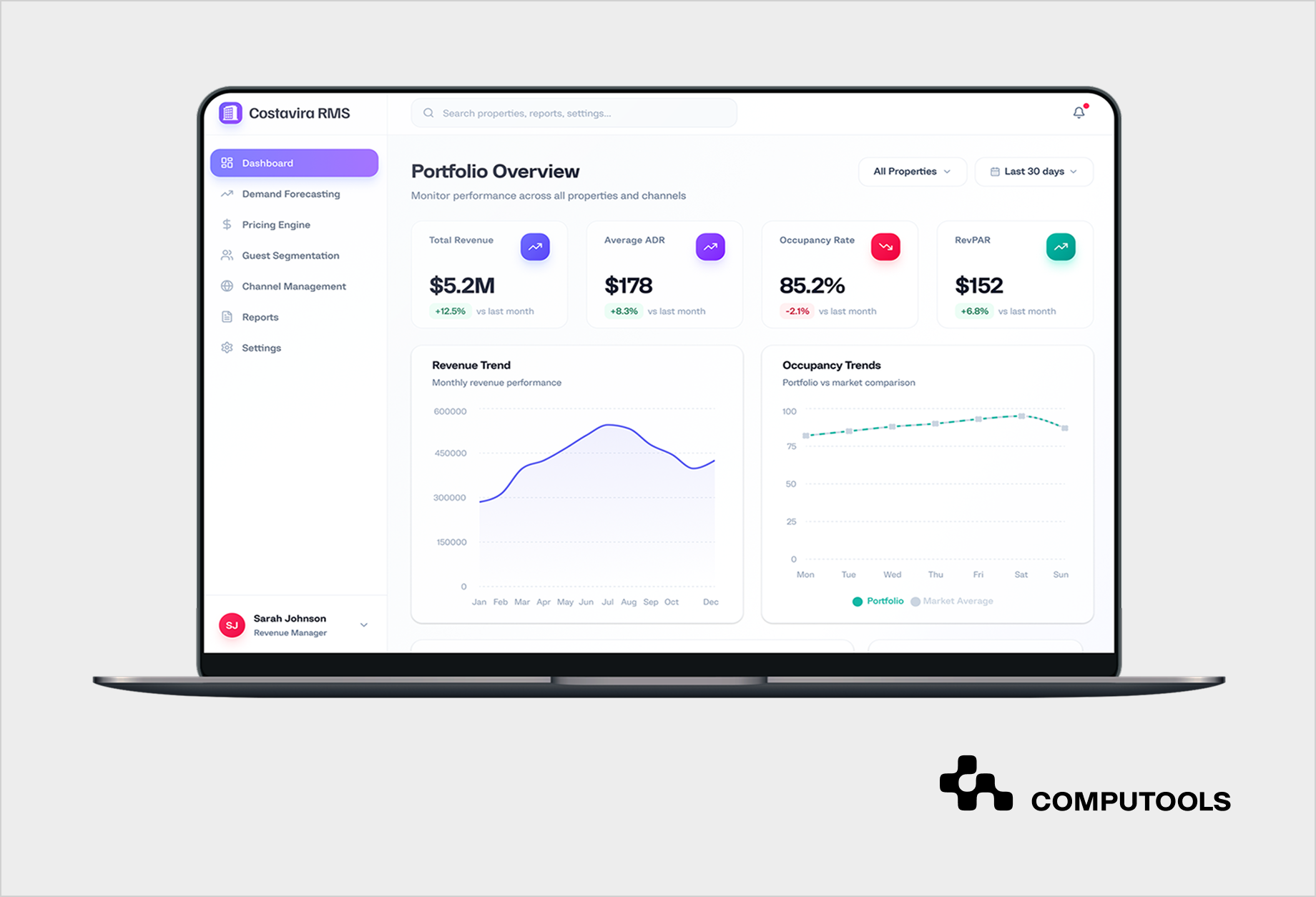
The platform required strong software engineering services and data engineering. Computools built a responsive revenue management interface, structured booking and pricing data in PostgreSQL, used Redis for faster data retrieval, and connected the system with PMS and channel manager APIs. Python and FastAPI powered forecasting requests, pricing recommendations, rule execution, and integration workflows.
Computools also introduced business process automation into rate management. The system generated pricing recommendations based on occupancy, booking pace, historical patterns, day-of-week behavior, seasonal trends, city-level events, and guest segments. Revenue managers could review forecasts, approve or override recommendations, and monitor pricing impact without manually updating every rate across every channel.
Within approximately six months after launch, the client increased room revenue by 21% without additional traffic, improved ADR by 12%, raised low-season occupancy by 9%, and reduced manual pricing work by 65%. The platform also improved pricing visibility across the website, OTA, and partner channels.
How to develop a dynamic pricing platform for hotels: 10 steps
Step 1. Analyze Current Pricing Workflows and Revenue Leakage
Before development begins, the hotel group needs a complete view of how pricing decisions are made across properties, room types, guest segments, and sales channels. In many hotels, rate management still depends on spreadsheets, periodic manual reviews, separate channel updates, and individual manager experience. This makes it difficult to see where revenue is being lost and whether the same commercial logic is applied consistently across the portfolio.
The audit should examine how often rates are updated, which signals influence price changes, who approves adjustments, and how quickly new rates reach direct and third-party booking channels. The team should also analyze historical situations in which rooms were sold below their revenue potential during high-demand periods or remained unsold because prices were not adjusted as demand weakened.
Key areas to review include:
- rate update frequency and approval workflows;
- occupancy, booking pace, and lead-time data used in decisions;
- seasonal, weekday, weekend, and event-based pricing rules;
- differences between direct, OTA, corporate, and partner-channel rates;
- room type pricing relationships and upgrade logic;
- guest segment handling, including early bookers, last-minute guests, and repeat customers;
- manual corrections, pricing conflicts, and rate parity issues;
- time revenue teams spend on repetitive pricing tasks.
This analysis forms the foundation of a reliable hotel pricing strategy. It helps define which decisions the future platform should support, which routine actions can be automated, which pricing scenarios require human approval, and which data sources must be integrated into one operating environment.
In the Costavira RMS project, Computools identified that stable occupancy concealed revenue loss. Rates were updated manually every few days, segmentation was limited, and the commercial team had insufficient visibility into changing demand across channels. Mapping these workflows allowed the team to design a centralized RMS focused on forecasting, pricing rules, channel synchronization, and faster revenue decisions.
Step 2. Define Pricing Objectives, Rules, and Control Levels
Then the hotel group should define the commercial targets the platform will support. These targets may include increasing ADR during high-demand periods, improving occupancy during weaker seasons, reducing rate-parity conflicts, protecting direct-booking margins, or reducing the hours that revenue teams spend on manual updates.
Each target should be translated into measurable pricing logic. The product team needs to document which room rates can change automatically, which changes require approval, how large an adjustment can be applied in a single update, and how pricing should differ across properties, room categories, guest segments, booking windows, and channels.
The rule framework may include:
- minimum and maximum rates for each room category;
- price differences between standard, premium, and suite inventory;
- weekday, weekend, seasonal, and event-based adjustments;
- corporate, loyalty, early booking, and last-minute rate conditions;
- minimum stay and closed-to-arrival restrictions;
- direct booking and OTA pricing controls;
- thresholds for manager approval;
- override reasons and audit requirements;
- access rights for revenue managers, property managers, and commercial leaders.
For hotel chains, control levels should be structured across the portfolio. Central revenue teams may manage group-wide rules, reporting standards, and approval policies, while individual properties need flexibility to respond to local events, business travel patterns, seasonal changes, and unexpected demand shifts. A revenue management system for hotels should support both levels through configurable rules and role-based permissions.
In the Costavira RMS project, Computools created pricing scenarios for corporate bookings, early reservations, last-minute demand, and repeat guests. Revenue managers could review forecasts, approve recommendations, and intervene when local knowledge or judgment was needed. This ensured consistent pricing governance across properties and practical day-to-day rate management for platform teams.
Step 3. Build a Unified Data Foundation
The pricing platform needs a consistent data structure across all properties and sales channels included in the rollout. Hotel groups often store reservation history, room inventory, rates, guest segments, occupancy data, and channel updates in different systems. When these records use different formats or update at different frequencies, revenue teams cannot accurately compare performance or apply the same pricing logic across the portfolio.
The data layer should bring together:
- reservation history by property, room type, date, and channel;
- current occupancy and available inventory;
- booking pace and pickup changes;
- ADR, revenue, and RevPAR history;
- booking lead time and length of stay;
- cancellations and no-shows;
- guest segment and rate plan data;
- direct booking, OTA, corporate, and partner-channel rates;
- seasonal periods and city-level events;
- historical price changes and their performance results.
Data consistency is especially important in dynamic pricing software for hotels because the system uses these inputs to analyze demand patterns, generate recommendations, and distribute approved rates. Room categories, booking statuses, channel identifiers, segment definitions, and pricing rules should be standardized before forecasting and rate logic are implemented.
The technical team should also define how frequently each data source must be updated. Current inventory, new reservations, cancellations, and published rates may require frequent synchronization, while historical reporting or long-term seasonality data can be refreshed on a different schedule. The platform should flag missing records, failed updates, duplicated data, and unusual changes that may affect pricing decisions.
For Costavira RMS, Computools centralized booking history, pricing rules, property data, guest segment configurations, and reporting in PostgreSQL. PMS and channel manager APIs provided booking, inventory, and rate data, while Redis enabled faster retrieval of pricing and forecasting data. This foundation ensured reliable rate recommendations and channel sync across properties.
Step 4. Develop Demand Forecasting Logic
Demand forecasting helps a hotel anticipate when booking behavior is likely to affect room value. The platform should analyze future stay dates by property, room type, booking window, and guest segment, then show where demand is accelerating, slowing down, or developing differently from historical patterns.
The forecasting layer should process:
- historical occupancy by property and room category;
- booking pace and pickup for future dates;
- average lead time and length of stay;
- weekday and weekend demand patterns;
- seasonal periods and recurring booking peaks;
- local events that influence hotel demand;
- cancellations and no-show behavior;
- demand by corporate, leisure, repeat, and last-minute guests;
- direct, OTA, and partner-channel booking performance.
Forecasts should be available at several levels. Revenue managers may need a portfolio overview to identify properties requiring attention, then drill down into a specific hotel, room type, date range, or guest segment. The system should also distinguish between expected demand growth and unusual short-term changes, such as a sudden booking surge due to an event or a drop in reservations on dates that usually perform well.
For hotels operating in urban destinations, local events and visitor activity can also be part of a wider digital ecosystem. Our guide explains how to develop a smart tourism platform for an urban destination that connects visitor services, bookings, recommendations, and destination-level data.
Hotel demand-based pricing software forecasts must link to decisions. Increased demand may lead to higher rates, tighter controls, or changes to discounts. Weak pickup prompts price reviews, targeted offers, or adjustments to the booking window. Revenue teams should see signals influencing forecasts and how recommendations impact occupancy and revenue.
In the Costavira RMS project, Computools created forecasting workflows for occupancy, booking pace, historical patterns, day-of-week trends, seasonal changes, and city events. The hotel group gained earlier insights into demand and could adjust rates based on structured recommendations rather than delayed manual reviews.
Step 5. Define Pricing Scenarios and Recommendation Logic
Once demand forecasting is in place, the platform needs logic that translates demand signals into proposed rate changes. The hotel group should define which situations affect room value, how strongly rates may change, and which commercial limits apply before a recommendation reaches the revenue team.
Pricing scenarios may be built around:
- occupancy levels for a specific stay date;
- booking pace compared with historical patterns;
- remaining inventory by room type;
- lead time before arrival;
- day-of-week and seasonal demand;
- city events and compression periods;
- corporate, repeat guest, early booking, and last-minute segments;
- cancellation trends;
- channel performance and distribution costs;
- rate floors, ceilings, and room category relationships.
Dynamic pricing algorithms for hospitality should process these signals in accordance with the hotel’s defined rules. For example, faster-than-expected pickup for a high-demand weekend may support a rate increase for remaining inventory. Slower bookings during a low-season period may trigger a reduced rate for selected room types or booking windows. The platform should also prevent recommendations that conflict with brand positioning, contractual rates, or internal revenue policies.
Recommendations need to be clear for the people approving them. Each suggested rate change should show the affected property, room category, stay dates, current and proposed rates, supporting demand indicators, and the rule or scenario behind the adjustment. This allows revenue managers to evaluate decisions quickly and review later whether the pricing action produced the expected result.
In Costavira RMS, Computools created pricing scenarios based on occupancy, booking pace, historical patterns, day-of-week behavior, seasonal trends, and city events. Separate paths were set for corporate bookings, early reservations, last-minute demand, and repeat guests, providing the hotel group better control over rate decisions in various revenue situations.
Step 6. Build the Pricing Engine and Rate Control Workflow
The pricing engine calculates proposed room rates based on approved business rules, forecast data, live inventory, booking behavior, and property-specific constraints. Its goal is to provide revenue teams with a consistent method to evaluate room value for each night, reducing the need for manual review of every change across spreadsheets and channels.
The engine should process several inputs at the same time:
- current rate and available inventory;
- projected occupancy for the selected date;
- booking pace compared with expected performance;
- room category and price hierarchy;
- segment-specific conditions;
- seasonal and event-related adjustments;
- minimum and maximum allowed rates;
- channel restrictions and contracted pricing;
- approval thresholds for significant changes.
During hotel pricing engine development, the team should define how each recommendation is calculated and what happens after it is generated. A routine change within an approved range may be prepared for quick publication. A larger adjustment, an unusual demand spike, or a change affecting corporate or partner rates may require manager review before it reaches booking channels.
The system should provide a structured decision record for every proposed change. Revenue teams need to see the current rate, recommended rate, stay dates, affected room types, related demand indicators, applicable pricing rules, approval status, and subsequent performance. This makes it easier to evaluate recommendations during daily work and refine pricing logic after launch.
In Costavira RMS, Computools developed pricing-rule logic and rate-recommendation workflows supporting various properties, channels, and guest scenarios. Revenue managers could review forecasts, approve suggestions, and override recommendations as needed, reducing manual corrections and maintaining rate control in collaboration with the hotel team.
Step 7. Integrate Pricing with PMS and Distribution Channels
A pricing platform needs direct access to operational booking data and a reliable way to distribute approved rate changes. For hotel groups, this usually means integrating the system with the property management system, channel manager, direct booking environment, OTA connections, and partner sales channels included in the revenue workflow.
The integration layer should handle:
- reservation and cancellation updates;
- room availability and inventory changes;
- current published rates by property and room type;
- approved rate updates sent to connected channels;
- confirmation that changes were successfully applied;
- failed synchronization alerts;
- rate discrepancies between direct and third-party channels;
- update history for reporting and audit purposes.
Integration frequency also matters. Booking pace, cancellations, remaining inventory, and channel rates can change throughout the day, especially during high-demand periods. If the pricing platform relies on outdated information, the revenue team may approve recommendations that no longer reflect actual availability or current demand conditions.
A connected hotel rate optimization software platform should allow revenue managers to review a recommendation, approve the change, and publish it across relevant channels from a single workflow. The system should also show whether each update reached the intended channel and flag inconsistencies that require attention. This reduces repeated manual actions and gives the commercial team clearer control over rate parity and distribution performance.
Pricing control is also closely connected to distribution strategy: hotels aiming to improve margin performance can explore ways to increase direct hotel bookings and reduce OTA dependence through improved booking flows, direct offers, guest data, and retention mechanisms.
In Costavira RMS, Computools linked the platform with PMS and channel manager systems via API. The RMS received booking, inventory, and rate data, enabling synchronization across the website, OTAs, and partner channels. This enhanced pricing visibility and reduced rate parity issues within the hotel group’s sales environment.
Step 8. Design Revenue Dashboards and Decision Workflows
Revenue teams need an interface that turns pricing data into daily actions. The dashboard should help managers review changes in demand, compare current and recommended rates, approve adjustments, investigate exceptions, and monitor whether published prices have reached the required channels.
The interface should provide:
- portfolio-level performance across properties;
- occupancy and forecasted demand by stay date;
- ADR, RevPAR, booking pace, and pickup trends;
- current and recommended rates by room category;
- segment-level pricing scenarios;
- alerts for unusual demand shifts or rate discrepancies;
- approval and override actions;
- synchronization status across connected channels;
- historical pricing decisions and their outcomes;
- reporting filters by property, channel, room type, segment, and period.
The design of hotel revenue management software should reflect how commercial teams work during rate reviews. A manager needs to move from a portfolio overview to a specific property, room category, or stay date without losing the pricing context. Recommended changes should appear alongside the indicators that triggered them, including booking pace, inventory level, forecasted occupancy, segment demand, and applicable pricing rules.
Role-based access is also necessary. Revenue managers may approve or override recommended rates, property managers may review local performance and operational alerts, while commercial leaders may need consolidated reporting across the hotel group. The system should record each action, including the user, time, affected rate, approval status, and publication result.
Computools built a responsive React management interface for Costavira RMS, supporting forecasting, pricing workflows, role-based navigation, channel monitoring, alerts, and reporting. It provided a single platform for reviewing pricing decisions and revenue impact.
Step 9. Automate Rate Updates with Approval and Override Controls
Once pricing rules, forecasts, integrations, and dashboards are in place, the hotel can automate routine parts of rate management. The platform should generate recommendations, route them to the right users, publish approved changes across connected channels, and record the outcome of each action.
Automation may cover:
- generation of rate recommendations based on configured scenarios;
- alerts when demand, booking pace, or inventory changes significantly;
- approval routing for changes above defined thresholds;
- automatic publication of approved rates;
- synchronization status checks across channels;
- notifications about failed updates or pricing conflicts;
- reporting on accepted, rejected, and overridden recommendations;
- audit history for each rate decision.
The level of automation should depend on the commercial risk of each action. Small rate adjustments within approved boundaries may be published automatically for selected properties or room types. Larger changes, event-driven increases, corporate rate adjustments, or recommendations outside expected ranges should remain subject to revenue manager approval.
A platform built for pricing automation for hospitality industry workflows also needs override controls. Revenue managers may have information the system does not yet reflect, such as a newly confirmed group booking, a local disruption, an unusual competitor move, or an operational restriction affecting available inventory. Each override should include a reason and remain visible in the reporting layer so the hotel can identify recurring gaps in pricing rules or forecast logic.
In Costavira RMS, Computools added automated rate suggestions to streamline pricing decisions for the revenue team. Managers could review forecasts, approve or override rates, and monitor updates from one platform. This cut repetitive pricing work by 65% in six months and provided more controlled rate management across multiple properties and channels.
Step 10. Test the Pricing Logic, Launch Gradually, and Monitor Results
Before live rate updates are enabled across the hotel portfolio, the platform should be tested against historical data and controlled operating scenarios. The team needs to confirm that forecasts reflect actual demand patterns, rate recommendations follow approved commercial rules, integrations deliver correct prices, and revenue managers can review or override decisions without workflow delays.
Testing should cover:
- forecast accuracy for high-, medium-, and low-demand periods;
- rate recommendations for different room types and guest segments;
- minimum and maximum rate controls;
- seasonal, weekday, weekend, and event-based scenarios;
- approval thresholds and override workflows;
- PMS and channel manager synchronization;
- rate publication across direct, OTA, and partner channels;
- alerts for failed updates, unusual recommendations, and parity conflicts;
- access permissions and audit records;
- reporting accuracy for ADR, occupancy, revenue, and manual interventions.
The launch should begin with a limited rollout. A hotel group may activate the platform for selected properties, specific room categories, or recommendation-only workflows before allowing automated publication of approved rates. During this period, revenue teams can compare system recommendations with their own pricing decisions, identify incorrect rules, review forecast deviations, and adjust thresholds before wider deployment.
After release, hotel dynamic pricing system development continues through performance monitoring and rule refinement. The hotel should track forecast accuracy, recommendation acceptance rates, override reasons, rate parity issues, synchronization failures, ADR, occupancy, room revenue, and low-season performance. Repeated overrides or recurring pricing conflicts indicate that a rule, data source, segment configuration, or integration workflow needs revision.

Launch your dynamic hotel pricing software within 1–3 months instead of years. Start optimizing revenue in real time with a system tailored to your business.
Common mistakes when building dynamic pricing software for hotels
1. Using Incomplete or Delayed Data
Pricing recommendations depend on current bookings, cancellations, availability, room types, published rates, and channel activity. Before implementing hotel price optimization tools, hotels need standardized data and reliable integrations with PMS, booking engines, and channel managers.
2. Relying on Occupancy Alone
Occupancy does not show the full revenue picture. A pricing system should also consider booking pace, lead time, seasonality, local events, guest segments, cancellation patterns, and remaining inventory value.
3. Applying the Same Rules Across All Properties
Properties in different locations and market segments follow different demand patterns. Smart pricing solutions for hotels should support configurable rules by property, room type, booking window, guest segment, and channel, without forcing a single model across the portfolio.
4. Automating Prices Without Human Control
Routine adjustments can be automated within approved limits, but unusual demand changes, large price shifts, corporate rates, and strategic periods may require manager approval. Override controls and audit history help revenue teams keep pricing decisions accountable.
5. Introducing AI Before the Pricing Process Is Ready
Hotels should consider AI pricing tools for hotels only after establishing reliable data, defined pricing objectives, and clear review workflows. Predictive models cannot compensate for inconsistent source data or unclear commercial rules.
5. Ignoring Channel Synchronization
Rate recommendations affect revenue only when approved prices are accurately distributed across direct booking channels, OTAs, and partner platforms. The system should confirm updates, flag synchronization failures, and monitor rate inconsistencies.
Why hotels choose Computools for revenue pricing platforms
Computools builds revenue-focused digital products for hotels, resorts, travel agencies, and tourism businesses. Our software development services for HoReCa cover hotel management systems, booking platforms, reservation automation, guest-facing products, and revenue and channel management solutions designed around real operational workflows.
For hotel pricing projects, we combine product discovery, integration architecture, data workflows, and web development services to create platforms that revenue teams can use every day. The Costavira RMS project reflects this approach: we delivered a custom system for demand forecasting, pricing recommendations, segmentation-based scenarios, channel synchronization, alerts, and reporting across multiple hotel properties.
Where a hotel has sufficient structured data and a clear pricing use case, our AI development services can support advanced forecasting models, adaptive recommendations, anomaly detection, and explainable pricing workflows. These capabilities are introduced in line with the product roadmap and data maturity, with approval controls and commercial rules built into the platform.
Our travel technology expertise also extends beyond hotel operations to booking ecosystems, guest engagement platforms, and heritage tourism software development for cultural sites, museums, tourism authorities, and visitor experience providers.
With 250+ experts, 40+ travel and hospitality projects delivered globally, and a 4.9 Clutch rating based on 95+ reviews, Computools has the technical and industry experience to build hotel dynamic pricing software connected with booking, revenue management, and channel control workflows. Need a custom dynamic pricing platform for your hotel business? Contact us at info@computools.com.
Hotel businesses comparing potential delivery partners can also review our overview of hotel management system software development companies working with reservation, revenue management, operational, and integration-focused hospitality platforms.
Computools
Software Solutions
Computools is an IT consulting and software development company that delivers innovative solutions to help businesses unlock tomorrow.