
THE AUTHOR:

The need to build hotel housekeeping management software addresses an operational problem that goes well beyond replacing paper checklists, spreadsheets, or supervisor calls. Room cleaning has become more interconnected with check-ins, staff availability, maintenance, inventory, guest requests, and the property management system. If these systems are using different data or updating at different speeds, a room can remain unavailable longer than necessary even when the cleaning itself is complete.
Industry research shows that this fragmentation remains widespread. The 2026 Hotel Operations Index found that only 11% of surveyed operators have a fully integrated technology stack, while 91% still rely on some manual reporting, including within otherwise automated workflows. Accuracy and timeliness of operational data is only very confident for 15% of the businesses. 27% use more than seven different technology platforms and another 27% spend more than 11 hours a week consolidating or reconciling information. In housekeeping, these gaps can lead to delayed room status updates with repeated calls across departments or assignment of tasks, and a significant lack of visibility into the housekeeping staff’s availability to prepare necessary rooms prior to the next guest arrival.
The Hotel Yearbook State of Hospitality Tech 2025 survey found that hotel companies rated their average technology maturity at only 5.35 out of 10, while 23% placed themselves at the very low end of the maturity scale. When evaluating new hotel technology, 53.48% selected ROI or profitability as their top priority. Integration issues, fragmentation, legacy infrastructure, and lack of standards were also among the most frequently reported technology frustrations. A new housekeeping management system for hotels therefore has to produce measurable operational value while fitting into the property’s existing technology environment.
The two largest AI opportunities ranked by hotel operators are predictive demand modeling and the collaborative use of data across departments. BCG reaches a similar conclusion: AI performs poorly when PMS, CRM, POS, F&B, and other hotel systems cannot exchange dependable data. Nearly half of hoteliers in its research struggled to access critical information, while four in five spent up to two working days assembling reports to obtain a complete business view.
| Capability | Business purpose | What the system should support |
| Real-time room status management | Keep front desk, housekeeping, and operations teams aligned on room availability. | Live status changes, event tracking, PMS synchronization, status history. |
| Intelligent task assignment | Improve labor utilization and reduce delays during peak periods. | Automated housekeeping workflows, workload balancing, priority rules, staff availability tracking. |
| Mobile housekeeping workflows | Give room attendants faster access to tasks and reduce manual communication. | Mobile task lists, issue reporting, room updates, offline synchronization. |
| Inspection and quality control | Maintain cleaning standards while increasing productivity. | Digital checklists, inspection results, re-clean workflows, audit history. |
| Workforce planning and scheduling | Match staffing levels with actual operational demand. | Demand forecasting with AI, shift planning, workload prediction, overtime visibility. |
| Maintenance coordination | Prevent rooms from remaining unavailable because issues are not escalated quickly. | Maintenance requests, room blocks, repair status updates, department notifications. |
| AI-powered operational recommendations | Support faster decisions using historical and real-time data. | Cleaning-time prediction, workload forecasting, anomaly detection, priority recommendations. |
| Multi-property management | Give hotel groups consistent processes without losing property-level flexibility. | Centralized analytics, configurable workflows, role-based access, property-level rules. |
Housekeeping is an excellent example of what more integrated data can offer. BCG reports the Ritz-Carlton San Francisco implemented an AI system to manage room cleaning and optimize resources based on check-in/check-out times, guest preferences, and staffing availability, reducing preparation and cleaning times by 20%. IHG also has used similar predictive housekeeping models to manage cleaning staff resources and anticipate cleaning surges.
This changes the business case for companies considering developing hotel housekeeping management solutions. Earlier, the product looked something like a workplace tool that an attendant used to mark a room as clean. Now, it would be one component of a hotel room management system that manages how quickly inventory of a hotel room moves from checkout to cleaning, inspection, maintenance, and preparation for the next guest.
The following sections explain how to build hotel housekeeping management software. This addresses the room status logic, the real-time architecture of the system, task orchestration, integrations with other systems, mobile interfaces, workflows, AI interfaces, security, performance, and the overall control system, including the different measures to guarantee performance and optimize housekeeping operations.
OpsCore Hospitality: connecting housekeeping with real-time hotel operations
The OpsCore Hospitality illustrates that hotel housekeeping management requires integration with other core components of the hotel operating system, such as staffing, maintenance, guest requests, and room readiness.
Client context and business challenge
The client, a US-based hospitality operator, used spreadsheets and phone calls to manage front desk, maintenance processes and workforce, while housekeeping tasks were run through messages and manual task assignments. The status information moved with a significant lag between relevant teams. Staffing levels were not adjusted based on the occupancy level and demand on the workforce.
This created several problems, such as unclear task ownership, delayed room cleaning status tracking, poor visibility into staff capacity, and maintenance issues that could hold rooms out of service without giving other departments a clear view of the cause.
Computools solution
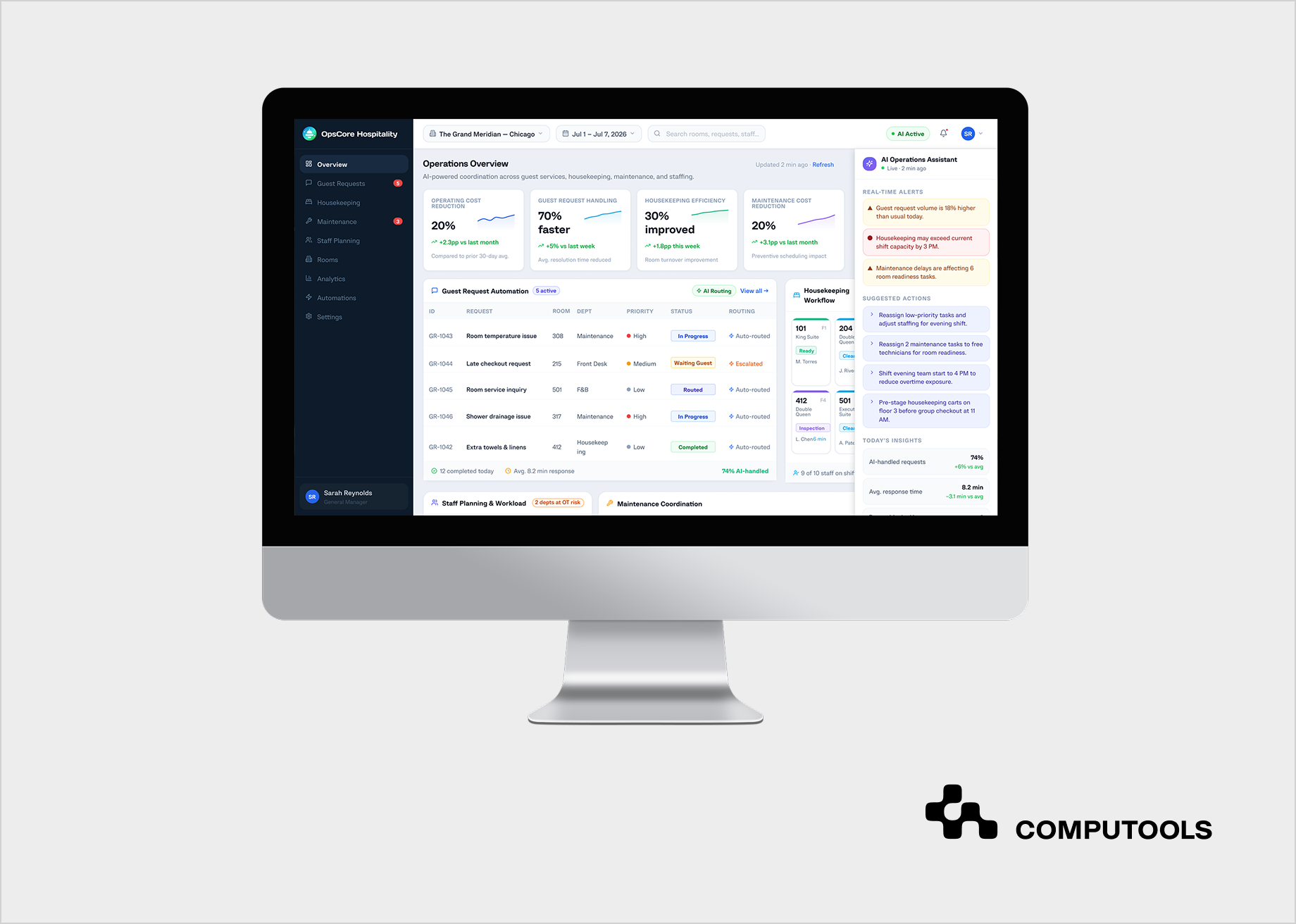
Our team engineered OpsCore, a connected operations platform for housekeeping, staff scheduling, maintenance, guest request handling, and operational analytics. Individual system supervisors can manage tasks and prioritize guest room assignments, monitor work progress, and escalate maintenance requests, all within a single workflow.
Next.js and React were used for role-based interfaces. Task routing and operational logic in this system were made with Node.js and NestJS. PostgreSQL was used to store the status of rooms, staffing schedules, maintenance logs, tasks, and KPIs. For forecasting and predictive functions, our team employed Python and FastAPI. AWS, Docker, and Terraform were used for the provisioning and configuration of the cloud infrastructure.
This design delivers a system with real-time room status updates and a shared view of room readiness, staffing, maintenance, and overall system load.
Business result
After three months, the client reported a 30% lift in housekeeping efficiency, while associated labor costs and OPEX dropped by 20%. Guest request processing improved by 70% and maintenance costs reduced by 20%.
This example illustrates that a modern housekeeping management system for hotels must integrate room state, task allocation, workforce balancing, maintenance and operational data.
How to build hotel housekeeping management software step-by-step
The design of a housekeeping management platform should incorporate the dynamics of rooms, employees, maintenance issues, and guest demand throughout the day. The goal is to create a solution that will enhance room readiness and labor productivity. The following steps describe how these dynamics will impact the operational and technical decisions in the system design.
Step 1. Define operating targets before choosing features
Start with the results the hotel wants to improve.
These may include:
- average checkout-to-ready time;
- percentage of rooms ready by check-in;
- minutes per cleaned room;
- rooms completed per labor hour;
- overtime;
- inspection failure and re-clean rates;
- rooms delayed by maintenance.
These targets determine what the system needs to measure and automate. To illustrate, in the case where early availability of rooms is critical, the platform should compare expected arrivals to current cleaning capacity and dynamically reprioritize rooms.
The technical design should capture a timestamp for each significant event, such as checkout, task assignment, cleaning, inspection, maintenance, completion, and room release. Without this data, management will recognize a room was held up, however, will not be able to discern the underlying reason (staffing, task allocation, maintenance, inspection).
Step 2. Create a clear room-state model
In the OpsCore Hospitality project, Computools structured operational data around rooms, tasks, staff schedules, guest requests, maintenance records, and KPIs. This type of data model allows hotel teams to move from isolated status updates toward a complete view of why a room is delayed, who is responsible, and what action should happen next.
Room status is the core data object in a housekeeping platform. A useful model separates occupancy state from housekeeping state rather than relying on a single “clean” or “dirty” field.
A typical sequence might be: Occupied → Due Out → Vacant Dirty → Assigned → Cleaning → Awaiting Inspection → Ready.
The system should also support exceptions such as:
- Do Not Disturb;
- maintenance required;
- re-clean required;
- out of order;
- blocked;
- late checkout.
Each change should record the room ID, previous and new status, timestamp, responsible employee or system, and reason for the update.
This is especially important when multiple systems can change room information. Hotel room status management systems should have clear ownership rules in order to prevent a housekeeping update from overwriting a room cleaning state that was vacated with a late checkout.
Maintaining a history of room states also generates an essential dataset to calculate notification times and identify persistent delays and build forecasting models.
Step 3. Build real-time event processing around room changes
Static room lists become outdated quickly. A checkout can occur earlier than planned, a guest can request late departure, maintenance can block a room, or an attendant can finish several rooms ahead of schedule.
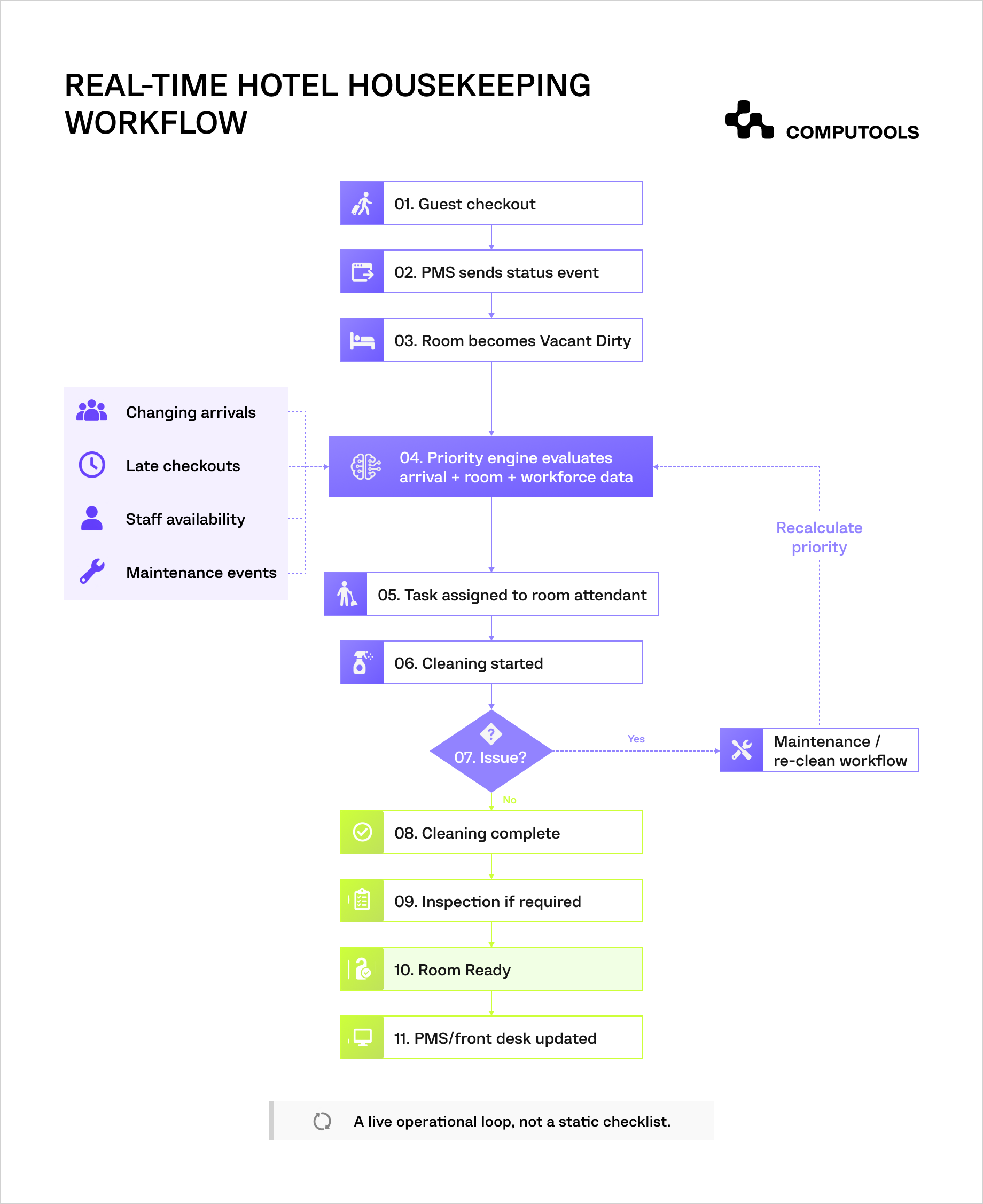
A real-time housekeeping software architecture should treat these changes as events.
A typical flow is: PMS event → API or webhook → event-processing layer → workflow engine → housekeeping application → room-status update → PMS/front desk.
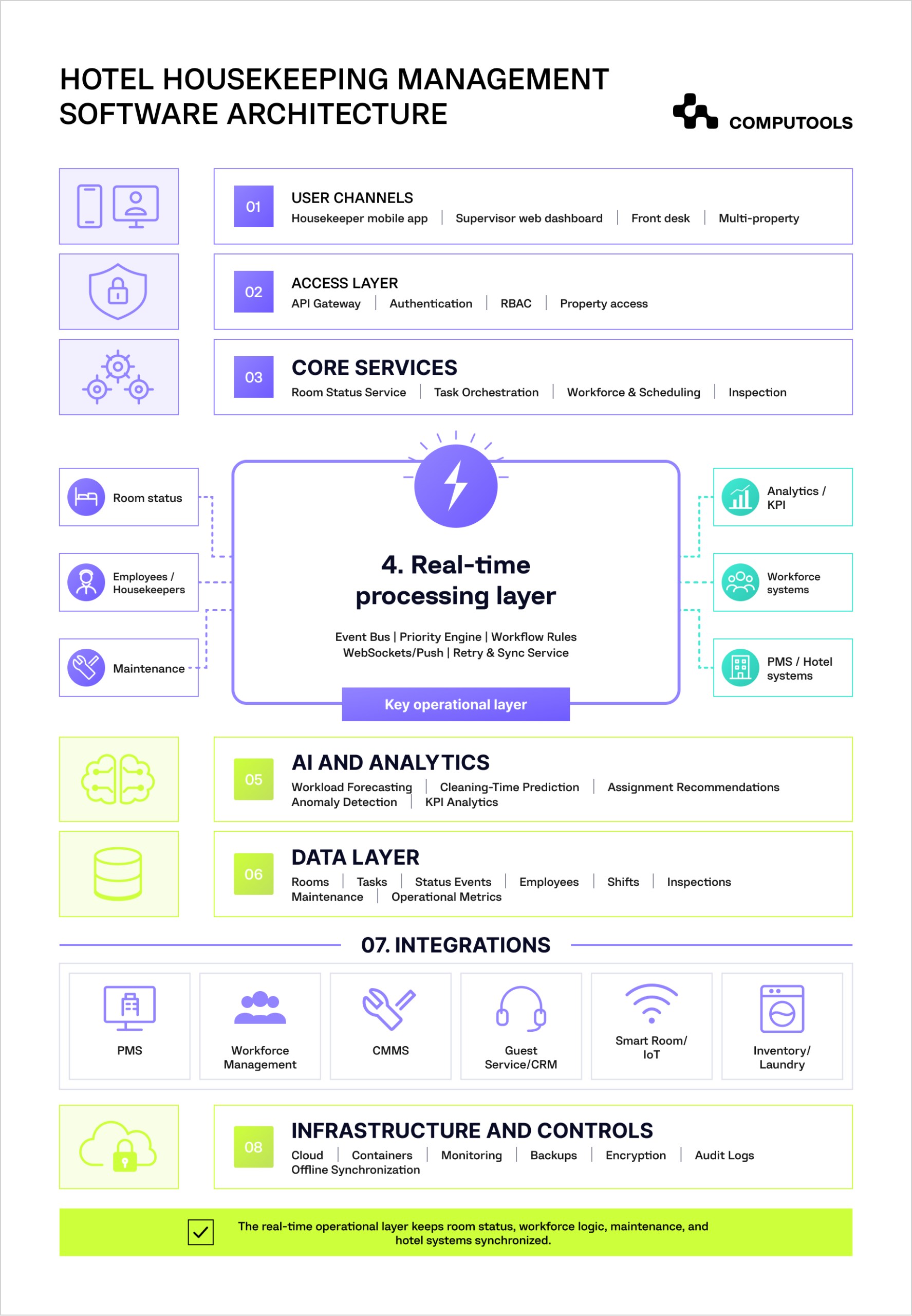
The processing layer should handle:
- duplicate events;
- retries when an integration fails;
- event ordering;
- status versioning;
- synchronization conflicts;
- mobile notifications;
- live supervisor dashboard updates.
WebSockets or server-sent events can update dashboards immediately, while push notifications can inform employees when priorities change.
Legacy PMS products may not support webhooks. In that case, controlled polling can retrieve changes at short intervals, but the architecture should isolate this logic in an integration layer rather than embedding it inside housekeeping workflows.
Offline operation also matters. If Wi-Fi drops on a hotel floor, employees should still be able to access assigned tasks and record progress. The application can synchronize changes once connectivity returns.
Step 4. Design task allocation around workload, not static room lists
Digitizing a printed room list provides limited operational value. The stronger approach is to build an assignment engine that considers actual workload and room priority.
Housekeeping task assignment can use variables such as:
- checkout or stayover service;
- room type;
- expected cleaning duration;
- arrival time;
- VIP or group priority;
- employee floor or zone;
- current task load;
- shift end time;
- required skills;
- maintenance dependencies.
For example, an attendant may have eight rooms assigned, but another employee with seven rooms can still have a heavier workload if several are suites or checkout cleans.
Good housekeeping task management software should therefore calculate workload in estimated minutes or weighted effort, rather than relying only on room counts.
This logic also supports automated housekeeping workflows. If an attendant reports a faulty shower, the platform can create a maintenance task, temporarily prevent the room from reaching Ready status, alert the supervisor, and return the room to the inspection queue once the repair is completed.
For hotel housekeeping app development, the frontline interface should remain simple. An employee normally needs to see the next room, service type, priority, required actions, relevant notes, and an obvious way to report an issue or complete the task. Complex management information should stay in supervisor interfaces.
This approach reflects the logic implemented in OpsCore Hospitality, where housekeeping task assignment was connected with workforce planning and operational priorities. The platform gave managers better visibility into staff workload and helped align scheduling decisions with actual hotel demand instead of fixed assumptions.
Step 5. Integrate housekeeping with the wider property technology stack
Housekeeping decisions depend on information generated outside the housekeeping department. Integration therefore has a direct effect on room readiness.
The most important connections usually include:
- PMS: arrivals, departures, stayovers, room moves, occupancy, and room status.
- Maintenance or CMMS: faults, work orders, room blocks, and repair completion.
- Workforce systems: employee shifts, absences, overtime, and availability.
- Guest-service tools: cleaning requests, extra amenities, late checkout, and service preferences.
- Inventory or laundry systems: linen, amenities, and cleaning supplies where these affect daily operations.
This connection with wider hotel operations management prevents each department from working with a different version of the same room.
Integration architecture should also support change. A hotel group may use different PMS products across properties, so vendor-specific APIs should sit behind adapters or integration services. Core housekeeping logic can then remain consistent even when the underlying systems differ.
Hotels with catering, events, or large-scale food service operations face similar workflow coordination challenges. Managing schedules, resources, service requests, and team responsibilities requires the same focus on process visibility and operational control.
Read more in the Catering Operations Workflow Guide.
Step 6. Add inspections, exception workflows, and operational controls
A room marked complete is not always ready for sale. Some properties require supervisor inspection, while others use inspections only for selected room types, new employees, VIP rooms, or random quality checks.
A structured room inspection management workflow can include:
- configurable checklists;
- room-type-specific standards;
- failed items;
- photos where appropriate;
- re-clean tasks;
- maintenance escalation;
- supervisor approval;
- inspection timestamps.
These records make quality measurable. Management can track inspection pass rates, repeat failures, re-clean frequency, and recurring problems by room, floor, employee, or property.
Exception workflows deserve equal attention. The platform should define what happens when an employee finds damaged equipment, missing linen, guest belongings, a DND room, or an unsafe condition. Simply allowing employees to type a note transfers the problem to somebody else rather than controlling it.
Cybersecurity should follow the same practical approach. Housekeepers rarely need access to full guest profiles. Use role-based access, property-level permissions, encryption, audit logs, and limited guest data exposure. Management interfaces may also require SSO or MFA.
Step 7. Use AI for forecasting and operational recommendations
Using reliable structure for room, task, staff and time data, AI becomes potentially useful.
One example, which requires all of these data types, is workload forecasting. The system can analyze expected occupancy, time of departures and arrivals, the time to clean different room types, and demand in the events hall to determine the total hours of housekeeping required for that period of the day.
This forecast can help with housekeeping staff scheduling by allowing managers to see if the planned shifts will fulfill the anticipated demand before the shift begins.
Additional features include:
- Estimated cleaning time. AI can predict how long it will take to clean a room based on the service, room type, occupancy duration and historical cleaning data.
- Automated priorities. This feature will determine which rooms should be cleaned first based on the time of check-in and check-out, the number of requests and staff onsite.
- Extreme case detection. This feature detects long cleaning times, repeated quality control failures, maintenance failures, and overtime.
- Forecasting supplies. The system can predict linen and cleaning supply needs using expected occupancy and cleaning time.
The goal of hotel housekeeping automation should be to improve operational decisions, not remove supervisor judgment. Managers should be able to adjust recommendations when local circumstances differ from what the model can see.
AI accuracy also depends on data quality. Conflicting room states, missing task timestamps, and inconsistent employee records will produce unreliable forecasts regardless of the model used.
Forecasting and automation are also changing other areas of hotel operations, including pricing decisions. Revenue teams increasingly use historical data, demand patterns, and automated recommendations to adjust rates and improve inventory decisions.
Learn more about the architecture behind these systems in How to Build Dynamic Pricing Software for Hotels.
Step 8. Test real hotel operating conditions before scaling
QA Testing should reproduce the events that create pressure during an actual hotel shift.
Useful scenarios include:
- 150–200 rooms checking out within a short period;
- a large group arriving earlier than expected;
- several employees becoming unavailable;
- simultaneous maintenance holds;
- duplicate PMS events;
- network interruptions on guest-room floors;
- a temporary PMS outage;
- dozens of room priorities changing at once.
The system should also be tested for synchronization failures, conflicting updates, notification delays, and high volumes of status changes rather than only for page-loading speed.
A phased rollout is usually safer for hotel housekeeping software development. Computools applied a phased delivery approach in OpsCore Hospitality, validating workflows such as guest request automation, housekeeping coordination, workforce management, maintenance processes, and analytics before expanding the platform further. This approach reduces implementation risk because operational teams can measure improvements before broader deployment. Start with one property, building, or operating zone and compare performance with a pre-launch baseline.
Track metrics such as checkout-to-ready time, rooms ready before target check-in, labor hours per cleaned room, overtime, inspection pass rate, re-cleans, maintenance-related delays, and manual calls between departments.
These measurements show whether the platform is reducing the actual operating bottlenecks. They also provide the data needed to refine workload rules, automation, and forecasting before expanding the system across additional properties.
Housekeeping is only one part of a connected hotel technology environment. Multi-property operators often need centralized systems that combine operational data from different locations, support consistent processes, and improve decision-making across the portfolio.
For a broader view of designing technology for hotel groups, explore How to Build a Hotel RMS System for Multi-Property Hotel Chains.

Launch your hotel housekeeping management platform in 1–2 months, not years, and enable your teams to coordinate room assignments, track cleaning status in real time, and turn rooms around faster while keeping daily operations under control.
Why choose Computools for hotel housekeeping management software development
Computools treats housekeeping software as an operational control system designed to improve room readiness, labor productivity, service coordination, and cost control across the property.
Through travel and hospitality software development services, Computools:
- connects housekeeping with PMS, workforce, maintenance, guest-service, and analytics systems so teams work from the same operational data;
- designs room-status and task workflows that reduce manual coordination and shorten the time between checkout and room readiness;
- structures workload and staffing logic around actual demand, supporting better labor utilization and lower overtime;
- gives managers clearer visibility into delays, maintenance dependencies, inspection failures, and recurring operational bottlenecks;
- builds multi-property architectures that support centralized control without forcing every hotel into identical operating rules.
For properties with broader service operations, software development services for HoReCa connect accommodation, reservations, food service, staffing, and service-capacity workflows. Heritage tourism software development addresses environments where visitor flows, physical assets, and site-specific constraints require tighter operational coordination.
At the product level, mobile app development services provide housekeepers with convenient access to tasks, priorities, and reporting of issues.
Web development services give multi-property team supervisors control over workload, room readiness, performance, and inspections. AI development services strengthen the ability to forecast, predict cleaning time, recommend priorities, and detect anomalies once the operational data is structured and reliable.
OpsCore Hospitality shows this approach at the operational level. Our team constructed a unified platform for housekeeping, workforce planning, maintenance, guest requests and analytics, AI, and cloud computing. This solution showed a 30% improvement in housekeeping and a 20% decrease in workforce costs and OPEX.
Other Computools hospitality projects extend the same logic into revenue and property performance.
Profiteto integrates PMS and channel data with demand forecasting, guest intelligence, and upselling, to achieve an 11.4% growth in RevPAR and 24% uplift in direct bookings.
Costavira RMS implements centralized pricing, forecasting and channel management at the property level, achieving a 21% increase in room revenues while reducing manual pricing efforts by 65%. Together, these projects show how Computools links daily hotel operations with the systems that influence cost control, room availability, staff productivity, and revenue growth.
For hotel operators, the benefits are clear: more rooms ready on time, fewer hiccups caused by coordination, better staff employment, quicker response to requests, and stronger control over room turnover-related operational costs.
Final thoughts
A hotel housekeeping platform should be evaluated by how well it controls the chain between checkout, cleaning, inspection, and room availability. Every delay in this process has an operational cost. A room that remains unavailable after cleaning is completed reduces sellable inventory. A room delayed by a maintenance issue can affect upgrades, early arrivals, and guest satisfaction. A poorly balanced shift can increase overtime without improving room readiness.
The best systems rely on metrics to show dependencies. Measuring cleaning time, number of tasks, employee workload, inspection results, and changes to status of rooms allows hotel operators to determine the source of delays and whether they are caused by staffing, inefficient assignments, dependencies, or workflow problems.
This data also improves management-level decisions. Instead of scheduling housekeeping based on the fixed staffing ratios, hotels can determine the workload needed with the arrival and departure of guests, their occupancy and room types, and historical performance. Managers can compare labor hours to rooms cleaned, turnaround time, and the quality of the service provided.
Companies that build hotel housekeeping management software should therefore design it as an operational platform connected to the wider hotel business system. The goal is to keep rooms available, allocate resources accurately, reduce avoidable delays, and protect the revenue potential of every room.
Build a real-time housekeeping platform that connects room readiness, workforce planning, maintenance workflows, and hotel performance data.
Computools
Software Solutions
Computools is an IT consulting and software development company that delivers innovative solutions to help businesses unlock tomorrow.