
THE AUTHOR:

Hotels are under increasing pressure to generate more revenue from each guest while meeting expectations for faster, more personalized digital experiences. To accommodate this, many operators develop hotel upselling software that can adapt to shifting contexts and offer tailored services and promotions at the precise moment. Traditional methods of upselling, such as service recommendations at the front desk, emails with promotional offers, or rigid packages, quickly become outdated and fail to account for demand fluctuations and preferences.
This article helps understand how to approach hotel revenue optimization through developing hotel upselling solutions. It includes business logic and architecture, AI and integrations, and touches on security controls and long-term optimization strategies.
Why hotels need to develop hotel upselling software for revenue growth
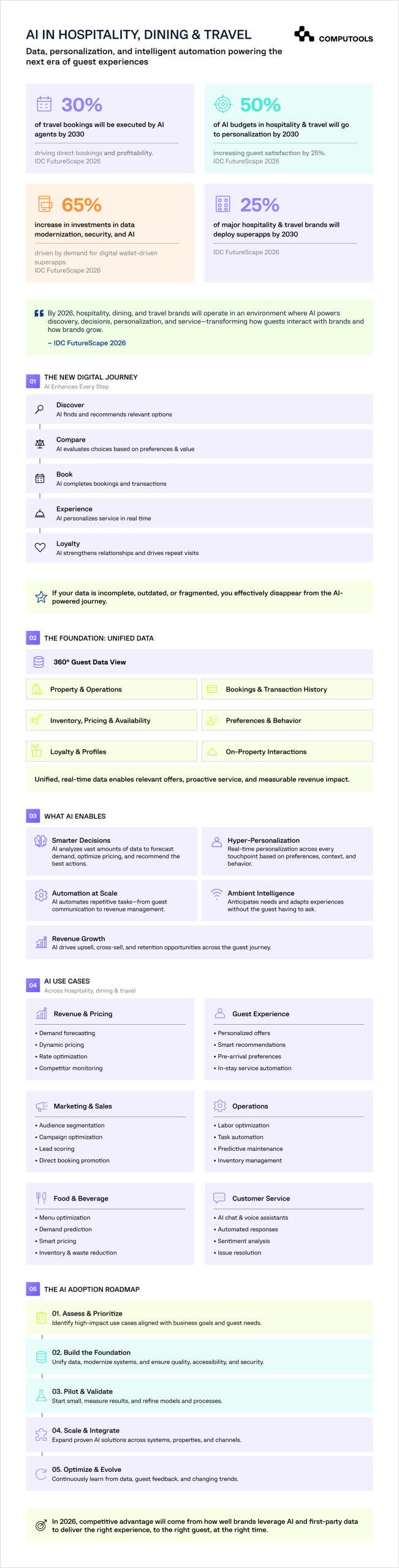
Revenue opportunities include upgrades and dining services, as well as in-room spa and wellness offerings, transport, tours, and experiences. Adyen’s 2025 Hospitality and Travel Report shows that guests demand personalized services and engagements, and hotels are investing in artificial intelligence, automation, and connected digital experiences to meet this need. The report polled 8,100 companies and 40,000 travelers in 27 countries and defined major industry focus areas as AI personalization, direct booking strategies, and improved digital platforms. IDC states that by 2030, 50% of AI budgets in hospitality and travel will be allocated to personalization efforts, powering ambient intelligence and preference anticipation to increase guest satisfaction by 25%.
An AI hotel upselling platform extends the venue’s existing revenue stream infrastructure. It connects different components of the property management system, customer data, booking engines, payment systems, loyalty systems, and analytics to understand each customer interaction and provide appropriate recommendations. It can determine the optimum conversion probability based on booking history, guest preferences, occupancy, service availability, and demand.
The latest industry data indicates that within AI, hospitality vendors are now moving beyond basic recommendations to take automated actions like personalized guest communications, revenue decisions, and operational workflows.
However, personalization requires structured data, reliable integrations, secure customer data management, and scalable architecture to ensure recommendations remain accurate and operationally possible. A guest should receive an upgrade offer only when inventory is available, a restaurant promotion only when capacity allows, and a service recommendation that matches their actual preferences.
What a modern hotel upselling system should include
| Capability | Business value for hotels |
| AI-powered offer recommendations | Analyzes guest profiles, booking context, preferences, and behavior to select the most relevant upgrades, services, and packages. |
| Real-time decision engine | Evaluates availability, demand, pricing, and operational capacity before presenting an offer to ensure it can actually be fulfilled. |
| Unified guest data platform | Combines PMS, CRM, booking history, loyalty data, and service interactions to create a complete guest view for personalization. |
| Predictive analytics and demand forecasting | Identifies future demand patterns, upgrade opportunities, and service needs before they occur. |
| Dynamic pricing and revenue intelligence | Connects upselling decisions with occupancy, inventory, market conditions, and revenue targets. |
| Conversational AI and automated communication | Delivers personalized recommendations through chat, mobile apps, messaging platforms, and digital assistants. |
| Continuous guest personalization | Adjusts recommendations throughout the guest journey based on real-time behavior, preferences, and interactions. |
| Multi-channel offer delivery | Provides consistent offers across booking engines, websites, mobile apps, email, messaging, and front-desk tools. |
| Cross-department upselling workflows | Coordinates offers across rooms, restaurants, spa services, activities, and events while considering operational capacity. |
| AI analytics and optimization | Measures conversion, revenue impact, and guest response to continuously improve recommendations and campaigns. |
| Secure data and consent management | Protects guest information with access controls, encryption, privacy rules, and auditability. |
| Multi-property scalability | Supports centralized revenue strategies while allowing individual properties to manage local offers and availability. |
Upselling also depends on how hotels manage direct relationships with guests. A strong direct booking strategy gives properties more control over customer data, communication, and personalized offers.
For more details on building direct revenue channels, see a hotels direct bookings vs OTAs guide.
How to develop hotel upselling software: Computools case study
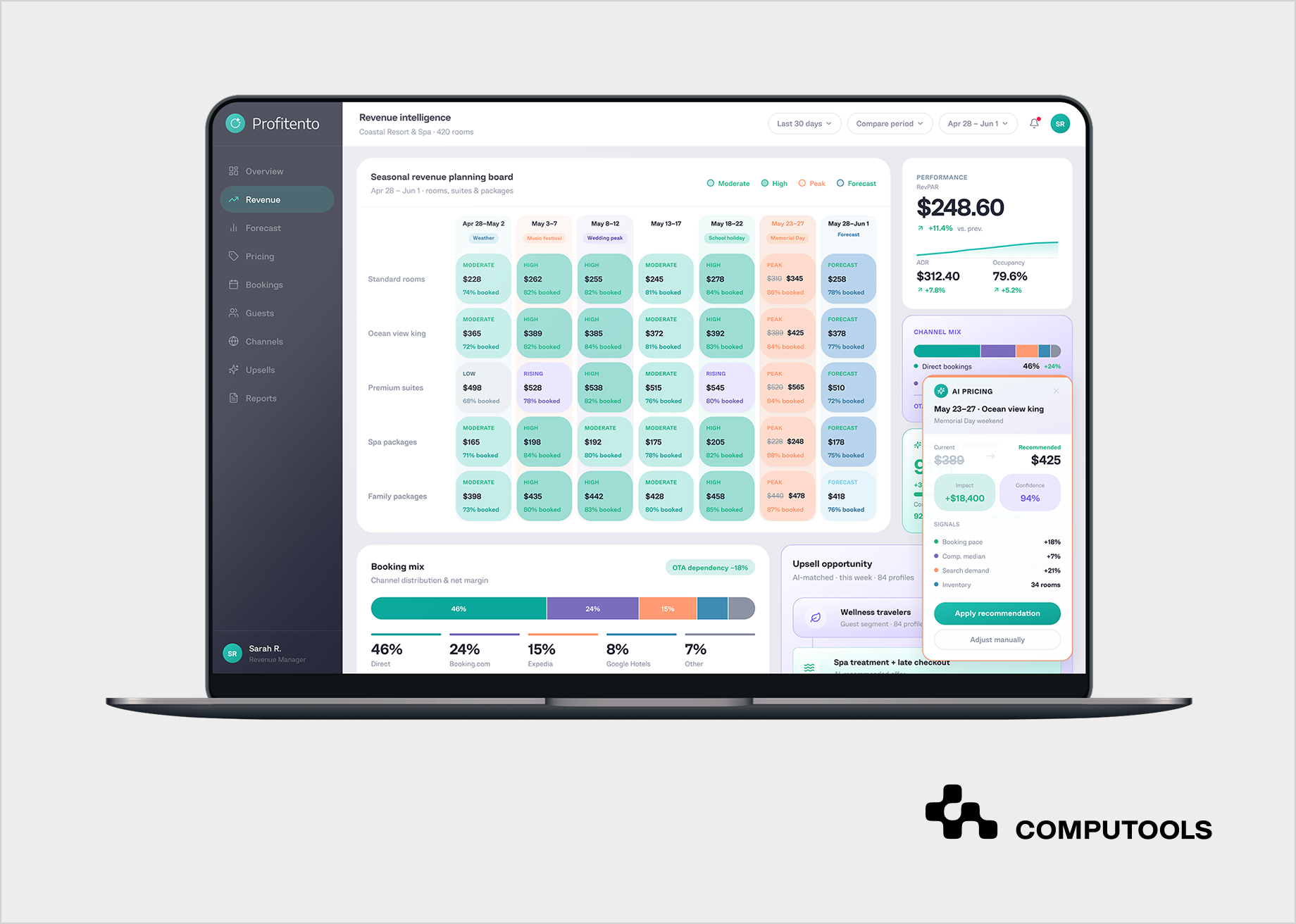
Before investing in a new hotel upselling solution, it is important to understand that revenue optimization starts with how effectively a business collects, processes, and uses data on guests and operations. A relevant example is the Profitento project by Computools, where we built a connected set of digital solutions to improve hotel revenue management and data-driven decision-making.
Business challenge
The hotel had to manage revenue data across various systems such as property management systems, booking systems, analytics tools, and third-party integrations. When all these elements exist in isolation, teams cannot fully understand guest behavior or predict booking patterns, or recognize potential upsell opportunities.
The goal here was to develop a tool to integrate siloed hospitality data and offer recommendations. The client was looking for ways to examine demand, locate potential revenue sources, and adapt individualized offerings for guests, all while decreasing the burden on the employee to perform additional work.
Computools solution
Computools developed a hospitality technology solution focused on improving revenue management through data processing, analytics, and automation. The solution included mechanisms for collecting and analyzing hotel performance data, connecting multiple information sources, and providing clearer visibility into revenue-related decisions.
The technical foundation included:
- data collection and processing workflows;
- integrations with hospitality systems;
- backend services for handling business logic;
- scalable data storage;
- analytical capabilities for identifying revenue patterns;
- interfaces that allowed teams to monitor performance and make informed decisions.
Business results
The platform improved hotel revenue management capabilities and created better visibility into commercial performance. The client saw the following improvements:
| Metric | Result |
| RevPAR increase | +11.4% |
| ADR increase | +7.8% |
| Occupancy increase | +5.2% |
| Direct bookings increase | +24% |
| OTA dependency reduction | -18% |
| Forecast accuracy improvement | +32% |
| Guest lifetime value increase | +17% |
| Upsell revenue increase | +14% |
These results demonstrate that revenue optimization depends on connecting data, automation, and operational decisions. A modern hotel upselling system should follow the same principle by linking personalized recommendations with the systems that control availability, pricing, and guest communication.
Upselling strategies also need to fit into the hotel’s wider revenue management approach. Pricing decisions, demand changes, and guest segments influence which offers make commercial sense at a specific moment.
Hotels exploring broader revenue optimization strategies can also review how to build dynamic pricing software for hotels.
How to develop hotel upselling software step-by-step
The following sections explain how businesses can develop a scalable hotel upselling software solution, including architecture decisions, AI capabilities, integrations, security requirements, and post-launch optimization.
Step 1. Define revenue goals and upselling scenarios
Prior to hotel upselling software development, companies must first identify which revenue streams they wish to improve and the role upselling will play within that improvement. The end goal should be the ability to provide guests with customized upsell offers that align with the hotel’s business goals and guest needs, while taking into account the real-time inventory.
Hotels must determine:
- which services are marketable, like room upgrades, food and beverage, spa and wellness, transfers, and experiences;
- the guest segments to target for specific offers;
- the offer delivery timing (before or after the stay, during the stay, etc.);
- the channels (web, mobile app, email, etc.)
- offer distribution channels to be used, i.e. websites, applications, email, or messaging.
The decisions mentioned above will determine the logic and the overall structure of the hotel upselling system.
Create business rules before automation
A scalable hotel upselling platform requires rules that connect recommendations with operational conditions.
The system should consider:
- room availability;
- occupancy levels;
- guest preferences;
- booking history;
- service capacity;
- pricing strategy.
This prevents irrelevant recommendations. For example, the system should not promote a suite upgrade when premium rooms are unavailable or suggest restaurant offers when capacity is limited.
Businesses should also define success metrics, including:
- upsell conversion rate;
- additional revenue per guest;
- offer acceptance by customer segment;
- impact on direct bookings;
- guest satisfaction.
These metrics guide future analytics and AI optimization.
A key decision at this stage is determining the required integrations. Hotel PMS integration for upselling allows the system to access reservation data, room status, and guest information. Connections with CRM, booking engines, payment systems, and revenue management tools create the data foundation required for personalized hotel guest offers.
In the Profitento project, Computools focused on connecting hospitality data sources and analytics capabilities to improve revenue visibility. This approach is also essential when building a modern hotel upselling software solution that supports personalization, automation, and scalable revenue growth.
Step 2. Build a unified guest data model
A modern hotel upselling platform requires high-quality data. A good system would use various sources to analyze preferences, behaviors, and spending patterns of guests before promoting additional offerings.
The data model should include:
- booking history;
- guest preferences;
- loyalty status;
- previous purchases;
- service usage;
- communication history;
- stay purpose and travel patterns.
The hotel guest personalization software should connect to the hotel’s PMS, CRM, booking engines, POS, and loyalty systems via an API or integration layer. This would be the foundation of the system and enable a shift from mass marketing to personalized marketing.
Poorly modeled data results in poor personalization recommendations, duplication of customer profiles, and weak AI functionality. Given the significance of AI-powered guest personalization, businesses should place importance on identity matching, data quality, and secure storage.
Step 3. Design a scalable hotel upselling platform architecture
The software architecture should support real-time recommendations, multiple sales channels, and integrations with existing hotel systems. The Profitento solution demonstrates the importance of connecting multiple hospitality data flows into a single technology foundation. For a hotel upselling system, the architecture should separate data collection, business logic, analytics, and user-facing functions so each component can scale independently.
This approach supports integrations with PMS, CRM, booking engines, and revenue systems while allowing new automation capabilities to be added without redesigning the entire platform.
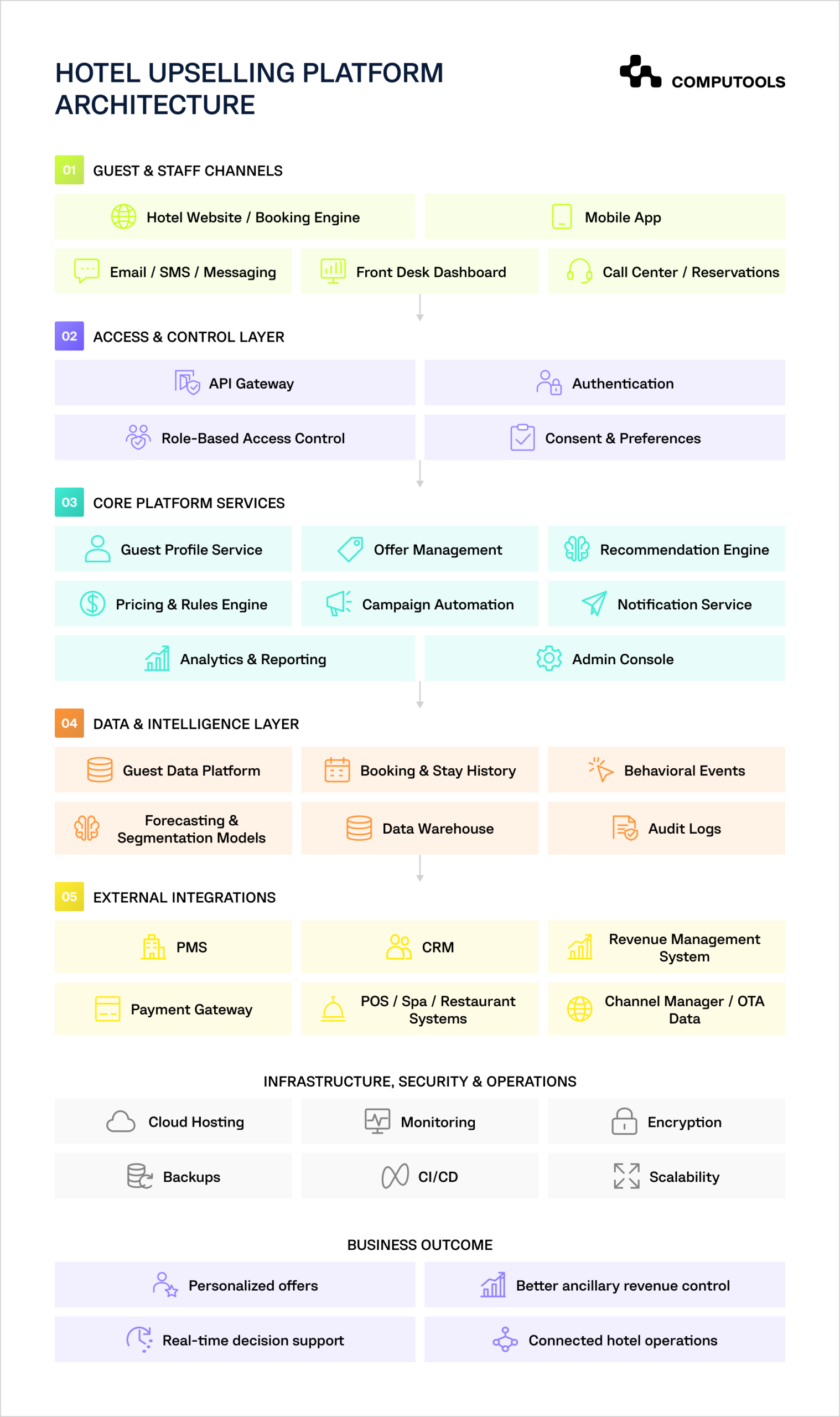
A typical architecture includes:
| Architecture layer | Components | Purpose |
| Guest channels | WebsiteMobile appEmail and messaging channelsFront desk interfaces | Provides touchpoints where guests and hotel teams view, accept, manage, and deliver personalized offers. |
| Access layer | API GatewayAuthenticationRole-based access control | Controls secure communication between users, services, and external systems while managing permissions and data access. |
| Core services | Guest Profile ServiceOffer Management ServiceRecommendation EnginePricing Rules EngineCampaign AutomationAnalytics Service | Runs the main upselling logic, including guest segmentation, offer generation, pricing decisions, automated campaigns, and performance tracking. |
| Data layer | Guest databaseBooking dataBehavioral eventsAnalytics warehouse | Stores and processes guest, reservation, and interaction data required for personalization, analytics, and AI-driven recommendations. |
| External integrations | PMSCRMPayment providersBooking enginesRevenue management systems | Connects the platform with existing hotel systems to access real-time availability, customer data, transactions, and revenue information. |
This structure supports automated hotel upselling by allowing the system to react to events such as new bookings, cancellations, availability changes, or guest interactions.
For example, when a guest completes a reservation, the platform can evaluate available upgrades, apply pricing rules, and deliver a personalized offer through the preferred channel.
The Profintento platform used API integrations to consolidate reservations, availability, rates, pickup data, channel performance, guest profiles, and ancillary spending. A similar architecture enables upselling software to produce recommendations based on real operational data instead of segmented customer records.
Our team opted to go with React to create management interfaces, Python to handle forecasting and the recommendation logic, FastAPI for backend and integration services, PostgreSQL to store guest and revenue data, Redis for faster data retrieval, and AWS to support cloud infrastructure. We chose this modular architecture because the solution must analyze guest data, recommend pricing, and undertake numerous integrations without affecting performance.
Step 4. Add AI-powered recommendations and revenue intelligence
Modern AI hotel upselling software should analyze guest context and operational data to suggest the right offer at the right moment based on the revenue goals.
The following capabilities support hotel ancillary revenue optimization by connecting guest preferences with commercial opportunities.
AI recommendations
Offers are ranked based on booking history, preferences, stay information, and availability. One guest may receive an offer to upgrade from a standard room to a premium one, while another guest could receive an offer that promotes a meal or experience at the resort.
Customer segmentation
Through AI algorithms, guests can be grouped based on the purpose of the trip, level of spending, loyalty, and other interactions. Hotel systems use these insights to maximize campaign effectiveness and increase conversion.
Demand forecasting
Predictive models can estimate demand for rooms and services, helping hotels decide when to promote upgrades or ancillary services without affecting operational capacity.
Pricing intelligence
The platform can consider occupancy, demand, and revenue targets when calculating suitable offers.
AI-assisted communication
Automated messages can deliver personalized recommendations through mobile apps, email, chat, or other guest communication channels.
AI-based recommendations become more effective when they work alongside accurate pricing and demand information.
Operators interested in the wider role of pricing automation can explore how to build dynamic pricing software for hotels.
Step 5. Implement real-time hotel upselling automation
A successful hotel upselling automation system must deliver offers at the right moment through the right channel while respecting operational limits.
The platform should include event-based workflows that respond to actions such as:
- booking confirmation;
- check-in completion;
- guest app activity;
- changes in room availability;
- service availability updates.
For example, a guest receives a room upgrade offer after booking when premium inventory is still available; a family traveling during a holiday period receives relevant activity packages before arrival; a business traveler receives airport transfer options shortly after confirming a reservation.
The automation layer should include:
- offer triggers;
- campaign rules;
- communication preferences;
- frequency limits;
- conversion tracking.
This reduces unnecessary messaging and ensures offers are sent according to available capacity.
A hotel upselling application can operate continuously, thanks to an intelligent automation layer that understands guest behavior, demand and business requirements.
Upselling often involves multiple hotel departments, including restaurants, wellness services, and events. Coordinating these operations requires clear workflows between teams and systems.
For additional examples of hospitality workflow automation, see this guide on catering operations workflows.

Launch personalized hotel upselling software within 1–3 months, automate targeted room upgrades and ancillary offers across the guest journey, and turn more bookings into higher revenue per stay without increasing staff workload.
Step 6. Connect the platform with hotel systems and protect guest data
Profitento integrates with different hospitality systems to create a unified revenue management backbone. Computools team linked Opera PMS, SiteMinder channel manager, booking engine, OTAs, CRM, POS, and spa management system to process bookings, manage distribution and balance channels, assess demand and supply gaps, view guest records, and track spending.
For a hotel upselling system, this integration layer is important because recommendations should be real and based on inventory, bookings, and services available at the time an offer is provided. Integration with the hotel PMS enables access to guest data and stay information. Hotel PMS integration for upselling allows access to reservation, room, guest, and stay data. Other systems add more context for recommendations.
Key integrations usually include:
- PMS for booking and room status data;
- CRM for guest history and preferences;
- booking engines for pre-arrival offers;
- payment systems for secure transactions;
- loyalty platforms for personalized incentives;
- revenue management systems for pricing decisions.
The integration layer should implement secure APIs and have rules and controls to govern data exchange and monitor for stale data. A good example would be the system removing the room upgrade offer when inventory changes or when a guest completes the purchase of that option.
An upselling hotel system also needs to process sensitive information, including guest profiles, payment data, and booking information. Security has to be embedded in the design of the system from the start.
Important controls include:
- encryption of stored and transferred data;
- role-based access control;
- authentication mechanisms;
- audit logs;
- secure API access;
- privacy and consent management.
Strong security protects guest trust, reduces fraud risks, and prevents operational disruptions caused by data issues.
Step 7. Test performance, recommendations, and business impact
Before launch, businesses should test and validate that the system works reliably under real hospitality conditions. Hotels experience demand peaks during holidays, events, and seasonal periods, so the platform must continue delivering offers without delays.
Testing should cover:
System performance
Verify response times during high traffic, campaign launches, and increased booking activity.
Integration reliability
Check that PMS, payment systems, CRM, and other connected platforms exchange accurate data.
Recommendation quality
Measure whether AI-generated offers match guest preferences, availability, and business rules.
Security testing
Identify vulnerabilities in authentication, APIs, and data access processes.
Business performance
Track metrics such as:
- offer conversion rate;
- additional revenue per guest;
- acceptance by customer segment;
- direct booking impact;
- guest satisfaction.
After launch, the platform should continue learning from real usage data. Regular analysis of accepted, rejected, and ignored offers allows businesses to improve recommendations, adjust campaigns, and increase the effectiveness of their personalized guest experience strategy.
Hospitality platforms increasingly need to support multiple systems, properties, and revenue workflows.
For businesses managing complex operations across locations, this guide on building an RMS for multi-property hotel chains provides additional context on designing scalable hospitality technology.
Why choose Computools for hotel upselling software development
A hotel upselling platform system must connect revenue goals, customer data, hotel operations, integrations, and automation into one reliable technology foundation.
Computools approaches hospitality software projects by focusing on the business processes behind the product. The team helps organizations define the right architecture, connect fragmented systems, and create scalable platforms that support revenue growth and operational control.
Through travel and hospitality software development services, we develop digital solutions that connect guest experiences with operational workflows, analytics, and business systems. For specialized tourism products, heritage tourism software development supports platforms that require personalized experiences, digital services, and customer engagement capabilities.
For hotels, restaurants, and hospitality businesses, software development services for HoReCa cover solutions that combine customer interactions, operational processes, and revenue-focused workflows.
Computools team brings expertise across the main components required for a scalable upselling system:
1. Backend architecture and integrations
Designing services that connect PMS, CRM, booking engines, payment systems, and analytics platforms.
2. AI and automation
Implementing recommendation engines, predictive analytics, segmentation, and automated guest communication through AI development services.
3. Guest-facing applications
Creating mobile experiences through mobile app development services and web interfaces through web development services.
4. Security and scalability
Building systems that protect guest data, support multiple properties, and maintain performance during demand peaks.
Our goal is to create a hotel revenue optimization software solution that supports measurable business outcomes: higher ancillary revenue, better use of available services, more relevant guest communication, and improved control over revenue opportunities.
By connecting personalization, automation, and operational data, Computools helps hospitality businesses develop platforms that continue improving after launch through analytics, optimization, and evolving guest behavior.
Building hotel upselling software as a revenue platform
Hotels can no longer view upselling as a big sales exercise or disparate promotions. Today, an upselling tech has to provide context for guests and connect to hotel systems in order to automate offer delivery based on real-time business needs.
When a guest is presented with a room upgrade, restaurant recommendation, or additional service, that recommendation should be data-driven and take into account the reservation, room availability, guest preferences, purchasing history, and demand.
To achieve this, organizations need integrations that are dependable, data with a defined structure, a secure architecture, and systems that can be optimized continually. When linked to other hotel software, an upselling platform can contribute to hotel ancillary revenue optimization and enhance the guest’s experience with the hotel.
Computools
Software Solutions
Computools is an IT consulting and software development company that delivers innovative solutions to help businesses unlock tomorrow.