
THE AUTHOR:

Spreadsheet-based decisions have become too inflexible for hotel pricing. Unpredictable demand, such as shifts on the event calendar, airline travel patterns, the booking behavior of competitors, OTA visibility, and even local business travel, can all affect the price of a hotel room. A rate that was justified a few days ago can suddenly become a lost opportunity for earned revenue by the middle of the week. This is why the hotel dynamic pricing system has become a core operational tactic and a competitive advantage, along with their service quality, brand, or location.
Research and Markets predicts a 12.5% increase in the hospitality revenue management and pricing analytics market, driven by the demand for dynamic pricing, real-time decision making, and revenue optimization tools.
This article explains why manual pricing leads to revenue leakage, how a hotel dynamic pricing system works, where ready-made RMS tools reach their limits, and how a custom RMS can help hotels improve ADR, RevPAR, forecasting, and channel control.
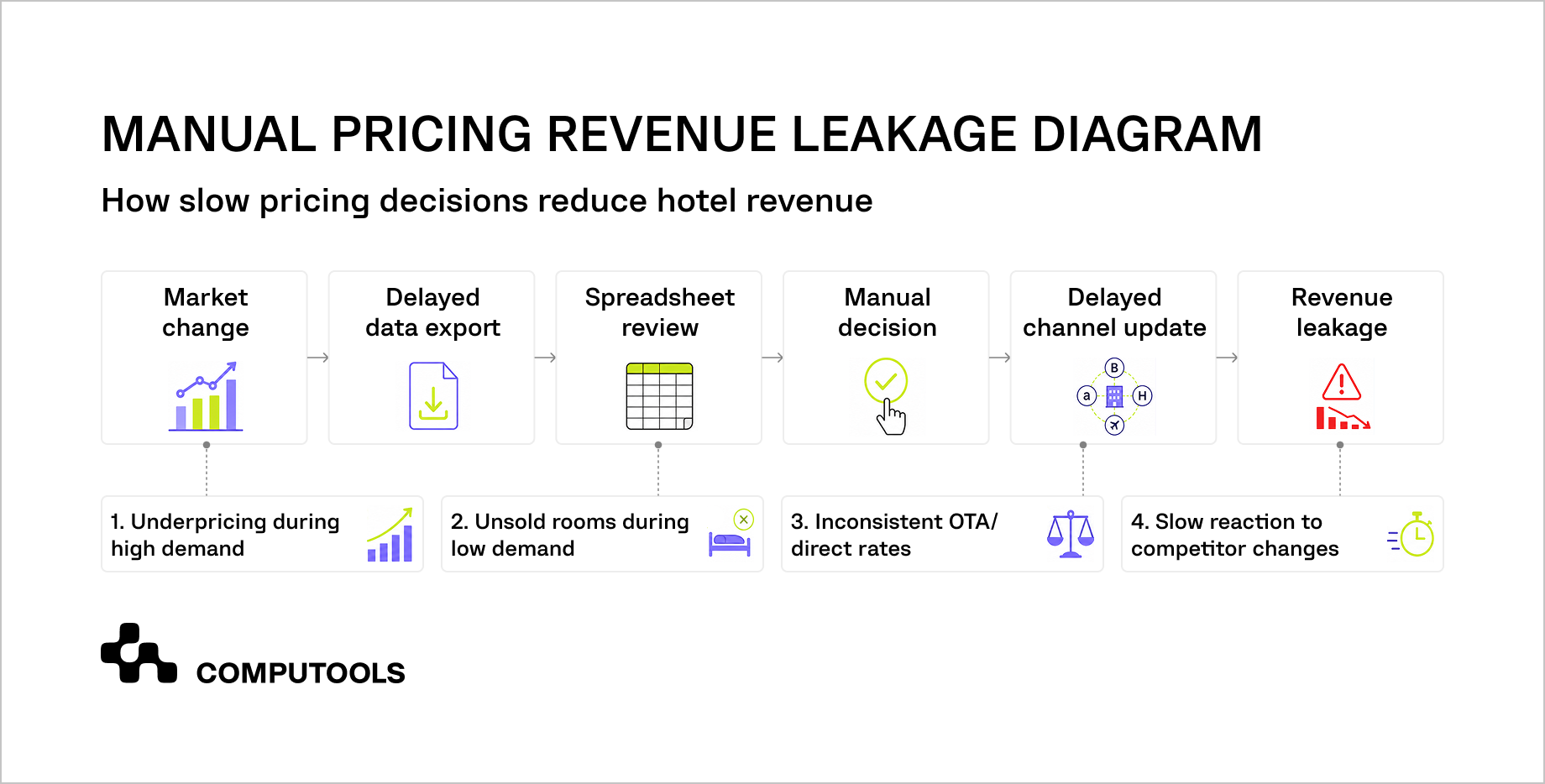
Why manual hotel pricing reduces profitability in hospitality
Manual pricing seems practical until a hotel expands across multiple channels or properties, or starts serving additional customer segments. Revenue managers have to update daily rates, manually compare competitor prices, review pickup reports, and adjust online travel agency rates whenever they have the time. This workflow might work in a stable market, but it inevitably fails when demand outstrips the speed of pricing.
The main issue is one of timing. Hotel revenues are time-sensitive and become zero when rooms remain un-booked after the day’s end. Manual pricing often leads to multiple forms of revenue loss.
First, operators price too low when demand spikes before the pricing team can react. Interventions of external factors (e.g., a regional conference, a sports event, a flight pattern disruption, a late-night visibility bump) can quickly increase the booking pace. In such instances, there is a good chance that the property is selling rooms at yesterday’s value.
Second, when demand weakens, hotels charge too much, leading to needless vacancies.
Third, manual pricing creates channel inconsistencies. A direct booking engine, OTA, corporate contract, and channel manager can implement the same commercial logic in different ways. The result is confusing pricing policies and system integration challenges that make trust difficult and parity and direct booking protection even more complex.
Fourth, teams spend too much time reconciling data and miss most of the key opportunities. According to theaccessgroup.com, disjoined systems cause 286 hours of wasted time in the hospitality sector each year, with 13% of operational costs lost. For revenue management teams, that means pricing decisions often depend on delayed exports, fragmented reports, and manual interpretation.
Revenue leakage is mostly a software problem. When pricing is updated manually, through fragmented systems, and based on late, inaccurate information, a hotel will ultimately have to react to the market after the optimal pricing opportunity has passed.
What a dynamic pricing in hospitality means today
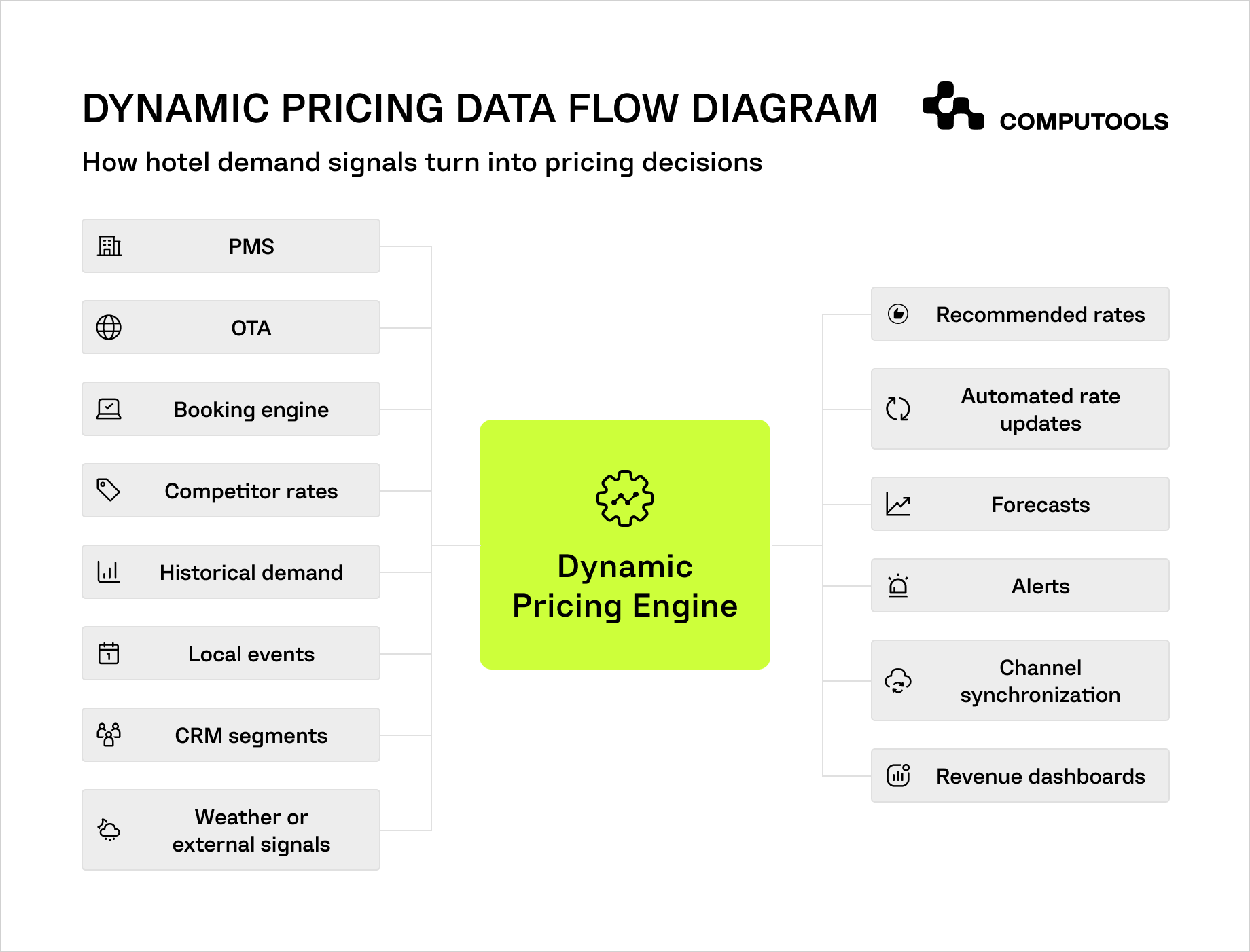
Dynamic pricing for hotels involves the modification of room rates in response to live and anticipated demand. This system uses information to suggest or implement pricing adjustments automatically across dates, room types, booking channels, and customer categories.
Hotel rate management solutions consider:
| Pricing Signal | Practical Use |
|---|---|
| Occupancy and booking pace | Determine if and when rooms are booking faster or slower than generally expected. |
| Historical demand | Compare current room rentals with prior reservations around certain holidays, major events, and typical weekdays and weekends. |
| Competitor rates | Set and maintain pricing strategies based on the expected market values. |
| OTA and channel performance | Reassess pricing based on demand. |
| Customer segments | Apply different rates for leisure, business, group, loyalty, and corporate clients. |
| Local events and seasonality | Capture higher willingness to pay during demand surges |
| Weather and external signals | Optimize pricings for short-term stays and travel around major events. |
The goal is not continual price increases. Proper dynamic hotel rate optimization manages ADR, RevPAR, and occupancy, and considers the brand’s future. Dynamic pricing works because it reduces the delay between market signal and pricing action. When the system detects a faster booking pace, high search volume, or competitor movement, it can recommend a price change immediately. When demand slows, it can suggest controlled adjustments before rooms remain unsold.
Where standard revenue management approaches break down
Off-the-shelf RMS solutions make the shift from spreadsheet quotes easy, help hotels improve pricing, and save valuable time through business automation. For many properties, this is an excellent starting point. Limitations become evident when they are placed within a fragmented tech stack where PMS, CRS, OTAs, channel managers, CRM, BI, and booking engines do not share clean data in real time.
The State of Distribution report (2025) confirms how intricate hotel revenue functions have become. Direct online reservations and OTA bookings stand at 21% each; GDS accounts for 20%; walk-ins and group bookings contribute 19%, and direct calls 18%. This implies that pricing logic needs to operate across multiple revenue streams.
1. Data Confidence Becomes a Pricing Risk
Data trust issues are also a barrier. Access Hospitality also reports that only 33% of operators trust the data of their current systems. Yet, 76% of hoteliers believe that real-time, consolidated signals would help them make better decisions more quickly in peak hours. When revenue teams can’t rely on their systems, they verify reports in a manual fashion, ignore recommendations, and use ancillary spreadsheets as a main data source. As a result, pricing is more automated, but the whole process remains dreadfully slow.
2. The Standard RMS Models Can Be Too Generic Failing To Meet Local Pricing Logic
Generic RMS frameworks were developed for broad hotel business cases. This makes them scalable and fast to deploy, but also limits their use for a large number of hotel revenue strategies.
A business hotel in the city, a boutique venue, an airport hotel, and a multi-property group would all have different pricing logic needs. Some require rate adjustments based on events. Others may apply separate rules for corporate accounts, package pricing, length-of-stay controls, group displacement analysis, loyalty segmentation, or low-season occupancy protection.
When automated hotel pricing strategies depend on local market patterns or non-standard commercial rules, generic RMS logic may not be enough. Revenue teams may still export reports, adjust rules manually, or build side spreadsheets to handle exceptions the system cannot model well.
3. AI Adoption Is Rising, but RMS Automation Still Faces Readiness Gaps
While hotels are headed toward using AI for revenue management, the degree of implementation varies. H2C’s AI and Automation in Hospitality Study indicates that a mere 6% have a fully developed AI strategy at the company level, and the average dependence on AI solutions rests at a low 4.7.
This report also shows that insufficient AI skills (62%), lack of strategy (51%), and problems with integration (45%) are the main obstacles to AI adoption. 70% of respondents also cited seamless integration with hotel systems as the most important factor when deciding on AI investment.
This represents a unique proposition for RMS buyers. An off-the-shelf AI-powered hotel pricing software assumes that the hotel has integrated all aspects of data management, pricing frameworks, staff engagement, and ROI measurement. If these factors are not in place, then the potential of AI remains dormant within the technology.
4. Legacy Systems Hold Back Advanced Forecasting
PwC’s 2025 tourism and hospitality AI report found that 63% of respondents are using or planning to use AI embedded in core hotel systems, while 86% plan to prioritize predictive analytics over the next 12–24 months. This supports the direction of travel: hotels want forecasting, not just reporting. Yet, legacy systems are brought up as a large obstacle. 85% of operators deal with outdated infrastructure, which restricts real-time data processing and makes AI integration across the processes challenging.
This is one of the most important limitations of standard RMS implementation. If the hotel’s PMS, CRS, CRM, or distribution tools cannot exchange clean, timely data, predictive pricing remains constrained. The RMS may recommend rate changes, but the network will not support the price execution in a real-time manner.
5. Hotels Add Tools Faster Than They Redesign Workflows
The common issue hotels face with ready-made RMS platforms is that many deploy them into fragmented environments where revenue management, marketing, distribution, and sales still operate through separate dashboards and processes.
The 2025 State of Distribution report supports this discrepancy. Commercial teams are integrating revenue management, marketing, and distribution, but many hotels still face gaps in training, talent, integration readiness, and workflow alignment. In this case, RMS solutions improve parts of the pricing workflow, but they do not always create a unified revenue operating model.
What This Means for Hotel Leaders
A prebuilt revenue management system (RMS) can be an excellent option for operators with a standard pricing logic, simple integrations, and low levels of customisation. This option becomes less viable if the hotel wants more flexibility and control over market-based price dynamics, strategies involving multiple properties, channel/segmentation logic, and AI-based forecasts.
For hotels with fluctuation in demand, layered distribution, and legacy systems (especially with a multi-property setup), the question is not simply “Which RMS should we buy?”
The better question is: Can our revenue system turn reliable data into pricing actions fast enough, across every channel, without creating more manual work?
Revenue management cannot be separated from the broader hotel technology environment. Pricing accuracy depends on how well reservation, booking, guest data, channel management, and operational systems work together.
For a wider view of vendors that build these connected platforms, see Computools’ overview of top hotel management system software development companies.
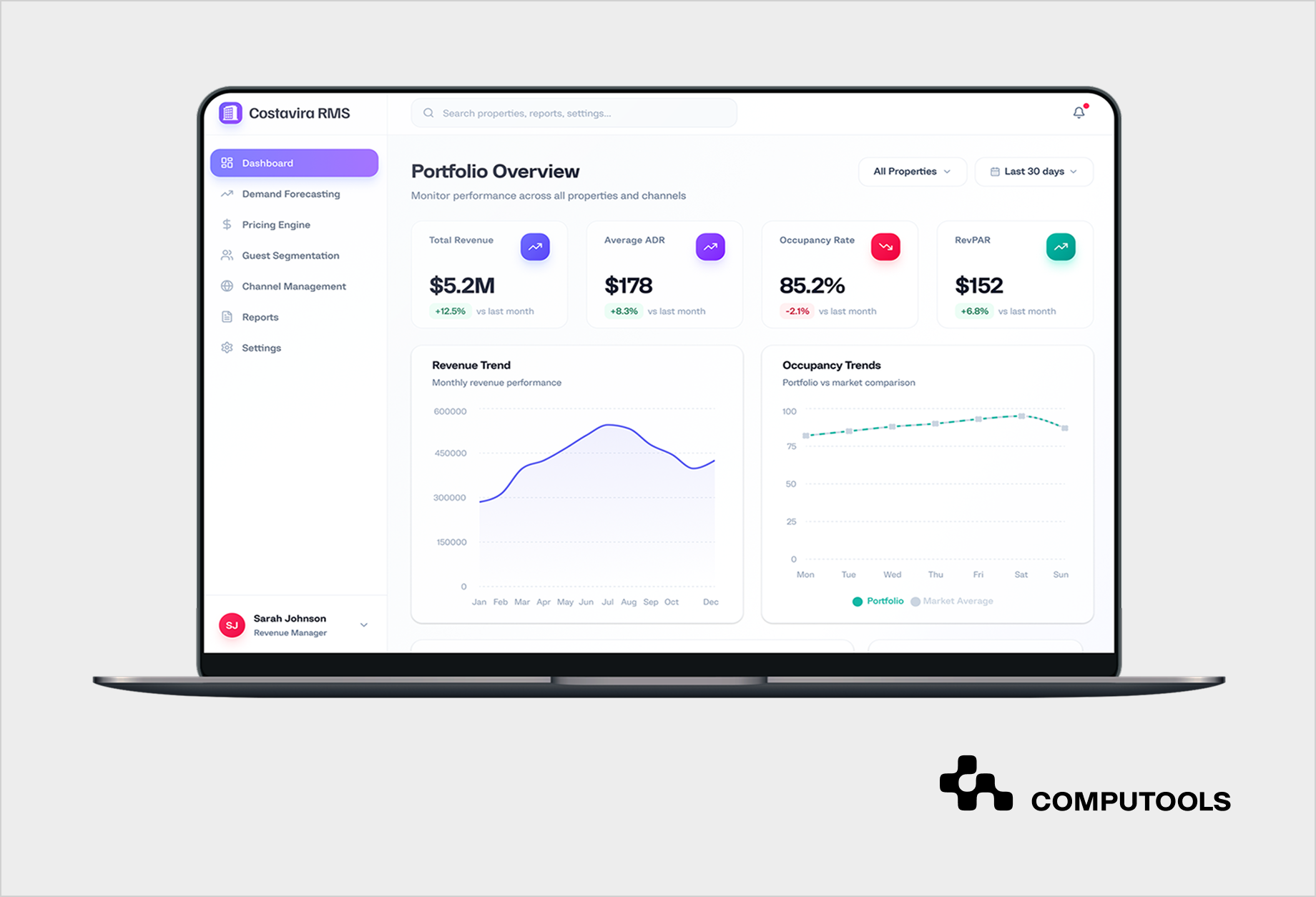
Costavira RMS case study: how a hotel dynamic pricing system increases hotel revenue
Computools’ Costavira RMS project shows how a custom revenue management system (RMS) can change hotel pricing performance when manual workflows no longer support growth.
The client is a growing U.S.-based hotel group that serves urban and business travel markets. They had stable booking patterns, but pricing operations still relied on spreadsheets, manual reviews, and experience-based decisions. The group would make manual rate updates on a website every few days and perform limited demand-based forecasting. Also, the pricing was inconsistent across the hotel’s site, online travel agencies (OTAs), and partner channels.
Business Challenge
Rooms were filling up, but the client wanted to maximize revenue by filling them at the best possible rate. Key issues the hotel groups was looking to solve were:
| Bottleneck | Revenue Impact |
| Manual rate adjustments | Delayed response to changes in the market |
| Minimal forecasting | Lost opportunities to plan for peaks in demand and take advantage of surges |
| Poor segmentation | Set pricing for different classes of guests didn’t contribute to the revenue |
| Channel inefficiencies | Impacted margins and pricing flexibility |
| Difficulty in managing several properties at once | Led to complications in implementing revenue strategies across different markets |
The hotel leadership wanted a smart hotel pricing technology to make pricing calls better without increasing the workload of the revenue team.
Computools Solution
We developed a custom Costavira RMS for hotel revenue management with a focus on pricing control for multiple properties. The cooperation involved discovery, pricing logic design, forecasting workflows, channel synchronization, and custom RMS development.
The solution addressed the main revenue bottlenecks directly. To reduce delayed rate updates, the RMS automated dynamic pricing based on occupancy, booking pace, historical demand, day-of-week patterns, and city events. To improve forecasting, the system analyzed booking history and demand trends, helping the hotel group prepare for peak periods earlier.
Computools also introduced more flexible pricing logic for different guest segments, channels, and demand scenarios, instead of applying the same rate strategy across all bookings. Centralized channel synchronization helped reduce pricing inconsistencies across the hotel website, OTAs, and partner platforms.
For multi-property management, the platform gave revenue teams a shared view of pricing performance across hotels while preserving property-level flexibility. As a result, the client gained faster pricing execution, less manual work, and a scalable foundation for revenue strategy.
Measurable Results
The Costavira RMS implementation delivered clear commercial impact within six months:
- Room revenue increase – 21%
- ADR improvement – 12%
- Manual pricing work reduction – 65%.
These results show the business value of custom RMS development beyond automation. The system improved pricing control, reduced operational workload, and gave the hotel group a scalable foundation for revenue strategy.
This is especially important for hotel groups, where pricing, availability, booking rules, and guest data need to remain consistent across properties while still allowing local flexibility.
For a related technical perspective, Computools breaks down how to develop a multi-property reservation system for hotel chains.

Want to stop leaking revenue through manual pricing and launch a high-performance dynamic pricing system in the next 1–3 months? Contact our team to design, integrate, and deploy a revenue engine built to maximize occupancy, ADR, and profit in real time.
How a custom hotel dynamic pricing system works
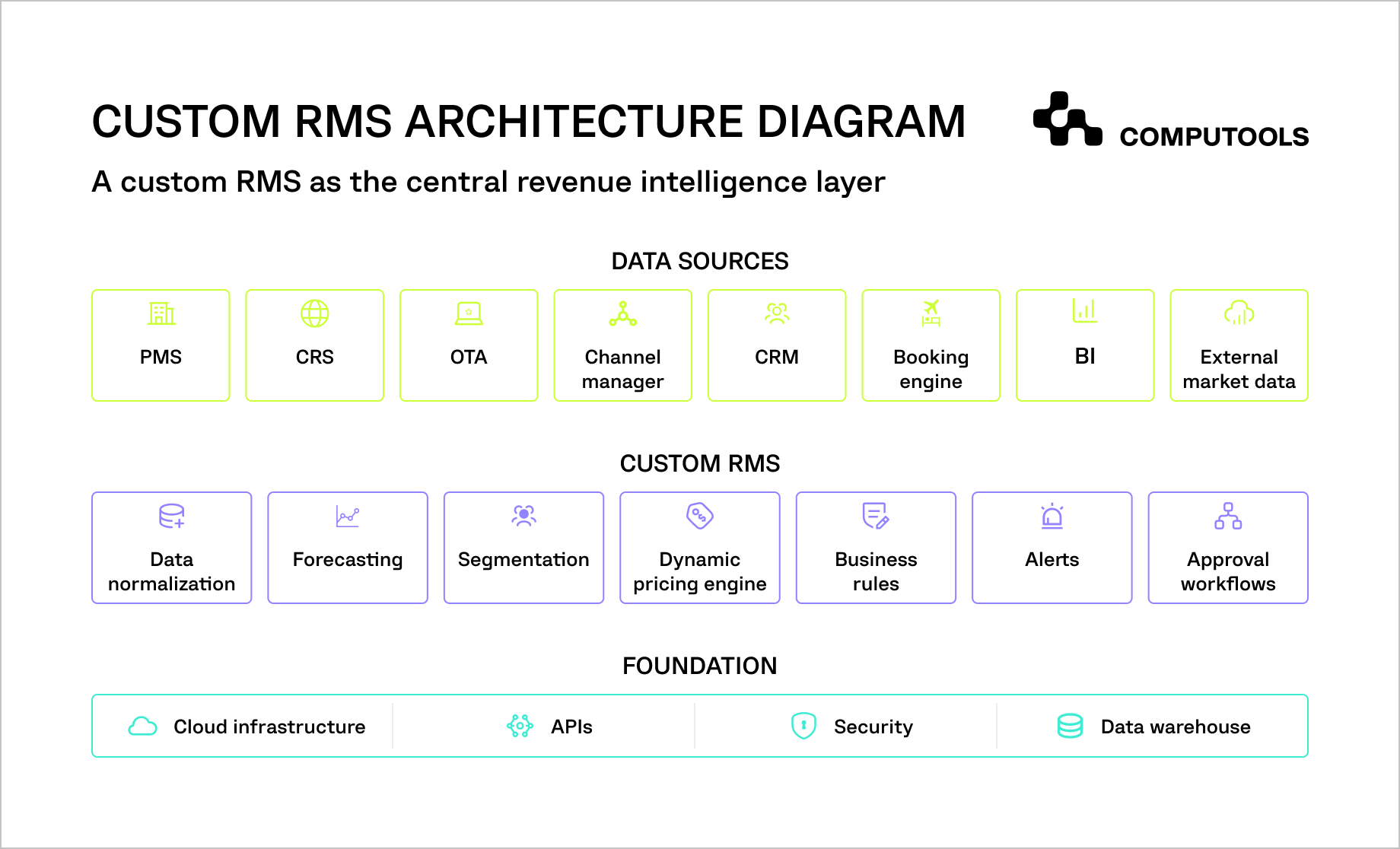
Unlike a simple pricing calculator, a custom RMS provides a revenue intelligence layer. It integrates a multitude of hotel data, market alerts, forecasting, pricing, and distribution layers.
1. The Data Layer
This layer captures and standardizes all relevant pricing information from various sources. This includes:
- Pickup and occupancy from the property management system (PMS).
- OTA bookings and channel performance.
- Direct booking engine data.
- Historical ADR, RevPAR, cancellations, no-shows patterns.
- Competitors’ rates.
- Local events and season-based demand.
- Customer and segment data.
- Corporate, group, and loyalty booking behavior.
The goal is to have a single source of truth for revenue decisions. Pricing strategies without a data layer are destined to be ineffective and fragmented.
2. AI, ML, and Revenue Analytics
AI and machine learning help the hotel revenue management software identify demand patterns that are hard to detect manually.
Examples include:
- Demand forecast by date, property, room type, and guest segment.
- Booking-window analysis.
- Demand uplift from special events.
- Cancellations and no-show risk detection.
- Demand segmentation.
- Price sensitivity.
- Comparison of properties.
Artificial Intelligence should always drive better business decisions, but it should not dictate your revenue strategies. In practice, the best RMS combines machine-generated recommendations with the business rules of the hotel.
For example, a hotel may allow automated rate increases during high-demand periods but restrict discounts below a minimum margin threshold. A resort may use different pricing logic for holiday packages than for midweek direct bookings. A business-travel hotel may prioritize weekday ADR while using controlled weekend promotions to protect occupancy.
3. Dynamic Pricing Engine
Turning data and predictions into pricing requires a dynamic pricing engine.
It works by changing prices based on:
- Day
- Room type
- Property
- Channel
- Customer segment
- Booking window
- Scenario of demand
- Position of the competitor.
The best hotel pricing automation systems consist of both rules and machine learning (ML) models. Rules provide the business with the controls. ML models help optimize predictions and accuracy.
4. Integrations
A revenue management system works as long as it connects with the systems that influence pricing and distribution. These include the connection of a PMS, CRS, Booking.com, Expedia and the other OTAs, channel managers, a direct booking engine, CRM, ERP finance systems, BI and analytics tools, payment and billing services.
An API-first development approach is essential as hotel technology never operates on its own. Many properties use legacy PMS platforms, regional tools, custom booking engines, and multiple OTA connections. If the RMS cannot exchange data reliably, pricing automation becomes risky.
5. Governance and Human Control
Dynamic pricing needs controls. Hotel teams should be able to set:
- Minimum and maximum rates
- Rules by channel
- Rules by segment
- Brand-positioning limits
- Workflows for exceptions
- Alert limits
- Rights for manual override.
This is more critical for chains and multi-property groups. Central revenue teams need to see everything at the portfolio level while the local teams need flexibility to operate in their specified marketplaces.
A custom RMS also needs to work closely with the direct booking engine. If availability, pricing logic, payment flows, and rate presentation are disconnected, even accurate RMS recommendations may not convert into direct revenue.
Computools covers this layer separately in its guide on how to build a hotel booking engine for direct reservations.
Business Results Hotels Can Expect from RMS Implementation
A custom RMS has to be assessed on the basis of its contribution to the business, as opposed to the metrics around the technical delivery.
1. Higher RevPAR
A hotel sees a rise in RevPAR when it achieves a better balance between occupancy and ADR. The hotel yield management system helps avoid two pricing mistakes: selling too cheap when there is a strong demand, and being price insensitive when demand is weak.
2. ADR Growth Without Blind Rate Increases
ADR improvement should come from better timing, segmentation, and demand detection. For instance, Costavira RMS improved ADR by 12% by helping the hotel group make faster, more accurate pricing decisions.
3. Better Occupancy Without Excessive Discounting
With a good hospitality pricing software, occupancy is protected without losing margin. In weaker times, the RMS will suggest more appropriate pricing for a specific channel/segment, rather than a broad-based discount across the inventory.
4. Reduced Manual Workload
With a revenue management system automating data collection, forecasting, recommendation, channel update, and alerts, manual pricing is no longer necessary. For example, in the Costavira RMS project, the manual pricing work was reduced by 65%.
5. Faster Decision-Making
Efficient RMS allows revenue managers to shift their focus from data collection to the assessment of the recommendations and making commercial decisions.
6. Consistent Pricing Across Channels
A connected real-time hotel pricing system helps keep rates aligned across direct channels, OTAs, partner platforms, and internal systems. This protects margins and reduces guest confusion.
It’s worth adding that OTA dependence alone also affects pricing economics. Financial Times reported that major OTAs typically charge hotels 15%–25% commissions, which makes direct pricing control and channel strategy commercially important.
Computools addresses this issue in more detail in the guide on how to increase direct hotel bookings and reduce OTA dependence.
Custom RMS vs ready-made RMS: where flexibility becomes business-critical
Out-of-the-box RMS solutions can be useful for many operators as they reduce a fair share of manual work, use established pricing features, and are easier and faster to implement than custom-built systems. Nevertheless, it is a matter of time when a system’s limitations will start impacting a hotel’s revenue strategy.
| Area | Ready-Made RMS | Custom RMS |
| Deployment speed | Usually faster | Requires discovery, design, and development |
| Pricing model | Standardized | Built around hotel-specific revenue logic |
| Integrations | Depends on vendor ecosystem | Can be designed around existing PMS, OTA, CRM integration, BI, and finance stack |
| Flexibility | Limited by product roadmap | Controlled by business needs |
| AI models | Generic or configurable | Can reflect local markets, property type, segments, and historical data |
| Multi-property strategy | Often supported, but standardized | Can match group-level and property-level decision rules |
| Ownership | Vendor-controlled | Greater control over logic, roadmap, and data flows |
Custom RMS development becomes more relevant when hotel pricing is tied to complex segmentation, regional demand patterns, direct booking strategy, local events, corporate contracts, or multi-property control.
When a hotel needs a custom RMS
A custom RMS is not always the first step in implementing hotel pricing software for revenue growth. Some hotels benefit from an improved channel manager, an RMS with fewer limitations, or stronger reporting. Custom development becomes more practical when pricing complexity affects revenue, operations, or growth.
Key indicators may include:
1. Multiple Hotel Properties
Multi-property pricing requires shared rules, local flexibility, portfolio visibility, and consistent reporting. As the number of properties increases, so does the complexity of the manual workflows.
2. Sales Channels Have Multiplied
When different sales channels, such as direct booking, OTAs, corporate contracts, metasearch, travel agents, and partner channels all affect inventory, pricing requires logic that is central.
3. Demand Is Highly Unpredictable
Hotels located near airports, event spaces, resorts, business and seasonal destinations are likely to benefit from pricing systems that can manage demand on a short-term basis.
4. Revenue Teams Depend on Manual Updates
If your hotel relies on manual updates and spreadsheets to control pricing, or if updates to OTAs are done manually, your hotel is losing revenue during peak demand.
5. Current RMS Tools Do Not Fit the Business Model
A hotel may outgrow the standard features of RMS when it requires custom segmentation, complex pricing, local market logic, or greater integration with internal systems.
6. Leadership Cannot Trust Revenue Data
When hospitality revenue management tools do not align on occupancy, ADR, pickup, channels, and forecasts, the revenue management team builds a culture of ineffective pricing and slow decisions.
Why clients choose Computools for a hotel dynamic pricing system development
Revenue management encompasses more than a pricing module. It involves how a hotel sells its rooms, manages distribution channels, answers market demand, and manages risk and revenue across its portfolio. Computools approaches RMS development from this business reality first, then translates it into architecture, data flows, pricing logic, and user workflows.
Good results depend on more than just software delivery. It requires understanding complex hotel revenue operations, distribution complexity, as well as the technical limitations of a PMS, OTA, booking engine, CRM, analytics, and channel manager integrations.
Computools’ value is based on deep expertise in travel and hospitality software development services, supported by the following capabilities:
1. Business Analysis and Discovery
For each client, prior to engineering a software solution, Computools examines existing pricing workflows, revenue gaps, channel flows, and points of data and logic. This analysis minimizes the chance of designing an RMS that is “fully-featured” but misaligned to actual revenue management processes.
2. Revenue-Oriented Architecture
For hotel groups with multiple properties, cross-unit commercial control is essential. We have vast experience in designing the architecture that integrates the PMS, OTA, booking engine, CRM, analytical, and financial systems into a scalable hotel dynamic pricing system.
3. Applied AI and Data Analytics
Computools applies AI development services and ML to forecasting, analytics, and data processing where they are most impactful in the value chain: pricing and recommendations, demand projection, segmentation, and pattern recognition.
4. UX/UI Tailored to Revenue Teams
We understand that a revenue management platform should be user-friendly for commercial teams. That’s why we design UI/UX to empower managers to make decisions faster thanks to dashboards, alerts, approval flows, and scenario views, without the need to comb through unrelated reports.
For RMS platforms that include revenue dashboards, admin portals, booking interfaces, or customer-facing modules, Computools can also support the broader product ecosystem through web development services and mobile app development services. This helps hotels keep revenue operations, guest touchpoints, and internal tools aligned across web and mobile environments.
5. Engineering, Integrations, and Scaling
Computools builds tailored enterprise systems tailored to the hotel environment and depth of integrations. With a strong understanding of the travel and hospitality sector, Computools covers a breadth of solutions, including booking engines, PMS, guest apps, channel management, payment systems, automation, analytics, and revenue management.
With software development services for HoReCa, our company helps hotels, resorts, and hospitality businesses that also manage restaurant, catering, or guest-service operations connect front-office, back-office, and revenue workflows into one operational environment.
6. Long-Term Support
A custom RMS should be designed in a way that it can support the evolution of a company’s pricing strategies. As a company grows, whether by adding new hotel properties, channels, geographic areas, brand loyalty programs, or market segments, the RMS roadmap can expand without waiting for a vendor’s generic product schedule.
For hotels, our approach means the platform becomes more than an internal tool. It becomes a growth engine for revenue control, pricing intelligence, and commercial scalability.
Final thoughts
Manual pricing no longer matches the speed of hospitality demand. When prices are updated every few days, revenue teams work from fragmented reports, and channel rates drift out of sync, revenue leakage becomes structural.
A hotel dynamic pricing system solves this by connecting live data, forecasting, pricing rules, automation, and channel synchronization into one revenue workflow. The strongest results come when the solution reflects the hotel’s real business model: property type, guest segments, local market behavior, direct booking strategy, and growth plans.
For operators dealing with volatile demand, multi-channel distribution, or multi-property pricing complexity, a custom RMS can provide the control that standard tools often cannot.
Computools can help hotel businesses design and build revenue management systems that improve pricing speed, reduce manual workload, and give teams stronger revenue control. Ready to stop losing revenue to slow pricing decisions? Contact our team at info@computools.com.
Computools
Software Solutions
Computools is an IT consulting and software development company that delivers innovative solutions to help businesses unlock tomorrow.