



THE AUTHOR:

The RMS build vs buy decision has become far more strategic for hotels. Revenue management is no longer just about adjusting room rates based on seasonality. Pricing has evolved into a real-time competitive function shaped by data, automation, forecasting, and market intelligence across channels and regions.
At the same time, hotels are operating in a more difficult revenue environment. Global travel demand has stabilized, but pricing power remains under pressure. Industry analysis shows that average daily rates (ADR) are expected to grow by only 1–2% in many markets, often below inflation. That leaves little room for pricing mistakes. Hotels can no longer rely on demand spikes alone to increase revenue. Instead, they need to optimize rates continuously using granular market signals, competitor pricing movements, booking pace, local events, and guest behavior.
As pricing logic becomes more complex, many hotel groups are starting to question whether standard boxed RMS platforms provide enough flexibility, control, and integration depth for their business model.
This article explores the differences between ready-made and custom revenue management systems, where each approach makes business sense, and why more hospitality businesses are investing in custom RMS platforms to improve pricing intelligence, business process automation, and long-term revenue performance.
RMS build vs buy: why hotels are reconsidering traditional solutions
In 2026, demand volatility and market shifts will challenge hotels like never before and will be painfully obvious to operators using legacy revenue management systems (RMS) or none at all. The pricing conditions can change multiple times during the day, thus rendering static pricing approaches irrelevant. Industry data reveals that almost 90% of hotels use automated or AI-supported RMS that address fluctuating conditions across channels based on live input from OTAs, brand websites, metasearch platforms, and competitor listings.
Studies illustrate a clear variance in results in favor of hotels that implement real-time pricing strategies. They earn between 10% and 25% more than those with static pricing models. The RevParGenius report indicates that advanced dynamic pricing systems add an average of 19% to the revenue in comparison with traditional software. This is a result of the hotels’ ability to adapt to the changing conditions of demand, competitor pricing, and buying behavior.
AI is in the fast lane to become a primary factor in revenue management. Data indicate that the majority (82%) of hotels will increase AI expenditures in 2026, with most investment focused on revenue management and dynamic pricing. This suggests a growing need for systems that can immediately act on current, relevant market information, rather than rely on historical data.
When looking at ready-made RMS for hotels, there are limits to what the product can do. Often, they rely on fixed rules and short forecasting time frames. These systems do achieve basic revenue yield goals, but often fall short when there is a need to adjust pricing based on 50+ demand signals per decision cycle. Moreover, such software offers “one-size-fits-all” pricing logic, which cannot account for a hotel’s relevant market, guest segmentation, and competitive environment. These increasingly determine if a hotel is able to attain its proportional share of market demand.
An industry-wide trend is evident: a transition from old, set, and reactive pricing to strategies that are modern, iterative, and data-focused.
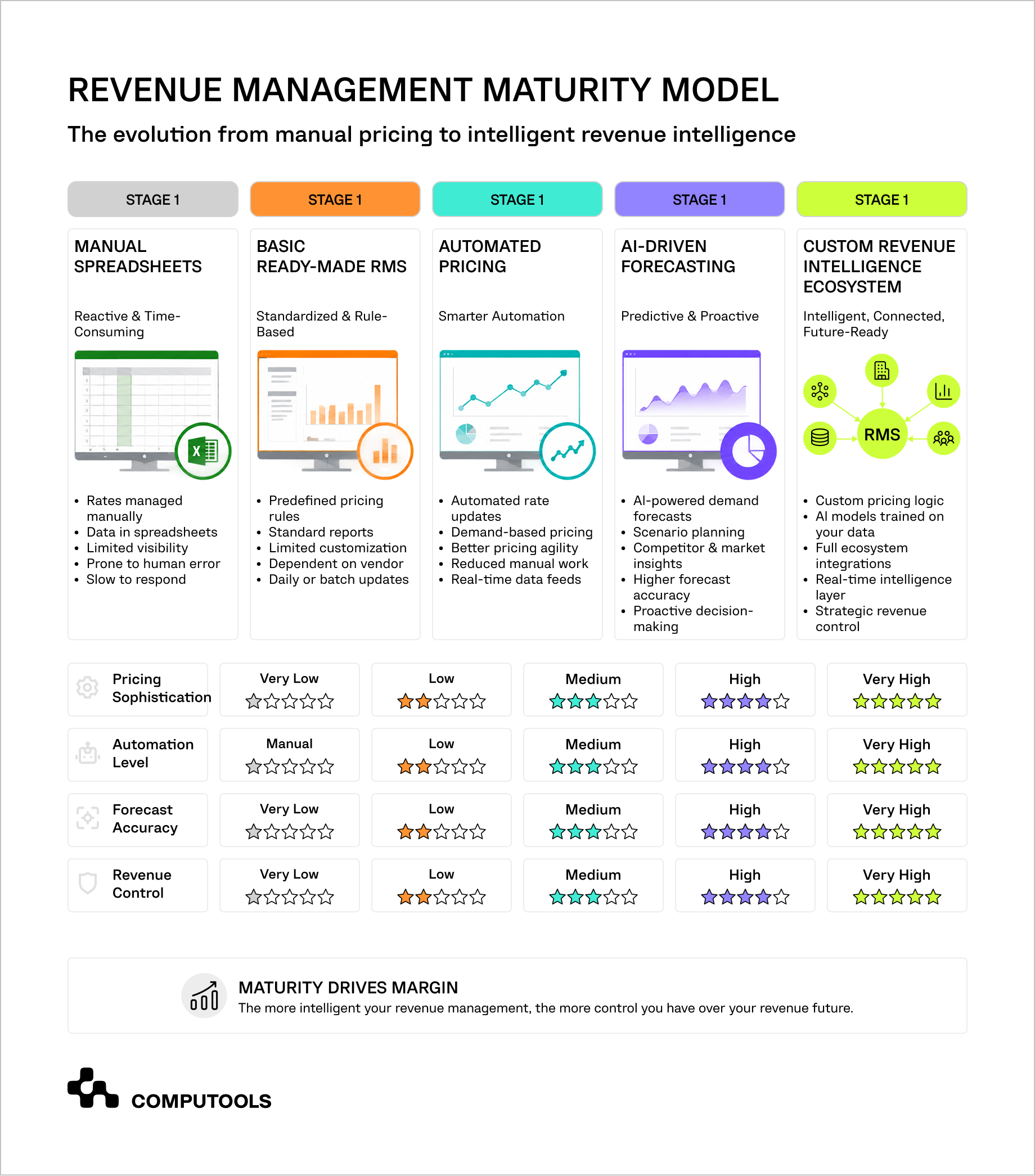
What hotels actually expect from a modern RMS
Today’s hotel revenue optimization software must go beyond simply suggesting room rates. With the evolution of the industry as a whole, hoteliers expect RMS solutions to optimize pricing strategies, forecast demand, and manage distribution channels, as well as provide analytics and insights on a per-property basis.
More and more hotels are modernizing their revenue management initiatives with the addition of AI. In 2026, 82% of industry insiders and decision makers expect Artificial Intelligence to be more present in operations. This shows that the early stages of AI-powered automation are giving way to more permanent and critical functions. 85% intend to spend a minimum of 5% of their IT budget on AI tools, specifically in revenue management and automated pricing.
The best RMS for the hospitality industry should include:
1. Dynamic pricing
Modern dynamic pricing is no longer based on simple seasonal rules or occupancy thresholds.
Hotels now expect RMS platforms to adjust rates continuously using live market signals such as:
- booking pace;
- competitor pricing;
- local events;
- search demand;
- cancellation trends;
- channel performance;
- guest segmentation.
Independent reviews claim that properties using dynamic pricing achieve higher RevPAR values.
2. Demand forecasting
AI-driven demand forecasting is taking over, as hotels stop depending on historical forecasts. Hotel pricing and revenue software should employ predictive analytics that incorporate both internal and external data, making them more accurate than legacy systems. Forecasting has changed in hotels because they no longer depend on historical forecasting models.
3. OTA and channel synchronization
Hoteliers want technology that simultaneously balances both rates and availability across all online travel agents and direct channels in real time. Without that, discrepancies will result in lost bookings and revenue left on the table.
4. Occupancy and Average Daily Rate (ADR) optimization
Separate from pricing, hotel RMS software solutions should manage both occupancy and ADR. Advanced AI algorithms can suggest adjustments to your bids based on demand and competitor behavior.
5. Automation of processes
Old ways of doing things continue to eat into staff time. Industry studies show that 91% of operators still use fragmented systems and manual reporting to run the operations. It means there is massive manual data work to be automated.
6. Real‑time analytics
Hoteliers are looking for dashboards that show the live progress of bookings, channel performance, forecast demand, and pricing. Static reports based on yesterday’s data no longer provide the responsiveness today’s competitive climate requires.
It is clear that an AI-driven hotel revenue management software is no longer optional, but a standard in the industry for a property to grow and maintain a competitive edge in the market. Because of disruptions in AI forecasting, pricing, and automation, operators should be positioned to respond faster and more accurately to market changes than their competitors.
Ready‑made RMS: advantages and limitations
Ready-made revenue management systems are essential to many hotels for automated pricing, forecasting and channel management. They are mature products with proven results across thousands of properties. They all come with clear value tailored to each segment of the industry. However, all these solutions have strengths and weaknesses that vary with the size and complexity of the property as well as the strategic ambition of the hotel.
Clear advantages of ready‑made RMS
1. Established market leaders with proven results
Duetto GameChanger and IDeaS G3 are two of the most recognized and most deployed RMS. Duetto’s Open Pricing model allows independent setting of channel, segment, and room type. This feature alone drives an average RevPAR increase of over 15-20%. IDeaS, with the product found in over 10,000 hotels worldwide, combines in-depth forecasting and pricing optimization for multi-product portfolios. These products have been adopted by both independent and large hotel chains.
2. Fast deployment and lower upfront cost relative to custom builds
Off-the-shelf options are much faster to implement and require less upfront investment compared to bespoke solutions. Many systems come with predictable subscription fees and pre-built integrations with PMS and channel managers, simplifying the initial setup.
3. Integrated with common hotel systems
The best ready-made revenue management technology for hotels comes with direct integrations with leading property management systems (PMS) and channel partners. This streamlines real-time pricing and minimizes the involvement of staff.
4. Strong automation for smaller teams
Properties with limited inventory, minimal segmentation needs, or single-property operations can often leverage ready-made RMS effectively.
Where limitations start to matter
Despite the appeal of off-the-shelf systems, the restrictions become apparent when hotels grow beyond basic pricing, such as:
1. Limited strategic flexibility
Pre-packaged pricing and forecasting tools operate well in a given context. However, they provide little to no flexibility to accommodate highly specific custom business rules, strategic goals, regional pricing levels, or local policies that vary by property, group, or brand.
2. AI recommendations still require human oversight
AI-based RMS platforms are reported to struggle in leisure, seasonal, boutique, and independent hotels where demand patterns deviate from a revenue management training set. When models are trained on demand and the behavior of hotels from different segments, pricing guidance can and often will be correct in only 40% of the cases, meaning 60% of the suggestions will be unreliable.
Also, data quality directly influences forecast accuracy. Pricing may be affected by incomplete booking histories, poor segmentation, or inconsistent sales channels. Consequently, revenue managers have to use their judgment to price in local events, weather, and competition.
3. Vendor dependence and integration barriers
Using a packaged solution means hotels must divert from their business best practices and adopt new workflows to meet the vendor’s API requirements and data formats.
Operators often face limitations in integration with existing infrastructure, including their enterprise CRMs integration, ERPs, or PMS. Such connections require middleware to a significant extent.
4. Feature complexity does not always equate to feature usefulness
Although large RMS suites like IDeaS and Duetto incorporate extensive feature sets and sophisticated modules, companies must invest heavily in staff training or have dedicated revenue personnel to use them fully. Also, many of the systems’ capabilities will never be used and will remain an operational overhead.
As for smaller hotels, they are unlikely to need the more complex modules, such as a five-year forecast or a detailed displacement analysis.
5. Analytics and AI differences in scope
The solutions available on the market are not equal in their analytical depth or AI forecasting capabilities. Some vendors offer dynamic pricing, along with basic market segmentation intelligence, while others focus on more advanced predictive modeling. For example, Atomize emphasises real‑time price optimisation with strong automation, while Duetto provides broader reporting and demand-pacing tools that can benefit larger, revenue‑mature teams.
6. Scaling costs with usage
Subscription costs in boxed solutions often grow as hotel portfolios expand or as advanced modules are added. While the initial investment may be smaller than a custom build, the total cost in the long run may be significantly higher.
The limitations listed above become important when revenue management develops from a basic pricing function to a competitive edge. Hotels that treat pricing intelligence as central to their differentiation will often find that boxed software imposes a framework that cannot fully reflect their evolving revenue strategies. At this point, the need for bespoke logic, deeper integration and ownership of data models often pushes operators to consider custom RMS implementation for hotels.
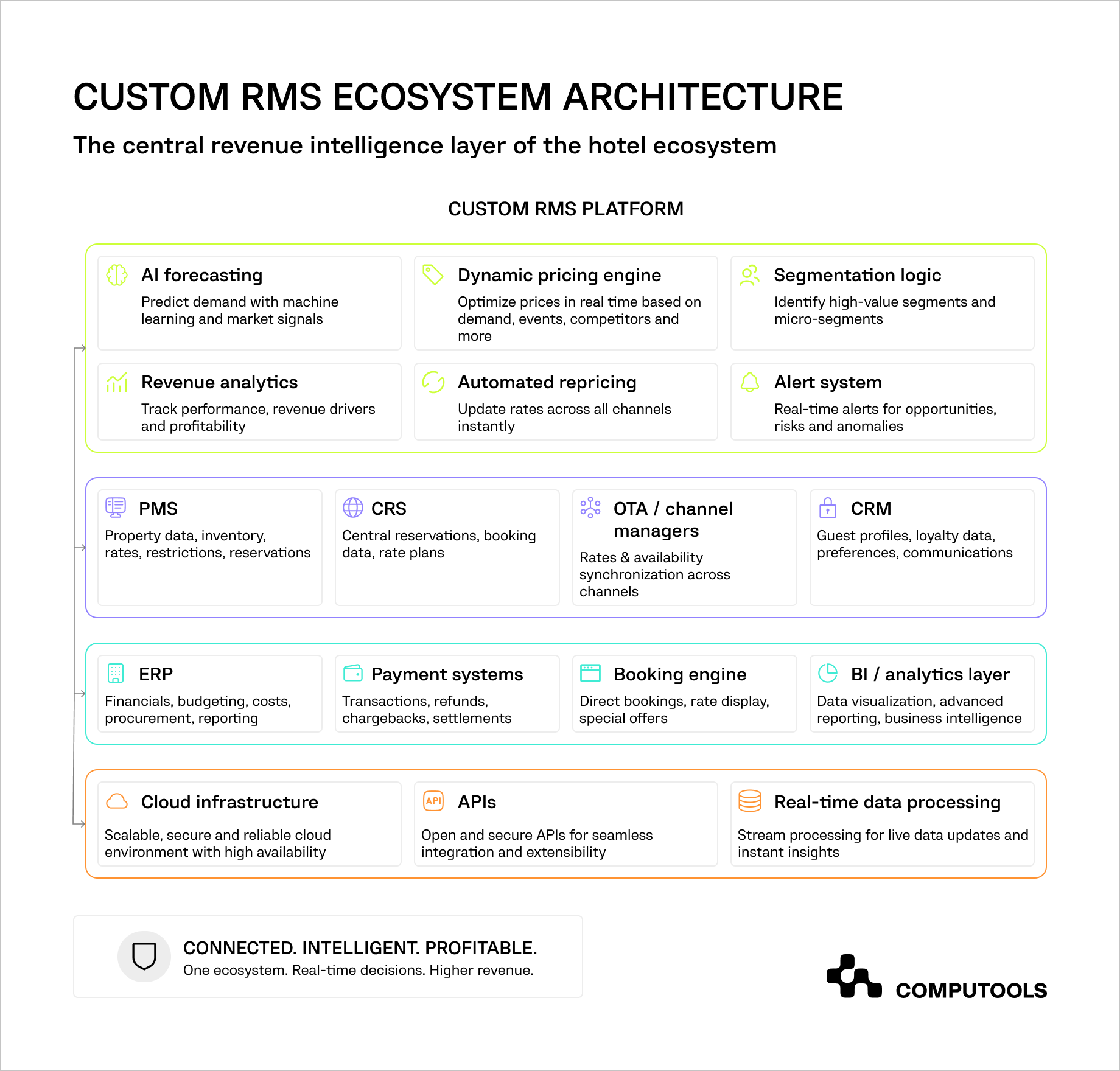
RMS build vs buy: why hotels choose custom revenue management systems
Developing a custom hospitality revenue management platform helps hoteliers gain complete control over how and when to use tailored pricing and analytics. Consequently, businesses, especially lifestyle brands, independent premium hotels and multi-property groups, prefer to design their own systems rather than alter their operational strategies to fit a fixed framework dictated by a vendor solution. Benefits of building a custom revenue management system for hotels are presented below.
1. Complete control over revenue logic
The main advantage of a custom revenue management system is flexibility. With control of the pricing mechanisms and forecasting options, hotels can select what best fits the market they serve. Off-the-shelf options provide little flexibility. With a bespoke solution, flexibility is dictated by the hotel, not the vendor.
2. Pricing rules aligned with your strategy
Independent operators or hotel chains have unique revenue levers. Some rely on premium packages for luxury segments. Others may be aggressive with midweek discounting or focus on corporate volume blocks. A custom platform allows you to implement your pricing policies, whether based on spend, customer tier, or a cluster of competitors.
3. Forecasting models tailored to your data
Generic demand modules are built to work “on average” across many clients. Custom RMS lets you develop forecasting models that reflect your actual operational data, seasonality, regional demand drivers and competitive set. That delivers more accurate suggestions because algorithms aren’t constrained by standardized assumptions.
4. Segmentation logic tailored to your business
Hotels with diverse customer mixes, such as corporate, leisure, groups, loyalty segments, benefit from tailored segmentation logic. You can define and adjust segments based on your specific bookings, not the limited categories of a generic product.
5. Deep integration with the hotel ecosystem
Custom RMS can act as a core component that interfaces with every critical component of your technology stack:
- Property management system (PMS)
- Central reservation system (CRS)
- Channel managers
- Customer relationship management (CRM)
- Enterprise resource planning (ERP)
- Payment and billing services.
Enhanced integration helps the data flow consistently. With a custom build, revenue rules, forecasts, and pricing updates can be pushed to each system in real time, which cuts down on errors and the time taken to do all of it manually.
6. Better automation with real‑time responsiveness
Custom systems let you automate rate updates the way your business needs them: real‑time repricing based on live demand signals, automated yield adjustments, or push rules tied to strategic triggers (events, corporate blocks, weather, search trends). You can eliminate manual pricing chores and let the system act without human bottlenecks.
7. Reduced manual workload
Bespoke solutions automate the entire workflow. This is critical because 27% of hotels use more than seven technology platforms, while another 27% spend over 11 hours per week consolidating disconnected data. Using a custom RMS platform results in less time spent on updating rates, exporting reports and making sure that all the spreadsheets are reconciled. from reporting to the reconciliation of rates. Revenue managers are free to focus on strategy rather than managing all of the operational work.
8. Scalability for hotel groups
Custom RMS architectures are more flexible for multi-property groups. They let hoteliers adopt different pricing strategies for different regions, brands, or market segments while maintaining core controls. A single system can support disparate business units without pushing them into a standard pricing model.
9. Multiple pricing strategies under one roof
Custom RMS allows each business unit to employ the pricing strategies that work best in its competitive environment. Operators can run one set of rules for city‑center luxury properties, another for resort locations, and yet another for leased or franchise units, all from a unified platform.
10. Ownership of data and algorithms
Having ownership of data is perhaps the most critical strategic advantage.
Using systems built to your specifications means:
- You can retain the control of your data.
- You’re free to design and improve AI applications without vendor constraints.
- You can experiment with new strategies and measure results directly.
- There’s no dependency on third‑party pricing logic black boxes.
Hotels that stay in charge of both their data and pricing algorithms can continuously improve their models, make long-term investments in their own intellectual capital, and defend the competitive edge they have in pricing, forecasting, and responding to market changes.
Custom RMS makes revenue management a flexible part of your business, rather than a rigid system that you have to fit into. It maximizes the fit between your corporate strategy and tech infrastructure, gives you the ability to change and improve your systems fast, and enables your employees to innovate rather than be forced to find workarounds for the limitations of the ready-made software.
At the same time, revenue management is no longer limited to ADR optimization. Hotels also are looking to improve channel mix and reduce dependency on high-commission booking platforms.
Computools explores this strategy in How to Increase Direct Hotel Bookings and Reduce OTA Dependence, where pricing intelligence and direct-booking strategy work together to improve margins.
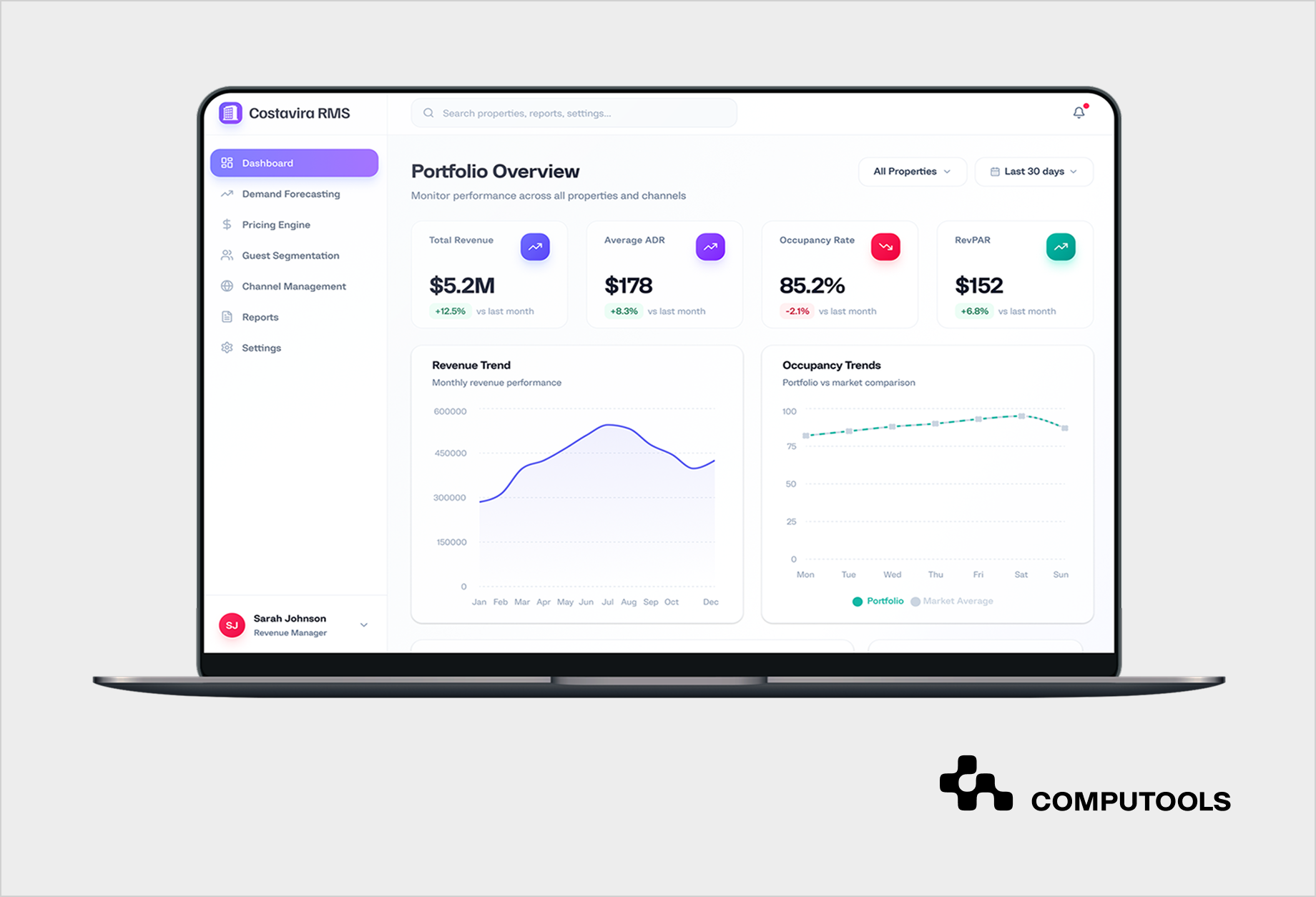
Case study: Costavira RMS
A U.S. hotel chain with urban and business-travel properties across multiple markets faced a hidden revenue challenge.
Although occupancy and bookings showed consistency, there was a lot of manual pricing:
- Room rates would be painstakingly updated by the team every couple of days.
- No forecasting tool was available to help predict shifts in demand.
- Improper segmentation would cause rates to be below market value for peak demand and excessive for low demand.
- Prices would differ on hotel websites, OTAs, and partnered channels.
With this approach, there was a lot of potential revenue left on the table and increased challenges to scale across multiple locations.
Computools Solution
As a solution, Computools designed and implemented Costavira RMS.
The platform focused on automation, centralization, and advanced analytics, specific to managing multiple hotel locations:
- We automated demand-based pricing. Bids were set based on occupancy, pace of bookings, day of the week, season, and city-level events taking place.
- We implemented a one-way control of pricing consistency across the website, OTAs, and partner platforms.
- Segmentation-based pricing logic was coupled with forecasting. It is available for the corporate, early, last-minute, and repeat customers.
- We worked out real-time analytics and alerts to monitor performance and support quick commercial decisions.
- Access to the system was based on roles, and was designed for the revenue, commercial, and operations teams.
The system integrated with PMS and channel managers via APIs and used Python, FastAPI, PostgreSQL, and Redis for scalable, responsive backend operations. React ensured a responsive, user-friendly interface for revenue teams.
Impact
The solution increased revenue and Average Daily Rate (ADR) in the first six months and help the hotel group achieve the following:
- Reduced the amount of effort needed to perform tasks by approximately 66%.
- Allowed the operator to react to changes in demand instantly.
- Empowered the revenue team to execute decisions based on forecasting.
- Enabled to manage multiple properties with the system.
Tangible Results
| Metric | Outcome |
| Room revenue | +21% without additional traffic |
| Average Daily Rate (ADR) | +12% |
| Low-season occupancy | +9% |
| Manual pricing work | −65% |
| Rate consistency across channels | Improved; parity issues reduced. |
The Costavira case signifies that a custom RMS is one of the best ways for hotels to manage the balance between the operational costs of running a business and the need to make data-driven decisions about pricing to stay competitive.
For hotel groups managing several properties, reservation infrastructure and revenue management are closely connected.
Computools’ experience in building multi-property booking ecosystems, described in How to Develop a Multi-Property Reservation System for Hotel Chains, supports centralized pricing control and synchronization across locations.

Want to increase hotel revenue by 30% without spending more on traffic, grow ADR, and eliminate up to 65% of manual pricing work? Learn how to go live in months—not years—by talking to our team about the fastest path to RMS development.
Build vs buy hotel RMS: when a custom solution makes business sense
How to choose between custom and ready-made hotel RMS software? The decision comes down to the complexity of your hotel revenue operations and how critical pricing strategies are to the growth of your business.
Ready-made RMS platforms are ideal for properties where operational activities are simple and uncomplicated.
They are often applicable when the operator has:
- A single location or a limited portfolio
- Basic pricing procedures
- Minimal segmentation
- Few integrations with other systems
- A desire for a quick implementation and lower initial investments.
Boxed solutions, balanced towards hotels with an uncomplicated structure, enable rapid access to price changes, estimates, and OTA connections with greater ease.
However, the revenue management system comparison reveals the true value of a custom RMS when your hotel operations and business grow.
Hotels with multiple brands, regions, segments of guests, and a variety of booking and selling channels will probably find the following features lacking in a standard RMS:
- Advanced pricing logic.
- Mass OTA connectivity.
- Custom forecasting and prediction.
- Advanced integrations with PMS, CRM, ERP, and payment services.
- High level of automation of pricing and sales.
- Comprehensive analytics and reporting by portfolio.
These shortcomings introduce friction into the business’s operations. Teams responsible for revenue are required to spend more time executing manual changes and balancing spreadsheets, in addition to correcting and addressing inconsistencies with pricing across multiple channels.
The Costavira RMS project illustrates this difference well.
After replacing manual pricing workflows with a custom platform, the hotel group achieved:
- +21% room revenue
- +12% ADR
- −65% manual pricing work.
The gains came from better forecasting, automated repricing, centralized channel control, and pricing strategies tailored to the business itself.
When pricing intelligence becomes part of competitive differentiation, standard software often stops being enough.
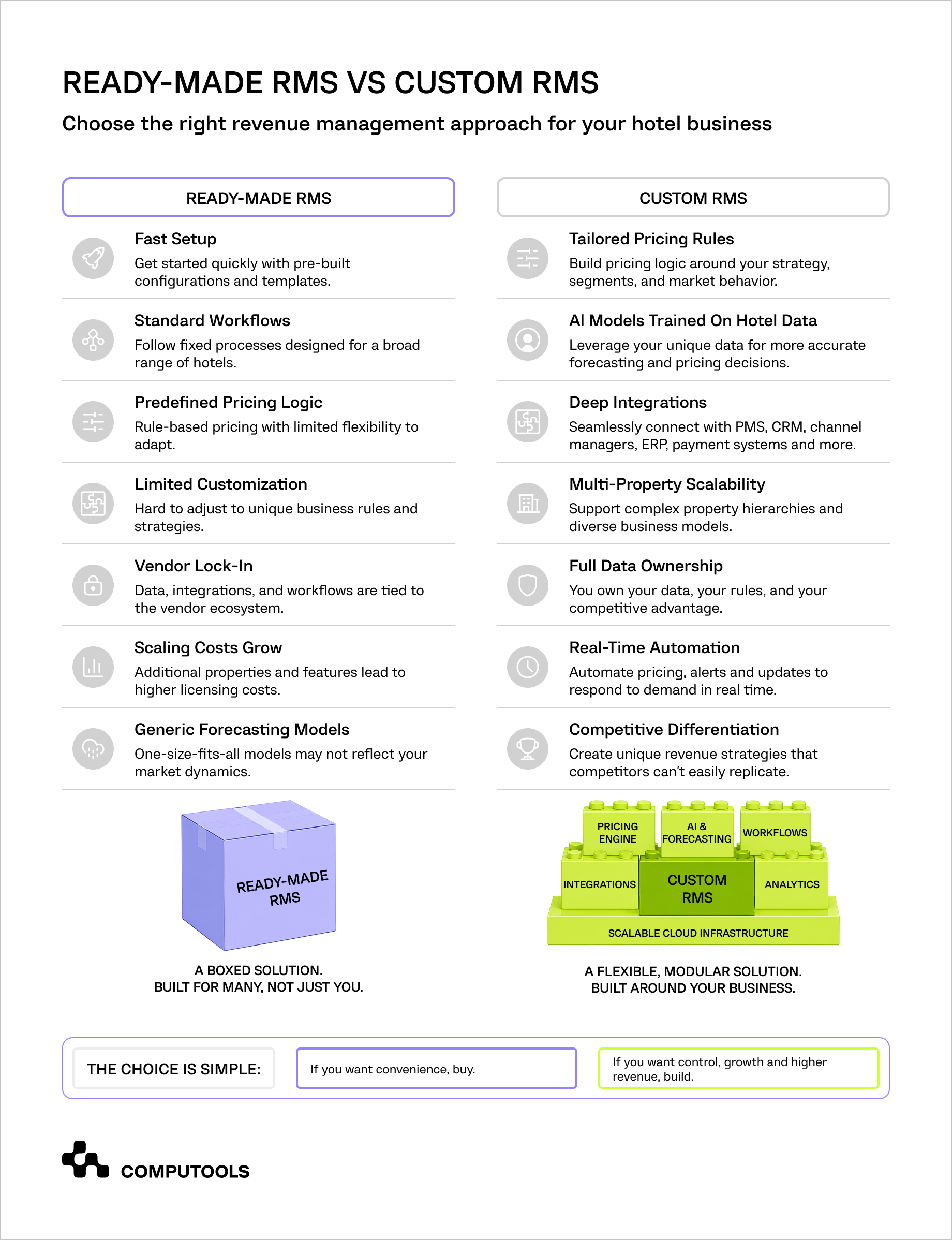
Technologies behind modern custom RMS
A modern custom RMS serves as a revenue control intermediary. Integrating forecasting, pricing, and analysis, the system allows hotel operators to respond to changes in a market landscape without the burden of additional manual processes.
1. AI & Machine Learning
Artificial Intelligence takes the system beyond rigid pricing. It considers many factors such as booking pace, occupancy, historical demand, competitor rates, local events, cancellation patterns, and guest segmentation.
It can enable:
- Forecasting demand for each property, room type and the booking lead time.
- Suggestions for pricing for listed rooms.
- Identifying under and over pricing.
- Changes to pricing that reflect shifts in demand
The strategy remains to be in the hands of revenue managers, but AI provides them with timely recommendations based on data collected.
2. Cloud Infrastructure
A cloud-based revenue management system possesses the scalability to address the needs of hotel chains. It enables central revenue management for multiple properties, while local pricing for different markets and brands is also accommodated.
The system also allows for:
- Real-time synchronization.
- Consistent performance even with higher volumes of booking data.
- More efficient updates to the system.
- Reporting across all units from the same platform.
3. API-First Architecture
Custom RMS platforms must be able to interact with the entire hotel ecosystem including PMS, CRS, channel managers, CRM, ERP, payment services, and direct booking engines.
Integrating an API-first software architecture makes those interactions more rapid and flexible. Additionally, it helps reduce the pricing gaps between channels since, in the background, rates, availability, and booking data can be exchanged among different systems in near real time.
4. Data Analytics
When combined with data analytics and data engineering, a custom RMS offers the revenue team more insights than just the current optimal selling price.
A custom RMS can analyze:
- Booking pace
- Occupancy trends
- Performance of segments
- Behavior of each booking channel
- Measurement of target achievement for each time period
- Missed revenue opportunities
- RevPAR and ADR.
Modern RMS platforms increasingly operate as part of a broader hospitality technology stack that includes PMS, CRS, CRM, loyalty systems, and booking environments. This is one reason many operators evaluate vendors when planning long-term revenue infrastructure.
Check out this guide featuring Top Hotel Management System Software Development Companies.
Why hotels choose Computools for custom RMS development
Computools supports hospitality business with custom RMS development for hotels that suit their operating workflows, pricing strategies, and system integrations. Operators benefit from a system that connects their unique revenue logic, forecasting, channel control, and automation in one scalable platform.
With extensive experience in travel and hospitality software development services, Computools caters to hotel groups that need deeper control of pricing and demand forecasting, guest segmentation, and revenue operations across all their locations.
The company also delivers broader software development services for HoReCa businesses that require integrated reservation, ordering, loyalty, POS, and revenue ecosystems across hospitality operations.
Computools brings together all the capabilities needed to build a custom hotel RMS from strategy to scaling.
These include:
- Revenue management platform development to manage dynamic pricing, forecasting workflows, optimization of rate controls and average daily rates (ADRs).
- Intelligent automation that speeds pricing and rate updates to help the system respond to demand more quickly.
- AI development services and data solutions that support demand forecasting, revenue analysis, pricing suggestions and market segmentation.
- Automation of pricing and demand management with integration of channel managers, CRM, ERP and payment systems.
- Cloud solutions architecture with built-in multi-tenant and cross-customer support for rapid system growth.
- Web development services for centralized revenue dashboards, analytics portals, booking environments, and operational control systems.
- Mobile app development services for multi-property monitoring, operational alerts, reporting, and revenue workflow management.
- Full-cycle delivery from consulting to design and engineering, to support and operate the system.
Computools combines RMS subject matter expertise with broader hospitality engineering experience across booking systems, operational platforms, and travel ecosystems.
The company is also recognized among the Top Travel & Hospitality Software Development Companies delivering scalable solutions for hotels, booking platforms, and hospitality operators.
Hotels no longer compete only on occupancy. They compete on pricing intelligence, speed of response, and control over revenue decisions.
If your current RMS limits your pricing strategy, Computools can help you build a custom hotel revenue management system designed around your business, your data, and your growth goals. Contact our team at info@computools.com to discuss your requirements.
Computools
Software Solutions
Computools is an IT consulting and software development company that delivers innovative solutions to help businesses unlock tomorrow.